Presentation of logic: Presented To:   Madam Uzma Rehman Presented By:   Syed Ali Kamran Abidi.  50   Mirza Ali Raza.  90     M. Jaffar Tayar.  48     Syed Hussain Zain-ul-Abideen.  85
Topic to be described: 1.) The Theory of Deduction. 2.) Categorical Propositions and classes. 3.) Quality, Quantity and Distribution. 4.) The Traditional Square of Opposition. (Contradictories, Contraries, Subcontraries, Subalternation).
1. The Theory of Deduction: “A deductive argument is one whose premises are claimed to provide conclusive grounds for the truth of its conclusion.” Logic is divided into two parts. The first of it is the “classical” or “Aristotelian” Logic. The second is called “Modern” or “Symbolic” Logic.
2. (a) Categorical propositions: Categorical proposition is the base for the Classical Logic. They are called categorical propositions because they are about categories or classes. Such propositions affirm or deny that some class S is included in some other class p, completely or partially.
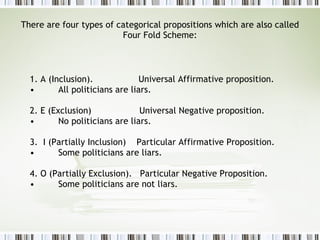
There are four types of categorical propositions which are also called Four Fold Scheme: 1. A (Inclusion).  Universal Affirmative proposition. All politicians are liars. 2. E (Exclusion)  Universal Negative proposition. No politicians are liars. 3.  I (Partially Inclusion)  Particular Affirmative Proposition. Some politicians are liars. 4. O (Partially Exclusion).  Particular Negative Proposition. Some politicians are not liars.
(b) Classes: Classical categories (special kinds) are three: Class Inclusion. Class Exclusion. Class Partially Inclusion and Exclusion
3. (a) Quality: Quality wise any proposition may be called negative or affirmative. If the proposition  affirms  some class inclusion, whether complete or partial, its quality is affirmative. If the proposition  denies  some class inclusion, whether complete or partial, its quality is negative.
(b) Quantity: Quantity wise any  proposition is divided into Universal & Particular. If the proposition refers to all members of the class designated by its subject term, its quantity is Universal. Thus A and E are Universal. If the proposition refers only to some members of the class designated by its subject term, its quantity is Particular. Thus I and O are Particular.
(c) Structure of standard form categorical proposition: The general skeleton of proposition is:  Quantifier  +  Subject  +  Copula  +  Predicate.
(d) Distribution: In distribution we check the class inclusion and exclusion in propositions. A: A distribute its subject only. E: E distributes its subject as well as predicate. I: In I Both terms are not distributed. O: O distributes its predicate only.
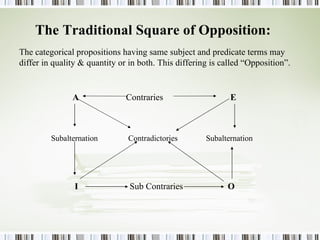
The Traditional Square of Opposition: The categorical propositions having same subject and predicate terms may differ in quality & quantity or in both. This differing is called “Opposition”. A   Contraries  E Subalternation  Contradictories   Subalternation   I  Sub Contraries   O
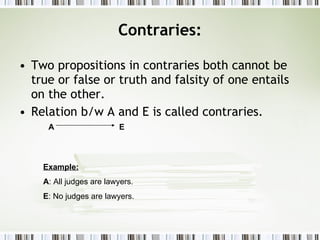
Contraries: Two propositions in contraries both cannot be true or false or truth and falsity of one entails on the other. Relation b/w A and E is called contraries. Example: A : All judges are lawyers. E : No judges are lawyers. A  E
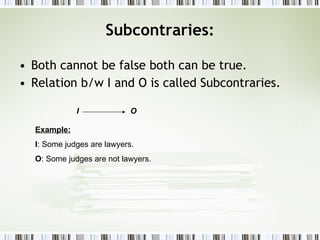
Subcontraries: Both cannot be false both can be true. Relation b/w I and O is called Subcontraries. I  O Example: I : Some judges are lawyers. O : Some judges are not lawyers.
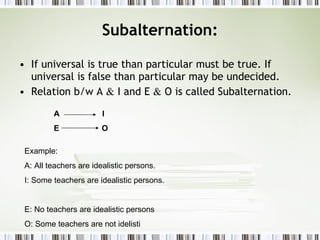
Subalternation: If universal is true than particular must be true. If universal is false than particular may be undecided. Relation b/w A  &  I and E  &  O is called Subalternation. A  I E  O Example: A: All teachers are idealistic persons. I: Some teachers are idealistic persons. E: No teachers are idealistic persons O: Some teachers are not idelisti
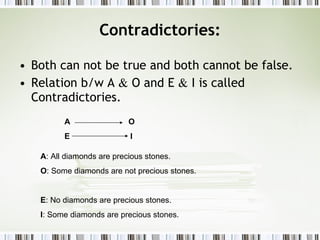
Contradictories: Both can not be true and both cannot be false. Relation b/w A  &  O and E  &  I is called Contradictories. A : All diamonds are precious stones. O : Some diamonds are not precious stones. E : No diamonds are precious stones. I : Some diamonds are precious stones. A  O E  I
Any Questions?
THANK YOU

Logic

  • 1.
    Presentation of logic:Presented To: Madam Uzma Rehman Presented By: Syed Ali Kamran Abidi. 50 Mirza Ali Raza. 90 M. Jaffar Tayar. 48 Syed Hussain Zain-ul-Abideen. 85
  • 2.
    Topic to bedescribed: 1.) The Theory of Deduction. 2.) Categorical Propositions and classes. 3.) Quality, Quantity and Distribution. 4.) The Traditional Square of Opposition. (Contradictories, Contraries, Subcontraries, Subalternation).
  • 3.
    1. The Theoryof Deduction: “A deductive argument is one whose premises are claimed to provide conclusive grounds for the truth of its conclusion.” Logic is divided into two parts. The first of it is the “classical” or “Aristotelian” Logic. The second is called “Modern” or “Symbolic” Logic.
  • 4.
    2. (a) Categoricalpropositions: Categorical proposition is the base for the Classical Logic. They are called categorical propositions because they are about categories or classes. Such propositions affirm or deny that some class S is included in some other class p, completely or partially.
  • 5.
    There are fourtypes of categorical propositions which are also called Four Fold Scheme: 1. A (Inclusion). Universal Affirmative proposition. All politicians are liars. 2. E (Exclusion) Universal Negative proposition. No politicians are liars. 3. I (Partially Inclusion) Particular Affirmative Proposition. Some politicians are liars. 4. O (Partially Exclusion). Particular Negative Proposition. Some politicians are not liars.
  • 6.
    (b) Classes: Classicalcategories (special kinds) are three: Class Inclusion. Class Exclusion. Class Partially Inclusion and Exclusion
  • 7.
    3. (a) Quality:Quality wise any proposition may be called negative or affirmative. If the proposition affirms some class inclusion, whether complete or partial, its quality is affirmative. If the proposition denies some class inclusion, whether complete or partial, its quality is negative.
  • 8.
    (b) Quantity: Quantitywise any proposition is divided into Universal & Particular. If the proposition refers to all members of the class designated by its subject term, its quantity is Universal. Thus A and E are Universal. If the proposition refers only to some members of the class designated by its subject term, its quantity is Particular. Thus I and O are Particular.
  • 9.
    (c) Structure ofstandard form categorical proposition: The general skeleton of proposition is: Quantifier + Subject + Copula + Predicate.
  • 10.
    (d) Distribution: Indistribution we check the class inclusion and exclusion in propositions. A: A distribute its subject only. E: E distributes its subject as well as predicate. I: In I Both terms are not distributed. O: O distributes its predicate only.
  • 11.
    The Traditional Squareof Opposition: The categorical propositions having same subject and predicate terms may differ in quality & quantity or in both. This differing is called “Opposition”. A Contraries E Subalternation Contradictories Subalternation I Sub Contraries O
  • 12.
    Contraries: Two propositionsin contraries both cannot be true or false or truth and falsity of one entails on the other. Relation b/w A and E is called contraries. Example: A : All judges are lawyers. E : No judges are lawyers. A E
  • 13.
    Subcontraries: Both cannotbe false both can be true. Relation b/w I and O is called Subcontraries. I O Example: I : Some judges are lawyers. O : Some judges are not lawyers.
  • 14.
    Subalternation: If universalis true than particular must be true. If universal is false than particular may be undecided. Relation b/w A & I and E & O is called Subalternation. A I E O Example: A: All teachers are idealistic persons. I: Some teachers are idealistic persons. E: No teachers are idealistic persons O: Some teachers are not idelisti
  • 15.
    Contradictories: Both cannot be true and both cannot be false. Relation b/w A & O and E & I is called Contradictories. A : All diamonds are precious stones. O : Some diamonds are not precious stones. E : No diamonds are precious stones. I : Some diamonds are precious stones. A O E I
  • 16.
  • 17.