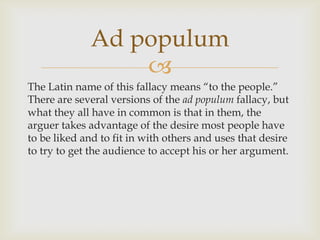
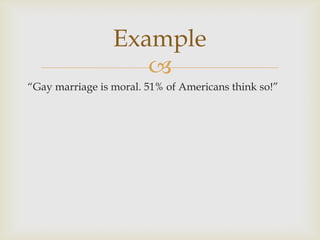
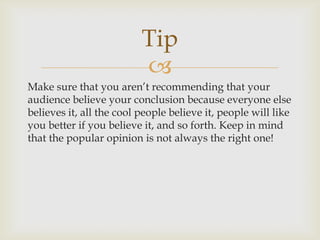
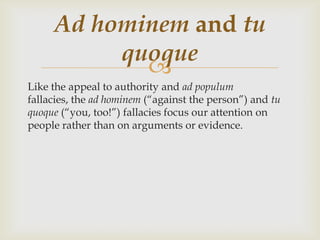
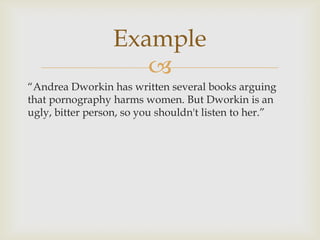
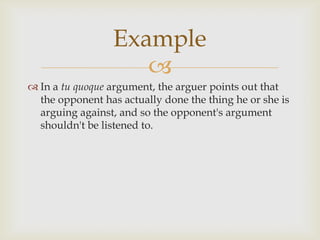
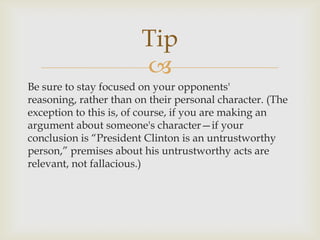
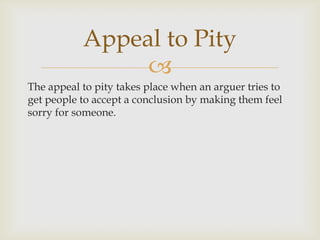
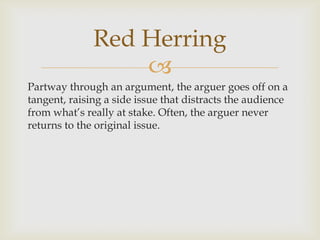
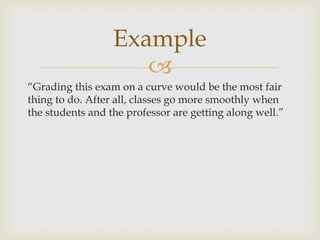
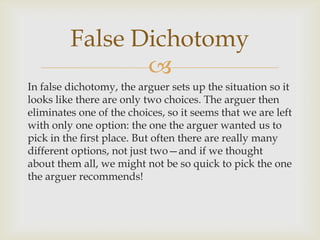
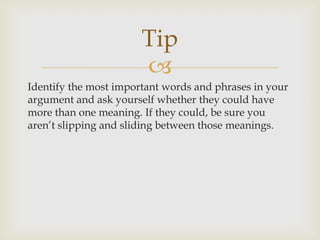
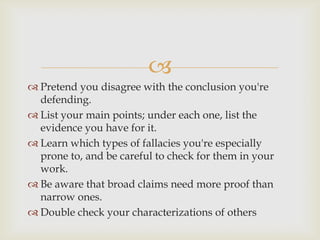
The document discusses various types of logical fallacies that can weaken arguments. It begins by defining a fallacy as a defect that weakens an argument. It then provides tips to help avoid common fallacies like hasty generalization, missing the point, post hoc reasoning, slippery slope, weak analogy, appeal to authority, ad populum, ad hominem, tu quoque, appeal to pity, appeal to ignorance, straw man, red herring, false dichotomy, begging the question, and equivocation. The overall goal is to help readers critically examine their own arguments and strengthen them by identifying and avoiding logical fallacies.



![Logical fallacies ppt[1]](https://cdn.slidesharecdn.com/ss_thumbnails/logicalfallaciesppt1-101028111554-phpapp01-thumbnail.jpg?width=640&height=640&fit=bounds)


