Introduction to Logic

 A Short History    Though the concept
                     of causation has
 of ‘Causation’      emerged in Pre-
                     Socratic
                     philosophy, it was
                     probably Plato who
                     first stated the
                     principle of causality:
                     However, Aristotle
                     was the first
                     philosopher to give
                     an extensive account
                     of causes.
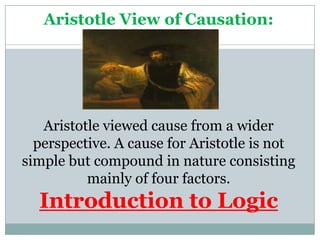
Aristotle View of Causation:


   Aristotle viewed cause from a wider
  perspective. A cause for Aristotle is not
simple but compound in nature consisting
          mainly of four factors.
  Introduction to Logic
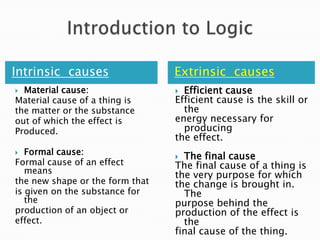
Intrinsic causes                 Extrinsic causes
 Material cause:                 Efficient cause
Material cause of a thing is     Efficient cause is the skill or
the matter or the substance        the
out of which the effect is       energy necessary for
Produced.                          producing
                                 the effect.
  Formal cause:                  The final cause
Formal cause of an effect        The final cause of a thing is
   means                         the very purpose for which
the new shape or the form that   the change is brought in.
is given on the substance for      The
   the                           purpose behind the
production of an object or       production of the effect is
effect.                            the
                                 final cause of the thing.
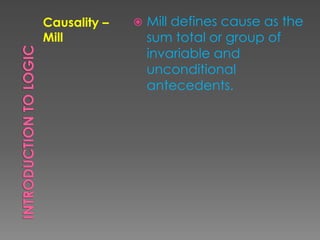
Causality –      Mill defines cause as the
Mill              sum total or group of
                  invariable and
                  unconditional
                  antecedents.
Introduction to Logic

.   DEVELOPMENT OF THE SEQUENCE
         VIEW OF CAUSATION :
      ACCORDING TO VENN, THIS VIEW HAS PASSED
    THROUGH THREE      STAGES OF DEVELOPMENT.

                 1)     THE POPULAR STAGE
               2)      THE SCIENTIFIC STAGE
              3)      THE SPECULATIVE STAGE
Introduction to Logic

                        At this stage, from
 The Popular Stage:
                         various causes, the
                         dominant cause was
                         singles out and regards it
                         as the whole cause.
                         Similarly, out of many
                         effects, only dominant
                         effect was considered as a
                         whole.
A distinction was
made between
Cause and mere co-
existence. Cause is
to be considered
more scientific than
the co-existence.
This stage goes a step farther than the
scientific stage. At this stage, the effect is
also regarded, like the cause, as complex, a
sum-total of consequents
Causes and Conditions:
 Condition:
A condition is anything that exercises some influence upon the effect
  and is essential for bringing it about.

 Cause:
From many of conditions, we select one and call it the cause, and
  refer to the others as mere conditions. Thus, scientifically speaking,
  cause is a sum-total of all the condition, positive as well as negative
Popularity of Causes: Mill’s Doctrine:

 Mill urges that one
 and the same effect
 may be due to any
 one of several
 causes, that the
 same effect may be
 produced sometimes
 by one cause and
 sometimes by
 another
1-    If there are many variable causes
                         for a given effect, then Mill’s
                                  definition of cause as a
                                   group of invariable
                                   antecedents collides with
                                   it.
                                      2-     Secondly, Mill is
                                      wrong in saying
                                      that different causes
                                      can produce exactly
                                      the same effect.
                                       3-     Plurality of
                                       causes is also against
                                       the law of uniformity
                                       which says that the
                                       Same effect is
                                       produced by the
                                       same cause, but
plurality of causes says that the same effect can be produced
by different causes.
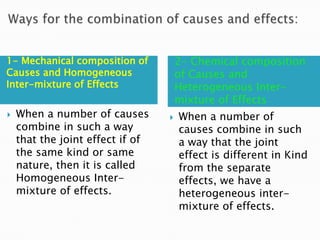
1- Mechanical composition of          2- Chemical composition
Causes and Homogeneous                of Causes and
Inter-mixture of Effects              Heterogeneous Inter-
                                      mixture of Effects
   When a number of causes          When a number of
    combine in such a way             causes combine in such
    that the joint effect if of       a way that the joint
    the same kind or same             effect is different in Kind
    nature, then it is called         from the separate
    Homogeneous Inter-                effects, we have a
    mixture of effects.               heterogeneous inter-
                                      mixture of effects.
Introduction to Logic
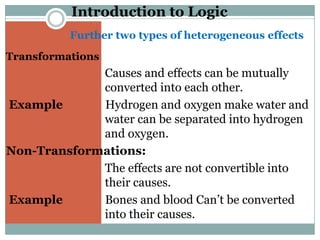
          Further two types of heterogeneous effects.
Transformations
             Causes and effects can be mutually
             converted into each other.
Example      Hydrogen and oxygen make water and
             water can be separated into hydrogen
             and oxygen.
Non-Transformations:
             The effects are not convertible into
             their causes.
Example      Bones and blood Can’t be converted
             into their causes.
Cause and effect
often act and
react on each
other, and their
mutual action and
reaction is known
as Mutuality of
cause and effect.

Introduction to logic

  • 1.
    Introduction to Logic A Short History  Though the concept of causation has of ‘Causation’ emerged in Pre- Socratic philosophy, it was probably Plato who first stated the principle of causality: However, Aristotle was the first philosopher to give an extensive account of causes.
  • 3.
    Aristotle View ofCausation: Aristotle viewed cause from a wider perspective. A cause for Aristotle is not simple but compound in nature consisting mainly of four factors. Introduction to Logic
  • 4.
    Intrinsic causes Extrinsic causes  Material cause:  Efficient cause Material cause of a thing is Efficient cause is the skill or the matter or the substance the out of which the effect is energy necessary for Produced. producing the effect.  Formal cause:  The final cause Formal cause of an effect The final cause of a thing is means the very purpose for which the new shape or the form that the change is brought in. is given on the substance for The the purpose behind the production of an object or production of the effect is effect. the final cause of the thing.
  • 6.
    Causality –  Mill defines cause as the Mill sum total or group of invariable and unconditional antecedents.
  • 8.
    Introduction to Logic . DEVELOPMENT OF THE SEQUENCE VIEW OF CAUSATION : ACCORDING TO VENN, THIS VIEW HAS PASSED THROUGH THREE STAGES OF DEVELOPMENT. 1) THE POPULAR STAGE 2) THE SCIENTIFIC STAGE 3) THE SPECULATIVE STAGE
  • 9.
    Introduction to Logic  At this stage, from  The Popular Stage: various causes, the dominant cause was singles out and regards it as the whole cause. Similarly, out of many effects, only dominant effect was considered as a whole.
  • 10.
    A distinction was madebetween Cause and mere co- existence. Cause is to be considered more scientific than the co-existence.
  • 11.
    This stage goesa step farther than the scientific stage. At this stage, the effect is also regarded, like the cause, as complex, a sum-total of consequents
  • 12.
    Causes and Conditions: Condition: A condition is anything that exercises some influence upon the effect and is essential for bringing it about.  Cause: From many of conditions, we select one and call it the cause, and refer to the others as mere conditions. Thus, scientifically speaking, cause is a sum-total of all the condition, positive as well as negative
  • 13.
    Popularity of Causes:Mill’s Doctrine: Mill urges that one and the same effect may be due to any one of several causes, that the same effect may be produced sometimes by one cause and sometimes by another
  • 14.
    1- If there are many variable causes for a given effect, then Mill’s definition of cause as a group of invariable antecedents collides with it. 2- Secondly, Mill is wrong in saying that different causes can produce exactly the same effect. 3- Plurality of causes is also against the law of uniformity which says that the Same effect is produced by the same cause, but plurality of causes says that the same effect can be produced by different causes.
  • 16.
    1- Mechanical compositionof 2- Chemical composition Causes and Homogeneous of Causes and Inter-mixture of Effects Heterogeneous Inter- mixture of Effects  When a number of causes  When a number of combine in such a way causes combine in such that the joint effect if of a way that the joint the same kind or same effect is different in Kind nature, then it is called from the separate Homogeneous Inter- effects, we have a mixture of effects. heterogeneous inter- mixture of effects.
  • 17.
    Introduction to Logic Further two types of heterogeneous effects. Transformations Causes and effects can be mutually converted into each other. Example Hydrogen and oxygen make water and water can be separated into hydrogen and oxygen. Non-Transformations: The effects are not convertible into their causes. Example Bones and blood Can’t be converted into their causes.
  • 18.
    Cause and effect oftenact and react on each other, and their mutual action and reaction is known as Mutuality of cause and effect.