1.4 Validity, Truth, Soundness, Strength, Cogency
Overview Deductive arguments Valid versus invalid Soundness Inductive arguments Strong versus weak Cogency
Traits of deductive arguments Validity A deductive argument is an argument where it’s  impossible  to have true premises and a false conclusion. This is called a  valid  deductive argument. An  invalid  deductive argument is one where it is possible to have true premises and a false conclusion. The conclusion doesn’t follow from the premises, even though it claims to do so.
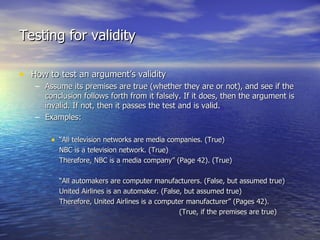
Testing for validity How to test an argument’s validity Assume its premises are true (whether they are or not), and see if the conclusion follows forth from it falsely. If it does, then the argument is invalid. If not, then it passes the test and is valid. Examples: “ All television networks are media companies. (True) NBC is a television network. (True) Therefore, NBC is a media company” (Page 42). (True) “ All automakers are computer manufacturers. (False, but assumed true) United Airlines is an automaker. (False, but assumed true) Therefore, United Airlines is a computer manufacturer” (Pages 42).  (True, if the premises are true)
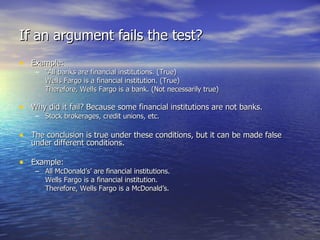
If an argument fails the test? Example: “ All banks are financial institutions. (True) Wells Fargo is a financial institution. (True) Therefore, Wells Fargo is a bank. (Not necessarily true) Why did it fail? Because some financial institutions are not banks. Stock brokerages, credit unions, etc. The conclusion is true under these conditions, but it can be made false under different conditions. Example: All McDonald’s’ are financial institutions. Wells Fargo is a financial institution. Therefore, Wells Fargo is a McDonald’s.
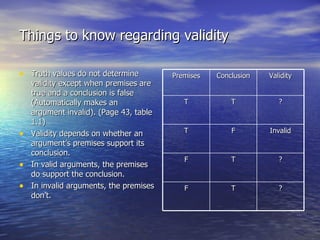
Things to know regarding validity Truth values do not determine validity except when premises are true and a conclusion is false (Automatically makes an argument invalid). (Page 43, table 1.1) Validity depends on whether an argument’s premises support its conclusion. In valid arguments, the premises do support the conclusion. In invalid arguments, the premises don’t. Premises Conclusion Validity T T ? T F Invalid F T ? F T ?
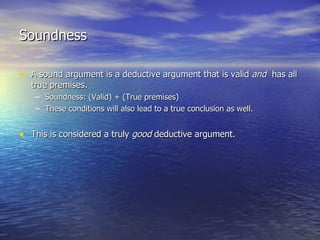
Soundness A sound argument is a deductive argument that is valid  and  has all true premises. Soundness: (Valid) + (True premises) These conditions will also lead to a true conclusion as well. This is considered a truly  good  deductive argument.
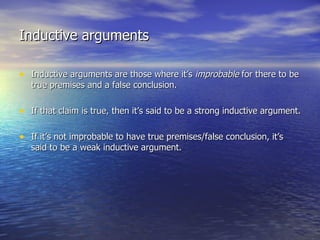
Inductive arguments Inductive arguments are those where it’s  improbable  for there to be true premises and a false conclusion. If that claim is true, then it’s said to be a strong inductive argument. If it’s not improbable to have true premises/false conclusion, it’s said to be a weak inductive argument.
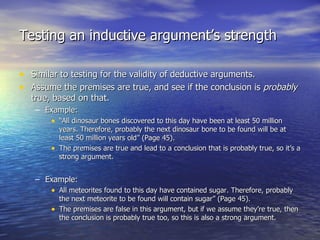
Testing an inductive argument’s strength Similar to testing for the validity of deductive arguments. Assume the premises are true, and see if the conclusion is  probably  true, based on that. Example: “ All dinosaur bones discovered to this day have been at least 50 million years. Therefore, probably the next dinosaur bone to be found will be at least 50 million years old” (Page 45). The premises are true and lead to a conclusion that is probably true, so it’s a strong argument. Example: All meteorites found to this day have contained sugar. Therefore, probably the next meteorite to be found will contain sugar” (Page 45). The premises are false in this argument, but if we assume they’re true, then the conclusion is probably true too, so this is also a strong argument.
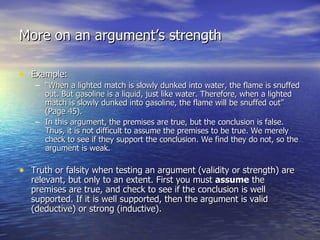
More on an argument’s strength Example: “ When a lighted match is slowly dunked into water, the flame is snuffed out. But gasoline is a liquid, just like water. Therefore, when a lighted match is slowly dunked into gasoline, the flame will be snuffed out” (Page 45). In this argument, the premises are true, but the conclusion is false. Thus, it is not difficult to assume the premises to be true. We merely check to see if they support the conclusion. We find they do not, so the argument is weak. Truth or falsity when testing an argument (validity or strength) are relevant, but only to an extent. First you must  assume  the premises are true, and check to see if the conclusion is well supported. If it is well supported, then the argument is valid (deductive) or strong (inductive).
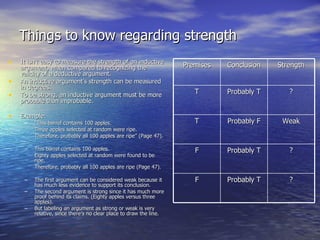
Things to know regarding strength It isn’t easy to measure the strength of an inductive argument, when compared to recognizing the validity of a deductive argument. An inductive argument’s strength can be measured in degrees. To be strong, an inductive argument must be more probable than improbable. Example: “ This barrel contains 100 apples. Three apples selected at random were ripe. Therefore, probably all 100 apples are ripe” (Page 47). This barrel contains 100 apples. Eighty apples selected at random were found to be ripe. Therefore, probably all 100 apples are ripe (Page 47). The first argument can be considered weak because it has much less evidence to support its conclusion. The second argument is strong since it has much more proof behind its claims. (Eighty apples versus three apples). But labeling an argument as strong or weak is very relative, since there’s no clear place to draw the line. Premises Conclusion Strength T Probably T ? T Probably F Weak F Probably T ? F Probably T ?
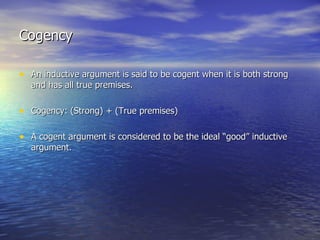
Cogency An inductive argument is said to be cogent when it is both strong and has all true premises. Cogency: (Strong) + (True premises) A cogent argument is considered to be the ideal “good” inductive argument.
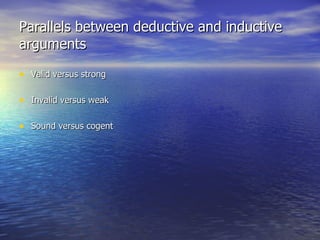
Parallels between deductive and inductive arguments Valid versus strong Invalid versus weak Sound versus cogent

1.4 Validity, Truth, Soundness, Strength, Cogency

  • 1.
    1.4 Validity, Truth,Soundness, Strength, Cogency
  • 2.
    Overview Deductive argumentsValid versus invalid Soundness Inductive arguments Strong versus weak Cogency
  • 3.
    Traits of deductivearguments Validity A deductive argument is an argument where it’s impossible to have true premises and a false conclusion. This is called a valid deductive argument. An invalid deductive argument is one where it is possible to have true premises and a false conclusion. The conclusion doesn’t follow from the premises, even though it claims to do so.
  • 4.
    Testing for validityHow to test an argument’s validity Assume its premises are true (whether they are or not), and see if the conclusion follows forth from it falsely. If it does, then the argument is invalid. If not, then it passes the test and is valid. Examples: “ All television networks are media companies. (True) NBC is a television network. (True) Therefore, NBC is a media company” (Page 42). (True) “ All automakers are computer manufacturers. (False, but assumed true) United Airlines is an automaker. (False, but assumed true) Therefore, United Airlines is a computer manufacturer” (Pages 42). (True, if the premises are true)
  • 5.
    If an argumentfails the test? Example: “ All banks are financial institutions. (True) Wells Fargo is a financial institution. (True) Therefore, Wells Fargo is a bank. (Not necessarily true) Why did it fail? Because some financial institutions are not banks. Stock brokerages, credit unions, etc. The conclusion is true under these conditions, but it can be made false under different conditions. Example: All McDonald’s’ are financial institutions. Wells Fargo is a financial institution. Therefore, Wells Fargo is a McDonald’s.
  • 6.
    Things to knowregarding validity Truth values do not determine validity except when premises are true and a conclusion is false (Automatically makes an argument invalid). (Page 43, table 1.1) Validity depends on whether an argument’s premises support its conclusion. In valid arguments, the premises do support the conclusion. In invalid arguments, the premises don’t. Premises Conclusion Validity T T ? T F Invalid F T ? F T ?
  • 7.
    Soundness A soundargument is a deductive argument that is valid and has all true premises. Soundness: (Valid) + (True premises) These conditions will also lead to a true conclusion as well. This is considered a truly good deductive argument.
  • 8.
    Inductive arguments Inductivearguments are those where it’s improbable for there to be true premises and a false conclusion. If that claim is true, then it’s said to be a strong inductive argument. If it’s not improbable to have true premises/false conclusion, it’s said to be a weak inductive argument.
  • 9.
    Testing an inductiveargument’s strength Similar to testing for the validity of deductive arguments. Assume the premises are true, and see if the conclusion is probably true, based on that. Example: “ All dinosaur bones discovered to this day have been at least 50 million years. Therefore, probably the next dinosaur bone to be found will be at least 50 million years old” (Page 45). The premises are true and lead to a conclusion that is probably true, so it’s a strong argument. Example: All meteorites found to this day have contained sugar. Therefore, probably the next meteorite to be found will contain sugar” (Page 45). The premises are false in this argument, but if we assume they’re true, then the conclusion is probably true too, so this is also a strong argument.
  • 10.
    More on anargument’s strength Example: “ When a lighted match is slowly dunked into water, the flame is snuffed out. But gasoline is a liquid, just like water. Therefore, when a lighted match is slowly dunked into gasoline, the flame will be snuffed out” (Page 45). In this argument, the premises are true, but the conclusion is false. Thus, it is not difficult to assume the premises to be true. We merely check to see if they support the conclusion. We find they do not, so the argument is weak. Truth or falsity when testing an argument (validity or strength) are relevant, but only to an extent. First you must assume the premises are true, and check to see if the conclusion is well supported. If it is well supported, then the argument is valid (deductive) or strong (inductive).
  • 11.
    Things to knowregarding strength It isn’t easy to measure the strength of an inductive argument, when compared to recognizing the validity of a deductive argument. An inductive argument’s strength can be measured in degrees. To be strong, an inductive argument must be more probable than improbable. Example: “ This barrel contains 100 apples. Three apples selected at random were ripe. Therefore, probably all 100 apples are ripe” (Page 47). This barrel contains 100 apples. Eighty apples selected at random were found to be ripe. Therefore, probably all 100 apples are ripe (Page 47). The first argument can be considered weak because it has much less evidence to support its conclusion. The second argument is strong since it has much more proof behind its claims. (Eighty apples versus three apples). But labeling an argument as strong or weak is very relative, since there’s no clear place to draw the line. Premises Conclusion Strength T Probably T ? T Probably F Weak F Probably T ? F Probably T ?
  • 12.
    Cogency An inductiveargument is said to be cogent when it is both strong and has all true premises. Cogency: (Strong) + (True premises) A cogent argument is considered to be the ideal “good” inductive argument.
  • 13.
    Parallels between deductiveand inductive arguments Valid versus strong Invalid versus weak Sound versus cogent