Categorical
Propositions
Logic 213
Kent Sunglao
Learning Goals
Define categorical proposition and identify its
parts;
Discuss the matter and form of a proposition;
Learn the distinctions among the four types of
categorical propositions; and
Learn how to reduce a proposition to its logical
form.
Contents
Nature of Categorical Proposition
Elements of Categorical Propositions
Symbols of Categorical Propositions
Logical Form of Categorical Propositions
Introduction
Categorical Propositions
Introduction
•It was Aristotle (384-322 BCE), the most famous
student of Plato (428-347 BCE), who was the first to
develop a formal system of logic. Aristotle’s followers
gathered his writings on logic and compiled them
into what they called the Organon, which is a word
that means "instrument." And this is exactly how
Aristotle conceived of logic, as an instrument for the
scientific and philosophical investigation of reality.
Introduction
•For Aristotle, reality is organized in categories or
classes. Such classes have members and Aristotle
thought knowledge of reality consisted of true
propositions (assertions) about these categories
and their members. Such a proposition would be,
for example, “All human beings are mortal.”
NATURE OF CATEGORICAL
PROPOSITIONS
What is a Categorical Proposition?
Nature of Categorical Proposition
A categorical proposition is a kind of proposition that
expresses an unconditional judgment (Babor, 2003).
It is a proposition in which the subject term is affirmed or
denied by the predicate term (De Leon, 2003)
ELEMENTS OF CATEGORICAL
PROPOSITIONS
The Materials from which the proposition is made.
Matter and Form
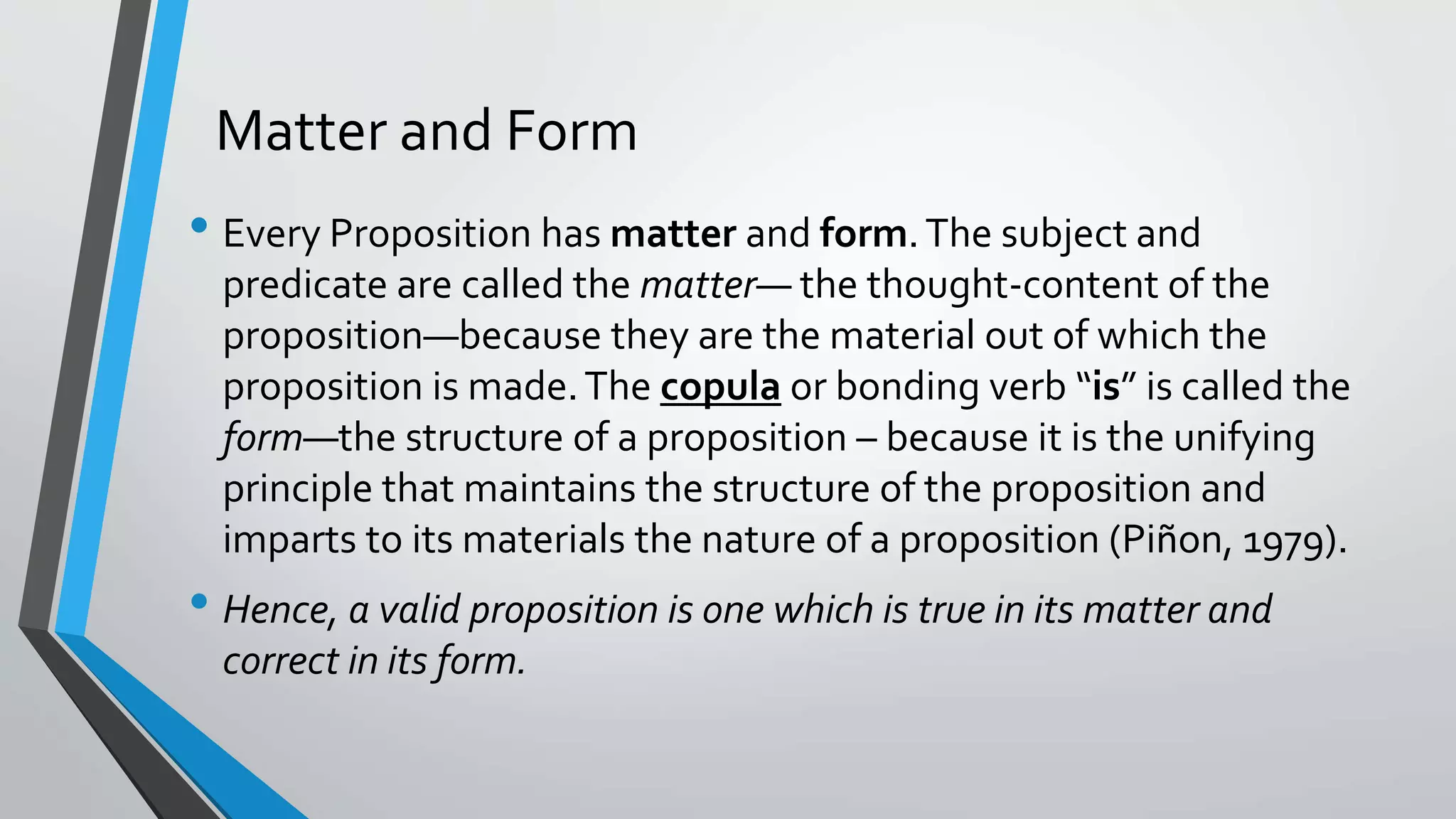
• Every Proposition has matter and form.The subject and
predicate are called the matter— the thought-content of the
proposition—because they are the material out of which the
proposition is made.The copula or bonding verb “is” is called the
form—the structure of a proposition – because it is the unifying
principle that maintains the structure of the proposition and
imparts to its materials the nature of a proposition (Piñon, 1979).
• Hence, a valid proposition is one which is true in its matter and
correct in its form.
Examples:
A monkey is an animal.
Matter
Form
Many Africans are not rich.
Logic vs. Grammar
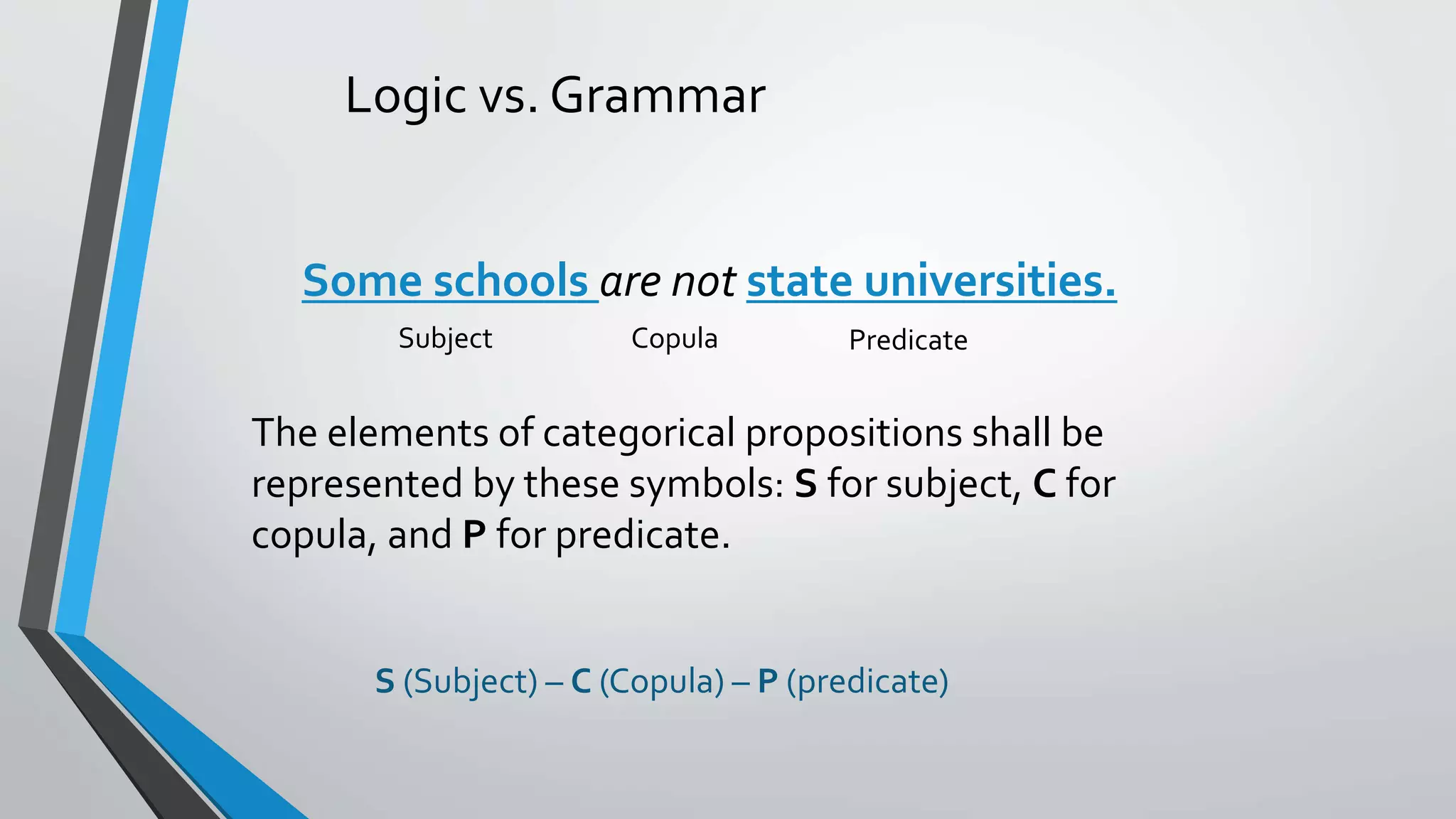
Some schools are not state universities.
Subject Copula Predicate
The elements of categorical propositions shall be
represented by these symbols: S for subject, C for
copula, and P for predicate.
S (Subject) – C (Copula) – P (predicate)
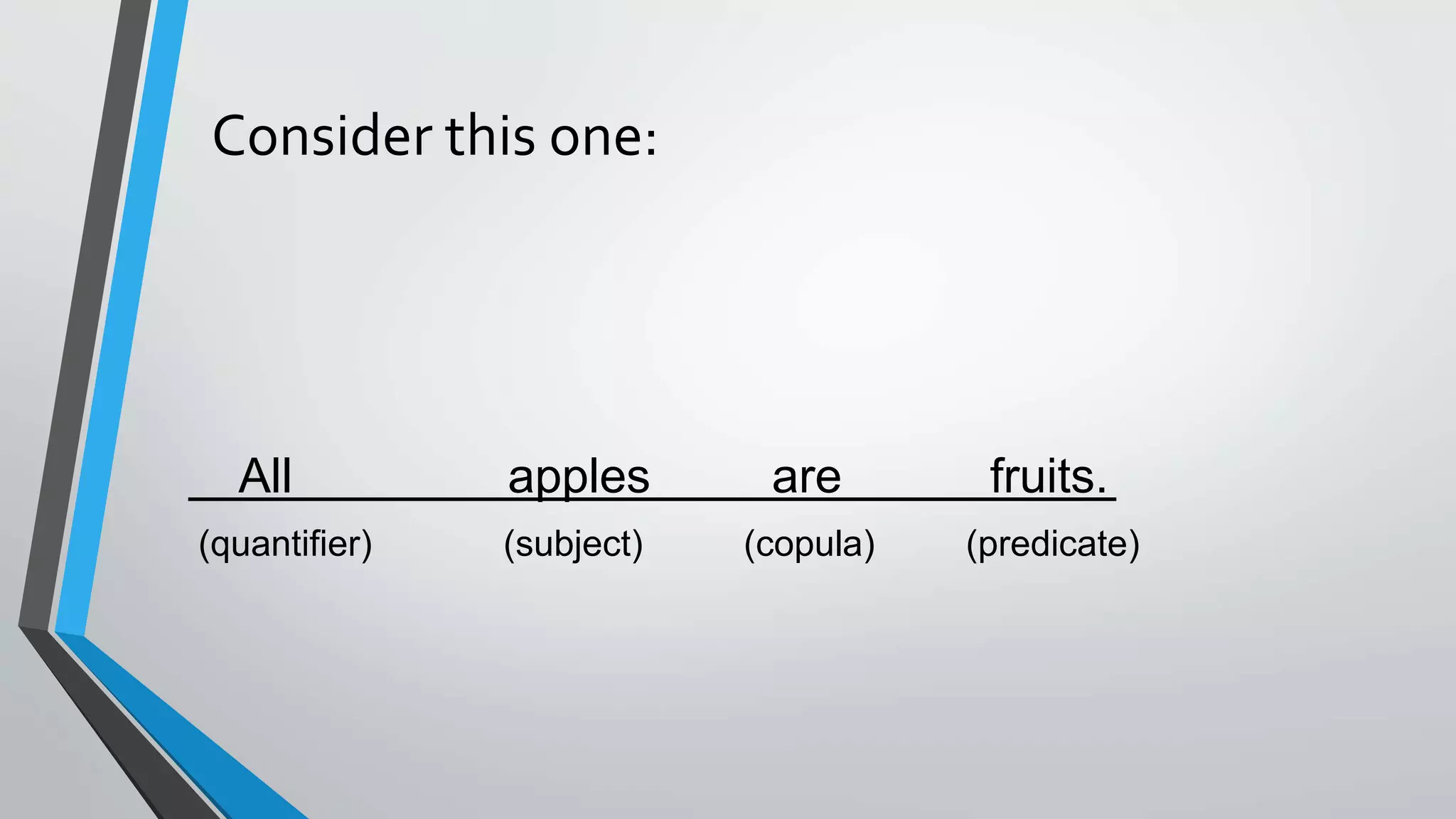
Consider this one:
All apples are fruits.
(quantifier) (subject) (copula) (predicate)
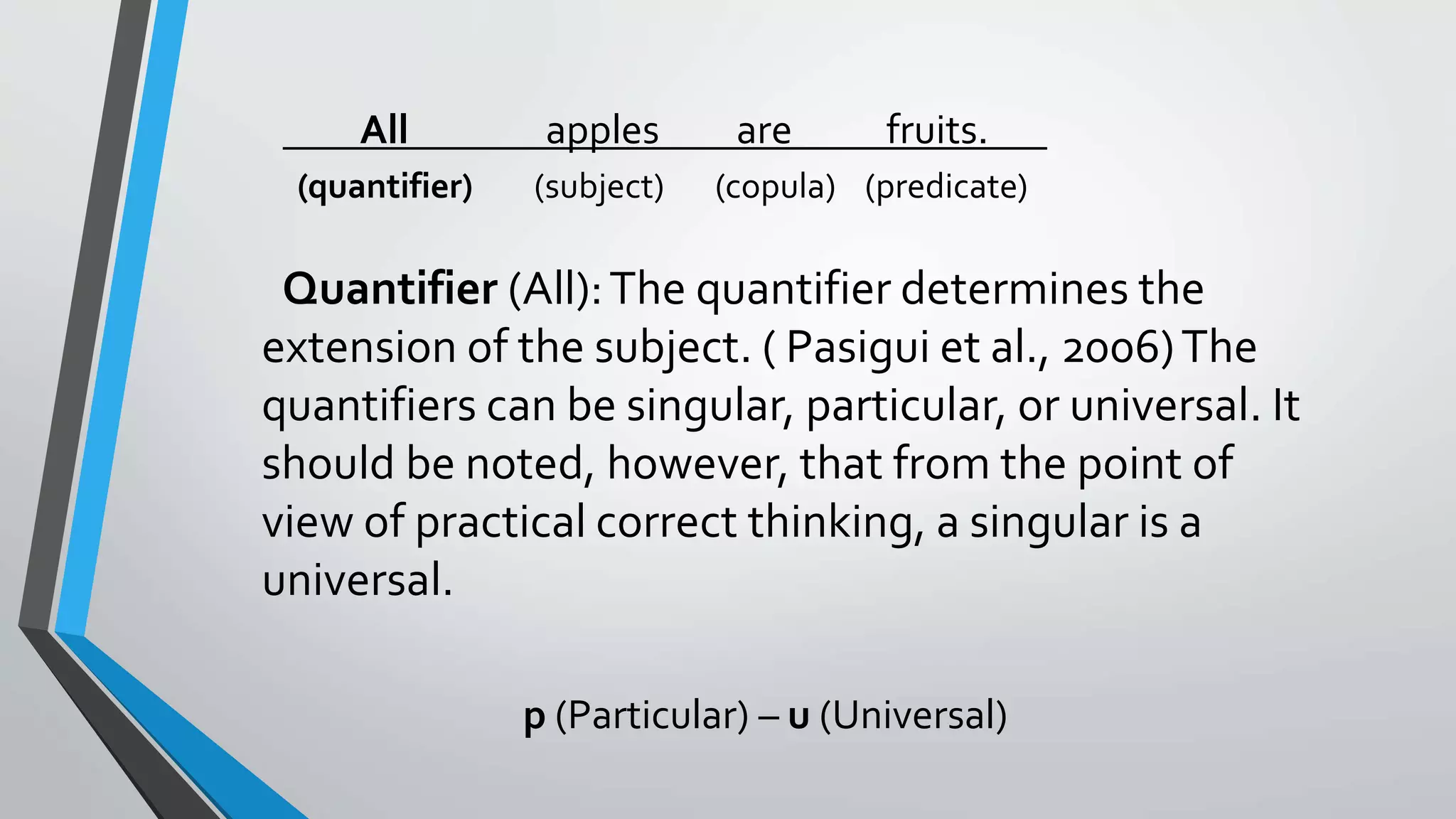
Quantifier (All):The quantifier determines the
extension of the subject. ( Pasigui et al., 2006)The
quantifiers can be singular, particular, or universal. It
should be noted, however, that from the point of
view of practical correct thinking, a singular is a
universal.
p (Particular) – u (Universal)
All apples are fruits.
(quantifier) (subject) (copula) (predicate)
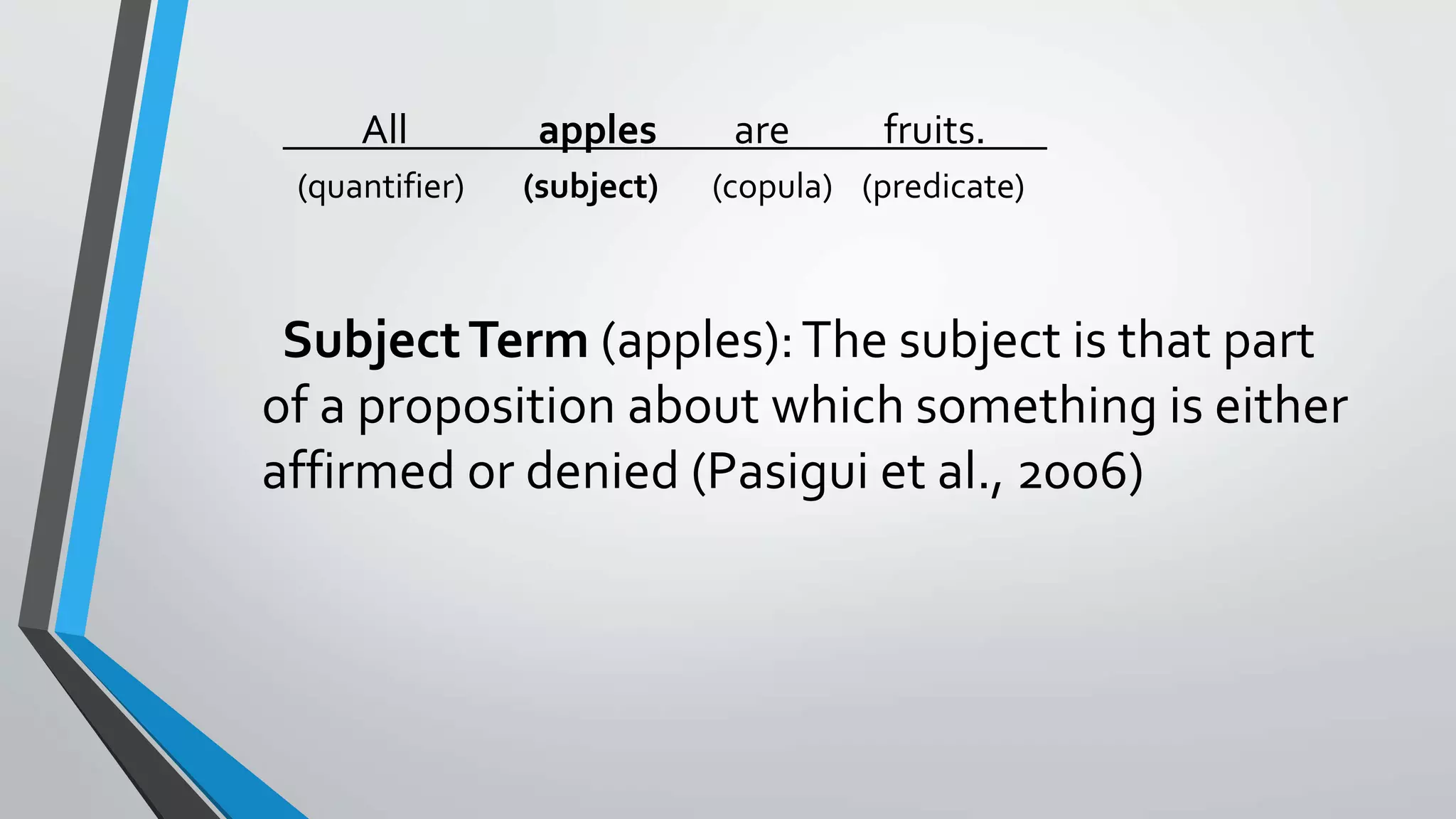
SubjectTerm (apples):The subject is that part
of a proposition about which something is either
affirmed or denied (Pasigui et al., 2006)
All apples are fruits.
(quantifier) (subject) (copula) (predicate)
All apples are fruits.
(quantifier) (subject) (copula) (predicate)
Copula (are): The copula is the qualifier of
the proposition. Because of it, the
proposition is either affirmative or negative.
Affirmative Copula is, am, and are
Negative Copula is not, am not, and are not
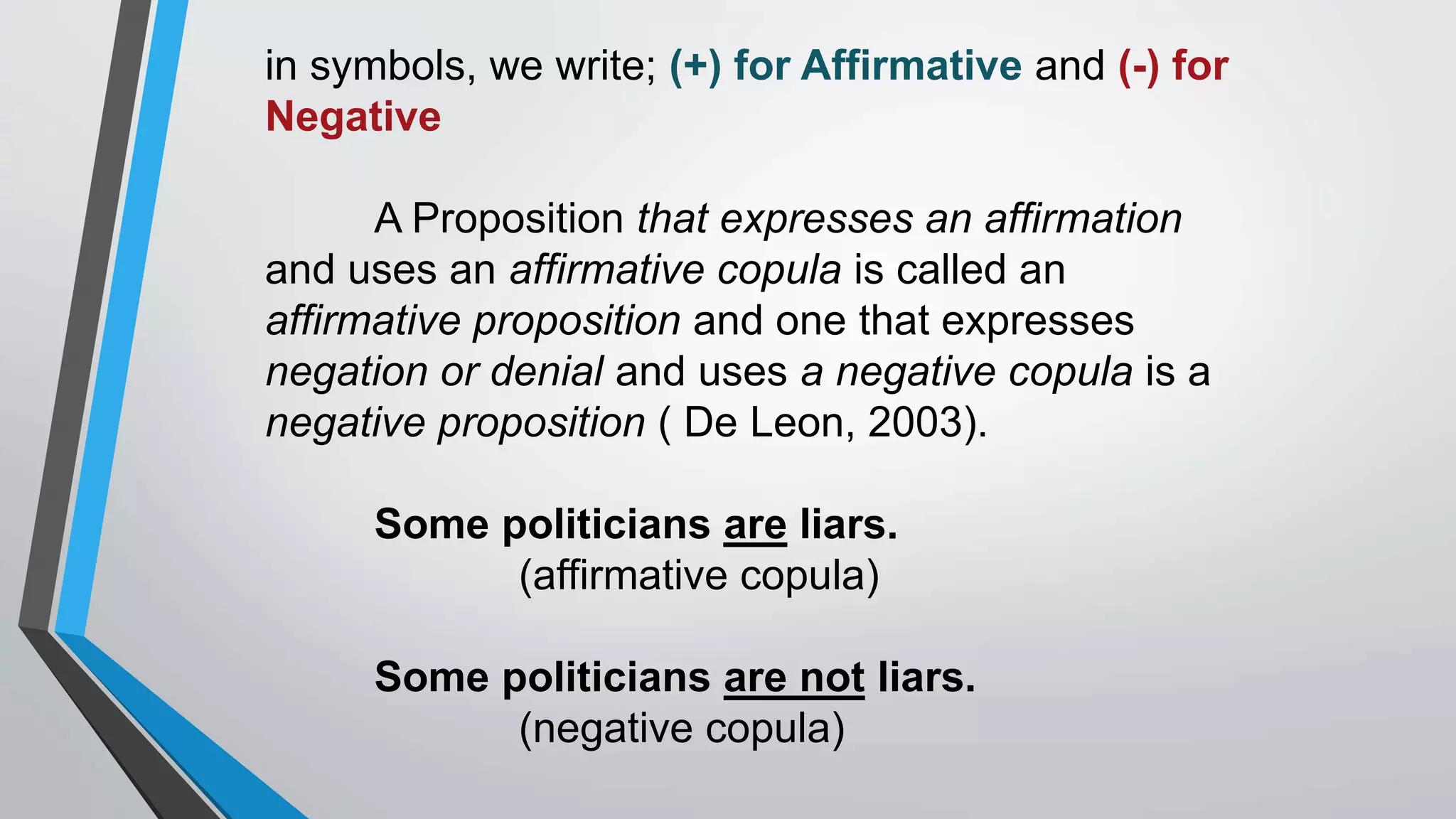
in symbols, we write; (+) for Affirmative and (-) for
Negative
A Proposition that expresses an affirmation
and uses an affirmative copula is called an
affirmative proposition and one that expresses
negation or denial and uses a negative copula is a
negative proposition ( De Leon, 2003).
Some politicians are liars.
(affirmative copula)
Some politicians are not liars.
(negative copula)
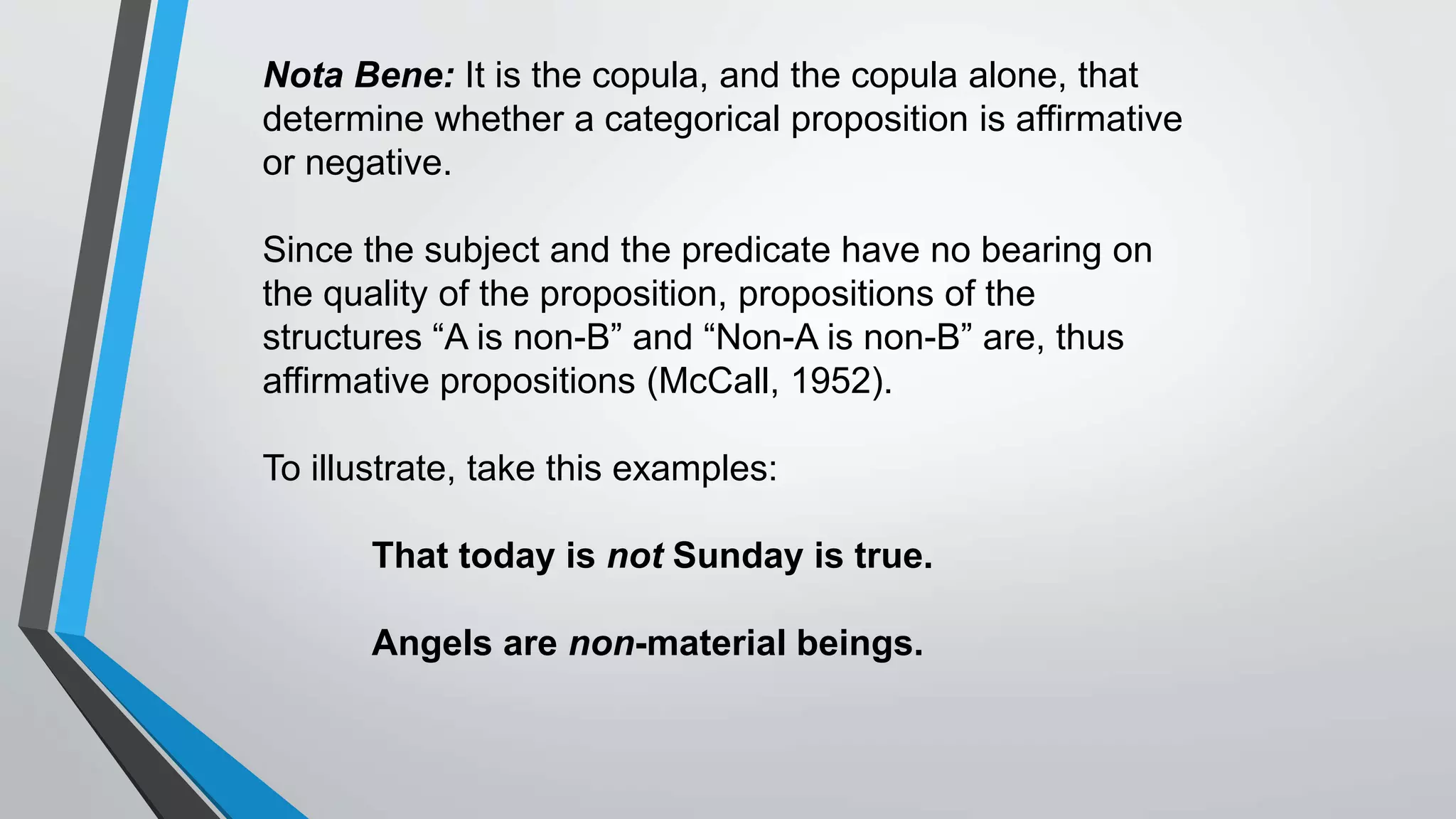
Nota Bene: It is the copula, and the copula alone, that
determine whether a categorical proposition is affirmative
or negative.
Since the subject and the predicate have no bearing on
the quality of the proposition, propositions of the
structures “A is non-B” and “Non-A is non-B” are, thus
affirmative propositions (McCall, 1952).
To illustrate, take this examples:
That today is not Sunday is true.
Angels are non-material beings.
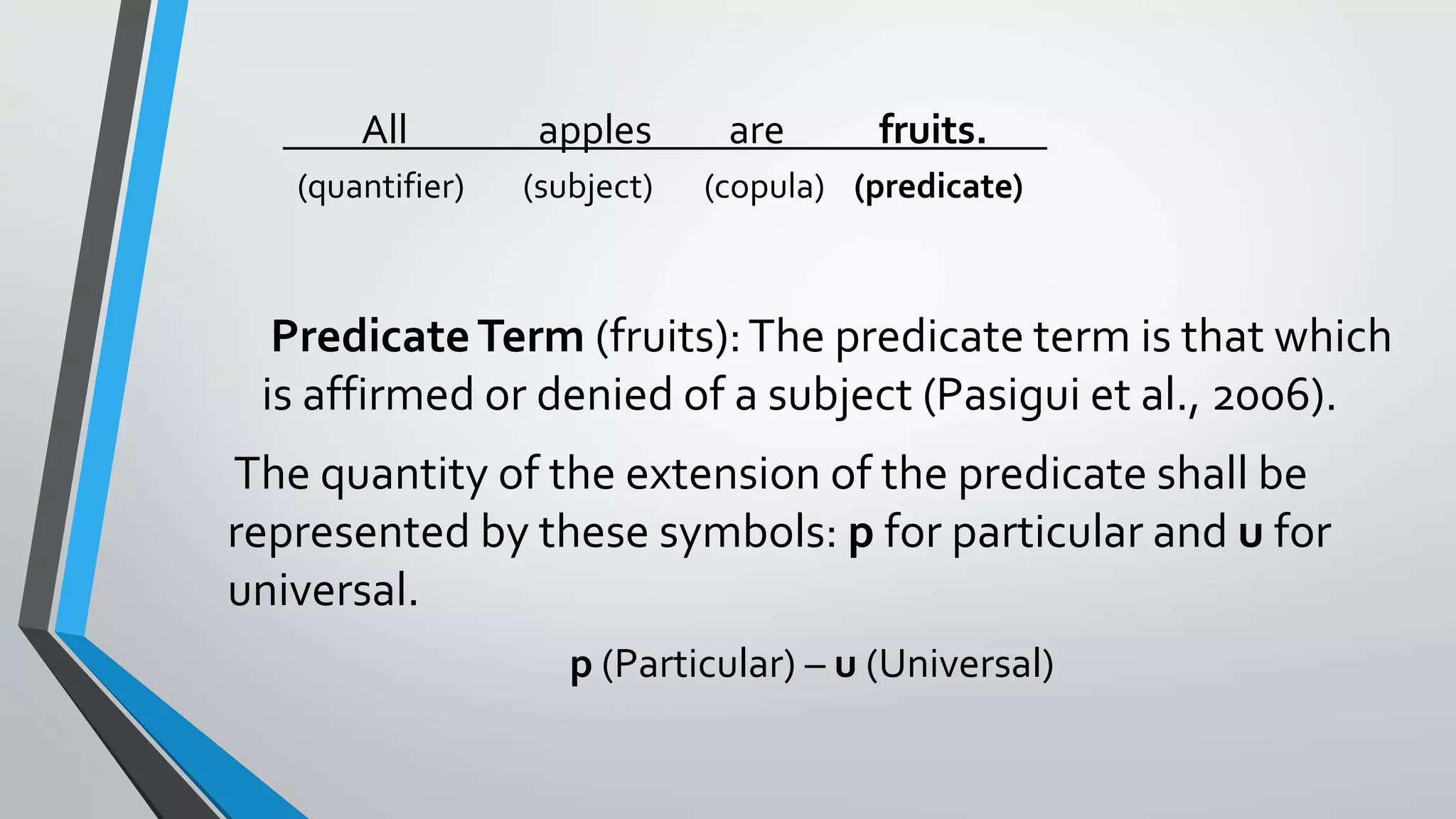
PredicateTerm (fruits):The predicate term is that which
is affirmed or denied of a subject (Pasigui et al., 2006).
The quantity of the extension of the predicate shall be
represented by these symbols: p for particular and u for
universal.
p (Particular) – u (Universal)
All apples are fruits.
(quantifier) (subject) (copula) (predicate)
SYMBOLS OF CATEGORICAL
PROPOSITIONS
The shortcuts to correct reasoning.
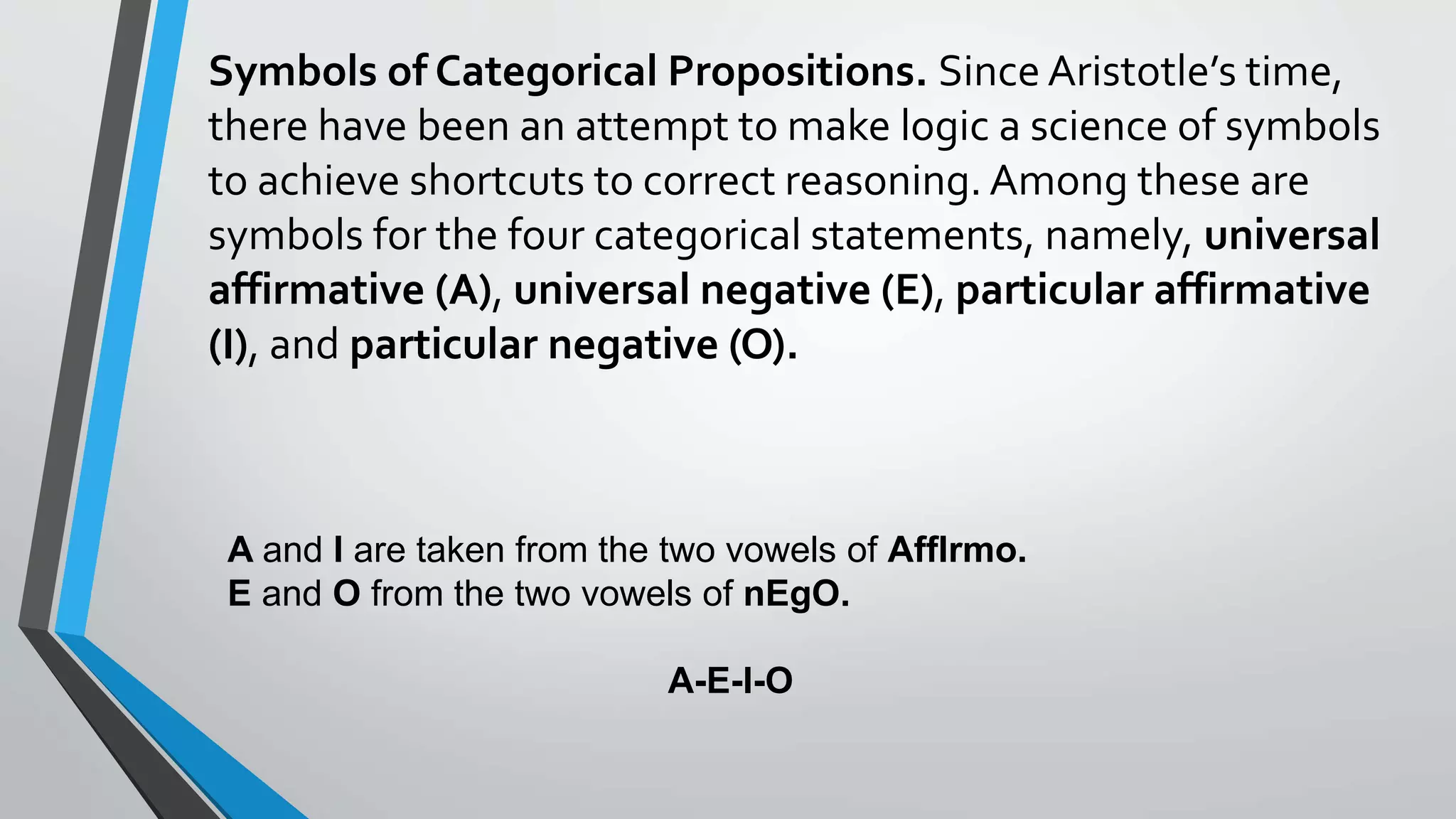
Symbols of Categorical Propositions. Since Aristotle’s time,
there have been an attempt to make logic a science of symbols
to achieve shortcuts to correct reasoning. Among these are
symbols for the four categorical statements, namely, universal
affirmative (A), universal negative (E), particular affirmative
(I), and particular negative (O).
A and I are taken from the two vowels of AffIrmo.
E and O from the two vowels of nEgO.
A-E-I-O
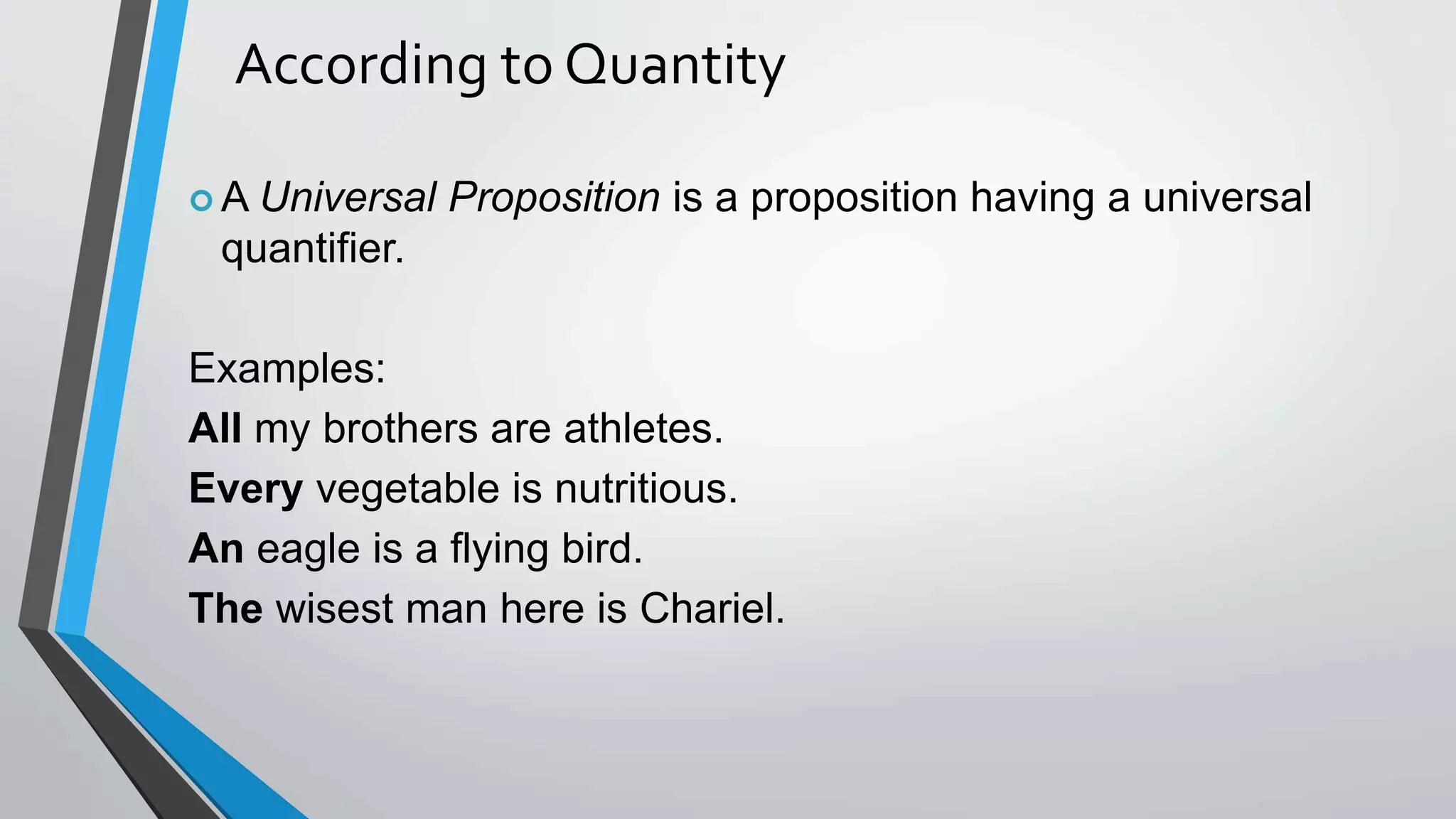
According to Quantity
 A Universal Proposition is a proposition having a universal
quantifier.
Examples:
All my brothers are athletes.
Every vegetable is nutritious.
An eagle is a flying bird.
The wisest man here is Chariel.
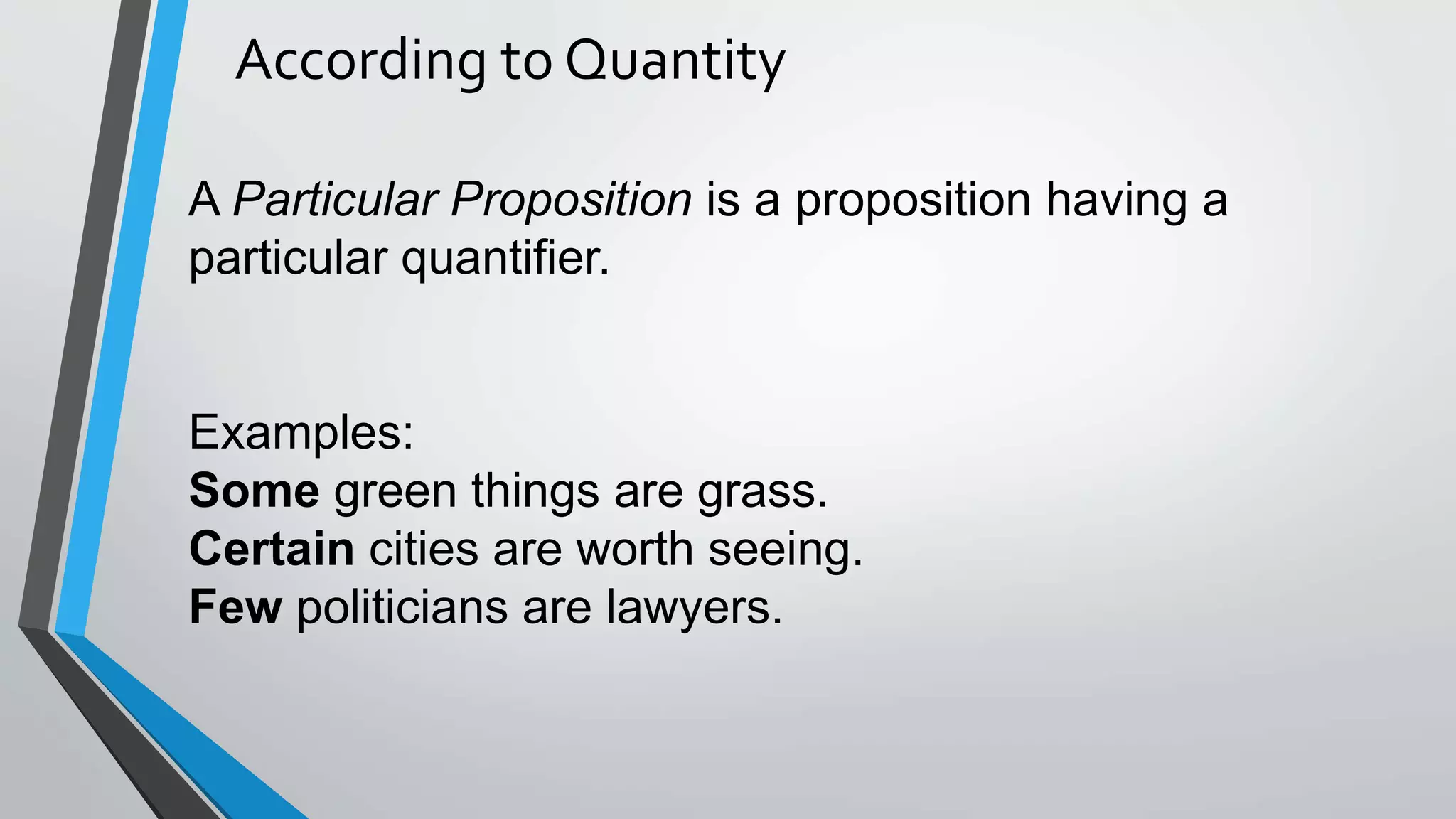
According to Quantity
A Particular Proposition is a proposition having a
particular quantifier.
Examples:
Some green things are grass.
Certain cities are worth seeing.
Few politicians are lawyers.
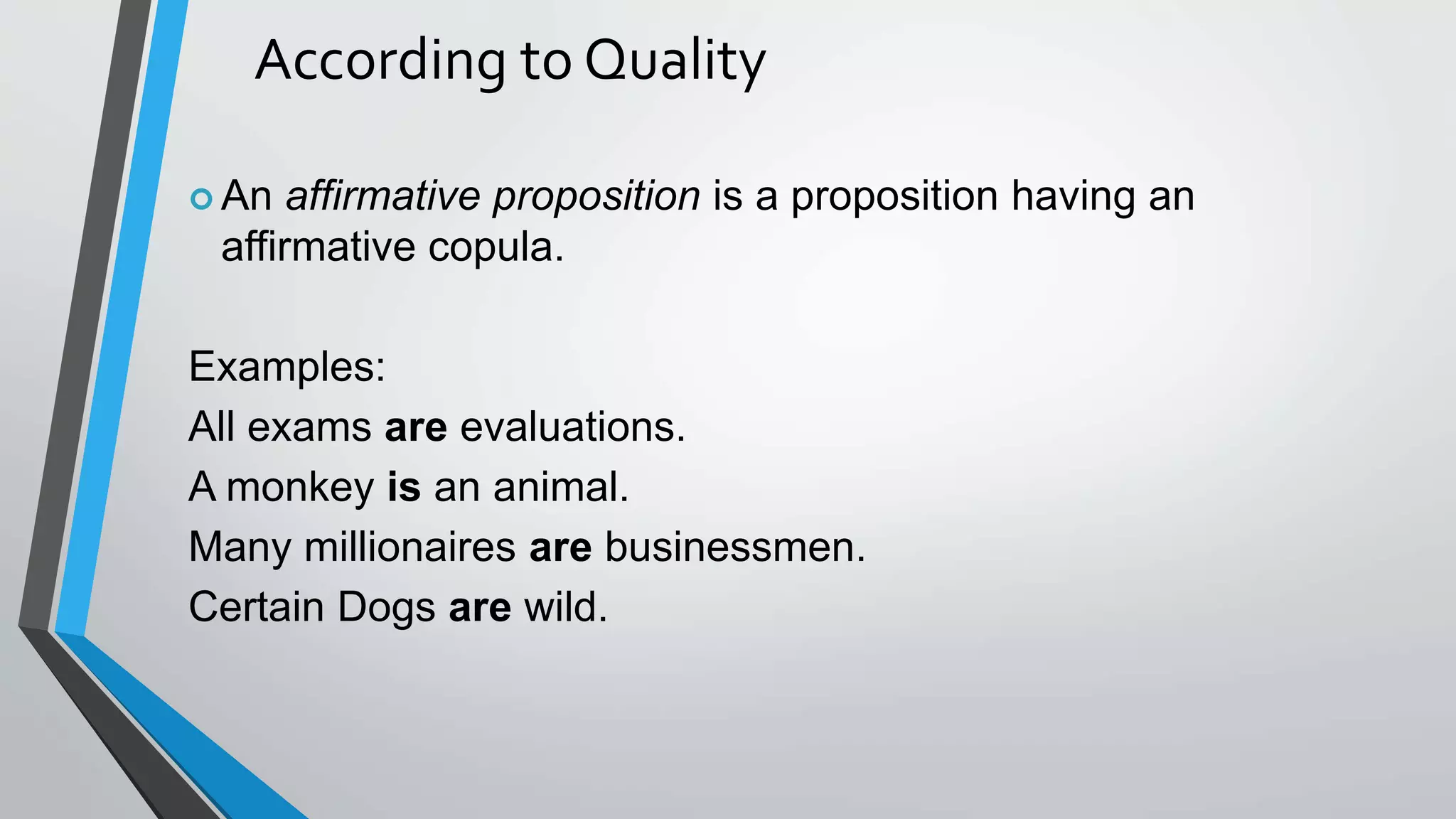
According to Quality
 An affirmative proposition is a proposition having an
affirmative copula.
Examples:
All exams are evaluations.
A monkey is an animal.
Many millionaires are businessmen.
Certain Dogs are wild.
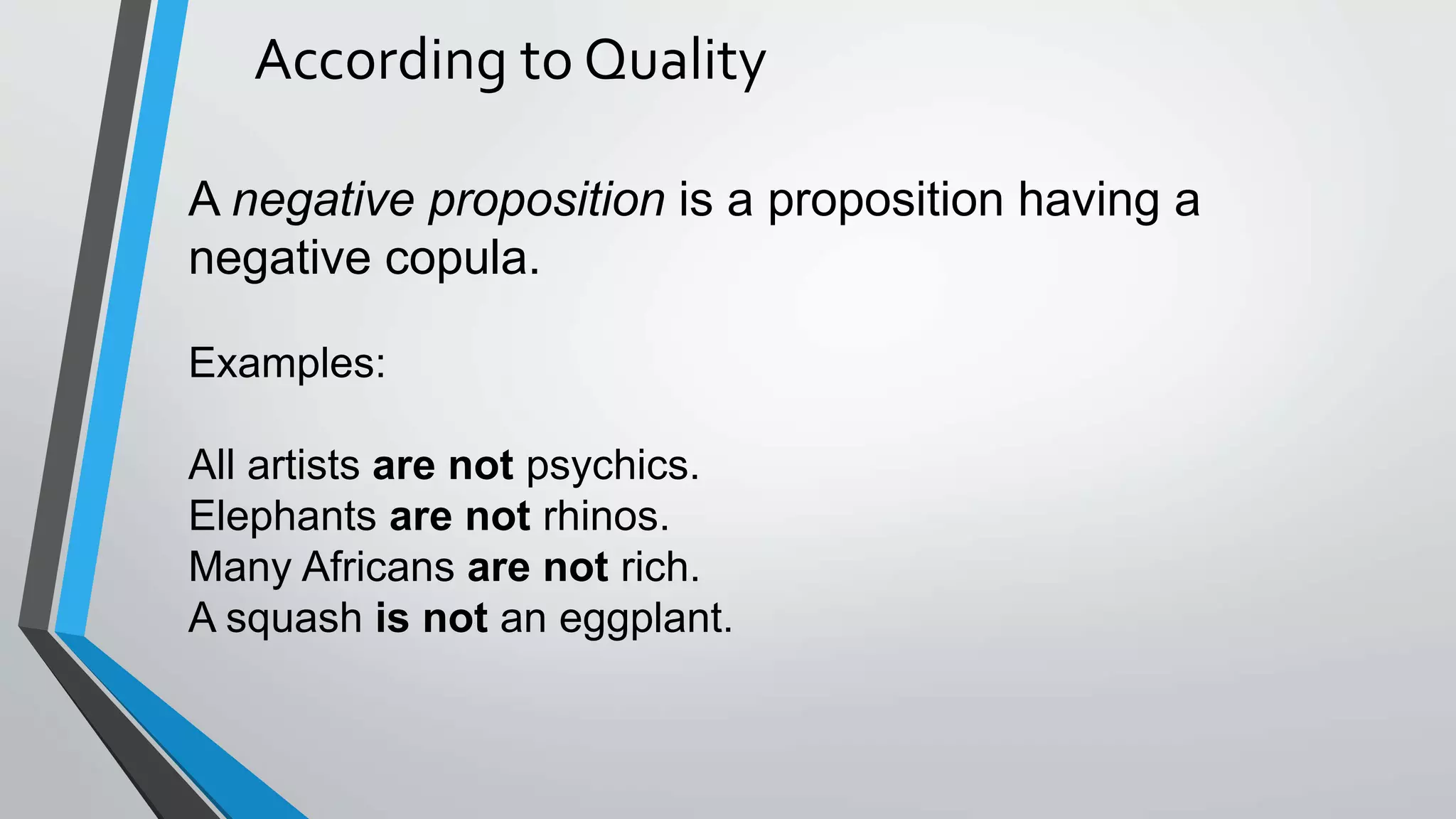
According to Quality
A negative proposition is a proposition having a
negative copula.
Examples:
All artists are not psychics.
Elephants are not rhinos.
Many Africans are not rich.
A squash is not an eggplant.
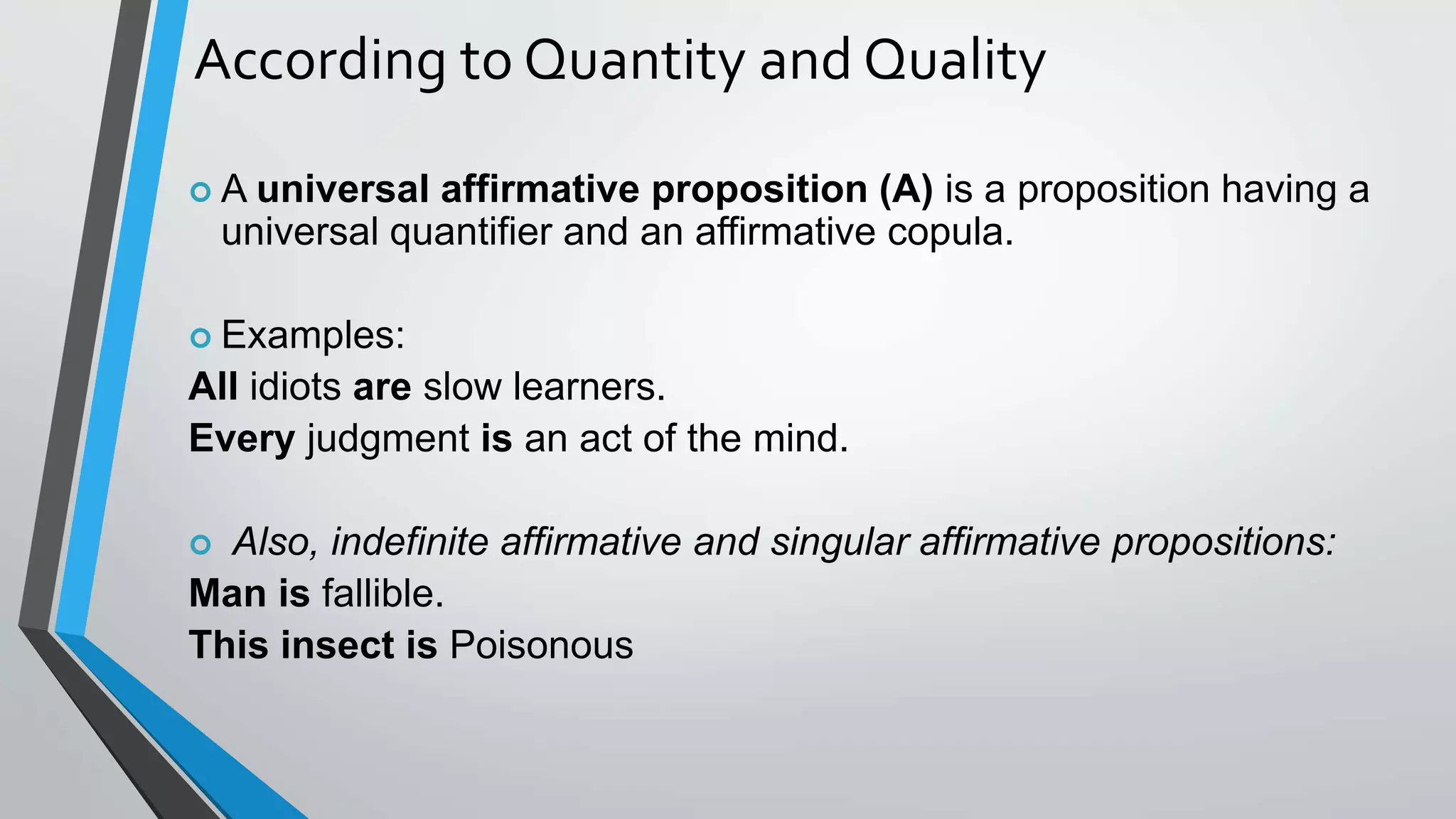
According to Quantity and Quality
 A universal affirmative proposition (A) is a proposition having a
universal quantifier and an affirmative copula.
 Examples:
All idiots are slow learners.
Every judgment is an act of the mind.
 Also, indefinite affirmative and singular affirmative propositions:
Man is fallible.
This insect is Poisonous
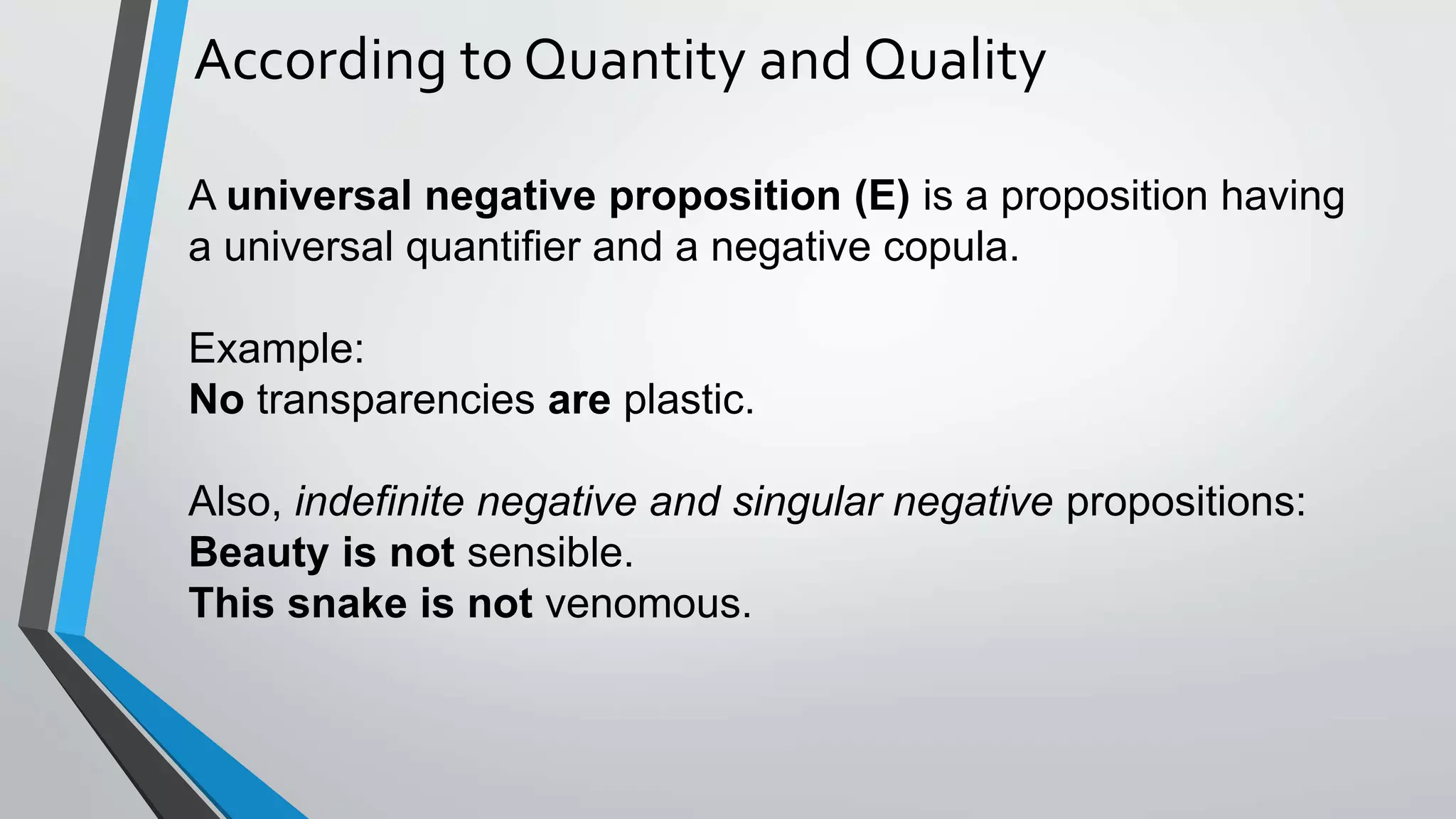
According to Quantity and Quality
A universal negative proposition (E) is a proposition having
a universal quantifier and a negative copula.
Example:
No transparencies are plastic.
Also, indefinite negative and singular negative propositions:
Beauty is not sensible.
This snake is not venomous.
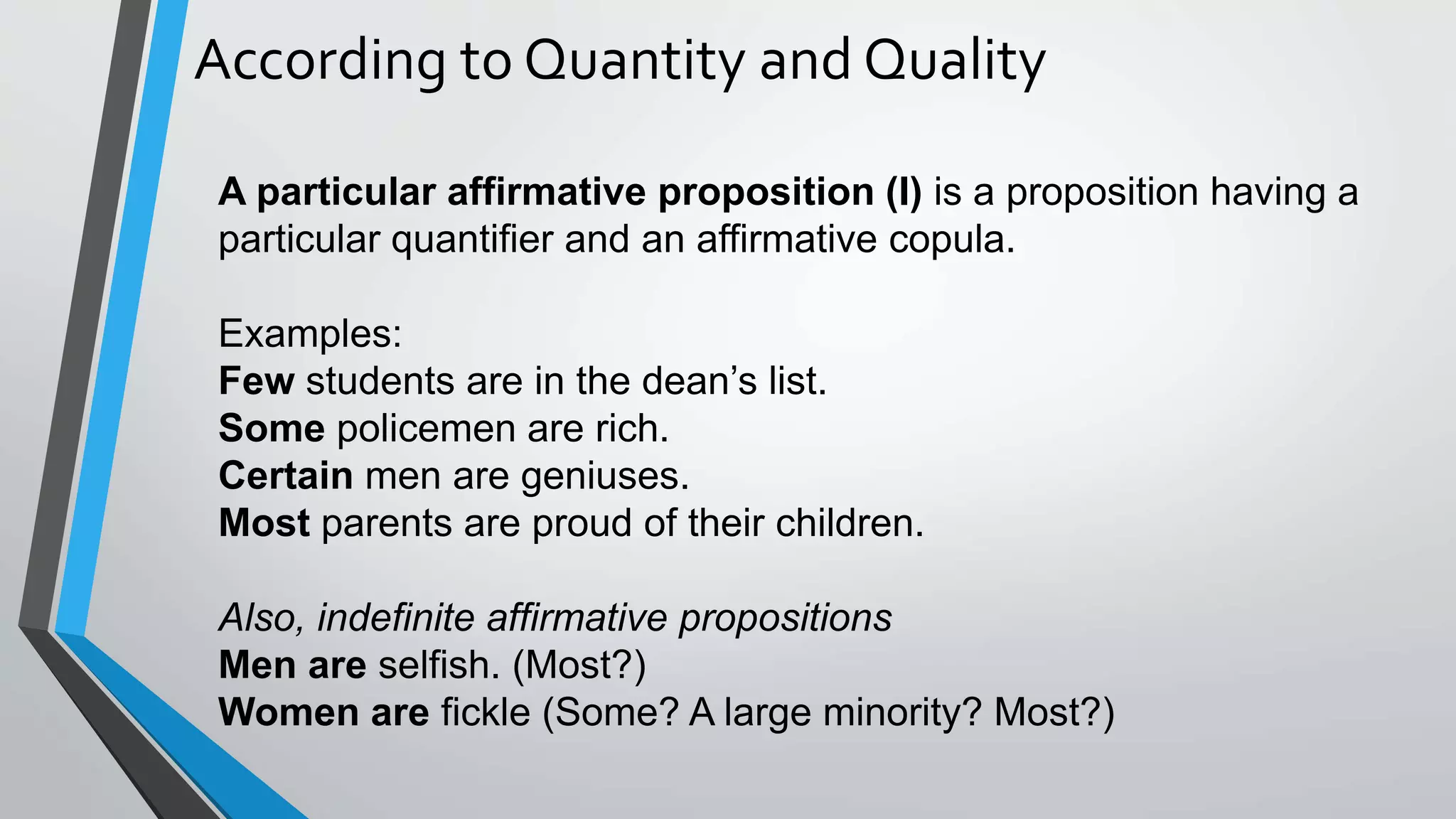
According to Quantity and Quality
A particular affirmative proposition (I) is a proposition having a
particular quantifier and an affirmative copula.
Examples:
Few students are in the dean’s list.
Some policemen are rich.
Certain men are geniuses.
Most parents are proud of their children.
Also, indefinite affirmative propositions
Men are selfish. (Most?)
Women are fickle (Some? A large minority? Most?)
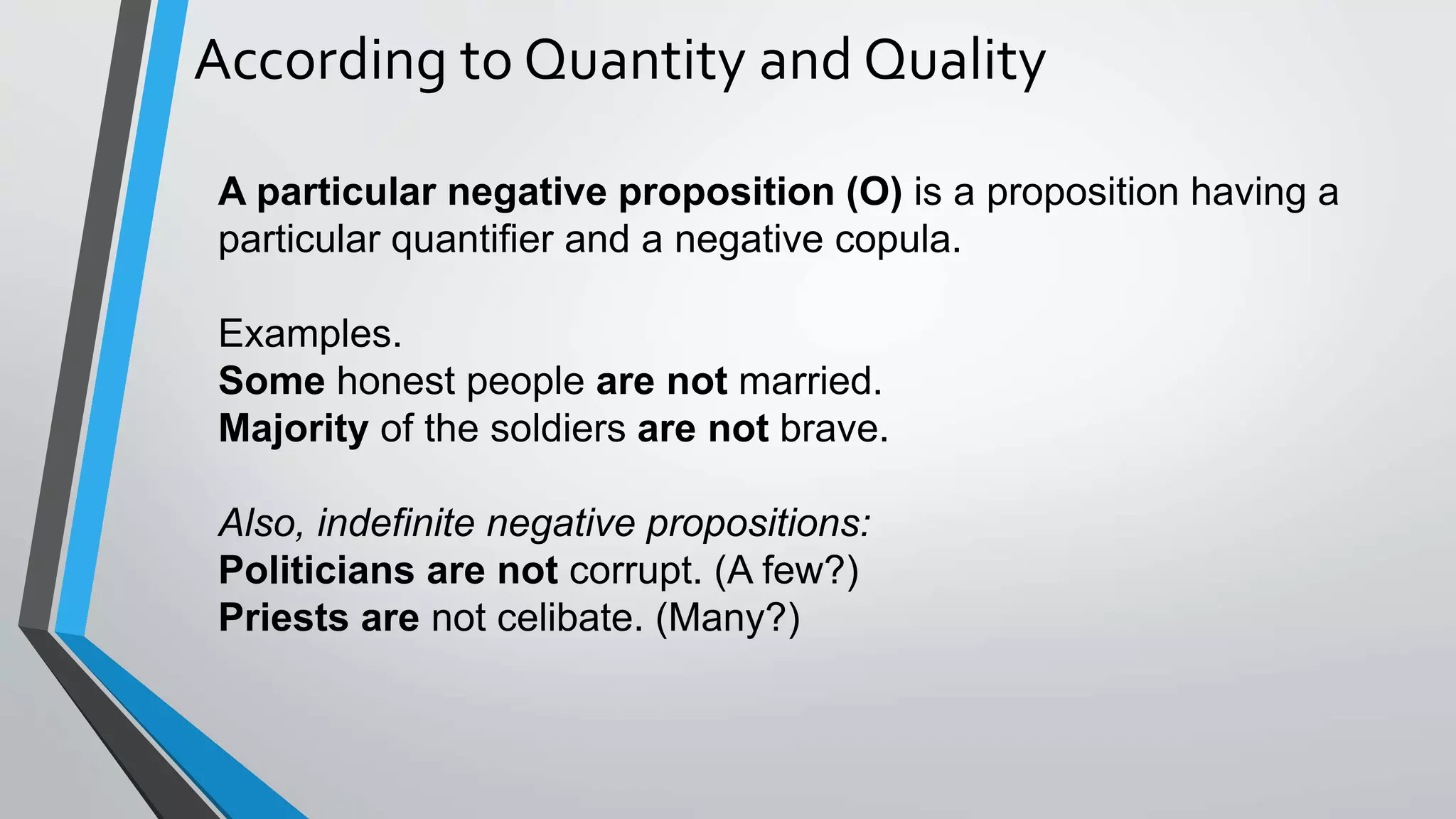
According to Quantity and Quality
A particular negative proposition (O) is a proposition having a
particular quantifier and a negative copula.
Examples.
Some honest people are not married.
Majority of the soldiers are not brave.
Also, indefinite negative propositions:
Politicians are not corrupt. (A few?)
Priests are not celibate. (Many?)
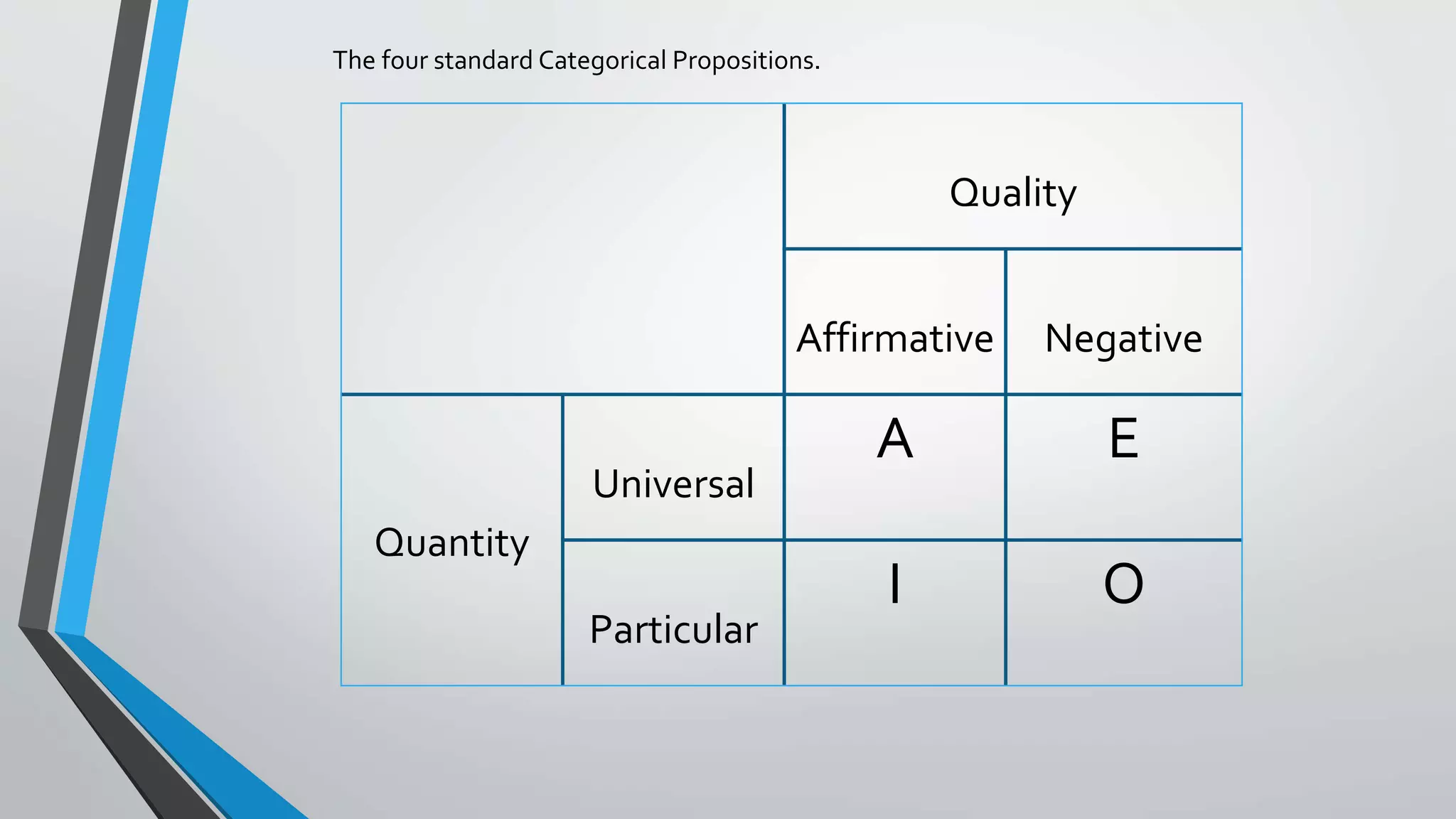
Quality
Affirmative Negative
Quantity
Universal
A E
Particular
I O
The four standard Categorical Propositions.
LOGICAL FORM OF
CATEGORICAL PROPOSITIONS
The basic agreement of parts.
Logical Form of Categorical Propositions.
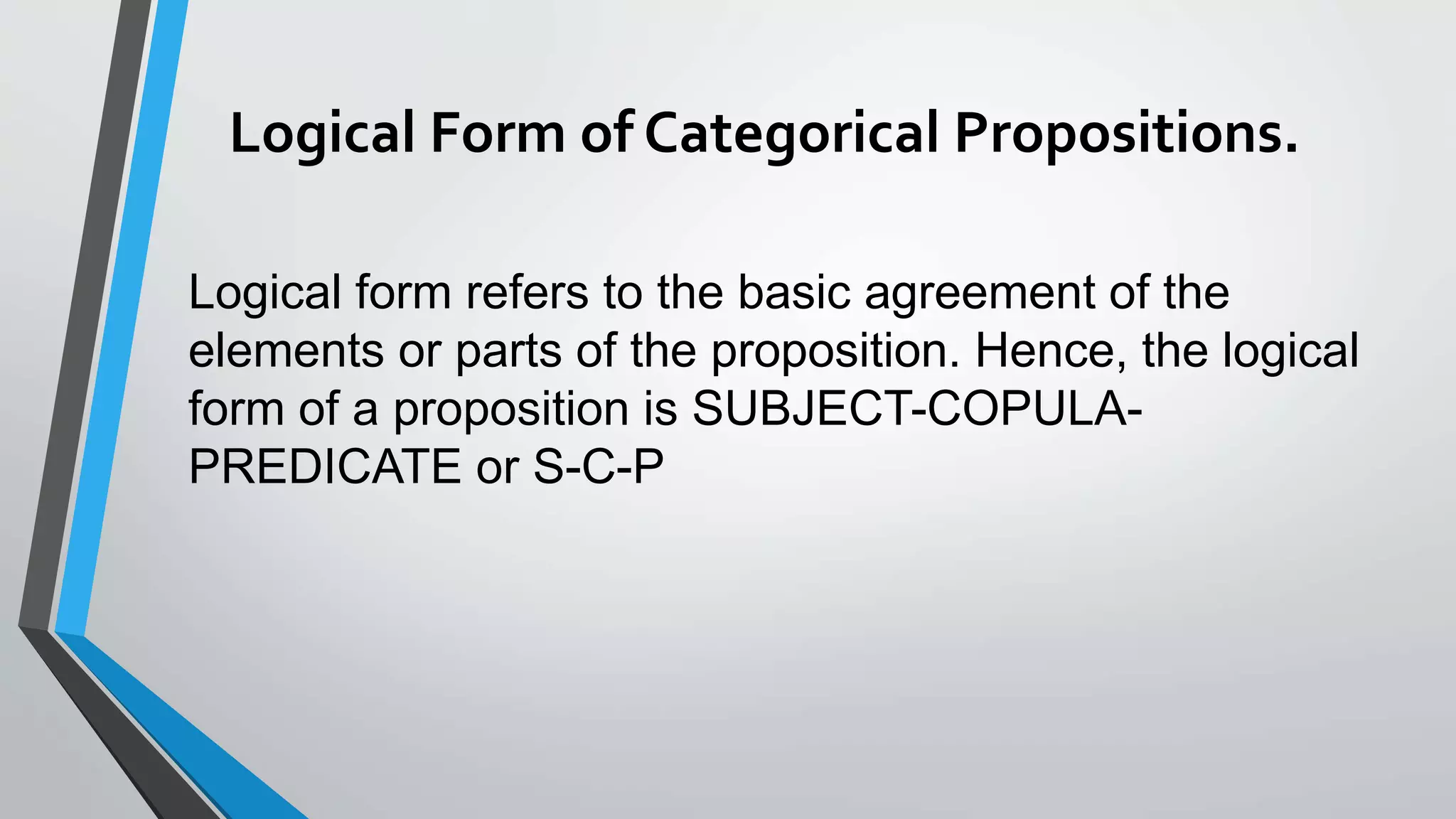
Logical form refers to the basic agreement of the
elements or parts of the proposition. Hence, the logical
form of a proposition is SUBJECT-COPULA-
PREDICATE or S-C-P
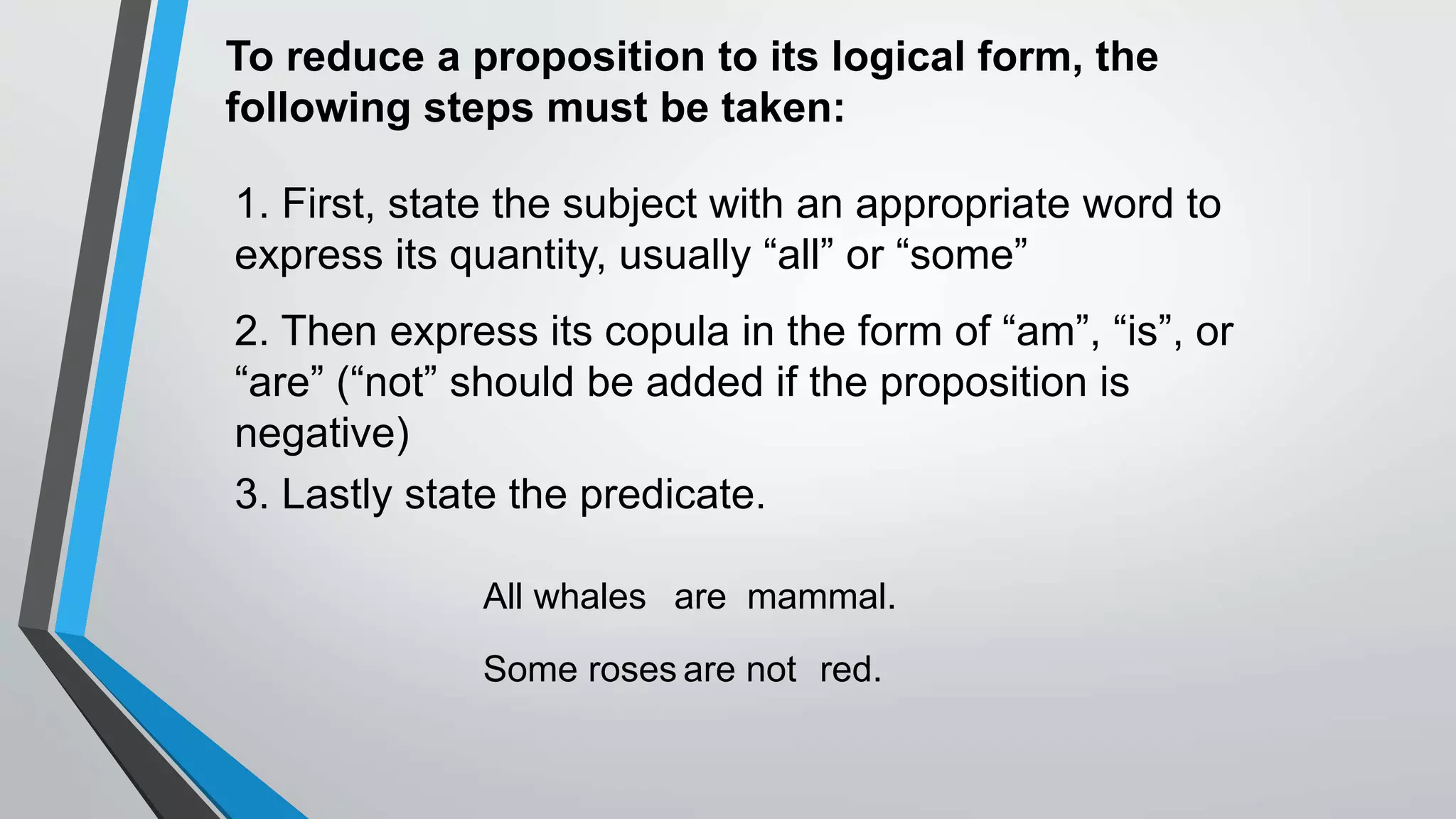
To reduce a proposition to its logical form, the
following steps must be taken:
1. First, state the subject with an appropriate word to
express its quantity, usually “all” or “some”
2. Then express its copula in the form of “am”, “is”, or
“are” (“not” should be added if the proposition is
negative)
3. Lastly state the predicate.
All whales are mammal.
Some roses are not red.
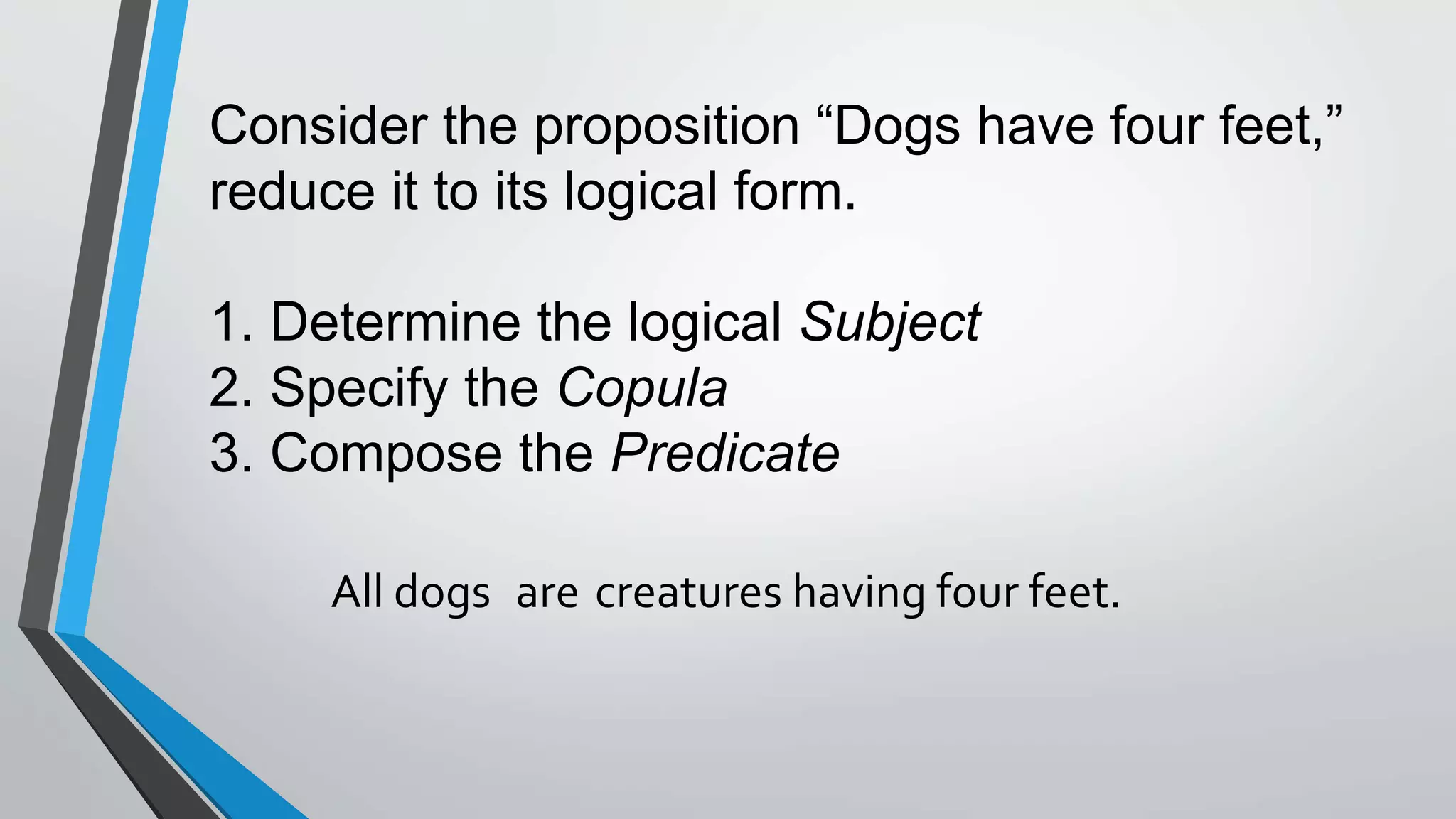
Consider the proposition “Dogs have four feet,”
reduce it to its logical form.
1. Determine the logical Subject
2. Specify the Copula
3. Compose the Predicate
All dogs are creatures having four feet.
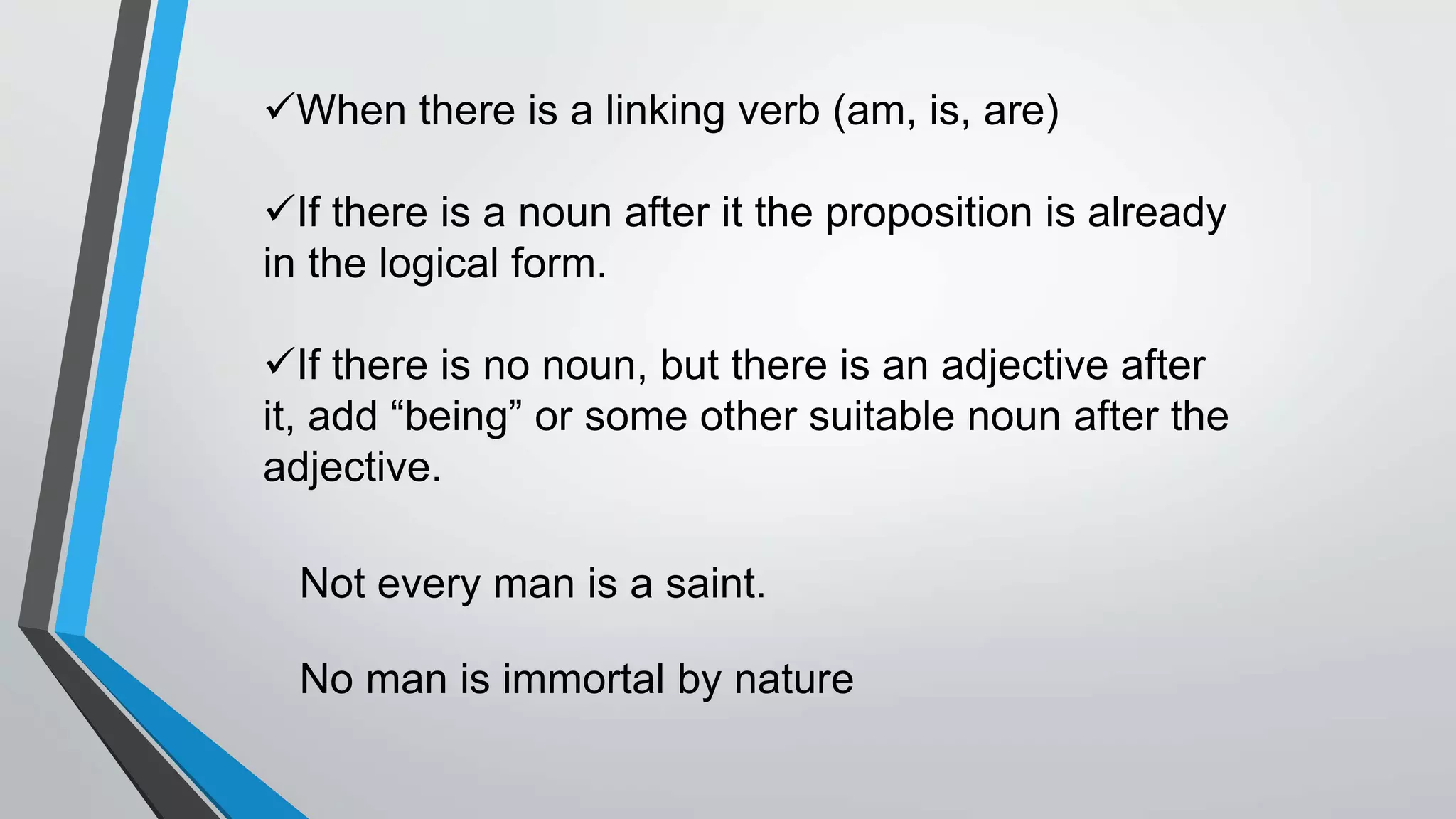
When there is a linking verb (am, is, are)
If there is a noun after it the proposition is already
in the logical form.
If there is no noun, but there is an adjective after
it, add “being” or some other suitable noun after the
adjective.
Not every man is a saint.
No man is immortal by nature
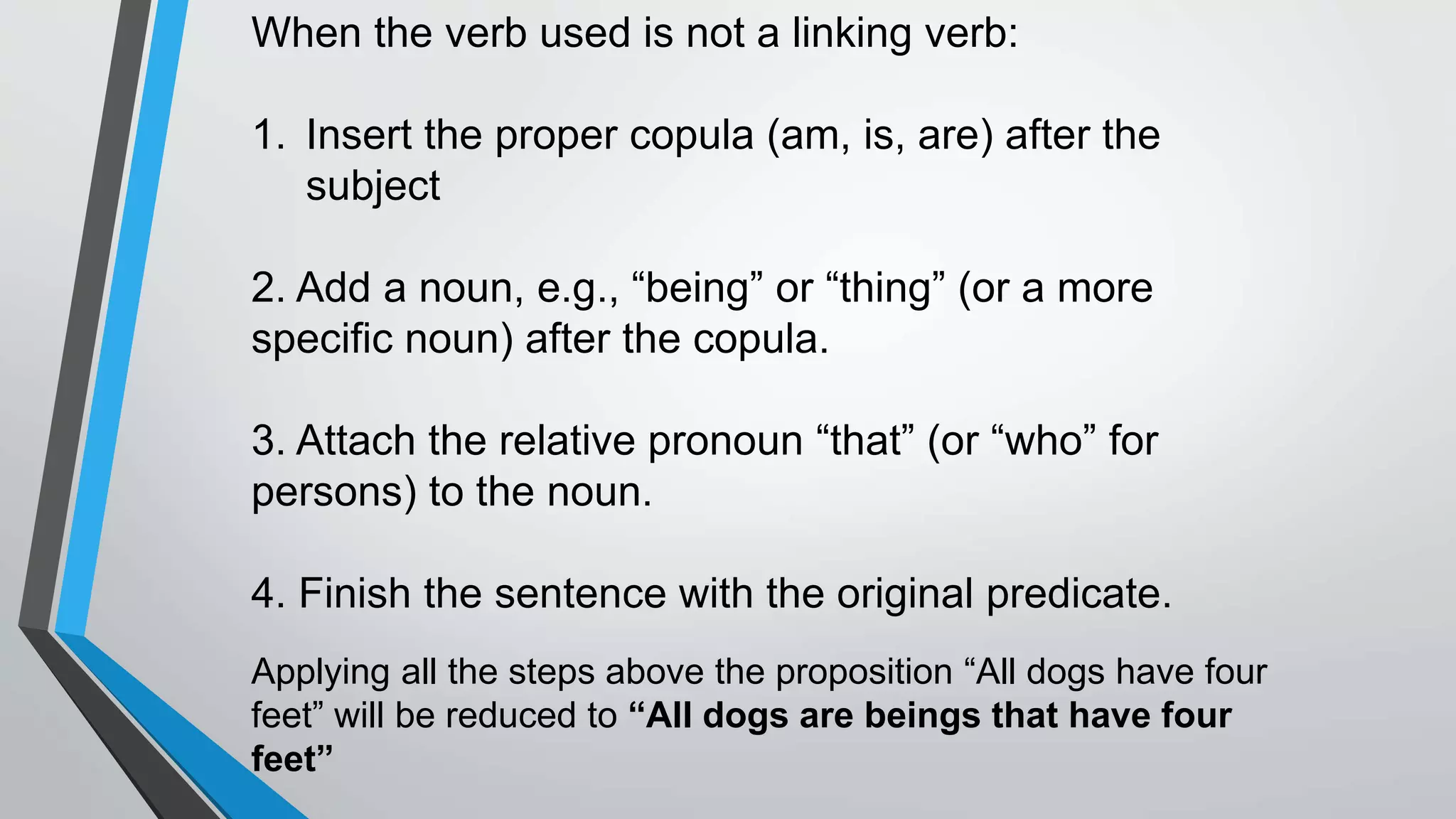
When the verb used is not a linking verb:
1. Insert the proper copula (am, is, are) after the
subject
2. Add a noun, e.g., “being” or “thing” (or a more
specific noun) after the copula.
3. Attach the relative pronoun “that” (or “who” for
persons) to the noun.
4. Finish the sentence with the original predicate.
Applying all the steps above the proposition “All dogs have four
feet” will be reduced to “All dogs are beings that have four
feet”
The proposition “All dogs have four legs”
may likewise have the following logical
forms:
All dogs are animals with four feet.
All dogs are creatures having four feet.
All dogs are four-footed beasts.
Original Form Logical Form
Bats fly.
Peter lives.
No tiger barks.
Some blonds have more fun.
All is well that ends well.
Some people do not drink.
God exists.
All bats are flying beings (or animals).
Peter is a living being (or person).
All tigers are not barking animals.
Some blonds are people who have more
fun.
All things that end well are things that
are well.
Some people are not drinkers.
God is an existing being.
Thank You
To God be the Glory.

Categorical Propositions- Logic

  • 1.
  • 2.
    Learning Goals Define categoricalproposition and identify its parts; Discuss the matter and form of a proposition; Learn the distinctions among the four types of categorical propositions; and Learn how to reduce a proposition to its logical form.
  • 3.
    Contents Nature of CategoricalProposition Elements of Categorical Propositions Symbols of Categorical Propositions Logical Form of Categorical Propositions
  • 4.
  • 5.
    Introduction •It was Aristotle(384-322 BCE), the most famous student of Plato (428-347 BCE), who was the first to develop a formal system of logic. Aristotle’s followers gathered his writings on logic and compiled them into what they called the Organon, which is a word that means "instrument." And this is exactly how Aristotle conceived of logic, as an instrument for the scientific and philosophical investigation of reality.
  • 6.
    Introduction •For Aristotle, realityis organized in categories or classes. Such classes have members and Aristotle thought knowledge of reality consisted of true propositions (assertions) about these categories and their members. Such a proposition would be, for example, “All human beings are mortal.”
  • 7.
    NATURE OF CATEGORICAL PROPOSITIONS Whatis a Categorical Proposition?
  • 8.
    Nature of CategoricalProposition A categorical proposition is a kind of proposition that expresses an unconditional judgment (Babor, 2003). It is a proposition in which the subject term is affirmed or denied by the predicate term (De Leon, 2003)
  • 9.
    ELEMENTS OF CATEGORICAL PROPOSITIONS TheMaterials from which the proposition is made.
  • 10.
    Matter and Form •Every Proposition has matter and form.The subject and predicate are called the matter— the thought-content of the proposition—because they are the material out of which the proposition is made.The copula or bonding verb “is” is called the form—the structure of a proposition – because it is the unifying principle that maintains the structure of the proposition and imparts to its materials the nature of a proposition (Piñon, 1979). • Hence, a valid proposition is one which is true in its matter and correct in its form.
  • 11.
    Examples: A monkey isan animal. Matter Form Many Africans are not rich.
  • 12.
    Logic vs. Grammar Someschools are not state universities. Subject Copula Predicate The elements of categorical propositions shall be represented by these symbols: S for subject, C for copula, and P for predicate. S (Subject) – C (Copula) – P (predicate)
  • 13.
    Consider this one: Allapples are fruits. (quantifier) (subject) (copula) (predicate)
  • 14.
    Quantifier (All):The quantifierdetermines the extension of the subject. ( Pasigui et al., 2006)The quantifiers can be singular, particular, or universal. It should be noted, however, that from the point of view of practical correct thinking, a singular is a universal. p (Particular) – u (Universal) All apples are fruits. (quantifier) (subject) (copula) (predicate)
  • 15.
    SubjectTerm (apples):The subjectis that part of a proposition about which something is either affirmed or denied (Pasigui et al., 2006) All apples are fruits. (quantifier) (subject) (copula) (predicate)
  • 16.
    All apples arefruits. (quantifier) (subject) (copula) (predicate) Copula (are): The copula is the qualifier of the proposition. Because of it, the proposition is either affirmative or negative. Affirmative Copula is, am, and are Negative Copula is not, am not, and are not
  • 17.
    in symbols, wewrite; (+) for Affirmative and (-) for Negative A Proposition that expresses an affirmation and uses an affirmative copula is called an affirmative proposition and one that expresses negation or denial and uses a negative copula is a negative proposition ( De Leon, 2003). Some politicians are liars. (affirmative copula) Some politicians are not liars. (negative copula)
  • 18.
    Nota Bene: Itis the copula, and the copula alone, that determine whether a categorical proposition is affirmative or negative. Since the subject and the predicate have no bearing on the quality of the proposition, propositions of the structures “A is non-B” and “Non-A is non-B” are, thus affirmative propositions (McCall, 1952). To illustrate, take this examples: That today is not Sunday is true. Angels are non-material beings.
  • 19.
    PredicateTerm (fruits):The predicateterm is that which is affirmed or denied of a subject (Pasigui et al., 2006). The quantity of the extension of the predicate shall be represented by these symbols: p for particular and u for universal. p (Particular) – u (Universal) All apples are fruits. (quantifier) (subject) (copula) (predicate)
  • 20.
    SYMBOLS OF CATEGORICAL PROPOSITIONS Theshortcuts to correct reasoning.
  • 21.
    Symbols of CategoricalPropositions. Since Aristotle’s time, there have been an attempt to make logic a science of symbols to achieve shortcuts to correct reasoning. Among these are symbols for the four categorical statements, namely, universal affirmative (A), universal negative (E), particular affirmative (I), and particular negative (O). A and I are taken from the two vowels of AffIrmo. E and O from the two vowels of nEgO. A-E-I-O
  • 22.
    According to Quantity A Universal Proposition is a proposition having a universal quantifier. Examples: All my brothers are athletes. Every vegetable is nutritious. An eagle is a flying bird. The wisest man here is Chariel.
  • 23.
    According to Quantity AParticular Proposition is a proposition having a particular quantifier. Examples: Some green things are grass. Certain cities are worth seeing. Few politicians are lawyers.
  • 24.
    According to Quality An affirmative proposition is a proposition having an affirmative copula. Examples: All exams are evaluations. A monkey is an animal. Many millionaires are businessmen. Certain Dogs are wild.
  • 25.
    According to Quality Anegative proposition is a proposition having a negative copula. Examples: All artists are not psychics. Elephants are not rhinos. Many Africans are not rich. A squash is not an eggplant.
  • 26.
    According to Quantityand Quality  A universal affirmative proposition (A) is a proposition having a universal quantifier and an affirmative copula.  Examples: All idiots are slow learners. Every judgment is an act of the mind.  Also, indefinite affirmative and singular affirmative propositions: Man is fallible. This insect is Poisonous
  • 27.
    According to Quantityand Quality A universal negative proposition (E) is a proposition having a universal quantifier and a negative copula. Example: No transparencies are plastic. Also, indefinite negative and singular negative propositions: Beauty is not sensible. This snake is not venomous.
  • 28.
    According to Quantityand Quality A particular affirmative proposition (I) is a proposition having a particular quantifier and an affirmative copula. Examples: Few students are in the dean’s list. Some policemen are rich. Certain men are geniuses. Most parents are proud of their children. Also, indefinite affirmative propositions Men are selfish. (Most?) Women are fickle (Some? A large minority? Most?)
  • 29.
    According to Quantityand Quality A particular negative proposition (O) is a proposition having a particular quantifier and a negative copula. Examples. Some honest people are not married. Majority of the soldiers are not brave. Also, indefinite negative propositions: Politicians are not corrupt. (A few?) Priests are not celibate. (Many?)
  • 30.
    Quality Affirmative Negative Quantity Universal A E Particular IO The four standard Categorical Propositions.
  • 31.
    LOGICAL FORM OF CATEGORICALPROPOSITIONS The basic agreement of parts.
  • 32.
    Logical Form ofCategorical Propositions. Logical form refers to the basic agreement of the elements or parts of the proposition. Hence, the logical form of a proposition is SUBJECT-COPULA- PREDICATE or S-C-P
  • 33.
    To reduce aproposition to its logical form, the following steps must be taken: 1. First, state the subject with an appropriate word to express its quantity, usually “all” or “some” 2. Then express its copula in the form of “am”, “is”, or “are” (“not” should be added if the proposition is negative) 3. Lastly state the predicate. All whales are mammal. Some roses are not red.
  • 34.
    Consider the proposition“Dogs have four feet,” reduce it to its logical form. 1. Determine the logical Subject 2. Specify the Copula 3. Compose the Predicate All dogs are creatures having four feet.
  • 35.
    When there isa linking verb (am, is, are) If there is a noun after it the proposition is already in the logical form. If there is no noun, but there is an adjective after it, add “being” or some other suitable noun after the adjective. Not every man is a saint. No man is immortal by nature
  • 36.
    When the verbused is not a linking verb: 1. Insert the proper copula (am, is, are) after the subject 2. Add a noun, e.g., “being” or “thing” (or a more specific noun) after the copula. 3. Attach the relative pronoun “that” (or “who” for persons) to the noun. 4. Finish the sentence with the original predicate. Applying all the steps above the proposition “All dogs have four feet” will be reduced to “All dogs are beings that have four feet”
  • 37.
    The proposition “Alldogs have four legs” may likewise have the following logical forms: All dogs are animals with four feet. All dogs are creatures having four feet. All dogs are four-footed beasts.
  • 38.
    Original Form LogicalForm Bats fly. Peter lives. No tiger barks. Some blonds have more fun. All is well that ends well. Some people do not drink. God exists. All bats are flying beings (or animals). Peter is a living being (or person). All tigers are not barking animals. Some blonds are people who have more fun. All things that end well are things that are well. Some people are not drinkers. God is an existing being.
  • 39.
    Thank You To Godbe the Glory.