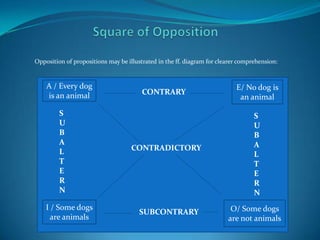
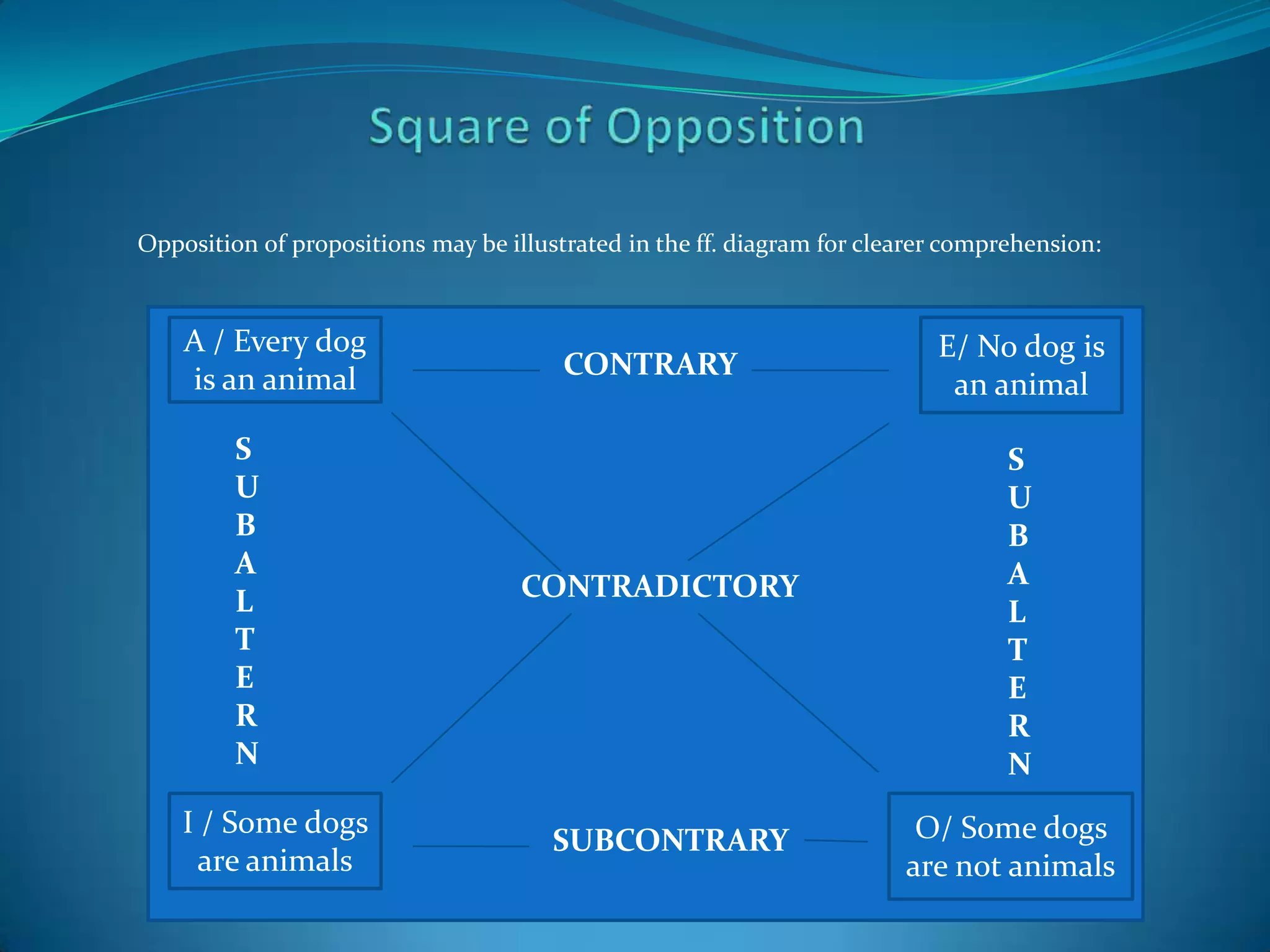
Opposition of propositions may be illustrated in the ff. diagram for clearer comprehension:


    A / Every dog
    A                                                                      E / No dog is
                                                                           E/ No dog is
                                        CONTRARY
    Everyanimal
    is an dog is                                                            an animal
                                                                            an animal

         S                                                                        S
         U                                                                        U
         B                                                                        B
         A                                                                        A
         L                          CONTRADICTORY
                                                                                  L
         T                                                                        T
         E                                                                        E
         R                                                                        R
         N                                                                        N
    I / Some dogs                                                      O /Some dogs
                                                                         O/ Some dogs
                                       SUBCONTRARY
      are animals
      are animals                                                      are not animals
                                                                        are not animals
Eduction
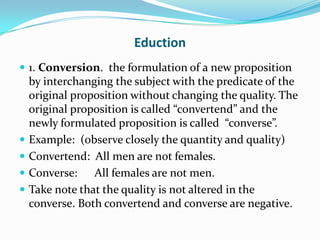
 1. Conversion. the formulation of a new proposition
    by interchanging the subject with the predicate of the
    original proposition without changing the quality. The
    original proposition is called “convertend” and the
    newly formulated proposition is called “converse”.
   Example: (observe closely the quantity and quality)
   Convertend: All men are not females.
   Converse: All females are not men.
   Take note that the quality is not altered in the
    converse. Both convertend and converse are negative.
Eduction

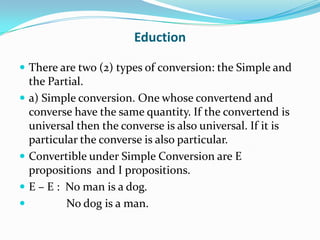
 There are two (2) types of conversion: the Simple and
    the Partial.
   a) Simple conversion. One whose convertend and
    converse have the same quantity. If the convertend is
    universal then the converse is also universal. If it is
    particular the converse is also particular.
   Convertible under Simple Conversion are E
    propositions and I propositions.
   E – E : No man is a dog.
           No dog is a man.
Egypt


 We call our dog EGYPT.


 He always leaves a pyramid in every room
Eduction
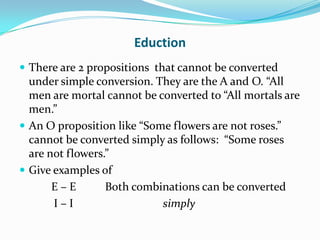
 There are 2 propositions that cannot be converted
  under simple conversion. They are the A and O. “All
  men are mortal cannot be converted to “All mortals are
  men.”
 An O proposition like “Some flowers are not roses.”
  cannot be converted simply as follows: “Some roses
  are not flowers.”
 Give examples of
       E–E        Both combinations can be converted
       I–I                  simply
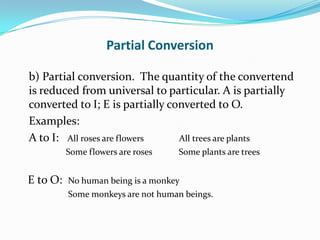
Partial Conversion

b) Partial conversion. The quantity of the convertend
is reduced from universal to particular. A is partially
converted to I; E is partially converted to O.
Examples:
A to I: All roses are flowers    All trees are plants
          Some flowers are roses   Some plants are trees


E to O:   No human being is a monkey
          Some monkeys are not human beings.
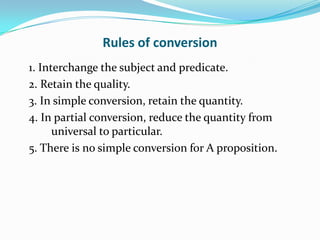
Rules of conversion
1. Interchange the subject and predicate.
2. Retain the quality.
3. In simple conversion, retain the quantity.
4. In partial conversion, reduce the quantity from
      universal to particular.
5. There is no simple conversion for A proposition.
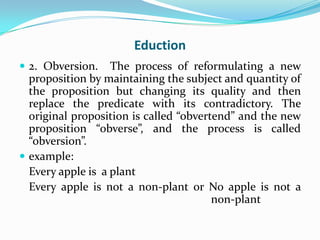
Eduction
 2. Obversion.    The process of reformulating a new
  proposition by maintaining the subject and quantity of
  the proposition but changing its quality and then
  replace the predicate with its contradictory. The
  original proposition is called “obvertend” and the new
  proposition “obverse”, and the process is called
  “obversion”.
 example:
  Every apple is a plant
  Every apple is not a non-plant or No apple is not a
                                        non-plant
Rules of Obversion
  The following are the rules in obverting propositions:
  1. Retain the subject-term and quantity iof the
        obvertend.
  2. Change the quality. If the obvertend is affirmative, the
        obverse is negative and vice-versa
  3. Put the predicate in its contradictory.
        Under Rules 1 and 2 the ff. are obvertible:
                      A to E
                      E to A
                      I to O
                      O to I
Examples of Obversion
 A to E: All women are beautiful
         All women are not non-beautiful or
         No women are non-beautiful

 E to A: Every Cordilleran is not Japanese
         Every Cordilleran is a non-Japanese

 I to O: Some people are Filipinos
         Some people are not non-Filipinos.

 O to I: Some students are not brown
         Some students are non-brown.

 You will note that the obvertend and the obverse have the same meaning.
Same Meaning
CHEATING . . . is two wrong people doing the right
thing.

Can I pray while smoking? Or

Can I smoke while praying?
Eduction
 3. Contraposition. The formulation of a new proposition by
  undergoing the process of obversion and conversion.The
  original proposition is called “contraponend” and the new
  propositon is called “contraposit”, and the process
  contraposition. There are two (2) types of contraposition,
  the partial and the complete. For our purposes let go
  immediately to the complete contraposition.
  There are three (3) steps to follow:
       1. First obvert the contraponend.
       2. Then, convert the obverse.
       3. Then, obvert the converse to get the contraposit.
  In other words the 3 steps are: obvert, convert, obvert
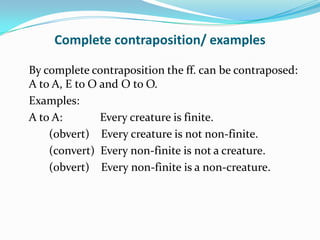
Complete contraposition/ examples

By complete contraposition the ff. can be contraposed:
A to A, E to O and O to O.
Examples:
A to A:        Every creature is finite.
    (obvert) Every creature is not non-finite.
    (convert) Every non-finite is not a creature.
    (obvert) Every non-finite is a non-creature.
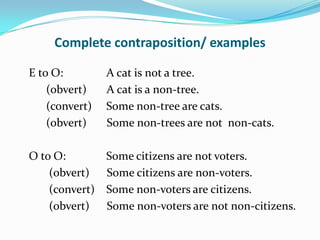
Complete contraposition/ examples

E to O:         A cat is not a tree.
    (obvert)    A cat is a non-tree.
    (convert)   Some non-tree are cats.
    (obvert)    Some non-trees are not non-cats.

O to O:       Some citizens are not voters.
    (obvert) Some citizens are non-voters.
    (convert) Some non-voters are citizens.
    (obvert) Some non-voters are not non-citizens.

Square of opposition

  • 1.
    Opposition of propositionsmay be illustrated in the ff. diagram for clearer comprehension: A / Every dog A E / No dog is E/ No dog is CONTRARY Everyanimal is an dog is an animal an animal S S U U B B A A L CONTRADICTORY L T T E E R R N N I / Some dogs O /Some dogs O/ Some dogs SUBCONTRARY are animals are animals are not animals are not animals
  • 2.
    Eduction  1. Conversion.the formulation of a new proposition by interchanging the subject with the predicate of the original proposition without changing the quality. The original proposition is called “convertend” and the newly formulated proposition is called “converse”.  Example: (observe closely the quantity and quality)  Convertend: All men are not females.  Converse: All females are not men.  Take note that the quality is not altered in the converse. Both convertend and converse are negative.
  • 3.
    Eduction  There aretwo (2) types of conversion: the Simple and the Partial.  a) Simple conversion. One whose convertend and converse have the same quantity. If the convertend is universal then the converse is also universal. If it is particular the converse is also particular.  Convertible under Simple Conversion are E propositions and I propositions.  E – E : No man is a dog.  No dog is a man.
  • 4.
    Egypt  We callour dog EGYPT.  He always leaves a pyramid in every room
  • 5.
    Eduction  There are2 propositions that cannot be converted under simple conversion. They are the A and O. “All men are mortal cannot be converted to “All mortals are men.”  An O proposition like “Some flowers are not roses.” cannot be converted simply as follows: “Some roses are not flowers.”  Give examples of E–E Both combinations can be converted I–I simply
  • 6.
    Partial Conversion b) Partialconversion. The quantity of the convertend is reduced from universal to particular. A is partially converted to I; E is partially converted to O. Examples: A to I: All roses are flowers All trees are plants Some flowers are roses Some plants are trees E to O: No human being is a monkey Some monkeys are not human beings.
  • 7.
    Rules of conversion 1.Interchange the subject and predicate. 2. Retain the quality. 3. In simple conversion, retain the quantity. 4. In partial conversion, reduce the quantity from universal to particular. 5. There is no simple conversion for A proposition.
  • 8.
    Eduction  2. Obversion. The process of reformulating a new proposition by maintaining the subject and quantity of the proposition but changing its quality and then replace the predicate with its contradictory. The original proposition is called “obvertend” and the new proposition “obverse”, and the process is called “obversion”.  example: Every apple is a plant Every apple is not a non-plant or No apple is not a non-plant
  • 9.
    Rules of Obversion The following are the rules in obverting propositions: 1. Retain the subject-term and quantity iof the obvertend. 2. Change the quality. If the obvertend is affirmative, the obverse is negative and vice-versa 3. Put the predicate in its contradictory. Under Rules 1 and 2 the ff. are obvertible: A to E E to A I to O O to I
  • 10.
    Examples of Obversion A to E: All women are beautiful All women are not non-beautiful or No women are non-beautiful E to A: Every Cordilleran is not Japanese Every Cordilleran is a non-Japanese I to O: Some people are Filipinos Some people are not non-Filipinos. O to I: Some students are not brown Some students are non-brown. You will note that the obvertend and the obverse have the same meaning.
  • 11.
    Same Meaning CHEATING .. . is two wrong people doing the right thing. Can I pray while smoking? Or Can I smoke while praying?
  • 12.
    Eduction  3. Contraposition.The formulation of a new proposition by undergoing the process of obversion and conversion.The original proposition is called “contraponend” and the new propositon is called “contraposit”, and the process contraposition. There are two (2) types of contraposition, the partial and the complete. For our purposes let go immediately to the complete contraposition. There are three (3) steps to follow: 1. First obvert the contraponend. 2. Then, convert the obverse. 3. Then, obvert the converse to get the contraposit. In other words the 3 steps are: obvert, convert, obvert
  • 13.
    Complete contraposition/ examples Bycomplete contraposition the ff. can be contraposed: A to A, E to O and O to O. Examples: A to A: Every creature is finite. (obvert) Every creature is not non-finite. (convert) Every non-finite is not a creature. (obvert) Every non-finite is a non-creature.
  • 14.
    Complete contraposition/ examples Eto O: A cat is not a tree. (obvert) A cat is a non-tree. (convert) Some non-tree are cats. (obvert) Some non-trees are not non-cats. O to O: Some citizens are not voters. (obvert) Some citizens are non-voters. (convert) Some non-voters are citizens. (obvert) Some non-voters are not non-citizens.