DISCRETE MATHEMATICS
Continuous Mathematics and Discrete
Mathematics
•Continuous Mathematics deals with
continuous functions, differential and integral
calculus etc.
•Discrete mathematics deals with
mathematical topics in the sense that it
analyzes data whose values are separated
(such as integers: Number line has gaps)
•Example of continuous math – Given a fixed
surface area, what are the dimensions of a
cylinder that maximizes volume?
•Example of Discrete Math – Given a fixed set of
characters, and a length, how many different
passwords can you construct? How many edges
in graph with n vertices? How many ways to
choose a team of two people from a group of n?
Why do you need to learn Discrete
Mathematics?
•This subject provides some of the mathematical
foundations and skills that you need in your
further study of Information Technology and
Computer Science & Engineering. These topics
include: Logic, Counting Methods, Relation and
Function, Recurrence Relation and Generating
Function, Introduction to Graph Theory And Group
Theory, Lattice Theory and Boolean Algebra etc.
PROPOSITIONAL LOGIC AND COUNTING
THEORY
After going through this unit, you will be able to :
• Define proposition & logical connectives.
• To use the laws of Logic.
• Describe the logical equivalence and implications.
• Define arguments & valid arguments.
• To study predicate and quantifier.
• Test the validity of argument using rules of logic.
• Give proof by truth tables.
• Give proof by mathematical Induction.
• Discuss Fundamental principle of counting.
• Discuss basic idea about permutation and combination.
• Define Pigeon hole principle.
• Study recurrence relation and generating function.
Mathematics is assumed to be an exact science. Every
statement in Mathematics must be precise. Also there can’t be
Mathematics without proofs and each proof needs proper
reasoning. Proper reasoning involves logic. The dictionary
meaning of ‘Logic’ is the science of reasoning. The rules of logic
give precise meaning to mathematical statements. These rules are
used to distinguish between valid & invalid mathematical
arguments.
In addition to its importance in mathematical reasoning,
logic has numerous applications in computer science to verify the
correctness of programs & to prove the theorems in natural &
physical sciences to draw conclusion from experiments, in social
sciences & in our daily lives to solve a multitude of problems.
The area of logic that deals with propositions is
called the propositional calculus or propositional logic.
The mathematical approach to logic was first discussed
by British mathematician George Boole; hence the
mathematical logic is also called as Boolean logic.
PROPOSITION (OR STATEMENT)
•A proposition (or a statement) is a declarative
sentence that is either true or false, but not both.
•Imperative, exclamatory, interrogative or open
sentences are not statementsin logic.
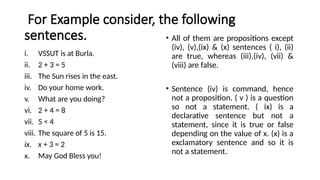
For Example consider, the following
sentences.
i. VSSUT is at Burla.
ii. 2 + 3 = 5
iii. The Sun rises in the east.
iv. Do your home work.
v. What are you doing?
vi. 2 + 4 = 8
vii. 5 < 4
viii. The square of 5 is 15.
ix. x + 3 = 2
x. May God Bless you!
• All of them are propositions except
(iv), (v),(ix) & (x) sentences ( i), (ii)
are true, whereas (iii),(iv), (vii) &
(viii) are false.
• Sentence (iv) is command, hence
not a proposition. ( v ) is a question
so not a statement. ( ix) is a
declarative sentence but not a
statement, since it is true or false
depending on the value of x. (x) is a
exclamatory sentence and so it is
not a statement.
Compound statements:
•Many propositions are composites that are,
composed of sub propositions and various
connectives discussed subsequently. Such
composite propositions are called
compound propositions.
A proposition is said to be primitive if it cannot be
broken down into simpler propositions, that is, if it is
not composite.
Consider, for example following sentences.
•“The sun is shining today and it is colder than
yesterday”
•“Sita is intelligent and she studies every night.”
LOGICALOPERATIONS OR LOGICAL
CONNECTIVES :
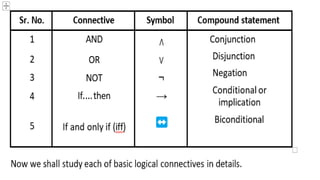
•The phrases or words which combine simple
statements are called logical connectives. There are
five types of connectives. Namely, ‘not’, ‘and’, ‘or’, ‘if…
then’, iff etc. The first one is a unitary operator
whereas the other four are binary operators.
•In the following table we list some possible
connectives, their symbols & the nature of the
compound statement formed by them.
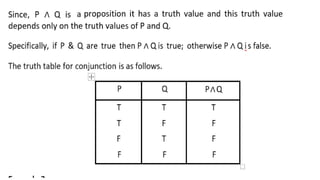
Basic Logical Connectives:
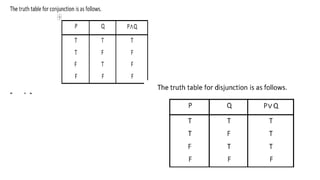
Conjunction (AND):
If two statements are combined by the word “and” to form a
compound proposition (statement) then the resulting
proposition is called the conjunction of two propositions.
Symbolically, if P & Q are two simple statements, then ‘P Q’
∧
denotes the conjunction of P and Q and is read as ‘P and Q.
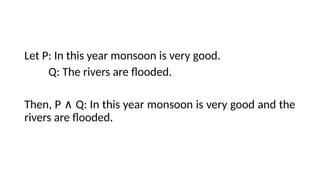
Let P: In this year monsoon is very good.
Q: The rivers are flooded.
Then, P Q: In this year monsoon is very good and the
∧
rivers are flooded.
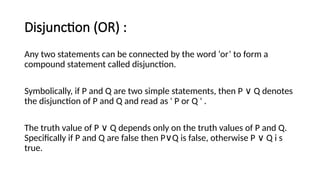
Disjunction (OR) :
Any two statements can be connected by the word ‘or’ to form a
compound statement called disjunction.
Symbolically, if P and Q are two simple statements, then P Q denotes
∨
the disjunction of P and Q and read as ' P or Q ' .
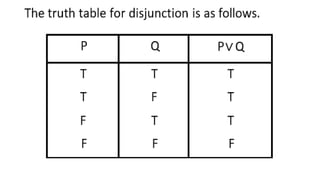
The truth value of P Q depends only on the truth values of P and Q.
∨
Specifically if P and Q are false then P Q is false, otherwise P Q i s
∨ ∨
true.
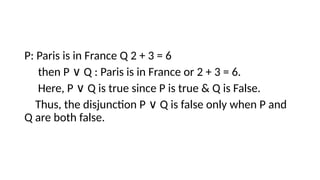
P: Paris is in France Q 2 + 3 = 6
then P Q : Paris is in France or 2 + 3 = 6.
∨
Here, P Q is true since P is true & Q is False.
∨
Thus, the disjunction P Q is false only when P and
∨
Q are both false.
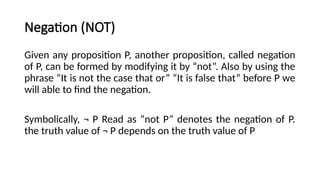
Negation (NOT)
Given any proposition P, another proposition, called negation
of P, can be formed by modifying it by “not”. Also by using the
phrase “It is not the case that or” “It is false that” before P we
will able to find the negation.
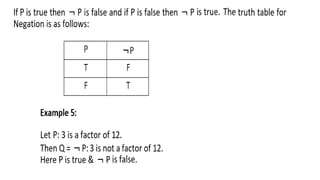
Symbolically, ¬ P Read as “not P” denotes the negation of P.
the truth value of ¬ P depends on the truth value of P
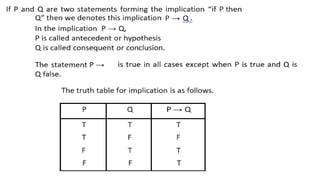
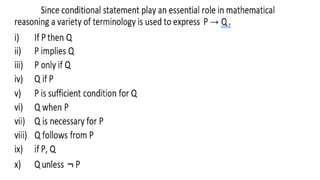
Conditional or Implication: (If…then)
• If two statements are combined by using the logical connective ‘if…
then’ then the resulting statement is called a conditional statement.
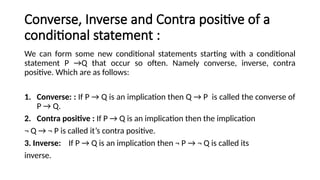
Converse, Inverse and Contra positive of a
conditional statement :
We can form some new conditional statements starting with a conditional
statement P →Q that occur so often. Namely converse, inverse, contra
positive. Which are as follows:
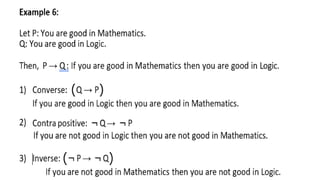
1. Converse: : If P → Q is an implication then Q → P is called the converse of
P → Q.
2. Contra positive : If P → Q is an implication then the implication
¬ Q → ¬ P is called it’s contra positive.
3. Inverse: If P → Q is an implication then ¬ P → ¬ Q is called its
inverse.
DISCRETE MATHEMATICS Presenatation for IT

DISCRETE MATHEMATICS Presenatation for IT

  • 1.
  • 2.
    Continuous Mathematics andDiscrete Mathematics •Continuous Mathematics deals with continuous functions, differential and integral calculus etc. •Discrete mathematics deals with mathematical topics in the sense that it analyzes data whose values are separated (such as integers: Number line has gaps)
  • 3.
    •Example of continuousmath – Given a fixed surface area, what are the dimensions of a cylinder that maximizes volume? •Example of Discrete Math – Given a fixed set of characters, and a length, how many different passwords can you construct? How many edges in graph with n vertices? How many ways to choose a team of two people from a group of n?
  • 4.
    Why do youneed to learn Discrete Mathematics? •This subject provides some of the mathematical foundations and skills that you need in your further study of Information Technology and Computer Science & Engineering. These topics include: Logic, Counting Methods, Relation and Function, Recurrence Relation and Generating Function, Introduction to Graph Theory And Group Theory, Lattice Theory and Boolean Algebra etc.
  • 5.
    PROPOSITIONAL LOGIC ANDCOUNTING THEORY After going through this unit, you will be able to : • Define proposition & logical connectives. • To use the laws of Logic. • Describe the logical equivalence and implications. • Define arguments & valid arguments. • To study predicate and quantifier. • Test the validity of argument using rules of logic. • Give proof by truth tables. • Give proof by mathematical Induction. • Discuss Fundamental principle of counting. • Discuss basic idea about permutation and combination. • Define Pigeon hole principle. • Study recurrence relation and generating function.
  • 6.
    Mathematics is assumedto be an exact science. Every statement in Mathematics must be precise. Also there can’t be Mathematics without proofs and each proof needs proper reasoning. Proper reasoning involves logic. The dictionary meaning of ‘Logic’ is the science of reasoning. The rules of logic give precise meaning to mathematical statements. These rules are used to distinguish between valid & invalid mathematical arguments. In addition to its importance in mathematical reasoning, logic has numerous applications in computer science to verify the correctness of programs & to prove the theorems in natural & physical sciences to draw conclusion from experiments, in social sciences & in our daily lives to solve a multitude of problems.
  • 7.
    The area oflogic that deals with propositions is called the propositional calculus or propositional logic. The mathematical approach to logic was first discussed by British mathematician George Boole; hence the mathematical logic is also called as Boolean logic.
  • 8.
    PROPOSITION (OR STATEMENT) •Aproposition (or a statement) is a declarative sentence that is either true or false, but not both. •Imperative, exclamatory, interrogative or open sentences are not statementsin logic.
  • 9.
    For Example consider,the following sentences. i. VSSUT is at Burla. ii. 2 + 3 = 5 iii. The Sun rises in the east. iv. Do your home work. v. What are you doing? vi. 2 + 4 = 8 vii. 5 < 4 viii. The square of 5 is 15. ix. x + 3 = 2 x. May God Bless you! • All of them are propositions except (iv), (v),(ix) & (x) sentences ( i), (ii) are true, whereas (iii),(iv), (vii) & (viii) are false. • Sentence (iv) is command, hence not a proposition. ( v ) is a question so not a statement. ( ix) is a declarative sentence but not a statement, since it is true or false depending on the value of x. (x) is a exclamatory sentence and so it is not a statement.
  • 10.
    Compound statements: •Many propositionsare composites that are, composed of sub propositions and various connectives discussed subsequently. Such composite propositions are called compound propositions.
  • 11.
    A proposition issaid to be primitive if it cannot be broken down into simpler propositions, that is, if it is not composite. Consider, for example following sentences. •“The sun is shining today and it is colder than yesterday” •“Sita is intelligent and she studies every night.”
  • 12.
    LOGICALOPERATIONS OR LOGICAL CONNECTIVES: •The phrases or words which combine simple statements are called logical connectives. There are five types of connectives. Namely, ‘not’, ‘and’, ‘or’, ‘if… then’, iff etc. The first one is a unitary operator whereas the other four are binary operators. •In the following table we list some possible connectives, their symbols & the nature of the compound statement formed by them.
  • 14.
    Basic Logical Connectives: Conjunction(AND): If two statements are combined by the word “and” to form a compound proposition (statement) then the resulting proposition is called the conjunction of two propositions. Symbolically, if P & Q are two simple statements, then ‘P Q’ ∧ denotes the conjunction of P and Q and is read as ‘P and Q.
  • 16.
    Let P: Inthis year monsoon is very good. Q: The rivers are flooded. Then, P Q: In this year monsoon is very good and the ∧ rivers are flooded.
  • 17.
    Disjunction (OR) : Anytwo statements can be connected by the word ‘or’ to form a compound statement called disjunction. Symbolically, if P and Q are two simple statements, then P Q denotes ∨ the disjunction of P and Q and read as ' P or Q ' . The truth value of P Q depends only on the truth values of P and Q. ∨ Specifically if P and Q are false then P Q is false, otherwise P Q i s ∨ ∨ true.
  • 19.
    P: Paris isin France Q 2 + 3 = 6 then P Q : Paris is in France or 2 + 3 = 6. ∨ Here, P Q is true since P is true & Q is False. ∨ Thus, the disjunction P Q is false only when P and ∨ Q are both false.
  • 21.
    Negation (NOT) Given anyproposition P, another proposition, called negation of P, can be formed by modifying it by “not”. Also by using the phrase “It is not the case that or” “It is false that” before P we will able to find the negation. Symbolically, ¬ P Read as “not P” denotes the negation of P. the truth value of ¬ P depends on the truth value of P
  • 23.
    Conditional or Implication:(If…then) • If two statements are combined by using the logical connective ‘if… then’ then the resulting statement is called a conditional statement.
  • 26.
    Converse, Inverse andContra positive of a conditional statement : We can form some new conditional statements starting with a conditional statement P →Q that occur so often. Namely converse, inverse, contra positive. Which are as follows: 1. Converse: : If P → Q is an implication then Q → P is called the converse of P → Q. 2. Contra positive : If P → Q is an implication then the implication ¬ Q → ¬ P is called it’s contra positive. 3. Inverse: If P → Q is an implication then ¬ P → ¬ Q is called its inverse.