Who Benefits from
          Improved Labor Standards?
Buyers
  More effective and reliable supply chain
  Measurable corporate social responsibility track
  record
  Improved employee recruitment, retention and
  performance
  Better risk management
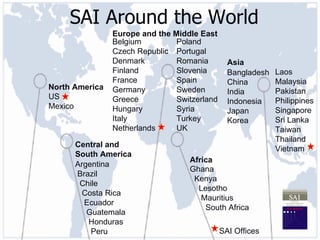
SAI Around the World
                Europe and the Middle East
                Belgium         Poland
                Czech Republic Portugal
                Denmark         Romania         Asia
                Finland         Slovenia        Bangladesh   Laos
                France          Spain           China        Malaysia
North America   Germany         Sweden          India        Pakistan
US              Greece          Switzerland     Indonesia    Philippines
Mexico          Hungary         Syria           Japan        Singapore
                Italy           Turkey          Korea        Sri Lanka
                Netherlands     UK                           Taiwan
                                                             Thailand
      Central and
                                                             Vietnam
      South America
                                   Africa
      Argentina
                                   Ghana
      Brazil
                                    Kenya
       Chile
                                     Lesotho
        Costa Rica
                                      Mauritius
        Ecuador
                                       South Africa
         Guatemala
         Honduras
          Peru                                SAI Offices
Background to Social
            Accountability

“Where, after all, do universal human rights begin? In
small places close to home – so close and so small that
they cannot be seen on any map of the world. Yet they
are the world of the individual person: the
neighborhood he lives in; the school or college he
attends; the factory, farm or office where he works.
Such are the places where every man, woman and child
seeks equal justice, equal opportunity, equal dignity
without discrimination. Unless these rights have
meaning there, they have little meaning anywhere.”
Eleanor Roosevelt – remarks at the United Nations Commission on
Human Rights – March 27, 1948.
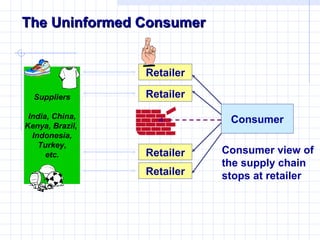
The Uninformed Consumer


                 Retailer

  Suppliers      Retailer

 India, China,               Consumer
Kenya, Brazil,
  Indonesia,
    Turkey,
      etc.       Retailer   Consumer view of
                            the supply chain
                 Retailer   stops at retailer
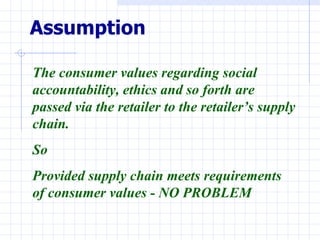
Assumption

The consumer values regarding social
accountability, ethics and so forth are
passed via the retailer to the retailer’s supply
chain.
So
Provided supply chain meets requirements
of consumer values - NO PROBLEM
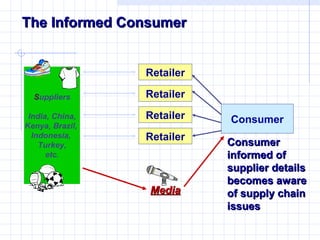
The Informed Consumer


                 Retailer

  Suppliers      Retailer

 India, China,   Retailer   Consumer
Kenya, Brazil,
  Indonesia,     Retailer
    Turkey,                 Consumer
      etc.                  informed of
                            supplier details
                            becomes aware
                 Media      of supply chain
                            issues
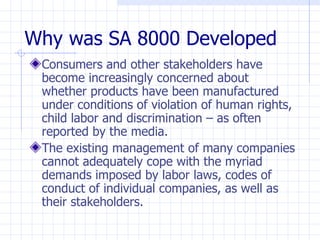
Why was SA 8000 Developed
 Consumers and other stakeholders have
 become increasingly concerned about
 whether products have been manufactured
 under conditions of violation of human rights,
 child labor and discrimination – as often
 reported by the media.
 The existing management of many companies
 cannot adequately cope with the myriad
 demands imposed by labor laws, codes of
 conduct of individual companies, as well as
 their stakeholders.
Why Use A Standard? - SA
8000
  is a broad consensus document
    represents the interests of many

     stakeholders, while being biased to none in
     particular
  is sufficiently rigid yet flexible
    meets the expectations of civil society, yet

     is suitable for application across all industry
     sectors and localities
Why Use A Standard? - SA
8000
 SA 8000
  unambiguously respects the key aspects
  of the ILO and UN conventions relevant
  to human rights in the workplace
  contains measurable and flexible
  management system requirements
Why Use A Standard? - SA
8000
   fundamental management concept
    embodied in section 9
   requires mechanisms to ensure

    control, response and accountability
   ensures that company management

    respects social accountability as a
    strategic business issue
Social Accountability International
        (CEPAA) Now (SAI)

•   Affiliate of the Council on Economic Priorities
•   Established 1997 ,Its Mission is to provide
    accurate and impartial analysis to evaluate
    corporate social performance.
•   Advisory Board convened to oversee SA
    8000 development and accreditation
    processes
SAI (Continued)
•   Consists of representatives of Unions, human rights
    and children’s rights organisations, academia,
    retailers, manufacturers, contractors, consulting,
    accounting and certification firms:
    e   Amnesty International, Association , Avon,
        Body Shop, CEP, Eileen Fisher, Group M,
        International Textile Garment and Leather
        Workers Federation, KPMG , National Child
        Labour Committee, Reebok, SGS ICS, Toys R
        Us, University of Texas
SAI Mission
  Development of consensus based
  voluntary based standard.
  Accredit qualified organization to verify
  compliance.
  Promoting understanding of such
  standards world wide.
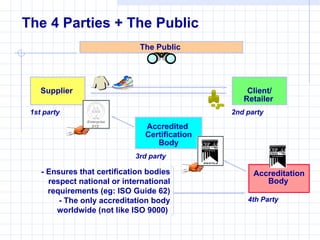
The 4 Parties + The Public
                              The Public


    Supplier                                                  Client/
                                                             Retailer
 1st party                                                2nd party
                Enterprise
                  XYZ           Accredited
                                Certification
                                   Body
                             3rd party
                                                SGS-ICS

    - Ensures that certification bodies                         Accreditation
      respect national or international                            Body
      requirements (eg: ISO Guide 62)
         - The only accreditation body                        4th Party
        worldwide (not like ISO 9000)
What is SA 8000
 Released in October 1997, the Social Accountability
 8000(or SA 8000) Standard is the first global ethical
 standard.
 SA 8000 has been developed based on the
 conventions of the International Labor
 Organization, the Universal Declaration of Human
 Rights, as well as the United Nations Convention on
 the Rights of a Child. It is applicable to all
 companies regardless of scale, industry and location
 Its objective is to ensure ethical sourcing and
 production of goods and services.
What is SA 8000
  SA 8000 aims to promote continuous
  improvement of workplace conditions.
  It encourage buyers to work with their
  suppliers to implement a social accountability
  policy that can improve the work place
  condition through technical assistance and
  increased awareness.
  General adherence to this standard will
  improve brand image and company
  reputation.
  SA 8000 address workplace conditions
How does SA 8000 Work
 As in the cases of ISO 9000 quality
 management system and ISO 14000
 environmental management system, SA
 8000 provides a framework for
 independent assessment by a third
 party certification body
 SA 8000 includes a set of social
 accountability standards and a guidance
 document
How does SA 8000 Work
 Through continuous assessment, it
 provides the companies with a system
 for continuous improvement
 Through an appeal process to the
 certification body, non-governmental
 organizations (i.e. NGOs), if they have
 supporting evidence, can challenge the
 SA 8000 certification of a company
Who Can Apply For
Certification
  Companies want to verify their Social
  Record.
  Contractors that are producing goods
  for US and European companies.
  Multinational Companies seek to
  ensure that they procure from
  companies which are not exploitative .
Special Features of SA 8000
Audit
  Specific Social performance standard
  with minimum requirement.
  Auditors are required to consult and
  learn from interested parties such as
  NGO’s, Trade unions etc.
  A complaint and appeal mechanism.
Benefits of SA 8000
Certification
 Increased customer recognition and loyalty.
 Globally recognized standard .
 Increase the ability of business to trade
 internationally.
 Removing the need of business to undergo
 multiple COC audits.
 Assurance that brand are produced in human
 and socially responsible conditions.

Section 1 back ground (2)

  • 1.
    Who Benefits from Improved Labor Standards? Buyers More effective and reliable supply chain Measurable corporate social responsibility track record Improved employee recruitment, retention and performance Better risk management
  • 2.
    SAI Around theWorld Europe and the Middle East Belgium Poland Czech Republic Portugal Denmark Romania Asia Finland Slovenia Bangladesh Laos France Spain China Malaysia North America Germany Sweden India Pakistan US Greece Switzerland Indonesia Philippines Mexico Hungary Syria Japan Singapore Italy Turkey Korea Sri Lanka Netherlands UK Taiwan Thailand Central and Vietnam South America Africa Argentina Ghana Brazil Kenya Chile Lesotho Costa Rica Mauritius Ecuador South Africa Guatemala Honduras Peru SAI Offices
  • 3.
    Background to Social Accountability “Where, after all, do universal human rights begin? In small places close to home – so close and so small that they cannot be seen on any map of the world. Yet they are the world of the individual person: the neighborhood he lives in; the school or college he attends; the factory, farm or office where he works. Such are the places where every man, woman and child seeks equal justice, equal opportunity, equal dignity without discrimination. Unless these rights have meaning there, they have little meaning anywhere.” Eleanor Roosevelt – remarks at the United Nations Commission on Human Rights – March 27, 1948.
  • 4.
    The Uninformed Consumer Retailer Suppliers Retailer India, China, Consumer Kenya, Brazil, Indonesia, Turkey, etc. Retailer Consumer view of the supply chain Retailer stops at retailer
  • 5.
    Assumption The consumer valuesregarding social accountability, ethics and so forth are passed via the retailer to the retailer’s supply chain. So Provided supply chain meets requirements of consumer values - NO PROBLEM
  • 6.
    The Informed Consumer Retailer Suppliers Retailer India, China, Retailer Consumer Kenya, Brazil, Indonesia, Retailer Turkey, Consumer etc. informed of supplier details becomes aware Media of supply chain issues
  • 7.
    Why was SA8000 Developed Consumers and other stakeholders have become increasingly concerned about whether products have been manufactured under conditions of violation of human rights, child labor and discrimination – as often reported by the media. The existing management of many companies cannot adequately cope with the myriad demands imposed by labor laws, codes of conduct of individual companies, as well as their stakeholders.
  • 8.
    Why Use AStandard? - SA 8000 is a broad consensus document  represents the interests of many stakeholders, while being biased to none in particular is sufficiently rigid yet flexible  meets the expectations of civil society, yet is suitable for application across all industry sectors and localities
  • 9.
    Why Use AStandard? - SA 8000 SA 8000 unambiguously respects the key aspects of the ILO and UN conventions relevant to human rights in the workplace contains measurable and flexible management system requirements
  • 10.
    Why Use AStandard? - SA 8000  fundamental management concept embodied in section 9  requires mechanisms to ensure control, response and accountability  ensures that company management respects social accountability as a strategic business issue
  • 11.
    Social Accountability International (CEPAA) Now (SAI) • Affiliate of the Council on Economic Priorities • Established 1997 ,Its Mission is to provide accurate and impartial analysis to evaluate corporate social performance. • Advisory Board convened to oversee SA 8000 development and accreditation processes
  • 12.
    SAI (Continued) • Consists of representatives of Unions, human rights and children’s rights organisations, academia, retailers, manufacturers, contractors, consulting, accounting and certification firms: e Amnesty International, Association , Avon, Body Shop, CEP, Eileen Fisher, Group M, International Textile Garment and Leather Workers Federation, KPMG , National Child Labour Committee, Reebok, SGS ICS, Toys R Us, University of Texas
  • 13.
    SAI Mission Development of consensus based voluntary based standard. Accredit qualified organization to verify compliance. Promoting understanding of such standards world wide.
  • 14.
    The 4 Parties+ The Public The Public Supplier Client/ Retailer 1st party 2nd party Enterprise XYZ Accredited Certification Body 3rd party SGS-ICS - Ensures that certification bodies Accreditation respect national or international Body requirements (eg: ISO Guide 62) - The only accreditation body 4th Party worldwide (not like ISO 9000)
  • 15.
    What is SA8000 Released in October 1997, the Social Accountability 8000(or SA 8000) Standard is the first global ethical standard. SA 8000 has been developed based on the conventions of the International Labor Organization, the Universal Declaration of Human Rights, as well as the United Nations Convention on the Rights of a Child. It is applicable to all companies regardless of scale, industry and location Its objective is to ensure ethical sourcing and production of goods and services.
  • 16.
    What is SA8000 SA 8000 aims to promote continuous improvement of workplace conditions. It encourage buyers to work with their suppliers to implement a social accountability policy that can improve the work place condition through technical assistance and increased awareness. General adherence to this standard will improve brand image and company reputation. SA 8000 address workplace conditions
  • 17.
    How does SA8000 Work As in the cases of ISO 9000 quality management system and ISO 14000 environmental management system, SA 8000 provides a framework for independent assessment by a third party certification body SA 8000 includes a set of social accountability standards and a guidance document
  • 18.
    How does SA8000 Work Through continuous assessment, it provides the companies with a system for continuous improvement Through an appeal process to the certification body, non-governmental organizations (i.e. NGOs), if they have supporting evidence, can challenge the SA 8000 certification of a company
  • 19.
    Who Can ApplyFor Certification Companies want to verify their Social Record. Contractors that are producing goods for US and European companies. Multinational Companies seek to ensure that they procure from companies which are not exploitative .
  • 20.
    Special Features ofSA 8000 Audit Specific Social performance standard with minimum requirement. Auditors are required to consult and learn from interested parties such as NGO’s, Trade unions etc. A complaint and appeal mechanism.
  • 21.
    Benefits of SA8000 Certification Increased customer recognition and loyalty. Globally recognized standard . Increase the ability of business to trade internationally. Removing the need of business to undergo multiple COC audits. Assurance that brand are produced in human and socially responsible conditions.