LIP-STICK
By;- Sanchit Dhankhar
INTRODUCTION
Lipstick is a cosmetic product containing pigments , oils , waxes and
emollients that apply color , texture and protection to lips.
They are classified under skin colorants which are referred as beauty aids
for purpose of alteration of appearance of skin and enhancing the
appearance.
As most other types of makeup, lipstick is typically, but not exclusively,
worn by women . some lipsticks are also lip balms, to add color and
hydration.
These preparation do not damage the skin and are non tacky. They
typically involve a color change but also increases shine and smooth out
appearance of wrinkles and folds on lips.
they are a solid product housed in a molded packaging.
HOW LIPSTICKS WORK
Lipsticks are made from hydrophobic materials. When the
solid formula is applied to lip surface, friction melts it
briefly and allow for transfer. The materials cools and
reforms creating a film that sticks to surface due to
hydrophobic interactions.
Color is a key ingredient of lipsticks . It gives an
impression on lip surface. Silicones and oily materials are
also added to reflect light and provide shine.
CHARACTERISTICS
 APPEARANCE:
 It has smooth surface with uniform color .
 It is free from defects which includes pinholes and grittiness.
 It should have stable shelf life.
 And should not exclude color.
It should be dermatological safe, non toxic and non irritant.
It must consist of stable color easy to apply and stay on for prolong period of
time.
Should not be excessive greasy or tacky.
It should not melt at high temperature(45 degree) and should not harden at
cold temperature(7-10 degree).
Selection of color and flavor should be complimentary and pleasant.
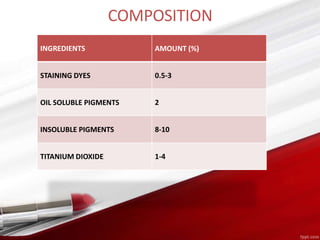
COMPOSITION
INGREDIENTS AMOUNT (%)
STAINING DYES 0.5-3
OIL SOLUBLE PIGMENTS 2
INSOLUBLE PIGMENTS 8-10
TITANIUM DIOXIDE 1-4
WAX MIXTURE: gloss and hardness of lipsticks are hardly dependant on
characteristics and the quantity of waxes used. So composition of wax is
of prime importance. Wax mixture includes
White beeswax Candelilla wax Carnauba wax Ozokerite wax Ceresin wax
Cetyl alcohol and cetostearyl alcohol
OILS MIXTURE: the oil mixtures are required to blend properly with
waxes to provide a suitable film on lips. It also acts as dispersing agent
for insoluble pigments. Ideal mixture is one which enables the product to
spread easily.
Castor oil
Tetrahydrofurfuryl alcohol and its esters
Fatty acids alkyl amides
Paraffin oil
Isopropyl myristate, isopropyl palmitate and butyl stearate.
BROMO MIXTURE: it is essentially a solution of staining dye stuff in a fatty
material to enable the dyestuff to remain either wholly or partially in
solution. It is known as bromo acids consists of flourescins, halogenated
flouresceins and water insoluble dyes. They are mainly of 2 types:
Red brom oacid: red in color and gives reddish stain.
Orange red bromo acid: orange red in color and gives pink and yellowish
pink stain. Solvents used are
Tetrahydrofurfuryl alcohol and esters
Glycerol derivatives
Propylene glycol,triethylene glycol, propylene glycol.
COLORS: the color of lipstick is most important commercial and appealing
view.the color is imparted by 2 ways:
By staining the skin with a solution of dyestuff which can penetrate the
outer layer of lip skin.
By covering lips with colored layer. Commonly used dyes are:
Staining dyes(soluble dyes)- flourescein, eosin.
Insoluble dyestuff and lake colors-calcium, barium,aluminium and strontium.
PRESERVATIVES, PERFUMES,SURFACTANTS AND OTHER
ADDITIVES:
Preservatives are used for prevention of growth of
microbes.
E.g. methyl / propyl paraben. Perfume is used to mask the
odor.
Surfactants are used to promote wetting properties.
Antioxidants are used to prevent rancidification.
e.g. BHT,BHA.
FATS:
Petroleum jelly , lanolin , paraffin oil and cocoa butter are
used in this category.
Provides emollient and lubricating effects.
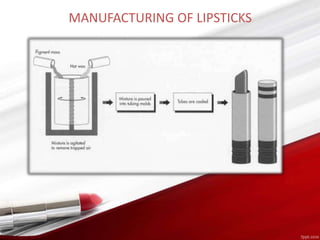
MANUFACTURING OF LIPSTICKS
MELTING AND MIXING
MELTING
AND MIXING
POURING
INTO TUBE
PACKAGING
AND SALE
•First the raw materials like solvents, oils and waxy material
are melted in separate stainless steel container.
•The solvents and oils are mixed with color pigments.
•Then the mixture is passed through roller mill grinding the
pigments to avoid grainy feel in lipsticks.
•after the pigment mass is grounded and mixed it id added to
hot wax until uniform color and consistency is obtained.
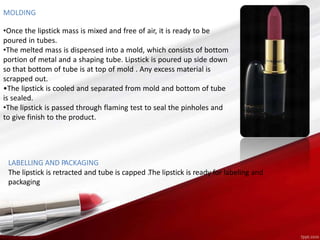
MOLDING
•Once the lipstick mass is mixed and free of air, it is ready to be
poured in tubes.
•The melted mass is dispensed into a mold, which consists of bottom
portion of metal and a shaping tube. Lipstick is poured up side down
so that bottom of tube is at top of mold . Any excess material is
scrapped out.
•The lipstick is cooled and separated from mold and bottom of tube
is sealed.
•The lipstick is passed through flaming test to seal the pinholes and
to give finish to the product.
LABELLING AND PACKAGING
The lipstick is retracted and tube is capped .The lipstick is ready for labeling and
packaging
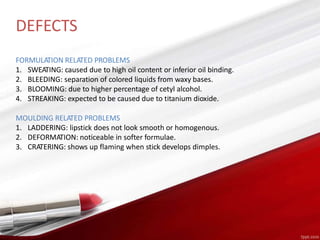
FORMULATION RELATED PROBLEMS
1. SWEATING: caused due to high oil content or inferior oil binding.
2. BLEEDING: separation of colored liquids from waxy bases.
3. BLOOMING: due to higher percentage of cetyl alcohol.
4. STREAKING: expected to be caused due to titanium dioxide.
MOULDING RELATED PROBLEMS
1. LADDERING: lipstick does not look smooth or homogenous.
2. DEFORMATION: noticeable in softer formulae.
3. CRATERING: shows up flaming when stick develops dimples.
DEFECTS
EVALUATION PARAMETER
•Melting point evaluation should be done to know the
problems during handling and storage. The melting point
should generally be above 50 degree Celsius.
•breaking point of lipsticks should be evaluated for
conforming strength of lipsticks.
•Force of application to evaluate the value of force to apply
to surface.
•Stability is an important evaluation parameter . stability
for long time and short time are evaluated.
COMPOSITION QTY(%)
HARDENED CASTOR OIL 10
CETYL ALCOHOL 2
BEES WAX 20
OZOKERITE 6
KAOLIN 10
EOSOL OLEATE 22
LIQUID PARAFFIN 20
BROMO ACID WITH COLOR 10
FLAVOUR 9
COMPOSITION QTY(%)
CARNOBA WAX 16
OZOKERITE 16
LANOLIN 24
LIQUID PARAFFIN 24
EOSIN SOLVENT 10
BROMO ACID WITH LAKE 7.5
TITANIUM DIOXIDE 1
FLAVOUR 1.5
THANKYOU

Lipstick

  • 1.
  • 2.
    INTRODUCTION Lipstick is acosmetic product containing pigments , oils , waxes and emollients that apply color , texture and protection to lips. They are classified under skin colorants which are referred as beauty aids for purpose of alteration of appearance of skin and enhancing the appearance. As most other types of makeup, lipstick is typically, but not exclusively, worn by women . some lipsticks are also lip balms, to add color and hydration. These preparation do not damage the skin and are non tacky. They typically involve a color change but also increases shine and smooth out appearance of wrinkles and folds on lips. they are a solid product housed in a molded packaging.
  • 3.
    HOW LIPSTICKS WORK Lipsticksare made from hydrophobic materials. When the solid formula is applied to lip surface, friction melts it briefly and allow for transfer. The materials cools and reforms creating a film that sticks to surface due to hydrophobic interactions. Color is a key ingredient of lipsticks . It gives an impression on lip surface. Silicones and oily materials are also added to reflect light and provide shine.
  • 4.
    CHARACTERISTICS  APPEARANCE:  Ithas smooth surface with uniform color .  It is free from defects which includes pinholes and grittiness.  It should have stable shelf life.  And should not exclude color. It should be dermatological safe, non toxic and non irritant. It must consist of stable color easy to apply and stay on for prolong period of time. Should not be excessive greasy or tacky. It should not melt at high temperature(45 degree) and should not harden at cold temperature(7-10 degree). Selection of color and flavor should be complimentary and pleasant.
  • 5.
    COMPOSITION INGREDIENTS AMOUNT (%) STAININGDYES 0.5-3 OIL SOLUBLE PIGMENTS 2 INSOLUBLE PIGMENTS 8-10 TITANIUM DIOXIDE 1-4
  • 6.
    WAX MIXTURE: glossand hardness of lipsticks are hardly dependant on characteristics and the quantity of waxes used. So composition of wax is of prime importance. Wax mixture includes White beeswax Candelilla wax Carnauba wax Ozokerite wax Ceresin wax Cetyl alcohol and cetostearyl alcohol OILS MIXTURE: the oil mixtures are required to blend properly with waxes to provide a suitable film on lips. It also acts as dispersing agent for insoluble pigments. Ideal mixture is one which enables the product to spread easily. Castor oil Tetrahydrofurfuryl alcohol and its esters Fatty acids alkyl amides Paraffin oil Isopropyl myristate, isopropyl palmitate and butyl stearate.
  • 7.
    BROMO MIXTURE: itis essentially a solution of staining dye stuff in a fatty material to enable the dyestuff to remain either wholly or partially in solution. It is known as bromo acids consists of flourescins, halogenated flouresceins and water insoluble dyes. They are mainly of 2 types: Red brom oacid: red in color and gives reddish stain. Orange red bromo acid: orange red in color and gives pink and yellowish pink stain. Solvents used are Tetrahydrofurfuryl alcohol and esters Glycerol derivatives Propylene glycol,triethylene glycol, propylene glycol. COLORS: the color of lipstick is most important commercial and appealing view.the color is imparted by 2 ways: By staining the skin with a solution of dyestuff which can penetrate the outer layer of lip skin. By covering lips with colored layer. Commonly used dyes are: Staining dyes(soluble dyes)- flourescein, eosin. Insoluble dyestuff and lake colors-calcium, barium,aluminium and strontium.
  • 8.
    PRESERVATIVES, PERFUMES,SURFACTANTS ANDOTHER ADDITIVES: Preservatives are used for prevention of growth of microbes. E.g. methyl / propyl paraben. Perfume is used to mask the odor. Surfactants are used to promote wetting properties. Antioxidants are used to prevent rancidification. e.g. BHT,BHA. FATS: Petroleum jelly , lanolin , paraffin oil and cocoa butter are used in this category. Provides emollient and lubricating effects.
  • 9.
  • 11.
    MELTING AND MIXING MELTING ANDMIXING POURING INTO TUBE PACKAGING AND SALE •First the raw materials like solvents, oils and waxy material are melted in separate stainless steel container. •The solvents and oils are mixed with color pigments. •Then the mixture is passed through roller mill grinding the pigments to avoid grainy feel in lipsticks. •after the pigment mass is grounded and mixed it id added to hot wax until uniform color and consistency is obtained.
  • 12.
    MOLDING •Once the lipstickmass is mixed and free of air, it is ready to be poured in tubes. •The melted mass is dispensed into a mold, which consists of bottom portion of metal and a shaping tube. Lipstick is poured up side down so that bottom of tube is at top of mold . Any excess material is scrapped out. •The lipstick is cooled and separated from mold and bottom of tube is sealed. •The lipstick is passed through flaming test to seal the pinholes and to give finish to the product. LABELLING AND PACKAGING The lipstick is retracted and tube is capped .The lipstick is ready for labeling and packaging
  • 13.
    FORMULATION RELATED PROBLEMS 1.SWEATING: caused due to high oil content or inferior oil binding. 2. BLEEDING: separation of colored liquids from waxy bases. 3. BLOOMING: due to higher percentage of cetyl alcohol. 4. STREAKING: expected to be caused due to titanium dioxide. MOULDING RELATED PROBLEMS 1. LADDERING: lipstick does not look smooth or homogenous. 2. DEFORMATION: noticeable in softer formulae. 3. CRATERING: shows up flaming when stick develops dimples. DEFECTS
  • 14.
    EVALUATION PARAMETER •Melting pointevaluation should be done to know the problems during handling and storage. The melting point should generally be above 50 degree Celsius. •breaking point of lipsticks should be evaluated for conforming strength of lipsticks. •Force of application to evaluate the value of force to apply to surface. •Stability is an important evaluation parameter . stability for long time and short time are evaluated.
  • 15.
    COMPOSITION QTY(%) HARDENED CASTOROIL 10 CETYL ALCOHOL 2 BEES WAX 20 OZOKERITE 6 KAOLIN 10 EOSOL OLEATE 22 LIQUID PARAFFIN 20 BROMO ACID WITH COLOR 10 FLAVOUR 9
  • 16.
    COMPOSITION QTY(%) CARNOBA WAX16 OZOKERITE 16 LANOLIN 24 LIQUID PARAFFIN 24 EOSIN SOLVENT 10 BROMO ACID WITH LAKE 7.5 TITANIUM DIOXIDE 1 FLAVOUR 1.5
  • 17.