Cosmetics
MS. NIKITA D. GIDDE
ASSISTANT PROFESSOR
DEPARTMENT OF PHARMACEUTICS
SATS, DIPLOMA IN PHARMACY COLLEGE,
MIRAJ
Content
Formulation and preparation of following cosmetics preparation
 Lipstick
 Shampoos
 Cold cream
 Vanishing cream
 Tooth paste
 Hair dye
 sunscreen
Introduction
 A "cosmetic" is any substance used to clean, improve or
change the complexion, skin, hair, nails or teeth.
 Cosmetics include beauty preparations (make-up, perfume, skin
cream, nail polish) and grooming aids (soap, shampoo, shaving
cream, deodorant).
Lipsticks
 Lipstick may be basically defined as dispersion of the colouring
matter in a base consisting of a suitable blend of oils, fats &
waxes with suitable perfumes and flavours moulded in form of
sticks to impart attractive gloss and colour, when applied on lips.
 Lipsticks provide moist appearance to the lips
IDEAL CHARACTERISTICS OF GOOD LIPSTICKS
 It should efficiently cover lips with color and impart a gloss which " would last long.
 It should be able to maintain the intensity of without any alteration in degree of its shade.
 It should be able to adhere firmly to the lips & should not provide any greasy appearance.
 It should possess good thixotropic property so as to deposit the color with minimum pressure.
 It should show a smear proof coloring effect.
 It should possess required plasticity and be able to maintain all the properties throughout the storage period.
 It should not be gritty & It should be easily dried.
 should maintain its strength at varying temperatures up to 55°C.
 The stick should not dry or crumble easily.
 Lipstick should possess a pleasant fragrance.
 Should be safe and non-irritating to the lips.
FORMULATON OF LIPSTICKS
 The lipstick base is made by mixing the oils and waxes in varying proportions in order to obtain
a desirable viscosity and melting point.
 The Solid Components/Waxes
The solid components are responsible for the final structure of the product by solidifying the liquid
matrix.
The materials required for attaining a reasonable body, hardness, melting point and shrinkage
necessary for the easy release of the mould are together referred to as natural waxes.
FORMULATON OF LIPSTICKS
 The solid components of the formulation are mostly natural waxes which may be classified as follows :
(a) The hydrocarbon waxes:
Example: White Beeswax: It is a so known as the common wax and forms the oily base in formulation of lipsticks.
Source: It is naturally obtained from honey combs of the honey bee Apis mellifera.
Melting Point: the ranges between 62 -65°C.
Concentration: It is used in concentrations of about 3-10% of the total formulation.
Available Forms: It is available in the form of blocks, pills, slabs and cakes. The commercially available bleached
form is widely used.
FORMULATON OF LIPSTICKS
The mineral waxes Ozokerite Wax: Source: It is a type of amorphous hydrocarbon
obtained naturally, from bituminous products. Melting Points: It is available in various
grades with melting point ranging b/w 56°C 82°C. Its concentration range is between 5 to
10%. It is used in order to increase the Melting point of the base. It is also efficient in
promoting the formulation of a fine crystalline wax gel and thus ensures the maximum
retention of the Oil matrix. It can be easily transformed into required shapes
FORMULATON OF LIPSTICKS
 These waxes are mainly responsible for the shape and the hardness of the lipsticks. They include the following waxes.
Candelilla Wax: It is obtained from Euphorbiaceae plants such a Euphorbia cerifera. The extraction involves the
immersing of the plant in boiling water containing sulfuric acid and later skimming off the wax that rises to the surface.
Melting Point Its melting point ranges between 65°C 75°C. It is used to increase the hardness and melting point of the
product either alone or in combination with carnauba wax.
Carnauba Wax: It is obtained as exudates from the pores of the leaves of the Brazilian wax palm tree Copernicia
prunifera. The extraction involves cutting, drying and heating of the leaves. Melting Point: Its melting point ranges
between 81 to 90°C. Available Forms: It is available in three colors yellow, gray and brown. It is available in hard forms
and soft forms. It is used to provide rigidity to the stick
FORMULATON OF LIPSTICKS
 Hard Paraffin: It may be present as a purified blend of several solid Hydrocarbon bases that are
obtained from petroleum. Melting Point: Its melting point ranges between 55°C - 65°C. It is
occasionally used in minor quantities to improve the gloss of the finished products. Imparts rigidity to
the product.
 Microcrystalline Waxes: They are the hydrocarbons containing a long carbon chain. They have
wide melting points ranging between 60°C to 120°C. They help in maintaining the crystal structure
of the lipstick and hence may prevent the sweating. They possess low solubility in the castor oil.
FORMULATON OF LIPSTICKS
 The Liquid Components The liquid components are mostly constituted by the oils such as
mineral oil, vegetable oil, castor oil, alcohol etc. The properties of the oils should be as follows:
It should possess good dissolution properties in order to dissolve all bromo acids. It should
possess an optimum viscosity range. It should be colourless, odourless and tasteless. It should
be non-toxic and non-irritating. It should be easily compatible and stable.
Mineral Oils: They consist of a blend of hydrocarbons obtained from petroleum They may be
available as either light mineral oils or heavy mineral oils. They are mostly used in order to
impart gloss to the product rather than their solvent property. Used in concentrations of less
than 5% & are not rancid.
FORMULATON OF LIPSTICKS
Vegetable Oils: The vegetable oils used may be sesame oil and olive oil. The vegetable oils provides low solubility
towards staining dyes and hence ess commonly used.
Castor Oils: It is obtained from seeds of castor plant, Ricinus communis. It forms a most valuable lipstick base.
Used in concentration of 40- 50% of total formulation. It has high viscosity and good dissolving power.
Butyl Stearates: They are useful for the dispersion of colour though they possess less solubility. They can readily
wet the coloring pigments.
 The Softening Agents They are used to increase the spread ability by softening the lipstick. The most commonly
used softening agents include
FORMULATON OF LIPSTICKS
 Lanolin: It is also referred to as hydrous wool fat. It is used in minor quantities in order to improve covering properties
of the film. It contains 25-30% of water and may result in sticky and greasy products.
 Cocoa Butter: It was used in the past due to its good emollient property. The usage has been stopped due to rancidity
and surface crystallization. It provides oily look on the lips and hence imparts good gloss.
 Petrolatum: It is a hydrocarbon obtained from petroleum. It is odourless and tasteless. It is added mainly to enhance
the gloss.
 Lecithin: It is used in minor quantities to impart smoothness and emollient effect. It increases the ease of application
 Anhydrous Lanolin: It is used at low concentration of about 0.25% in order to impart softness, emolliency &
protection to lips.
FORMULATON OF LIPSTICKS
 Colouring Agents: Colour may be imparted to the lips either by staining the lip with a dye stuff colour or by covering
the lips with coloring layers. The colors used in the formulation of lipsticks are of two types: Soluble Colours: They are
dye stuff agents which are easily soluble in oil, water and alcohol. Insoluble Colours: They are organic or inorganic
pigments which are insoluble.
 Pearlescent Pigments: They are used to impart nacreous or a pearl like appearance to the product when applied on the
lips. The natural pearlescent pigments may be guanine crystals obtained from fish scales. Bismuth oxychloride in
70% castor oil may also provide a lustrous look.
 Opacifying Agent: It is used for opacifying or whitening of lipsticks. It can also alter the basic shade of the pigment.
 Perfumeries: Light floral fragrances can be used in lipsticks. They include rose oil, cinnamon oil, lavender oil etc. The
fruity flavours that cover fatty odour of the oily waxes may also be used.
PREPARATION METHOD OF LIPSTICKS
 If a solvent is used for the dissolution of bromo acid, the solution is first prepared and set aside until
required. If commercial colour pastes are not being used, then lake colours are first dispersed by mixing
with suitable quantity of castor oil.
 The colour paste obtained is passed through a triple roller mill until it becomes smooth and free from
agglomerates and gritty particles.
 The colour mixture is then mixed with the bromo acid mixture.
 All the ingredients of the base are identified and arranged in the increasing order of their melting points.
 This mixture is remilled until it is perfectly smooth.
PREPARATION METHOD OF LIPSTICKS
 Preservatives and anti-oxidant are dissolved in remaining oil and are added to the mixture.
 Finally, the perfume is added and the mass is stirred thoroughly, but gently to avoid entrapment of air.
 Automatic ejection mould is preferred for the large scale production.
 The mould is lubricated with liquid paraffin or isopropylmyristate before pouring the mass into the mould.
 It is important to prevent settling down of the coloring mass when the moulds are chilled.
 Lubrication facilitates easy removal
EVALUATION OF LIPSTCKS
 Melting Point Determination Test
The determination of melting point is done in order to determine the storage
characteristics of the product. The inciting point of lipstick base should be between 60
to 65°C in order to avoid the sensation of friction or dryness during application. The
method of determination is known as capillary tube method.
EVALUATION OF LIPSTCKS
 Breaking Load Point Test
This test is done in order to determine the strength and hardness of the lipstick
In this method, the lipstick is placed horizontal position 1 inch from the base and weights with
increasing loads are attached to it. The weight at which the lipstick starts breaking, known
as the breaking load point. The test shall be carried out in specific condition and at about 25 ° c
temperatures
EVALUATION OF LIPSTCKS
 Storage Stability: This test is done in order to determine the stability of product
during storage.
 Test for rancidity: The oxidation of oil such as castor oil and many other
ingredients may result in bad odour and taste and also result in a sticky product.
SHAMPOOS
 A viscous cosmetic preparation with synthetic detergent used for washing hair is called shampoo.
 Its principle function is to clean the scalp such that it should become free from sebum and foreign
substances.
 Shampoo also makes the hair lustrous and good looking.
 In olden days detergent soap were used for washing hairs, but nowadays it has been replaced by
shampoo.
 Today shampoo has become an important hair cosmetic for both men and women.
Ideal Properties
 It should have good spreading properties.
 It should not form any kind of film on scalp.
 It should facilitate ease of combing after shampooing.
 After drying, the hair should not give rough appearance.
 It should provide luster to the hair.
 It should not support any microbial growth.
 It should produce good odour both before and after shampooing.
 It should not produce any kind of irritation or itching to the scalp.
TYPES OF SHAMPO0
 Clear liquid shampoos
 Liquid cream shampoos
 Cream shampoos
 Gel shampoos
 Powder shampoos
 Aerosol shampoos (Foam type)
 Special shampoo: Medicated Shampoo & Conditioner Shampoos
FORMULATION OF SHAMPOO
 Surfactants
The main use of surfactant is to cleanse and to produce foam.
They are generally categorized into four types
Anionic Surfactants: These surfactants have good foaming property; hence they are used as principle surfactant.
They are negatively charged. They are considered as main ingredient of shampoo formulation.
E.G.-Alkyl Sulphates, a- olefin Sulphate.
Non-ionic Surfactant: These are considered as secondary surfactants. They are not used to produce foam but used as
foam boosters, viscosity inducers, emulsion stabilizers and opacifiers. This is because they have less foaming power.
FORMULATION OF SHAMPOO
 Cationic Surfactants: Surfactants that contains positive charge are called as cationic surfactants.
They are used as both principle and secondary surfactants. These surfactants are used in low
concentrations because they are toxic to eye. Hence, they are considered as secondary surfactants.
 Amphoteric Surfactants: The surfactants which possess both cationic and anionic charges with
acidic and basic media are called as amphoteric Surfactants.
FORMULATION OF SHAMPOO
 Foam Boosters
The surfactants used in the preparation also serves as foaming agents.
They, form rich lather i.e., foam which is stabilized or strengthened by using a substance called foam boosters.
Substances like, alkanolamides, amine oxides are used.
They make the foam dense and it to remain for long duration.
Usually they are added in quantity of about 2 to 5%.
Fatty acids and fatty alcohols when added in a range of 0.25 to 0.50% concentrations, they also act as foam boosters.
FORMULATION OF SHAMPOO
 Germicide and Anti-dandruff Agents
Germicides are the agents which prevent the growth of micro-organism on the scalp whereas anti-dandruff agents
are used to eliminate dandruff from the scalp.
Germicides - Benzalkonium Chloride, Cetrimide
Anti-dandruffAgents - Selenium Sulphide, Cadmium Sulphide
 Conditioning Agents
These agents improve the condition of hair. These agents have property of reducing, electric charges hair, as result,
hair become lustrous & hence easily manageable. It also exhibit bactericidal effect. They make hair silky & shiny.
Most commonly used conditioning agents are lanolin, oils, herbal extracts, egg.
FORMULATION OF SHAMPOO
 Pearlescent Agent
These agents are usually added as adjuvants to the conditioning agents. They improve the conditioning property.
Addition of these agents also imparts brightness to hair. They make preparation transparent or opaque; hence
they are also called as opacifying agents.
 Sequestrants
These are complex forming agents. They form complex with metal ions like calcium and magnesium. Surfactant are
liable to form complex with the metals present in water i.e., calcium and magnesium. Hence addition of Sequestrants
prevents complex formation between metal and surfactant. The Sequestrant itself forms complex with the metal
ions.
FORMULATION OF SHAMPOO
 Thickeners
These agents are usually added to make the preparation thick.
Such viscous preparation facilitates ease of handling. Also, they prevent wastage during application.
Already the addition of various agents, such as surfactants, foam boosters etc. make the preparation viscous even though
thickening agent is added.
 Perfumes
Addition of these agents imparts good fragrance to the shampoo. It also neutralizes the undesirable odour of other
ingredients formulation especially surfactants. Nowadays it has become an important factor for consumer satisfaction. The
selected perfumes must be such that they should retain good smell for fixed period of time even after shampooing.
FORMULATION OF SHAMPOO
 Preservatives
These agents have the ability to prevent the growth of micro-organisms. They are usually added to maintain the
stability of the preparation for desired period of time. Shampoo is a wet preparation that provides a media for
various micro organisms hence addition of preservative is essential. Preservative used should not cause any
irritation to scalp. Para-hydroxybenzoic acid and phenyl mercuric nitrate are commonly used preservatives.
 Color
addition of colour gives pleasant appearance to the preparation. Various FD & C dyes are used for colouring the
preparation. The added colour must be water soluble and it should not impart any colour to hair or scalp.
METHOD FOR PREPARATION OF SHAMPOO
Shampoo is usually prepared by this method which involves the following steps
 Initially the detergent is converted into a solution form or a detergent solution.
 Take about half of the detergent solution into a separate container. To it, add the total
amount of secondary surfactant.
 Dissolve the alkanolamide along with stirring. Sometimes, gentle heat is also applied.
 To the remaining half of the detergent solution add suitable amount of perfuming agent
and dissolve it. The perfume solution is then added to the alkanolamide solution.
METHOD FOR PREPARATION OF SHAMPOO
 Color and preservatives are dissolved separately in sufficient volume of water and then added to the main
solution.
 The whole, solution is mixed well by gentle stirring. Excessive stirring may lead to bubble formation.
 Final volume of the preparation is usually adjusted by the addition of clear sterile waste.
 This gives clear liquid shampoo. However, When the preparation contains lauryl alcohol ether sulphate.
 It is required to adjust the viscosity of the shampoo. Viscosity adjustment is done by using an electrolyte solution.
 Usually, a solution of sodium chloride is added subsequently with constant stirring.
 Care must be taken to it event the excess addition of sodium chloride.
COLD CREAM
 These types of creams are water-in-oil type of emulsion.
 They produce cooling sensation by the evaporation of water, after application of cream
to the skin. Hence, they are known as cream.
 They should possess emollient action and the layer left on the skin after application should
be non-occlusive
 For composition, formulation, method of preparation, storage, label and evaluation : Refer
manual
Vanishing Cream
 They are oil in water type of emulsion.
 When applied on the surface of skin, they spread as thin oil less film which is not visible to the naked eye. Hence, they
are called as vanishing creams.
 They are used to hold powder on the skin as well as to improve adhesion.
PROPERTIES OE VANISHING CREAM
1. It should have high melting point.
2. It should be pure white in colour.
3. It should possess very little odour.
4. It should have less number of iodine
TOOTHPASTES
 Dentifrices such as toothpastes, tooth powders and tooth gels are meant for the cleaning the surface
of the teeth by removing the food debris and plaque adhered to surface of the teeth which is the
main cause for tooth problems.
 GENERAL REOUIREMENTS FORA DENTIERICE
 It should be capable of cleaning the teeth adequately by removing food debris, plaque and stains
efficiently.
 It should leave a pleasant, cool and refreshing sensation in the mouth.
 It should be harmless, non-toxic and should not cause irritation in the mouth or any ulcers in the
buccal cavity.
 It should be able to maintain its flow properties all through its commercial period of storage.
 It should be easy to pack and easy to use
FORMULATION OF TOOTHPASTES
 Polishing Agents/Abrasive Agents
The abrasives or the polishing agents are used to polish the teeth and remove food debris
adhered to the surface of the teeth.
They are used in concentration of about 20 - 50% of the total formulation.
They should not produce any gritty sensation in the mouth. They should possess good
abrasive properties. They should not lead to any incompatibilities and should be compatible
with the other ingredients
FORMULATION OF TOOTHPASTES
 Foaming Agents /Surfactants
They are also known as wetting agents.
The mechanism of cleansing action is by reducing the surface tension at the interface of the adhered material and
enamel of the teeth.
They aid in abrasive action by wetting the surface of the teeth.
They help in the diffusion of into narrow spaces, thus enhancing the cleansing action.
The properties of the surfactants are as follows : It should be compatible with other ingredients of formulation. It should
possess good surface active property. It should be non-toxic and non-irritant to oral mucosa of the buccal cavity.
FORMULATION OF TOOTHPASTES
 Humectants
Humectants are used in order to prevent the rapid drying of dentifrices.
They prevent excessive moisture loss from the product.
They may additionally impart plasticity to the final product.
The concentration of the humectant used in the formulation may vary from 20% to 40%.
FORMULATION OF TOOTHPASTES
 Gelling / Binding Agents
The binding agents are used in order to hold the solid and the liquid components
together to form a smooth paste and maintain its property, particularly during storage.
The commonly used binding agents are cellulose derivatives such as Carboxy Methyl
Cellulose (CMC), Sodium Carboxy Methyl Cellulose (SCMC), Hydroxyethy] cellulose,
Cellulose ethers etc.
FORMULATION OF TOOTHPASTES
 Sweetening Agents
These are added in order to improve the sweetening properties and cover the bitter
taste of the other ingredients like surfactants, binders etc
They help in promoting the acceptance of the product when administered orally.
The most commonly used sweetening agents are Saccharin sodium, Chloroform,
Aspartame, Cyclamates and Potassium acesulfame.
FORMULATION OF TOOTHPASTES
 Flavoring Agents
Flavoring agents may comprise the most proprietary and most crucial part of the formulation essential to meet
the consumer preferences.
They are generally a mixture of edible volatile oils consisting of spearmint and peppermint oil as major
components.
The other components included may be thymol, anethol, eucalyptol.
 Coloring Agents
They are used in concentration of less than 0.01% as permitted.
They can be used generally in combination with a portion of a white creamy base.
FORMULATION OF TOOTHPASTES
 Whitening Agents
Whitening agents such as Titaniumn dioxide shall be preferentially added order to provide additional
whiteness and brilliance to the paste.
 Preservatives
Preservatives are used in the formulation in order to maintain the properties of the product throughout
the storage period and to improve the shelf-life of the product.
 Therapeutic Agents
Therapeutic agents are included in toothpastes in order to provide additional beneficial effects besides
normal cleansing properties.
PREPARATION OF TOOTHPASTE
 Dry gum method
In this method, all the solid components of the formulation like abrasive agent, binding agent etc., except the
surfactants are mixed together in a dry mixer.
The mixer may be an agitation mixer which consists of slow rotating blades.
The liquid components such as the humectants and water are gradually added to the dry mix.
The mixing process is carried out till a smooth paste is formed.
The remaining ingredients like the surfactants and the flavouring agents are added to the homogenous paste
under vacuum.
PREPARATION OF TOOTHPASTE
 Wet gum Method
In this method, all the liquid components are mixed together to form a liquid phase. The binding
agent is then mixed with the liquid phase with uniform stirring in order form mucilage.
The solid ingredients excluding the surfactants are then gradually added to the mucilage with
uniform mixing in an agitation mixer, in order to form a homogenous paste.
The remaining ingredients ie., the surfactants, the flavoring agents, coloring agents are added
under vacuum to the homogenous paste.
HAIR DYES
 Hair colourants are the cosmetic preparations which are used by men and women either to
change the natural hair colour or to mask grey hair.
 The properties of typical hair colourants are
The formulation of the hair colourant should be stable. They should colour the hair evenly.
They should not lead to loss of the natural shine of hair. The shaft of the hair must not be
damaged. The natural moisture of the hair must not be lost. Must possess properties like non-
irritant and non-sensitizing. Must be non-toxic in nature. Must impart stable color to the hair.
The colored hair must be unaffected by air, water, sunlight, shampoos, lotions, gels, oils etc.
CLASSIFICATION OF HAIR COLOURANTS
 Temporary hair colourants.
 Semi-permanent hair colourants/Direct dyes
 Oxidative dyeing systems:
Semi-permanent hair colourants.
Permanent hair colourants.
 Gradual hair colourants.
 Natural dyes.
Raw Materials for Hair Dye Production
Common Hair Dye Ingredients
Hair colours or dyes contain chemical modifications of colour, antioxidants, alkaliser solutions, soaps,
ammonia, wetting agents, and odour.
2. Chemicals
Hair dyes also contain small amounts of chemicals to achieve specific properties like soft texture or
lessen fizziness.
Chemicals in hair dye are also used to give the colour a desired effect like permanence or temporary
effect.
The chemicals in hair dye are usually amino compounds with names like 4-amino-2-hydroxytoluene
and m-aminophenol on the product ingredient list.
Titanium dioxide and iron oxide are metal oxides used as pigments.
Raw Materials for Hair Dye Production
Modifiers
Hair dyes contain substances called modifiers used to stabilise or modify the dye components.
Modifiers can bring a complementary colour tone, such as green or purple, to the dye pigment.
Resorcinol is a popular modifier.
4. Antioxidants
Antioxidants stop the dye from interacting with oxygen in the air. The most prevalent antioxidant is
sodium sulfite. Because the dyes operate best in a very alkaline formula, alkalies are used to modify
the pH levels of the dye mixture. Ammonium hydroxide, an alkaliser, is extensively used.
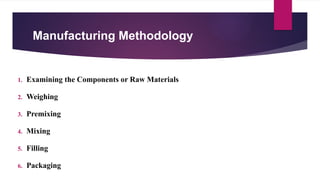
Manufacturing Methodology
1. Examining the Components or Raw Materials
2. Weighing
3. Premixing
4. Mixing
5. Filling
6. Packaging
Evaluation test
Sensitization test: To detect whether your preparation
having any sensitivity with your formulation or not
Toxicity study: to know about long term effect of
preparation
SUNSCREENS
 Sunscreen (also known as sunblock or suntan lotion is a lotion, spray, gel or other topical
product that absorbs or reflects the sun's ultraviolet (UV) radiation and protects the skin.
 IDEAL SUN-SCREEN CHARACTERS
Absorb light preferentially over range of 280 - 320um.
Resistance to water.
It should be stable to heat, light and perspiration.
Preferably odorless, if mild odor: accepted by user.
Sunscreen
It should be non-toxic, non-irritant, non- sensitizing.
Capable of retaining sun screening property for several hours.
Stable under condition of use.
Non- stain, Not be rapidly absorbed.
It should be rapidly soluble in suitable vehicles.
SUNSCREEN AGENTS
 Para-amino benzoic acid
Very effective in the UVB range (200-320 nm).
Most effective in concentration. of 5% in 70% ethanol.
Maximum benefit when applied 60 mins prior to exposure (To ensure penetration and
binding to stratum corneum).
Contact dermatitis can develop.
SUNSCREEN AGENTS
 PABA Esters. (Padimate A, Padimate 0, Glyceryl PABA)
Also very effective in UVB range (280-320 nm)
Most effective in concentration 2.5-8% in 65% alcohol.
May penetrate less effectively than PABA.
Less staining
PROCEDURE FOR MANUFACTURING OF SUNSCREEN
 Flake/powder ingredients, such as cetyl alcohol and stearic acid, sometimes dry blended in
advance, are dispersed into the oil phase.
 The water phase is prepared separately, containing emulsifiers and stabilizers such as
Veegum® or Carbopol®.
 The two phases are then mixed to form an emulsion.
 This is aided by heating to between 110 and 185°F (45 -80°C) depending on ingredients.
 UV filters and absorbers are supplied as dry powder or predispersed in either oil or aqueous bases.
PROCEDURE FOR MANUFACTURING OF SUNSCREEN
 Depending on raw material type and formulation requirements
these "micronized oxides" are dispersed into the appropriate
phase or added to the product once emulsion has been
formed.
 Mixing is continued until the end product is homogeneous.
SUN PROTECTION FACTOR
 According to the FDA, the use of a sunscreen with an SPF of 15 or above, combined with other
measures, such as wearing sunglasses and avoiding the midday sun,can help prevent the skin cancer,
 In some places, protection levels are expressed as follows:
 Low protection: SPF is below 15
 Medium protection: SPF is 15 to 29
 High protection: SPF is 30 to 49
 Very high protection: SPF is over 50
Evaluation test
 Physical test
 PH
 Viscosity
 Separability
 Irritancy test
 Stability test
 Washability
Thank You

Industrial Pharmacy Unit V Cosmetics.pptx

  • 1.
    Cosmetics MS. NIKITA D.GIDDE ASSISTANT PROFESSOR DEPARTMENT OF PHARMACEUTICS SATS, DIPLOMA IN PHARMACY COLLEGE, MIRAJ
  • 2.
    Content Formulation and preparationof following cosmetics preparation  Lipstick  Shampoos  Cold cream  Vanishing cream  Tooth paste  Hair dye  sunscreen
  • 3.
    Introduction  A "cosmetic"is any substance used to clean, improve or change the complexion, skin, hair, nails or teeth.  Cosmetics include beauty preparations (make-up, perfume, skin cream, nail polish) and grooming aids (soap, shampoo, shaving cream, deodorant).
  • 4.
    Lipsticks  Lipstick maybe basically defined as dispersion of the colouring matter in a base consisting of a suitable blend of oils, fats & waxes with suitable perfumes and flavours moulded in form of sticks to impart attractive gloss and colour, when applied on lips.  Lipsticks provide moist appearance to the lips
  • 5.
    IDEAL CHARACTERISTICS OFGOOD LIPSTICKS  It should efficiently cover lips with color and impart a gloss which " would last long.  It should be able to maintain the intensity of without any alteration in degree of its shade.  It should be able to adhere firmly to the lips & should not provide any greasy appearance.  It should possess good thixotropic property so as to deposit the color with minimum pressure.  It should show a smear proof coloring effect.  It should possess required plasticity and be able to maintain all the properties throughout the storage period.  It should not be gritty & It should be easily dried.  should maintain its strength at varying temperatures up to 55°C.  The stick should not dry or crumble easily.  Lipstick should possess a pleasant fragrance.  Should be safe and non-irritating to the lips.
  • 6.
    FORMULATON OF LIPSTICKS The lipstick base is made by mixing the oils and waxes in varying proportions in order to obtain a desirable viscosity and melting point.  The Solid Components/Waxes The solid components are responsible for the final structure of the product by solidifying the liquid matrix. The materials required for attaining a reasonable body, hardness, melting point and shrinkage necessary for the easy release of the mould are together referred to as natural waxes.
  • 7.
    FORMULATON OF LIPSTICKS The solid components of the formulation are mostly natural waxes which may be classified as follows : (a) The hydrocarbon waxes: Example: White Beeswax: It is a so known as the common wax and forms the oily base in formulation of lipsticks. Source: It is naturally obtained from honey combs of the honey bee Apis mellifera. Melting Point: the ranges between 62 -65°C. Concentration: It is used in concentrations of about 3-10% of the total formulation. Available Forms: It is available in the form of blocks, pills, slabs and cakes. The commercially available bleached form is widely used.
  • 8.
    FORMULATON OF LIPSTICKS Themineral waxes Ozokerite Wax: Source: It is a type of amorphous hydrocarbon obtained naturally, from bituminous products. Melting Points: It is available in various grades with melting point ranging b/w 56°C 82°C. Its concentration range is between 5 to 10%. It is used in order to increase the Melting point of the base. It is also efficient in promoting the formulation of a fine crystalline wax gel and thus ensures the maximum retention of the Oil matrix. It can be easily transformed into required shapes
  • 9.
    FORMULATON OF LIPSTICKS These waxes are mainly responsible for the shape and the hardness of the lipsticks. They include the following waxes. Candelilla Wax: It is obtained from Euphorbiaceae plants such a Euphorbia cerifera. The extraction involves the immersing of the plant in boiling water containing sulfuric acid and later skimming off the wax that rises to the surface. Melting Point Its melting point ranges between 65°C 75°C. It is used to increase the hardness and melting point of the product either alone or in combination with carnauba wax. Carnauba Wax: It is obtained as exudates from the pores of the leaves of the Brazilian wax palm tree Copernicia prunifera. The extraction involves cutting, drying and heating of the leaves. Melting Point: Its melting point ranges between 81 to 90°C. Available Forms: It is available in three colors yellow, gray and brown. It is available in hard forms and soft forms. It is used to provide rigidity to the stick
  • 10.
    FORMULATON OF LIPSTICKS Hard Paraffin: It may be present as a purified blend of several solid Hydrocarbon bases that are obtained from petroleum. Melting Point: Its melting point ranges between 55°C - 65°C. It is occasionally used in minor quantities to improve the gloss of the finished products. Imparts rigidity to the product.  Microcrystalline Waxes: They are the hydrocarbons containing a long carbon chain. They have wide melting points ranging between 60°C to 120°C. They help in maintaining the crystal structure of the lipstick and hence may prevent the sweating. They possess low solubility in the castor oil.
  • 11.
    FORMULATON OF LIPSTICKS The Liquid Components The liquid components are mostly constituted by the oils such as mineral oil, vegetable oil, castor oil, alcohol etc. The properties of the oils should be as follows: It should possess good dissolution properties in order to dissolve all bromo acids. It should possess an optimum viscosity range. It should be colourless, odourless and tasteless. It should be non-toxic and non-irritating. It should be easily compatible and stable. Mineral Oils: They consist of a blend of hydrocarbons obtained from petroleum They may be available as either light mineral oils or heavy mineral oils. They are mostly used in order to impart gloss to the product rather than their solvent property. Used in concentrations of less than 5% & are not rancid.
  • 12.
    FORMULATON OF LIPSTICKS VegetableOils: The vegetable oils used may be sesame oil and olive oil. The vegetable oils provides low solubility towards staining dyes and hence ess commonly used. Castor Oils: It is obtained from seeds of castor plant, Ricinus communis. It forms a most valuable lipstick base. Used in concentration of 40- 50% of total formulation. It has high viscosity and good dissolving power. Butyl Stearates: They are useful for the dispersion of colour though they possess less solubility. They can readily wet the coloring pigments.  The Softening Agents They are used to increase the spread ability by softening the lipstick. The most commonly used softening agents include
  • 13.
    FORMULATON OF LIPSTICKS Lanolin: It is also referred to as hydrous wool fat. It is used in minor quantities in order to improve covering properties of the film. It contains 25-30% of water and may result in sticky and greasy products.  Cocoa Butter: It was used in the past due to its good emollient property. The usage has been stopped due to rancidity and surface crystallization. It provides oily look on the lips and hence imparts good gloss.  Petrolatum: It is a hydrocarbon obtained from petroleum. It is odourless and tasteless. It is added mainly to enhance the gloss.  Lecithin: It is used in minor quantities to impart smoothness and emollient effect. It increases the ease of application  Anhydrous Lanolin: It is used at low concentration of about 0.25% in order to impart softness, emolliency & protection to lips.
  • 14.
    FORMULATON OF LIPSTICKS Colouring Agents: Colour may be imparted to the lips either by staining the lip with a dye stuff colour or by covering the lips with coloring layers. The colors used in the formulation of lipsticks are of two types: Soluble Colours: They are dye stuff agents which are easily soluble in oil, water and alcohol. Insoluble Colours: They are organic or inorganic pigments which are insoluble.  Pearlescent Pigments: They are used to impart nacreous or a pearl like appearance to the product when applied on the lips. The natural pearlescent pigments may be guanine crystals obtained from fish scales. Bismuth oxychloride in 70% castor oil may also provide a lustrous look.  Opacifying Agent: It is used for opacifying or whitening of lipsticks. It can also alter the basic shade of the pigment.  Perfumeries: Light floral fragrances can be used in lipsticks. They include rose oil, cinnamon oil, lavender oil etc. The fruity flavours that cover fatty odour of the oily waxes may also be used.
  • 15.
    PREPARATION METHOD OFLIPSTICKS  If a solvent is used for the dissolution of bromo acid, the solution is first prepared and set aside until required. If commercial colour pastes are not being used, then lake colours are first dispersed by mixing with suitable quantity of castor oil.  The colour paste obtained is passed through a triple roller mill until it becomes smooth and free from agglomerates and gritty particles.  The colour mixture is then mixed with the bromo acid mixture.  All the ingredients of the base are identified and arranged in the increasing order of their melting points.  This mixture is remilled until it is perfectly smooth.
  • 16.
    PREPARATION METHOD OFLIPSTICKS  Preservatives and anti-oxidant are dissolved in remaining oil and are added to the mixture.  Finally, the perfume is added and the mass is stirred thoroughly, but gently to avoid entrapment of air.  Automatic ejection mould is preferred for the large scale production.  The mould is lubricated with liquid paraffin or isopropylmyristate before pouring the mass into the mould.  It is important to prevent settling down of the coloring mass when the moulds are chilled.  Lubrication facilitates easy removal
  • 17.
    EVALUATION OF LIPSTCKS Melting Point Determination Test The determination of melting point is done in order to determine the storage characteristics of the product. The inciting point of lipstick base should be between 60 to 65°C in order to avoid the sensation of friction or dryness during application. The method of determination is known as capillary tube method.
  • 18.
    EVALUATION OF LIPSTCKS Breaking Load Point Test This test is done in order to determine the strength and hardness of the lipstick In this method, the lipstick is placed horizontal position 1 inch from the base and weights with increasing loads are attached to it. The weight at which the lipstick starts breaking, known as the breaking load point. The test shall be carried out in specific condition and at about 25 ° c temperatures
  • 19.
    EVALUATION OF LIPSTCKS Storage Stability: This test is done in order to determine the stability of product during storage.  Test for rancidity: The oxidation of oil such as castor oil and many other ingredients may result in bad odour and taste and also result in a sticky product.
  • 20.
    SHAMPOOS  A viscouscosmetic preparation with synthetic detergent used for washing hair is called shampoo.  Its principle function is to clean the scalp such that it should become free from sebum and foreign substances.  Shampoo also makes the hair lustrous and good looking.  In olden days detergent soap were used for washing hairs, but nowadays it has been replaced by shampoo.  Today shampoo has become an important hair cosmetic for both men and women.
  • 21.
    Ideal Properties  Itshould have good spreading properties.  It should not form any kind of film on scalp.  It should facilitate ease of combing after shampooing.  After drying, the hair should not give rough appearance.  It should provide luster to the hair.  It should not support any microbial growth.  It should produce good odour both before and after shampooing.  It should not produce any kind of irritation or itching to the scalp.
  • 22.
    TYPES OF SHAMPO0 Clear liquid shampoos  Liquid cream shampoos  Cream shampoos  Gel shampoos  Powder shampoos  Aerosol shampoos (Foam type)  Special shampoo: Medicated Shampoo & Conditioner Shampoos
  • 23.
    FORMULATION OF SHAMPOO Surfactants The main use of surfactant is to cleanse and to produce foam. They are generally categorized into four types Anionic Surfactants: These surfactants have good foaming property; hence they are used as principle surfactant. They are negatively charged. They are considered as main ingredient of shampoo formulation. E.G.-Alkyl Sulphates, a- olefin Sulphate. Non-ionic Surfactant: These are considered as secondary surfactants. They are not used to produce foam but used as foam boosters, viscosity inducers, emulsion stabilizers and opacifiers. This is because they have less foaming power.
  • 24.
    FORMULATION OF SHAMPOO Cationic Surfactants: Surfactants that contains positive charge are called as cationic surfactants. They are used as both principle and secondary surfactants. These surfactants are used in low concentrations because they are toxic to eye. Hence, they are considered as secondary surfactants.  Amphoteric Surfactants: The surfactants which possess both cationic and anionic charges with acidic and basic media are called as amphoteric Surfactants.
  • 25.
    FORMULATION OF SHAMPOO Foam Boosters The surfactants used in the preparation also serves as foaming agents. They, form rich lather i.e., foam which is stabilized or strengthened by using a substance called foam boosters. Substances like, alkanolamides, amine oxides are used. They make the foam dense and it to remain for long duration. Usually they are added in quantity of about 2 to 5%. Fatty acids and fatty alcohols when added in a range of 0.25 to 0.50% concentrations, they also act as foam boosters.
  • 26.
    FORMULATION OF SHAMPOO Germicide and Anti-dandruff Agents Germicides are the agents which prevent the growth of micro-organism on the scalp whereas anti-dandruff agents are used to eliminate dandruff from the scalp. Germicides - Benzalkonium Chloride, Cetrimide Anti-dandruffAgents - Selenium Sulphide, Cadmium Sulphide  Conditioning Agents These agents improve the condition of hair. These agents have property of reducing, electric charges hair, as result, hair become lustrous & hence easily manageable. It also exhibit bactericidal effect. They make hair silky & shiny. Most commonly used conditioning agents are lanolin, oils, herbal extracts, egg.
  • 27.
    FORMULATION OF SHAMPOO Pearlescent Agent These agents are usually added as adjuvants to the conditioning agents. They improve the conditioning property. Addition of these agents also imparts brightness to hair. They make preparation transparent or opaque; hence they are also called as opacifying agents.  Sequestrants These are complex forming agents. They form complex with metal ions like calcium and magnesium. Surfactant are liable to form complex with the metals present in water i.e., calcium and magnesium. Hence addition of Sequestrants prevents complex formation between metal and surfactant. The Sequestrant itself forms complex with the metal ions.
  • 28.
    FORMULATION OF SHAMPOO Thickeners These agents are usually added to make the preparation thick. Such viscous preparation facilitates ease of handling. Also, they prevent wastage during application. Already the addition of various agents, such as surfactants, foam boosters etc. make the preparation viscous even though thickening agent is added.  Perfumes Addition of these agents imparts good fragrance to the shampoo. It also neutralizes the undesirable odour of other ingredients formulation especially surfactants. Nowadays it has become an important factor for consumer satisfaction. The selected perfumes must be such that they should retain good smell for fixed period of time even after shampooing.
  • 29.
    FORMULATION OF SHAMPOO Preservatives These agents have the ability to prevent the growth of micro-organisms. They are usually added to maintain the stability of the preparation for desired period of time. Shampoo is a wet preparation that provides a media for various micro organisms hence addition of preservative is essential. Preservative used should not cause any irritation to scalp. Para-hydroxybenzoic acid and phenyl mercuric nitrate are commonly used preservatives.  Color addition of colour gives pleasant appearance to the preparation. Various FD & C dyes are used for colouring the preparation. The added colour must be water soluble and it should not impart any colour to hair or scalp.
  • 30.
    METHOD FOR PREPARATIONOF SHAMPOO Shampoo is usually prepared by this method which involves the following steps  Initially the detergent is converted into a solution form or a detergent solution.  Take about half of the detergent solution into a separate container. To it, add the total amount of secondary surfactant.  Dissolve the alkanolamide along with stirring. Sometimes, gentle heat is also applied.  To the remaining half of the detergent solution add suitable amount of perfuming agent and dissolve it. The perfume solution is then added to the alkanolamide solution.
  • 31.
    METHOD FOR PREPARATIONOF SHAMPOO  Color and preservatives are dissolved separately in sufficient volume of water and then added to the main solution.  The whole, solution is mixed well by gentle stirring. Excessive stirring may lead to bubble formation.  Final volume of the preparation is usually adjusted by the addition of clear sterile waste.  This gives clear liquid shampoo. However, When the preparation contains lauryl alcohol ether sulphate.  It is required to adjust the viscosity of the shampoo. Viscosity adjustment is done by using an electrolyte solution.  Usually, a solution of sodium chloride is added subsequently with constant stirring.  Care must be taken to it event the excess addition of sodium chloride.
  • 32.
    COLD CREAM  Thesetypes of creams are water-in-oil type of emulsion.  They produce cooling sensation by the evaporation of water, after application of cream to the skin. Hence, they are known as cream.  They should possess emollient action and the layer left on the skin after application should be non-occlusive  For composition, formulation, method of preparation, storage, label and evaluation : Refer manual
  • 33.
    Vanishing Cream  Theyare oil in water type of emulsion.  When applied on the surface of skin, they spread as thin oil less film which is not visible to the naked eye. Hence, they are called as vanishing creams.  They are used to hold powder on the skin as well as to improve adhesion. PROPERTIES OE VANISHING CREAM 1. It should have high melting point. 2. It should be pure white in colour. 3. It should possess very little odour. 4. It should have less number of iodine
  • 34.
    TOOTHPASTES  Dentifrices suchas toothpastes, tooth powders and tooth gels are meant for the cleaning the surface of the teeth by removing the food debris and plaque adhered to surface of the teeth which is the main cause for tooth problems.  GENERAL REOUIREMENTS FORA DENTIERICE  It should be capable of cleaning the teeth adequately by removing food debris, plaque and stains efficiently.  It should leave a pleasant, cool and refreshing sensation in the mouth.  It should be harmless, non-toxic and should not cause irritation in the mouth or any ulcers in the buccal cavity.  It should be able to maintain its flow properties all through its commercial period of storage.  It should be easy to pack and easy to use
  • 35.
    FORMULATION OF TOOTHPASTES Polishing Agents/Abrasive Agents The abrasives or the polishing agents are used to polish the teeth and remove food debris adhered to the surface of the teeth. They are used in concentration of about 20 - 50% of the total formulation. They should not produce any gritty sensation in the mouth. They should possess good abrasive properties. They should not lead to any incompatibilities and should be compatible with the other ingredients
  • 36.
    FORMULATION OF TOOTHPASTES Foaming Agents /Surfactants They are also known as wetting agents. The mechanism of cleansing action is by reducing the surface tension at the interface of the adhered material and enamel of the teeth. They aid in abrasive action by wetting the surface of the teeth. They help in the diffusion of into narrow spaces, thus enhancing the cleansing action. The properties of the surfactants are as follows : It should be compatible with other ingredients of formulation. It should possess good surface active property. It should be non-toxic and non-irritant to oral mucosa of the buccal cavity.
  • 37.
    FORMULATION OF TOOTHPASTES Humectants Humectants are used in order to prevent the rapid drying of dentifrices. They prevent excessive moisture loss from the product. They may additionally impart plasticity to the final product. The concentration of the humectant used in the formulation may vary from 20% to 40%.
  • 38.
    FORMULATION OF TOOTHPASTES Gelling / Binding Agents The binding agents are used in order to hold the solid and the liquid components together to form a smooth paste and maintain its property, particularly during storage. The commonly used binding agents are cellulose derivatives such as Carboxy Methyl Cellulose (CMC), Sodium Carboxy Methyl Cellulose (SCMC), Hydroxyethy] cellulose, Cellulose ethers etc.
  • 39.
    FORMULATION OF TOOTHPASTES Sweetening Agents These are added in order to improve the sweetening properties and cover the bitter taste of the other ingredients like surfactants, binders etc They help in promoting the acceptance of the product when administered orally. The most commonly used sweetening agents are Saccharin sodium, Chloroform, Aspartame, Cyclamates and Potassium acesulfame.
  • 40.
    FORMULATION OF TOOTHPASTES Flavoring Agents Flavoring agents may comprise the most proprietary and most crucial part of the formulation essential to meet the consumer preferences. They are generally a mixture of edible volatile oils consisting of spearmint and peppermint oil as major components. The other components included may be thymol, anethol, eucalyptol.  Coloring Agents They are used in concentration of less than 0.01% as permitted. They can be used generally in combination with a portion of a white creamy base.
  • 41.
    FORMULATION OF TOOTHPASTES Whitening Agents Whitening agents such as Titaniumn dioxide shall be preferentially added order to provide additional whiteness and brilliance to the paste.  Preservatives Preservatives are used in the formulation in order to maintain the properties of the product throughout the storage period and to improve the shelf-life of the product.  Therapeutic Agents Therapeutic agents are included in toothpastes in order to provide additional beneficial effects besides normal cleansing properties.
  • 42.
    PREPARATION OF TOOTHPASTE Dry gum method In this method, all the solid components of the formulation like abrasive agent, binding agent etc., except the surfactants are mixed together in a dry mixer. The mixer may be an agitation mixer which consists of slow rotating blades. The liquid components such as the humectants and water are gradually added to the dry mix. The mixing process is carried out till a smooth paste is formed. The remaining ingredients like the surfactants and the flavouring agents are added to the homogenous paste under vacuum.
  • 43.
    PREPARATION OF TOOTHPASTE Wet gum Method In this method, all the liquid components are mixed together to form a liquid phase. The binding agent is then mixed with the liquid phase with uniform stirring in order form mucilage. The solid ingredients excluding the surfactants are then gradually added to the mucilage with uniform mixing in an agitation mixer, in order to form a homogenous paste. The remaining ingredients ie., the surfactants, the flavoring agents, coloring agents are added under vacuum to the homogenous paste.
  • 44.
    HAIR DYES  Haircolourants are the cosmetic preparations which are used by men and women either to change the natural hair colour or to mask grey hair.  The properties of typical hair colourants are The formulation of the hair colourant should be stable. They should colour the hair evenly. They should not lead to loss of the natural shine of hair. The shaft of the hair must not be damaged. The natural moisture of the hair must not be lost. Must possess properties like non- irritant and non-sensitizing. Must be non-toxic in nature. Must impart stable color to the hair. The colored hair must be unaffected by air, water, sunlight, shampoos, lotions, gels, oils etc.
  • 45.
    CLASSIFICATION OF HAIRCOLOURANTS  Temporary hair colourants.  Semi-permanent hair colourants/Direct dyes  Oxidative dyeing systems: Semi-permanent hair colourants. Permanent hair colourants.  Gradual hair colourants.  Natural dyes.
  • 46.
    Raw Materials forHair Dye Production Common Hair Dye Ingredients Hair colours or dyes contain chemical modifications of colour, antioxidants, alkaliser solutions, soaps, ammonia, wetting agents, and odour. 2. Chemicals Hair dyes also contain small amounts of chemicals to achieve specific properties like soft texture or lessen fizziness. Chemicals in hair dye are also used to give the colour a desired effect like permanence or temporary effect. The chemicals in hair dye are usually amino compounds with names like 4-amino-2-hydroxytoluene and m-aminophenol on the product ingredient list. Titanium dioxide and iron oxide are metal oxides used as pigments.
  • 47.
    Raw Materials forHair Dye Production Modifiers Hair dyes contain substances called modifiers used to stabilise or modify the dye components. Modifiers can bring a complementary colour tone, such as green or purple, to the dye pigment. Resorcinol is a popular modifier. 4. Antioxidants Antioxidants stop the dye from interacting with oxygen in the air. The most prevalent antioxidant is sodium sulfite. Because the dyes operate best in a very alkaline formula, alkalies are used to modify the pH levels of the dye mixture. Ammonium hydroxide, an alkaliser, is extensively used.
  • 48.
    Manufacturing Methodology 1. Examiningthe Components or Raw Materials 2. Weighing 3. Premixing 4. Mixing 5. Filling 6. Packaging
  • 49.
    Evaluation test Sensitization test:To detect whether your preparation having any sensitivity with your formulation or not Toxicity study: to know about long term effect of preparation
  • 50.
    SUNSCREENS  Sunscreen (alsoknown as sunblock or suntan lotion is a lotion, spray, gel or other topical product that absorbs or reflects the sun's ultraviolet (UV) radiation and protects the skin.  IDEAL SUN-SCREEN CHARACTERS Absorb light preferentially over range of 280 - 320um. Resistance to water. It should be stable to heat, light and perspiration. Preferably odorless, if mild odor: accepted by user.
  • 51.
    Sunscreen It should benon-toxic, non-irritant, non- sensitizing. Capable of retaining sun screening property for several hours. Stable under condition of use. Non- stain, Not be rapidly absorbed. It should be rapidly soluble in suitable vehicles.
  • 52.
    SUNSCREEN AGENTS  Para-aminobenzoic acid Very effective in the UVB range (200-320 nm). Most effective in concentration. of 5% in 70% ethanol. Maximum benefit when applied 60 mins prior to exposure (To ensure penetration and binding to stratum corneum). Contact dermatitis can develop.
  • 53.
    SUNSCREEN AGENTS  PABAEsters. (Padimate A, Padimate 0, Glyceryl PABA) Also very effective in UVB range (280-320 nm) Most effective in concentration 2.5-8% in 65% alcohol. May penetrate less effectively than PABA. Less staining
  • 54.
    PROCEDURE FOR MANUFACTURINGOF SUNSCREEN  Flake/powder ingredients, such as cetyl alcohol and stearic acid, sometimes dry blended in advance, are dispersed into the oil phase.  The water phase is prepared separately, containing emulsifiers and stabilizers such as Veegum® or Carbopol®.  The two phases are then mixed to form an emulsion.  This is aided by heating to between 110 and 185°F (45 -80°C) depending on ingredients.  UV filters and absorbers are supplied as dry powder or predispersed in either oil or aqueous bases.
  • 55.
    PROCEDURE FOR MANUFACTURINGOF SUNSCREEN  Depending on raw material type and formulation requirements these "micronized oxides" are dispersed into the appropriate phase or added to the product once emulsion has been formed.  Mixing is continued until the end product is homogeneous.
  • 56.
    SUN PROTECTION FACTOR According to the FDA, the use of a sunscreen with an SPF of 15 or above, combined with other measures, such as wearing sunglasses and avoiding the midday sun,can help prevent the skin cancer,  In some places, protection levels are expressed as follows:  Low protection: SPF is below 15  Medium protection: SPF is 15 to 29  High protection: SPF is 30 to 49  Very high protection: SPF is over 50
  • 57.
    Evaluation test  Physicaltest  PH  Viscosity  Separability  Irritancy test  Stability test  Washability
  • 58.