Cleansing and Care for lips
Monika
M.Pharmacy
Introduction
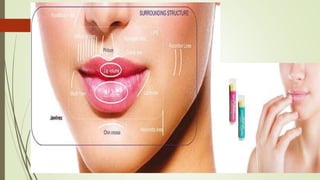
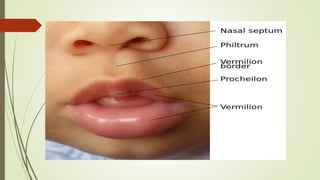
 The upper and lower lips are referred to as the "Labium superius oris" and "Labium
inferius oris". The junction where the lips meet the surrounding skin of the mouth
area is the vermilion border, and the typically reddish area within the borders is
called the vermilion zone. The vermilion border of the upper lip is known as
the cupid's bow.
 The fleshy protuberance located in the center of the upper lip is a tubercle known
by various terms including the procheilon (also spelled prochilon), the "tuberculum
labii superioris", and the "labial tubercle". The vertical groove extending from the
procheilon to the nasal septum is called the philtrum.
 The skin of the lip, with three to five cellular layers, is very thin compared to typical
face skin, which has up to 16 layers.
 With light skin colour, the lip skin contains fewer melanocytes. Because of this,
the blood vessels appear through the skin of the lips, which leads to their notable
red coloring.
The skin of the lip forms the border between the exterior skin of the face, and the
interior mucous membrane of the inside of the mouth
The lip skin is not hairy and does not have sweat glands. Therefore, it does not have the usual
protection layer of sweat and body oils which keep the skin smooth, inhibit pathogens, and
regulate warmth. For these reasons, the lips dry out faster and become chapped more easily.
 Nerve supply:
• Trigeminal nerve
• Infraorbital nerve( It supplies not only the upper lip,
but much of the skin of the face between the upper lip
and the lower eyelid, except for the bridge of the nose.)
• Mental nerve( It supplies the skin and mucous membrane of the lower lip and
labial gingiva (gum) anteriorly.)
 Blood supply
• facial artery is one of the six non-terminal branches of the external
artery.
 Functions:
• Food intake: Lips are used for eating functions, like holding food or to
it in the mouth. Through making a narrow funnel with the lips, the
of the mouth is increased. This suction is essential for babies to breast
feed. Lips can also be used to suck in other contexts, such as sucking on
straw to drink liquids.
 Articulation
 Tactile organ: The lip has many nerve endings and reacts as part of
the tactile (touch) senses. Lips are very sensitive to touch, warmth, and
cold.
 Facial expression
Cleansing and Care
 Lips are very sensitive and can be easily chapped. Soft pink lips denote health but
harsh winters make it difficult to maintain them. The skin on our lips is very thin and
it doesn’t have any oil glands to produce oils naturally. This is why, lack of proper
hydration leads to chapped and dry lips. Winters are extremely rough and you need
to moisturize your lips to protect them from harsh cold.
 Lip balm
 Lip rouge
 Lip jelly
 Lipsticks
 Lip glosses
 Lip pencils
 Lip scrubber
 Lip conditioner
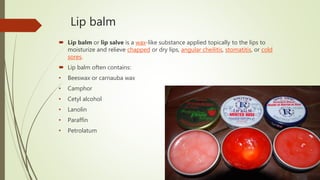
Lip balm
 Lip balm or lip salve is a wax-like substance applied topically to the lips to
moisturize and relieve chapped or dry lips, angular cheilitis, stomatitis, or cold
sores.
 Lip balm often contains:
• Beeswax or carnauba wax
• Camphor
• Cetyl alcohol
• Lanolin
• Paraffin
• Petrolatum
 Some varieties contain dyes, flavor, fragrance, phenol, salicylic acid,
and sunscreens.
 The primary purpose of lip balm is to provide an occlusive layer on the lip surface
to seal moisture in lips and protect them from external exposure.
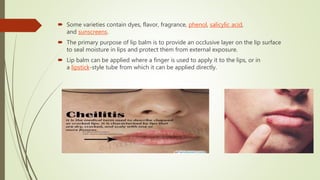
 Lip balm can be applied where a finger is used to apply it to the lips, or in
a lipstick-style tube from which it can be applied directly.
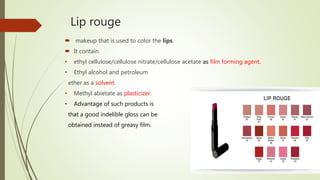
Lip rouge
 makeup that is used to color the lips.
 It contain
• ethyl cellulose/cellulose nitrate/cellulose acetate as film forming agent.
• Ethyl alcohol and petroleum
ether as a solvent.
• Methyl abietate as plasticizer.
• Advantage of such products is
that a good indelible gloss can be
obtained instead of greasy film.
 Evaluation tests for rouges:
 Melting point test: determined for cream rouges by capillary tube method
and it should be below 50*C for good application and storage.
 Colour dispersion: done under microscope. Colour particles above size 50
micron, may cause agglomeration so particles should be below this range.
 Sedimentation characteristics: is important for liquid rouges. Viscosity
should be adjusted in such a manner that has low sedimentation.
 Ageing stability: performed by keeping product at 40*C for one month and
compare with fresh one, discarded if it shows difference.
 Accelerated stability study: for liquid or cream rouge it is important that it is
compatible with the container in which it is packed. This can be studied at
higher temperature to predict its normal shelf life.
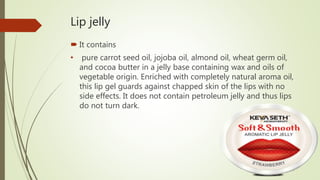
Lip jelly
 It contains
• pure carrot seed oil, jojoba oil, almond oil, wheat germ oil,
and cocoa butter in a jelly base containing wax and oils of
vegetable origin. Enriched with completely natural aroma oil,
this lip gel guards against chapped skin of the lips with no
side effects. It does not contain petroleum jelly and thus lips
do not turn dark.
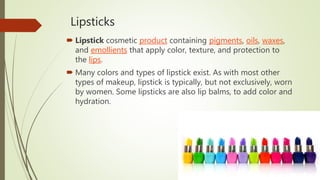
Lipsticks
 Lipstick cosmetic product containing pigments, oils, waxes,
and emollients that apply color, texture, and protection to
the lips.
 Many colors and types of lipstick exist. As with most other
types of makeup, lipstick is typically, but not exclusively, worn
by women. Some lipsticks are also lip balms, to add color and
hydration.
 Characteristics:
 Should make the lips soft.
 Should have high retention of colour intensity without any
change in shade.
 Should be non-irritating to the skin of lips.
 Should have pleasant odour and flavour.
 A smooth and shiny appearance.
 Should cover the lips adequately with some gloss.
 Have a desirable degree of plasticity.
 Film must adhere firmly to the lips without being brittle and
tacky.
 Composition:
 Basic raw materials required for formulating lipsticks:
• Waxes - white beeswax, candelilla wax, carnauba wax, ceresin wax
• Oils – castor oil (plasticising agent), paraffin oil (not more than 5%), fatty
acid alkyl amides (help in dispersing the pigments).
• Isopropyl myristate, isopropyl palmitate and butyl stearate – used to
facilitate smooth application. Also act as mutual solvents for oils and
waxes.
• Bromo mixture – a solution of the staining dyestuff in a fatty material to
enable the dyestuff to remain either wholly or partially in solution. This is
portion of the product which imparts an indelible stain as distinct from
opaque film of colour given by insoluble pigments.
The dyestuff of bromo mixture consists of fluoresceins, halogenated
fluoresceins and related water insoluble dyes.
Bromo acid 15gm
Propylene glycol 200gm
Propylene glycol monomyristate 100gm
• Colours – used as lipstick pigments.
• The colour is imparted to the lips in two ways:
o By staining the skin with a solution of dyestuff which can penetrate the outer layer
the lip skin.
o By covering the lips with a coloured layer which serves to hide any skin roughness
and give a smooth appearance.
First requirement is met by soluble dyes and other is by insoluble dyes and
which make the film more or less opaque.
 Staining dyes (fluorescein, eosin halogenated fluorescein). Fluorescein and its
derivatives can produce sensitization or photosensitization leading to cheilitis.
 Insoluble dyestuffs and lake colours- consist of calcium, barium, aluminium and
strontium lakes. These dyestuffs are used in 10-15% depending upon the shade
opacity of the film. Aluminium lakes are not usually preferred because of their lack
opacity, but can be used in transparent lipsticks.
 Titanium dioxide is often used at levels up to 1% as white pigment for brightening
the colour, obtaining pink shades.
• Preservatives, fragrances, surfactants and other additives – 0.1% propyl
para hydroxybenzoate. Higher conc. of 0.2% can cause a burning
o Perfumes are used to mask the odour of the fatty or wax base as well as to
impart an attractive flavour. These are used in conc. 2-4%.
o Antioxidants are also be incorporated to prevent rancidification of oily base
during storage. e.g., (BHA), (BHT), citric acid etc.
o Surfactants are occasionally added to the lipstick. Used to promote wetting
and stabilize the dispersion of insoluble pigments in the base. But such
additives may influence the consistency of the stick.
o Oil soluble sun-screens are also used.
 Manufacture of lipsticks: involves four distinct operations namely colour dispersion,
mixing, moulding and flaming.
• Colour dispersion- pigments meant for manufacture of lipsticks are available in fine
powder, but small particles of colour usually form agglomerates of varying size. For
preparing smooth lipstick, agglomerates of colour pigments must be broken down
that free particles are surrounding by oil. Rubbing or shearing force of considerable
magnitude should be applied.(ball mill, roller mill, colloid mill).
If solvent is used for preparation of solution of bromo acids, it is prepared first and
set aside. Lake colours are first dispersed in suitable quantity of oil to make a paste. This
paste is passed through triple roller mill till it free from agglomerates of colour particles.
The colour mix is then mixed with bromo acid mixture. Lower melting point fatty
are melted next and added to the colour mix.
This mixture is passed through the mill until it becomes perfectly smooth. Preservatives
and antioxidants are dissolved in remaining oil and added to the colour mix.
• Mixing- the equipment that is used is jacketed kettle made of inert material
like aluminium, stainless steel, tinned copper. The material after milling is
transferred to the kettle and is heated with steam or water. High melting
point waxes are melted and added to the colour mix and stirred slowly.
Overheating should be avoided. In mixing batch, rapid stirring should
also be avoided as, rapid stirring may introduce air. After the mixture is
completely melted and blended, perfume is added and blended thoroughly.
Next, molten mixture is strained through fine mesh screen and transferred to
moulds.
• Flaming- the sticks are inserted in lipstick containers . After inserting , free ends of
sticks are reheated for a very short time. This make the surface of the stick smooth and
glossy. This process is usually done passing the lipstick through gas flame. The lipstick
is rotated so that entire surface is exposed to heat. Finally, the stick and containers are
examined for any visual defects.
• Moulding- moulds are made of metals like brass, aluminium can be used. Molten
lipsticks is then run on to the seat of mould. Speed should be such that molten mixture
is not splashed outside the mould but fast enough so that the last cavity of the mould
is filled. The moulds are allowed to stand without movement until surplus material has
congealed over the surface.
Next, the surplus material is scrapped off and moulds are transferred to chilled metallic
plate. Over cooling should be avoided. As soon as the lipsticks are firm enough to handle,
moulds are unclamped and lipsticks are pushed out with the help of finger.
Evaluation of lipsticks
 Melting point: determined by capillary tube method by keeping the size of
capillary, length of fill, and rate of heating constant. Another imp. Test of similar
nature is yield point or droop point. Droop point is the temp. at which the lipstick
will melt within the case and ooze out oil or flatten out. Droop point should
preferably be above 50*C for safe handling and storage.
 Breaking point: is done to determine the strength of lipstick. Lipstick is held
horizontally in a socket ½ inch above the bade and wt. is applied on the lipstick, ½
inch away from the edge of the support. The wt. is gradually increased by a specific
value (10gm) at a specific interval of 30 seconds and the wt. at which the lipstick
breaks is considered as the breaking point. Test should be done at a specific
temp.(25*C) and lipstick should be stored at that temp. for at least 30 minutes prior
to the test.
 Thixotropy character (test for penetrability): indication of thixotropic quality and is
done by using penetrometer. A standard needle of specific diameter is allowed to
penetrate for 5 seconds under a 50gm load at 25*C. the lipstick is kept at 25*C
to the experiment. The depth of the penetration is a measurement of the
structure. Penetration of 9 to 10.5mm is indicative of a soft and thixotropic
 Aging stability: the product is stored at 40*C and periodical observation of oil
bleed, crystallization of wax on surface and application characteristics is made.
 Perfume stability: also done by storing 40*C and periodically comparing, after
bringing the temp. down, with a fresh lipstick.
 Oxidative stability: it is predicted by standard determination of peroxide value after
exposure to oxygen under given conditions.
 Surface anomalies: studied by surface defects, such as formation of crystals on
surface, contamination by moulds, fungi etc., exudation of liquid substances and of
solid fatty substances.
 Accelerated stability test: studied at higher temp. (45*C) or alternately keeping at
45*C and 0*C and observing the changes.
 Force of application: two lipsticks are kept opposite way by mechanical holders.
Lower lipstick, standing upright and fixed. Upper lipstick is moving downward, by
mechanical means under a given weight to the flat surface of the lower lipstick. A
strip of smooth paper is attached to a dynamometer and is drawn between the two
lipstick ends at a constant speed. The force required to pull the paper against a
specific weight is measured and compared with those made on other sticks of
diameter.
Alternatively a piece of coarse brown paper can be kept on a shadow graph
and lipstick can be applied, at 45* angle, to cover a 1 square inch area until fully
The pressure reading is an indication of force of application.
Lip gloss
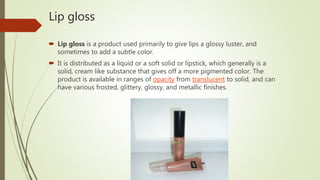
 Lip gloss is a product used primarily to give lips a glossy luster, and
sometimes to add a subtle color.
 It is distributed as a liquid or a soft solid or lipstick, which generally is a
solid, cream like substance that gives off a more pigmented color. The
product is available in ranges of opacity from translucent to solid, and can
have various frosted, glittery, glossy, and metallic finishes.
 Like lipstick, lip gloss is a mixture of waxes, oils, and pigments. However, lip gloss
contains less pigments, and those used are often pale in color or diluted (<3%).
Furthermore, the free-flowing nature of the product requires less wax
 The principal components are lanolin, which feels good on the lips due to its
moisturizing qualities and imparts gloss, and polybutene.
Lip pencil
 Lip liner, also known as a lip pencil, is a cosmetic product. It is intended
to fill in uneven areas on the outer edges of the lips before
applying lipstick to give a smoother shape.
 It is also used to outline the lips, keeping lipstick inside the lip area and
preventing it from "bleeding", creating a bigger contrast and making the
lips stand out more.
 The product is usually sold in a retractable tube or pencil form which can
be sharpened. Lip liner is usually available in the same range of colors as
lipsticks: e.g., reds, pinks, browns, plums, etc. Lip liner also comes in
invisible, for giving the illusion of smooth lips without adding or affecting
color.
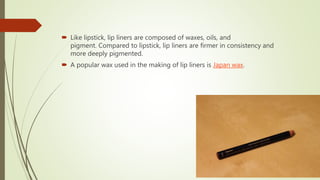
 Like lipstick, lip liners are composed of waxes, oils, and
pigment. Compared to lipstick, lip liners are firmer in consistency and
more deeply pigmented.
 A popular wax used in the making of lip liners is Japan wax.
Lip crayons
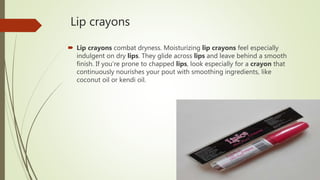
 Lip crayons combat dryness. Moisturizing lip crayons feel especially
indulgent on dry lips. They glide across lips and leave behind a smooth
finish. If you're prone to chapped lips, look especially for a crayon that
continuously nourishes your pout with smoothing ingredients, like
coconut oil or kendi oil.
Lip conditioner
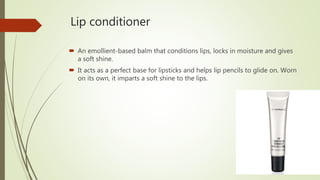
 An emollient-based balm that conditions lips, locks in moisture and gives
a soft shine.
 It acts as a perfect base for lipsticks and helps lip pencils to glide on. Worn
on its own, it imparts a soft shine to the lips.
 With a stacked lineup of super-hydrating ingredients—mango
seed butter, shea butter, jojoba oil, and rice bran oil—this turns painfully
chapped lips soft on the spot.
Lip scrubber
 Lip Scrub, at the start of your make-up routine to ensure your lipstick glides on and
stays put, Just apply with a clean finger, jojoba oil scrub away dead skin and infuse
moisture to rejuvenate your smile.
 Don't use them more than 3-4 times per week.
 To apply: Rub scrub on to lips and exfoliate gently. Let it sit for a minute or two, then
rinse off with warm water. Apply a lip balm afterwards to rehydrate lips. Use 1-2
times weekly.
 Mint Lip Scrub
 Ingredients
• 1/4 cup sugar
• 1 teaspoon honey
• 1 teaspoon olive oil
• 1 drop peppermint oil
Cleansing and care for lips

Cleansing and care for lips

  • 1.
    Cleansing and Carefor lips Monika M.Pharmacy
  • 3.
    Introduction  The upperand lower lips are referred to as the "Labium superius oris" and "Labium inferius oris". The junction where the lips meet the surrounding skin of the mouth area is the vermilion border, and the typically reddish area within the borders is called the vermilion zone. The vermilion border of the upper lip is known as the cupid's bow.  The fleshy protuberance located in the center of the upper lip is a tubercle known by various terms including the procheilon (also spelled prochilon), the "tuberculum labii superioris", and the "labial tubercle". The vertical groove extending from the procheilon to the nasal septum is called the philtrum.  The skin of the lip, with three to five cellular layers, is very thin compared to typical face skin, which has up to 16 layers.  With light skin colour, the lip skin contains fewer melanocytes. Because of this, the blood vessels appear through the skin of the lips, which leads to their notable red coloring.
  • 5.
    The skin ofthe lip forms the border between the exterior skin of the face, and the interior mucous membrane of the inside of the mouth The lip skin is not hairy and does not have sweat glands. Therefore, it does not have the usual protection layer of sweat and body oils which keep the skin smooth, inhibit pathogens, and regulate warmth. For these reasons, the lips dry out faster and become chapped more easily.  Nerve supply: • Trigeminal nerve • Infraorbital nerve( It supplies not only the upper lip, but much of the skin of the face between the upper lip and the lower eyelid, except for the bridge of the nose.) • Mental nerve( It supplies the skin and mucous membrane of the lower lip and labial gingiva (gum) anteriorly.)
  • 6.
     Blood supply •facial artery is one of the six non-terminal branches of the external artery.  Functions: • Food intake: Lips are used for eating functions, like holding food or to it in the mouth. Through making a narrow funnel with the lips, the of the mouth is increased. This suction is essential for babies to breast feed. Lips can also be used to suck in other contexts, such as sucking on straw to drink liquids.  Articulation  Tactile organ: The lip has many nerve endings and reacts as part of the tactile (touch) senses. Lips are very sensitive to touch, warmth, and cold.  Facial expression
  • 7.
    Cleansing and Care Lips are very sensitive and can be easily chapped. Soft pink lips denote health but harsh winters make it difficult to maintain them. The skin on our lips is very thin and it doesn’t have any oil glands to produce oils naturally. This is why, lack of proper hydration leads to chapped and dry lips. Winters are extremely rough and you need to moisturize your lips to protect them from harsh cold.  Lip balm  Lip rouge  Lip jelly  Lipsticks  Lip glosses  Lip pencils  Lip scrubber  Lip conditioner
  • 8.
    Lip balm  Lipbalm or lip salve is a wax-like substance applied topically to the lips to moisturize and relieve chapped or dry lips, angular cheilitis, stomatitis, or cold sores.  Lip balm often contains: • Beeswax or carnauba wax • Camphor • Cetyl alcohol • Lanolin • Paraffin • Petrolatum
  • 9.
     Some varietiescontain dyes, flavor, fragrance, phenol, salicylic acid, and sunscreens.  The primary purpose of lip balm is to provide an occlusive layer on the lip surface to seal moisture in lips and protect them from external exposure.  Lip balm can be applied where a finger is used to apply it to the lips, or in a lipstick-style tube from which it can be applied directly.
  • 10.
    Lip rouge  makeupthat is used to color the lips.  It contain • ethyl cellulose/cellulose nitrate/cellulose acetate as film forming agent. • Ethyl alcohol and petroleum ether as a solvent. • Methyl abietate as plasticizer. • Advantage of such products is that a good indelible gloss can be obtained instead of greasy film.
  • 11.
     Evaluation testsfor rouges:  Melting point test: determined for cream rouges by capillary tube method and it should be below 50*C for good application and storage.  Colour dispersion: done under microscope. Colour particles above size 50 micron, may cause agglomeration so particles should be below this range.  Sedimentation characteristics: is important for liquid rouges. Viscosity should be adjusted in such a manner that has low sedimentation.  Ageing stability: performed by keeping product at 40*C for one month and compare with fresh one, discarded if it shows difference.  Accelerated stability study: for liquid or cream rouge it is important that it is compatible with the container in which it is packed. This can be studied at higher temperature to predict its normal shelf life.
  • 12.
    Lip jelly  Itcontains • pure carrot seed oil, jojoba oil, almond oil, wheat germ oil, and cocoa butter in a jelly base containing wax and oils of vegetable origin. Enriched with completely natural aroma oil, this lip gel guards against chapped skin of the lips with no side effects. It does not contain petroleum jelly and thus lips do not turn dark.
  • 13.
    Lipsticks  Lipstick cosmeticproduct containing pigments, oils, waxes, and emollients that apply color, texture, and protection to the lips.  Many colors and types of lipstick exist. As with most other types of makeup, lipstick is typically, but not exclusively, worn by women. Some lipsticks are also lip balms, to add color and hydration.
  • 14.
     Characteristics:  Shouldmake the lips soft.  Should have high retention of colour intensity without any change in shade.  Should be non-irritating to the skin of lips.  Should have pleasant odour and flavour.  A smooth and shiny appearance.  Should cover the lips adequately with some gloss.  Have a desirable degree of plasticity.  Film must adhere firmly to the lips without being brittle and tacky.
  • 15.
     Composition:  Basicraw materials required for formulating lipsticks: • Waxes - white beeswax, candelilla wax, carnauba wax, ceresin wax • Oils – castor oil (plasticising agent), paraffin oil (not more than 5%), fatty acid alkyl amides (help in dispersing the pigments). • Isopropyl myristate, isopropyl palmitate and butyl stearate – used to facilitate smooth application. Also act as mutual solvents for oils and waxes. • Bromo mixture – a solution of the staining dyestuff in a fatty material to enable the dyestuff to remain either wholly or partially in solution. This is portion of the product which imparts an indelible stain as distinct from opaque film of colour given by insoluble pigments. The dyestuff of bromo mixture consists of fluoresceins, halogenated fluoresceins and related water insoluble dyes.
  • 16.
    Bromo acid 15gm Propyleneglycol 200gm Propylene glycol monomyristate 100gm
  • 17.
    • Colours –used as lipstick pigments. • The colour is imparted to the lips in two ways: o By staining the skin with a solution of dyestuff which can penetrate the outer layer the lip skin. o By covering the lips with a coloured layer which serves to hide any skin roughness and give a smooth appearance. First requirement is met by soluble dyes and other is by insoluble dyes and which make the film more or less opaque.  Staining dyes (fluorescein, eosin halogenated fluorescein). Fluorescein and its derivatives can produce sensitization or photosensitization leading to cheilitis.  Insoluble dyestuffs and lake colours- consist of calcium, barium, aluminium and strontium lakes. These dyestuffs are used in 10-15% depending upon the shade opacity of the film. Aluminium lakes are not usually preferred because of their lack opacity, but can be used in transparent lipsticks.  Titanium dioxide is often used at levels up to 1% as white pigment for brightening the colour, obtaining pink shades.
  • 18.
    • Preservatives, fragrances,surfactants and other additives – 0.1% propyl para hydroxybenzoate. Higher conc. of 0.2% can cause a burning o Perfumes are used to mask the odour of the fatty or wax base as well as to impart an attractive flavour. These are used in conc. 2-4%. o Antioxidants are also be incorporated to prevent rancidification of oily base during storage. e.g., (BHA), (BHT), citric acid etc. o Surfactants are occasionally added to the lipstick. Used to promote wetting and stabilize the dispersion of insoluble pigments in the base. But such additives may influence the consistency of the stick. o Oil soluble sun-screens are also used.
  • 19.
     Manufacture oflipsticks: involves four distinct operations namely colour dispersion, mixing, moulding and flaming. • Colour dispersion- pigments meant for manufacture of lipsticks are available in fine powder, but small particles of colour usually form agglomerates of varying size. For preparing smooth lipstick, agglomerates of colour pigments must be broken down that free particles are surrounding by oil. Rubbing or shearing force of considerable magnitude should be applied.(ball mill, roller mill, colloid mill). If solvent is used for preparation of solution of bromo acids, it is prepared first and set aside. Lake colours are first dispersed in suitable quantity of oil to make a paste. This paste is passed through triple roller mill till it free from agglomerates of colour particles. The colour mix is then mixed with bromo acid mixture. Lower melting point fatty are melted next and added to the colour mix. This mixture is passed through the mill until it becomes perfectly smooth. Preservatives and antioxidants are dissolved in remaining oil and added to the colour mix.
  • 20.
    • Mixing- theequipment that is used is jacketed kettle made of inert material like aluminium, stainless steel, tinned copper. The material after milling is transferred to the kettle and is heated with steam or water. High melting point waxes are melted and added to the colour mix and stirred slowly. Overheating should be avoided. In mixing batch, rapid stirring should also be avoided as, rapid stirring may introduce air. After the mixture is completely melted and blended, perfume is added and blended thoroughly. Next, molten mixture is strained through fine mesh screen and transferred to moulds.
  • 21.
    • Flaming- thesticks are inserted in lipstick containers . After inserting , free ends of sticks are reheated for a very short time. This make the surface of the stick smooth and glossy. This process is usually done passing the lipstick through gas flame. The lipstick is rotated so that entire surface is exposed to heat. Finally, the stick and containers are examined for any visual defects. • Moulding- moulds are made of metals like brass, aluminium can be used. Molten lipsticks is then run on to the seat of mould. Speed should be such that molten mixture is not splashed outside the mould but fast enough so that the last cavity of the mould is filled. The moulds are allowed to stand without movement until surplus material has congealed over the surface. Next, the surplus material is scrapped off and moulds are transferred to chilled metallic plate. Over cooling should be avoided. As soon as the lipsticks are firm enough to handle, moulds are unclamped and lipsticks are pushed out with the help of finger.
  • 22.
    Evaluation of lipsticks Melting point: determined by capillary tube method by keeping the size of capillary, length of fill, and rate of heating constant. Another imp. Test of similar nature is yield point or droop point. Droop point is the temp. at which the lipstick will melt within the case and ooze out oil or flatten out. Droop point should preferably be above 50*C for safe handling and storage.  Breaking point: is done to determine the strength of lipstick. Lipstick is held horizontally in a socket ½ inch above the bade and wt. is applied on the lipstick, ½ inch away from the edge of the support. The wt. is gradually increased by a specific value (10gm) at a specific interval of 30 seconds and the wt. at which the lipstick breaks is considered as the breaking point. Test should be done at a specific temp.(25*C) and lipstick should be stored at that temp. for at least 30 minutes prior to the test.
  • 23.
     Thixotropy character(test for penetrability): indication of thixotropic quality and is done by using penetrometer. A standard needle of specific diameter is allowed to penetrate for 5 seconds under a 50gm load at 25*C. the lipstick is kept at 25*C to the experiment. The depth of the penetration is a measurement of the structure. Penetration of 9 to 10.5mm is indicative of a soft and thixotropic  Aging stability: the product is stored at 40*C and periodical observation of oil bleed, crystallization of wax on surface and application characteristics is made.  Perfume stability: also done by storing 40*C and periodically comparing, after bringing the temp. down, with a fresh lipstick.  Oxidative stability: it is predicted by standard determination of peroxide value after exposure to oxygen under given conditions.
  • 24.
     Surface anomalies:studied by surface defects, such as formation of crystals on surface, contamination by moulds, fungi etc., exudation of liquid substances and of solid fatty substances.  Accelerated stability test: studied at higher temp. (45*C) or alternately keeping at 45*C and 0*C and observing the changes.  Force of application: two lipsticks are kept opposite way by mechanical holders. Lower lipstick, standing upright and fixed. Upper lipstick is moving downward, by mechanical means under a given weight to the flat surface of the lower lipstick. A strip of smooth paper is attached to a dynamometer and is drawn between the two lipstick ends at a constant speed. The force required to pull the paper against a specific weight is measured and compared with those made on other sticks of diameter. Alternatively a piece of coarse brown paper can be kept on a shadow graph and lipstick can be applied, at 45* angle, to cover a 1 square inch area until fully The pressure reading is an indication of force of application.
  • 25.
    Lip gloss  Lipgloss is a product used primarily to give lips a glossy luster, and sometimes to add a subtle color.  It is distributed as a liquid or a soft solid or lipstick, which generally is a solid, cream like substance that gives off a more pigmented color. The product is available in ranges of opacity from translucent to solid, and can have various frosted, glittery, glossy, and metallic finishes.
  • 26.
     Like lipstick,lip gloss is a mixture of waxes, oils, and pigments. However, lip gloss contains less pigments, and those used are often pale in color or diluted (<3%). Furthermore, the free-flowing nature of the product requires less wax  The principal components are lanolin, which feels good on the lips due to its moisturizing qualities and imparts gloss, and polybutene.
  • 27.
    Lip pencil  Lipliner, also known as a lip pencil, is a cosmetic product. It is intended to fill in uneven areas on the outer edges of the lips before applying lipstick to give a smoother shape.  It is also used to outline the lips, keeping lipstick inside the lip area and preventing it from "bleeding", creating a bigger contrast and making the lips stand out more.  The product is usually sold in a retractable tube or pencil form which can be sharpened. Lip liner is usually available in the same range of colors as lipsticks: e.g., reds, pinks, browns, plums, etc. Lip liner also comes in invisible, for giving the illusion of smooth lips without adding or affecting color.
  • 28.
     Like lipstick,lip liners are composed of waxes, oils, and pigment. Compared to lipstick, lip liners are firmer in consistency and more deeply pigmented.  A popular wax used in the making of lip liners is Japan wax.
  • 29.
    Lip crayons  Lipcrayons combat dryness. Moisturizing lip crayons feel especially indulgent on dry lips. They glide across lips and leave behind a smooth finish. If you're prone to chapped lips, look especially for a crayon that continuously nourishes your pout with smoothing ingredients, like coconut oil or kendi oil.
  • 30.
    Lip conditioner  Anemollient-based balm that conditions lips, locks in moisture and gives a soft shine.  It acts as a perfect base for lipsticks and helps lip pencils to glide on. Worn on its own, it imparts a soft shine to the lips.
  • 31.
     With astacked lineup of super-hydrating ingredients—mango seed butter, shea butter, jojoba oil, and rice bran oil—this turns painfully chapped lips soft on the spot.
  • 32.
    Lip scrubber  LipScrub, at the start of your make-up routine to ensure your lipstick glides on and stays put, Just apply with a clean finger, jojoba oil scrub away dead skin and infuse moisture to rejuvenate your smile.  Don't use them more than 3-4 times per week.  To apply: Rub scrub on to lips and exfoliate gently. Let it sit for a minute or two, then rinse off with warm water. Apply a lip balm afterwards to rehydrate lips. Use 1-2 times weekly.  Mint Lip Scrub  Ingredients • 1/4 cup sugar • 1 teaspoon honey • 1 teaspoon olive oil • 1 drop peppermint oil