LIPSTICK
NAME - AYESHA
HASHIM
CLASS - 12TH SCI 'C’
Acknowledgement
I would like to express my immense gratitude to my chemistry teacher Mr. Vikas Upadhyay, for the help and guidance he
provided for completing the investigatory project.
I also thank my parents who gave their ideas and inputs in making this project. Most of all I thank our school
management, for providing us the facilities and opportunities to do this project.
Lastly, I would like to thank my schoolmates who have rendered and done this project along with me. Their support made
this project fruitful.
Ayesha Hashim
Certificate
This is to certify that Ayesha Hashim (student of class 12th Sci ‘C’ Kids Corner Happy Sr. Sec. School, Fzd.) has
successfully completed research in the below given project under the heading ‘LIPSTICK’ during the academic
session 2023-2024 under the guidance of Mr. Vikas Upadhyay.
Signature of Principal
Signature of external examiner
Signature of chemistry teacher
Points to be
studied…
● Definition
● Characteristics
● Composition
● Formulation related problems
● Moulding related problems
● Evaluation of finished products
● Marketed products
Definition… ● Also called as lip cosmetics, widely used by
women.
● It may be refer as color cosmetics.
● Lipstick is a cosmetic product containing
pigments, oils, waxes, and emollients that
applies color and texture to the lips.
● There are many varieties of lipstick.
● Lippy is a common British word for lipstick.
Characteristics….
● Should cover lips adequately
● Long last effect
● Make lips soft
● Must adhere firmly to lips without being brittle &
tacky
● Good degree of quality
● Completely free from grittiness
● Non-drying
● Non- irritating to skin of lips
● Desirable degree of plasticity
● Should have high retention of colors intensity
without any change in shades
● Pleasant odor & flavor
● Free from sweating
● Shiny & smooth appearance
● Easily applicable & removable
● Stable both physically & chemically
Composition…
● Wax mixture
● Oil mixture
● Bromo mixture
● Colors
● Preservatives
● Fragrance
● Antioxidants
● Surfactants & other additives
The gloss & hardness are generally depends on
characteristics & quantity of waxes
Best characteristic is obtained by using mixture of
waxes of different m.p & adjusting the final m.p by
incorporating a sufficient amount of high m.p. wax.
WAXES…
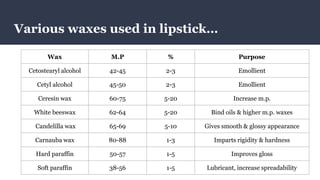
Various waxes used in lipstick…
Wax M.P % Purpose
Cetostearyl alcohol 42-45 2-3 Emollient
Cetyl alcohol 45-50 2-3 Emollient
Ceresin wax 60-75 5-20 Increase m.p.
White beeswax 62-64 5-20 Bind oils & higher m.p. waxes
Candelilla wax 65-69 5-10 Gives smooth & glossy appearance
Carnauba wax 80-88 1-3 Imparts rigidity & hardness
Hard paraffin 50-57 1-5 Improves gloss
Soft paraffin 38-56 1-5 Lubricant, increase spreadability
OILS…
● The oil mixture is required to blend properly with
the waxes to provide a suitable film on the applied
lip skin.
● Also acts as solvent in some formulation.
● Acts as dispersing agent for insoluble pigments.
● The ideal mixture of oil should produce the
product, easily spread & produce a thin film with
good covering power.
Examples:
● Castor oil
● Tetrahydrofurfuryl alcohol (THFA) & esters
● Fatty acid alkylamides
● Paraffin oil
● Isopropyl myristate
● Isopropyl palmitate
● Butyl stearate
BROMO
MIXTURE…
● Maintain the physical form of the formulation
● Also called as bromo acids
● Two classes:
Red: gives red or reddish blue stain
Orange, red: gives pink to yellowish pink stain
● About 2-3% bromo acids are used in lipstick
● Solvent used to be mixed with bromo acids:
Castor oil & butyl stearate
THFA & esters like acetate, stearate & benzoate
Glyceryl monostearate or monolaurate & diethylene
glycol monostearate
PG or PEG
Bromo Acid 15gm
PG 200gm
PG monomyristate 100gm
Examples of bromo mixture
Procedure
● Mix bromo acid solution & PG (for clearing each other)
● Add PG monomyristate
● Which gives bromo acid that easily mixes with mineral oil & castor oil & produces
a homogenous mass with waxes.
COLORS…
● Most important from commercial & appearance
point of view.
● In olden days, carmine was widely used, but
nowadays various other are available.
● Color in lipstick is imparted by two ways:
By staining the skin with soln of dyestuff which can
penetrate the outer layer of skin-SOLUBLE DYES
By covering the lips with a colored layer which
serves to hide any skin roughness & give a smooth
appearance ---- INSOLUBLE DYES
Soluble Dyes / Staining Dyes:
- Example:
Fluorescein,
. Eosin
. Insoluble Dyes / Nonstaining Dyes / lake colors:
- Example:
• Lakes of Calcium, Barium, Aluminium, Strontium
• Used in 10-15% concentration based on shade
Ti*O_{2} is generally used in conc. of 1% for pink shade
PRESERVATIONS Used to prevent microbial growth
. Example:
- 0.1% propyl parahydrohybenzoate in 0.1%
Higher conc. of preservative can cause slightly burning
. sensation or allergic reaction.
FRAGRANCE…
Essential component of lipstick
Used to mask bad odor of fatty or wax
Used to impart attractive flavor
Conc. 2-4%
Qualities for selection:
- Free from irritating effect
Free from disagreeable taste
- Stable & compatible with other ings.
ANTIOXIDANTS…
. Incorporated to prevent rancidification of oily base
during storage.
Generally used in combination
Example:
- BHA,
- BHT.
- Propyl gallate,
- Citric acid
SURFACTANTS &
OTHER
ADDITIVES…
SURFACTANTS:Used to promote wetting & stabilize the
dispersion of insoluble pigments in lipstick base
ADDITIVES: used for various purposes
Oil - soluble sunscreen: filter the sunrays & protect lip skin
from sun burn.
Silicon fluid: used as fixative & prevent colors, from
bleeding on lips.
PVP: (conc. 0.5 - 1% ) film former on lips & reduce allergic
reaction of other ings. in lipstick.
Isopropyl linoleate: prevent drying effect.
Formula & Procedure
Ingredients Quantity Given
Carnauba Wax 10
Lanolin 5
Cetyl Alcohol 5
Castor Oil 65
Bromo Acid 2% of base weight
Colour Pigment (FeO + TiO2) 5% of base weight
Perfume q.s.
Bees Wax 15
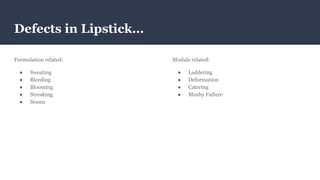
Defects in Lipstick…
Formulation related:
● Sweating
● Bleeding
● Blooming
● Streaking
● Seams
Module related:
● Laddering
● Deformation
● Catering
● Mushy Failure
Evaluation of
Finished
Products…
● Color control
● Determination of Melting Point (Heat Test)
● Softening Point
● Microbial Testing
● Rancidity
● Rupture Test
● Breaking Load Test
Marketed
Products…
● Lakme
● ELE-18
Bibliography… www.wikipedia.com
www.sciencejournals.com
www.encyclopedia.com
www.zetascience.com
www.scribd.com

LIPSTICK. Presentation class. .pptx

  • 1.
  • 2.
    Acknowledgement I would liketo express my immense gratitude to my chemistry teacher Mr. Vikas Upadhyay, for the help and guidance he provided for completing the investigatory project. I also thank my parents who gave their ideas and inputs in making this project. Most of all I thank our school management, for providing us the facilities and opportunities to do this project. Lastly, I would like to thank my schoolmates who have rendered and done this project along with me. Their support made this project fruitful. Ayesha Hashim
  • 3.
    Certificate This is tocertify that Ayesha Hashim (student of class 12th Sci ‘C’ Kids Corner Happy Sr. Sec. School, Fzd.) has successfully completed research in the below given project under the heading ‘LIPSTICK’ during the academic session 2023-2024 under the guidance of Mr. Vikas Upadhyay. Signature of Principal Signature of external examiner Signature of chemistry teacher
  • 4.
    Points to be studied… ●Definition ● Characteristics ● Composition ● Formulation related problems ● Moulding related problems ● Evaluation of finished products ● Marketed products
  • 5.
    Definition… ● Alsocalled as lip cosmetics, widely used by women. ● It may be refer as color cosmetics. ● Lipstick is a cosmetic product containing pigments, oils, waxes, and emollients that applies color and texture to the lips. ● There are many varieties of lipstick. ● Lippy is a common British word for lipstick.
  • 6.
    Characteristics…. ● Should coverlips adequately ● Long last effect ● Make lips soft ● Must adhere firmly to lips without being brittle & tacky ● Good degree of quality ● Completely free from grittiness ● Non-drying ● Non- irritating to skin of lips ● Desirable degree of plasticity ● Should have high retention of colors intensity without any change in shades ● Pleasant odor & flavor ● Free from sweating ● Shiny & smooth appearance ● Easily applicable & removable ● Stable both physically & chemically
  • 7.
    Composition… ● Wax mixture ●Oil mixture ● Bromo mixture ● Colors ● Preservatives ● Fragrance ● Antioxidants ● Surfactants & other additives
  • 8.
    The gloss &hardness are generally depends on characteristics & quantity of waxes Best characteristic is obtained by using mixture of waxes of different m.p & adjusting the final m.p by incorporating a sufficient amount of high m.p. wax. WAXES…
  • 9.
    Various waxes usedin lipstick… Wax M.P % Purpose Cetostearyl alcohol 42-45 2-3 Emollient Cetyl alcohol 45-50 2-3 Emollient Ceresin wax 60-75 5-20 Increase m.p. White beeswax 62-64 5-20 Bind oils & higher m.p. waxes Candelilla wax 65-69 5-10 Gives smooth & glossy appearance Carnauba wax 80-88 1-3 Imparts rigidity & hardness Hard paraffin 50-57 1-5 Improves gloss Soft paraffin 38-56 1-5 Lubricant, increase spreadability
  • 10.
    OILS… ● The oilmixture is required to blend properly with the waxes to provide a suitable film on the applied lip skin. ● Also acts as solvent in some formulation. ● Acts as dispersing agent for insoluble pigments. ● The ideal mixture of oil should produce the product, easily spread & produce a thin film with good covering power. Examples: ● Castor oil ● Tetrahydrofurfuryl alcohol (THFA) & esters ● Fatty acid alkylamides ● Paraffin oil ● Isopropyl myristate ● Isopropyl palmitate ● Butyl stearate
  • 11.
    BROMO MIXTURE… ● Maintain thephysical form of the formulation ● Also called as bromo acids ● Two classes: Red: gives red or reddish blue stain Orange, red: gives pink to yellowish pink stain ● About 2-3% bromo acids are used in lipstick ● Solvent used to be mixed with bromo acids: Castor oil & butyl stearate THFA & esters like acetate, stearate & benzoate Glyceryl monostearate or monolaurate & diethylene glycol monostearate PG or PEG
  • 12.
    Bromo Acid 15gm PG200gm PG monomyristate 100gm Examples of bromo mixture Procedure ● Mix bromo acid solution & PG (for clearing each other) ● Add PG monomyristate ● Which gives bromo acid that easily mixes with mineral oil & castor oil & produces a homogenous mass with waxes.
  • 13.
    COLORS… ● Most importantfrom commercial & appearance point of view. ● In olden days, carmine was widely used, but nowadays various other are available. ● Color in lipstick is imparted by two ways: By staining the skin with soln of dyestuff which can penetrate the outer layer of skin-SOLUBLE DYES By covering the lips with a colored layer which serves to hide any skin roughness & give a smooth appearance ---- INSOLUBLE DYES
  • 14.
    Soluble Dyes /Staining Dyes: - Example: Fluorescein, . Eosin . Insoluble Dyes / Nonstaining Dyes / lake colors: - Example: • Lakes of Calcium, Barium, Aluminium, Strontium • Used in 10-15% concentration based on shade Ti*O_{2} is generally used in conc. of 1% for pink shade
  • 15.
    PRESERVATIONS Used toprevent microbial growth . Example: - 0.1% propyl parahydrohybenzoate in 0.1% Higher conc. of preservative can cause slightly burning . sensation or allergic reaction.
  • 16.
    FRAGRANCE… Essential component oflipstick Used to mask bad odor of fatty or wax Used to impart attractive flavor Conc. 2-4% Qualities for selection: - Free from irritating effect Free from disagreeable taste - Stable & compatible with other ings.
  • 17.
    ANTIOXIDANTS… . Incorporated toprevent rancidification of oily base during storage. Generally used in combination Example: - BHA, - BHT. - Propyl gallate, - Citric acid
  • 18.
    SURFACTANTS & OTHER ADDITIVES… SURFACTANTS:Used topromote wetting & stabilize the dispersion of insoluble pigments in lipstick base ADDITIVES: used for various purposes Oil - soluble sunscreen: filter the sunrays & protect lip skin from sun burn. Silicon fluid: used as fixative & prevent colors, from bleeding on lips. PVP: (conc. 0.5 - 1% ) film former on lips & reduce allergic reaction of other ings. in lipstick. Isopropyl linoleate: prevent drying effect.
  • 19.
    Formula & Procedure IngredientsQuantity Given Carnauba Wax 10 Lanolin 5 Cetyl Alcohol 5 Castor Oil 65 Bromo Acid 2% of base weight Colour Pigment (FeO + TiO2) 5% of base weight Perfume q.s. Bees Wax 15
  • 20.
    Defects in Lipstick… Formulationrelated: ● Sweating ● Bleeding ● Blooming ● Streaking ● Seams Module related: ● Laddering ● Deformation ● Catering ● Mushy Failure
  • 21.
    Evaluation of Finished Products… ● Colorcontrol ● Determination of Melting Point (Heat Test) ● Softening Point ● Microbial Testing ● Rancidity ● Rupture Test ● Breaking Load Test
  • 22.
  • 23.