A Survey on Linux Volatile Memory
Forensic Techniques
Suba Surianarayanan
suba.suri@gmail.com

Dr. V. Uma Maheswari
umam_in@yahoo.com

College Of Engineering, Chennai
Anna University
INTRODUCTION

Various threats to a Linux machine

 Loadable kernel modules

 Directly accessible kernel Memory in some versions of Linux
  - /dev/kmem
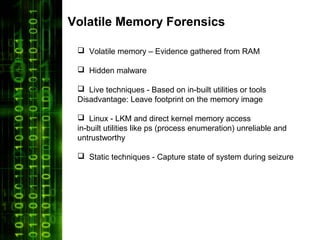
Volatile Memory Forensics

  Volatile memory – Evidence gathered from RAM

  Hidden malware

  Live techniques - Based on in-built utilities or tools
 Disadvantage: Leave footprint on the memory image

  Linux - LKM and direct kernel memory access
 in-built utilities like ps (process enumeration) unreliable and
 untrustworthy

  Static techniques - Capture state of system during seizure
Linux Volatile Memory Forensics -
Challenges
 Numerous builds and versions – Challenges applicability of
techniques

 Kernel structure changes between versions

 Security vulnerabilities – LKM and Direct access of
/dev/kmem
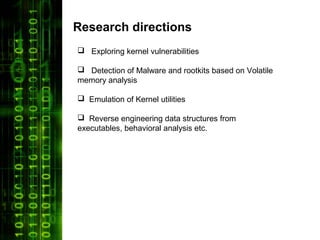
Research directions
 Exploring kernel vulnerabilities

 Detection of Malware and rootkits based on Volatile
memory analysis

 Emulation of Kernel utilities

 Reverse engineering data structures from
executables, behavioral analysis etc.
Deriving Kernel data structures

 Reverse engineering kernel data structures – from
executable [10]

 Graph based signatures (pointer pattern based) [11]

 Utilization of debugging information [5]

 Simulation of utilities based on kernel structures [13]

 Understanding kernel data structures forms the core of
Volatile memory forensics – eg. enables detection of
Hidden Processes [9], [15], [16], [17]
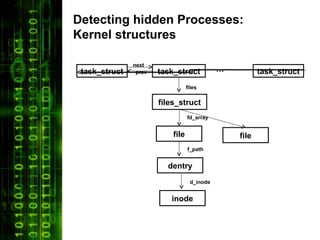
Detecting hidden Processes:
Kernel structures

               next
 task_struct    prev   task_struct           …          task_struct
                                  files

                       files_struct
                                  fd_array


                           file                  file
                                  f_path


                         dentry
                                   d_inode


                          inode
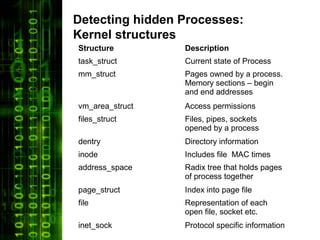
Detecting hidden Processes:
Kernel structures
Structure        Description
task_struct      Current state of Process
mm_struct        Pages owned by a process.
                 Memory sections – begin
                 and end addresses
vm_area_struct   Access permissions
files_struct     Files, pipes, sockets
                 opened by a process
dentry           Directory information
inode            Includes file MAC times
address_space    Radix tree that holds pages
                 of process together
page_struct      Index into page file
file             Representation of each
                 open file, socket etc.
inet_sock        Protocol specific information
Detecting hidden Processes:
Kernel structures (Kernel 2.6.32)
struct task_struct {
    [0] volatile long int state;
    [4] void *stack;
    [8] atomic_t usage;
   [12] unsigned int flags;
   [16] unsigned int ptrace;
   [20] int lock_depth;
   [24] int prio;
   [28] int static_prio;
   [32] int normal_prio;
   [36] unsigned int rt_priority;
   [40] const struct sched_class *sched_class;
   [44] struct sched_entity se;
  [376] struct sched_rt_entity rt;
  [412] struct hlist_head preempt_notifiers;
  [416] unsigned char fpu_counter;
  [420] unsigned int btrace_seq;
  [424] unsigned int policy;
  [428] cpumask_t cpus_allowed;
  [432] struct sched_info sched_info;
  [464] struct list_head tasks; //Circular linked list of processes,
tasks.next and task.prev
   …
   [3248] struct memcg_batch_info memcg_batch;
}
SIZE: 3264
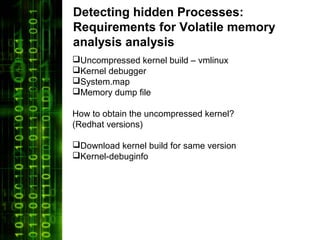
Detecting hidden Processes:
Requirements for Volatile memory
analysis analysis
Uncompressed kernel build – vmlinux
Kernel debugger
System.map
Memory dump file

How to obtain the uncompressed kernel?
(Redhat versions)

Download kernel build for same version
Kernel-debuginfo
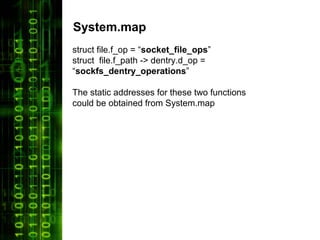
System.map
struct file.f_op = “socket_file_ops”
struct file.f_path -> dentry.d_op =
“sockfs_dentry_operations”

The static addresses for these two functions
could be obtained from System.map
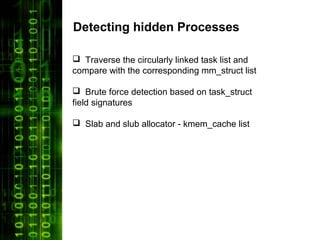
Detecting hidden Processes

 Traverse the circularly linked task list and
compare with the corresponding mm_struct list

 Brute force detection based on task_struct
field signatures

 Slab and slub allocator - kmem_cache list
Locating Kernel structures from
Memory Dump
Types of data structures
(1)Static
(2)Dynamic

Locating static data structures
 Using, System.map file
 Contains name and address of every static
data structure in kernel
 Created during kernel build process using nm
on the compiled vmlinux file

Locating dynamic data structures
 Derive from static data structures
Malware detection techniques

Based on:

 Data access patterns and structural signatures
[4],[6],[8]

 Binary analysis based on instruction sequence
[12]

 task structure analysis [14]
Malware detection techniques [4]

Inter-structure pointers:

struct socket_alloc{
  [0] struct socket socket;
  [1] struct inode vfs_inode; //0x28
}
size: 392
Malware detection techniques [4]
     socket_alloc
0
                                  dentry
                    struct file
            file     f_dentry     d_inode


40


        vfs_inode
Rootkit Detection

Hidden Rootkit – DKOM and Function hooking

Remain undetected through normal modes of
detection such as ps

Finding hidden objects such as sockets and
processes based on field types and inter-structure
pointers in kernel structures [4, 6]

Behavioral analysis – such as data access
patterns [8]
Classification of various techniques
Title                    Analysis type   Application
Detecting stealthy
malware with Inter-
Structure and            In-execution    Malware detection
imported Signatures
[4]
Characterizing Kernel
Malware Behavior
                         In-execution    Malware detection
with Kernel Data
Access Patterns [8]
In-Execution Malware
Detection using Task
                         In-execution    Malware detection
Structures of Linux
Processes [14]
Detecting Kernel-level
Rootkits
                         In-execution    Rootkit detection
using Data Structure
Invariants [6]
Detecting Kernel-        Pre execution   Rootkit detection
Level Rootkits
Through Binary
Analysis [12]
Locating 386 paging      Memory dump     Hidden process
structures in memory     analysis        detection
images [9]
Classification of various techniques

Title                     Analysis type          Application
FACE: Automated digital   Memory dump analysis   Evidence correlation
evidence discovery and
correlation [13]
The 7 dwarves:            Post execution         Identification of Kernel
debugging information                            structure offsets
beyond gdb [5]
SigGraph: Brute Force     In-execution           Identification of Kernel
Scanning of Kernel Data                          structures
Structure Instances
Using
Graph-based Signatures
[11]
Automatic Reverse        In-execution            Identification of Kernel
Engineering of Data                              structures from memory
Structures from Binary                           image
Execution [10]
An Analysis of Linux RAM Memory dump analysis    Identification of
Forensics [16]                                   forensically relevant data
                                                 structures (SUSE Linux
                                                 kernel 2.6)
Linux Memory Forensic:    Memory dump analysis   Identification of
Searching for processes                          forensically relevant data
[17]                                             structures (kernel version
                                                 2.6.20 and 2.4.23)
Conclusion and future trends
 Understanding the Kernel memory structures
of the target system forms the basis of Volatile
memory forensics

 task_struct and System.map are the starting
points of such analysis on a Linux machine

 Frameworks and techniques applicable
across kernel versions

 Interpretation of collected evidence

 User-friendly report format
References

[1] Wikipedia, http://en.wikipedia.org/wiki/Cyber_forensics
[2] ”Crash utility”, http://people.redhat.com/anderson/crash_whitepaper/
[3] Case, A., Marziale, L., Richard, G.G., “Dynamic recreation of kernel data
structures for live forensics”, Digital Investigations, 2010
[4] Liang, B., You, W., Shi, W., Liang, Z., “Detecting stealthy malware with Inter-
Structure and imported Signatures”, Proceedings of the 6th ACM Symposium on
Information, Computer and Communications Security, 2011
[5] Arnaldo Carvalho de Melo, "The 7 dwarves: debugging information beyond
gdb", Proceedings of the Linux Symposium, 2007
[6] Baliga, A., “Detecting Kernel-level Rootkits using Data Structure Invariants,
IEEE Transactions on Dependable and Secure Computing”, 2011
[7] Ramaswamy, A., “Detecting Kernel rootkits”, Dartmouth College Masters
Thesis, 2008
[8] Rhee, J., Lin, Z., Xu, D., “Characterizing Kernel Malware Behavior with Kernel
Data Access Patterns”, Proceedings of the 6th ACM Symposium on Information,
Computer and Communications Security, 2011
[9] Saur, K., Julian B. Grizzard, “Locating 386 paging structures in memory
images”, Digital Investigations, 2010
[10] Lin, Z., Zhang, X., Xu, D., “Automatic Reverse Engineering of Data
Structures from Binary Execution”, the 17th Network and Distributed System
Security Symposium, 2010
[11] Lin, Z., “SigGraph: Brute Force Scanning of Kernel Data Structure Instances
Using Graph-based Signatures”, 40th Annual IEEE/IFIP International Conference
on Dependable Systems and Networks, 2010
References

[12] Christopher , K., “Detecting Kernel-Level Rootkits Through Binary Analysis”,
Computer Security Applications Conference, 2004
[13] Case, A., Cristina, A., Marziale, L., Golden G. Richard, Roussev, V., “FACE:
Automated digital evidence discovery and correlation”, Digital Investigations,
2008
[14] Shahzad, F. et al, “In-Execution Malware Detection using Task Structures of
Linux Processes”, IEEE International Conference on Communications, 2011
[15] Burdach, M., “Digital Forensics of the physical memory”, 2005
[16] Urrea, J.M., “An analysis of Linux RAM forensics”, Naval Postgraduate
School Thesis, 2006
[17] Gao, Y., Cao, T., “Linux Memory Forensic: Searching for processes”,
Computer Security Applications Conference, 2010
[18] Movall, P., Nelson, W., Wetzstein, S., “Linux Physical Memory Analysis”,
Proceedings of the annual conference on USENIX Annual Technical Conference,
2005
[19] Wikipedia, http://en.wikipedia.org/wiki/Computer_forensics
[20] DFRWS. Dfrws 2005 forensics challenge,
http://www.dfrws.org/2005/challenge/index.shtml; 2005.
[21] Volatility framework, https://www.volatilesystems.com/default/volatility
Thank you

Linux Forensics

  • 1.
    A Survey onLinux Volatile Memory Forensic Techniques Suba Surianarayanan suba.suri@gmail.com Dr. V. Uma Maheswari umam_in@yahoo.com College Of Engineering, Chennai Anna University
  • 2.
    INTRODUCTION Various threats toa Linux machine  Loadable kernel modules  Directly accessible kernel Memory in some versions of Linux - /dev/kmem
  • 3.
    Volatile Memory Forensics  Volatile memory – Evidence gathered from RAM  Hidden malware  Live techniques - Based on in-built utilities or tools Disadvantage: Leave footprint on the memory image  Linux - LKM and direct kernel memory access in-built utilities like ps (process enumeration) unreliable and untrustworthy  Static techniques - Capture state of system during seizure
  • 4.
    Linux Volatile MemoryForensics - Challenges  Numerous builds and versions – Challenges applicability of techniques  Kernel structure changes between versions  Security vulnerabilities – LKM and Direct access of /dev/kmem
  • 5.
    Research directions  Exploringkernel vulnerabilities  Detection of Malware and rootkits based on Volatile memory analysis  Emulation of Kernel utilities  Reverse engineering data structures from executables, behavioral analysis etc.
  • 6.
    Deriving Kernel datastructures  Reverse engineering kernel data structures – from executable [10]  Graph based signatures (pointer pattern based) [11]  Utilization of debugging information [5]  Simulation of utilities based on kernel structures [13]  Understanding kernel data structures forms the core of Volatile memory forensics – eg. enables detection of Hidden Processes [9], [15], [16], [17]
  • 7.
    Detecting hidden Processes: Kernelstructures next task_struct prev task_struct … task_struct files files_struct fd_array file file f_path dentry d_inode inode
  • 8.
    Detecting hidden Processes: Kernelstructures Structure Description task_struct Current state of Process mm_struct Pages owned by a process. Memory sections – begin and end addresses vm_area_struct Access permissions files_struct Files, pipes, sockets opened by a process dentry Directory information inode Includes file MAC times address_space Radix tree that holds pages of process together page_struct Index into page file file Representation of each open file, socket etc. inet_sock Protocol specific information
  • 9.
    Detecting hidden Processes: Kernelstructures (Kernel 2.6.32) struct task_struct { [0] volatile long int state; [4] void *stack; [8] atomic_t usage; [12] unsigned int flags; [16] unsigned int ptrace; [20] int lock_depth; [24] int prio; [28] int static_prio; [32] int normal_prio; [36] unsigned int rt_priority; [40] const struct sched_class *sched_class; [44] struct sched_entity se; [376] struct sched_rt_entity rt; [412] struct hlist_head preempt_notifiers; [416] unsigned char fpu_counter; [420] unsigned int btrace_seq; [424] unsigned int policy; [428] cpumask_t cpus_allowed; [432] struct sched_info sched_info; [464] struct list_head tasks; //Circular linked list of processes, tasks.next and task.prev … [3248] struct memcg_batch_info memcg_batch; } SIZE: 3264
  • 10.
    Detecting hidden Processes: Requirementsfor Volatile memory analysis analysis Uncompressed kernel build – vmlinux Kernel debugger System.map Memory dump file How to obtain the uncompressed kernel? (Redhat versions) Download kernel build for same version Kernel-debuginfo
  • 11.
    System.map struct file.f_op =“socket_file_ops” struct file.f_path -> dentry.d_op = “sockfs_dentry_operations” The static addresses for these two functions could be obtained from System.map
  • 12.
    Detecting hidden Processes Traverse the circularly linked task list and compare with the corresponding mm_struct list  Brute force detection based on task_struct field signatures  Slab and slub allocator - kmem_cache list
  • 13.
    Locating Kernel structuresfrom Memory Dump Types of data structures (1)Static (2)Dynamic Locating static data structures  Using, System.map file  Contains name and address of every static data structure in kernel  Created during kernel build process using nm on the compiled vmlinux file Locating dynamic data structures  Derive from static data structures
  • 14.
    Malware detection techniques Basedon:  Data access patterns and structural signatures [4],[6],[8]  Binary analysis based on instruction sequence [12]  task structure analysis [14]
  • 15.
    Malware detection techniques[4] Inter-structure pointers: struct socket_alloc{ [0] struct socket socket; [1] struct inode vfs_inode; //0x28 } size: 392
  • 16.
    Malware detection techniques[4] socket_alloc 0 dentry struct file file f_dentry d_inode 40 vfs_inode
  • 17.
    Rootkit Detection Hidden Rootkit– DKOM and Function hooking Remain undetected through normal modes of detection such as ps Finding hidden objects such as sockets and processes based on field types and inter-structure pointers in kernel structures [4, 6] Behavioral analysis – such as data access patterns [8]
  • 18.
    Classification of varioustechniques Title Analysis type Application Detecting stealthy malware with Inter- Structure and In-execution Malware detection imported Signatures [4] Characterizing Kernel Malware Behavior In-execution Malware detection with Kernel Data Access Patterns [8] In-Execution Malware Detection using Task In-execution Malware detection Structures of Linux Processes [14] Detecting Kernel-level Rootkits In-execution Rootkit detection using Data Structure Invariants [6] Detecting Kernel- Pre execution Rootkit detection Level Rootkits Through Binary Analysis [12] Locating 386 paging Memory dump Hidden process structures in memory analysis detection images [9]
  • 19.
    Classification of varioustechniques Title Analysis type Application FACE: Automated digital Memory dump analysis Evidence correlation evidence discovery and correlation [13] The 7 dwarves: Post execution Identification of Kernel debugging information structure offsets beyond gdb [5] SigGraph: Brute Force In-execution Identification of Kernel Scanning of Kernel Data structures Structure Instances Using Graph-based Signatures [11] Automatic Reverse In-execution Identification of Kernel Engineering of Data structures from memory Structures from Binary image Execution [10] An Analysis of Linux RAM Memory dump analysis Identification of Forensics [16] forensically relevant data structures (SUSE Linux kernel 2.6) Linux Memory Forensic: Memory dump analysis Identification of Searching for processes forensically relevant data [17] structures (kernel version 2.6.20 and 2.4.23)
  • 20.
    Conclusion and futuretrends  Understanding the Kernel memory structures of the target system forms the basis of Volatile memory forensics  task_struct and System.map are the starting points of such analysis on a Linux machine  Frameworks and techniques applicable across kernel versions  Interpretation of collected evidence  User-friendly report format
  • 21.
    References [1] Wikipedia, http://en.wikipedia.org/wiki/Cyber_forensics [2]”Crash utility”, http://people.redhat.com/anderson/crash_whitepaper/ [3] Case, A., Marziale, L., Richard, G.G., “Dynamic recreation of kernel data structures for live forensics”, Digital Investigations, 2010 [4] Liang, B., You, W., Shi, W., Liang, Z., “Detecting stealthy malware with Inter- Structure and imported Signatures”, Proceedings of the 6th ACM Symposium on Information, Computer and Communications Security, 2011 [5] Arnaldo Carvalho de Melo, "The 7 dwarves: debugging information beyond gdb", Proceedings of the Linux Symposium, 2007 [6] Baliga, A., “Detecting Kernel-level Rootkits using Data Structure Invariants, IEEE Transactions on Dependable and Secure Computing”, 2011 [7] Ramaswamy, A., “Detecting Kernel rootkits”, Dartmouth College Masters Thesis, 2008 [8] Rhee, J., Lin, Z., Xu, D., “Characterizing Kernel Malware Behavior with Kernel Data Access Patterns”, Proceedings of the 6th ACM Symposium on Information, Computer and Communications Security, 2011 [9] Saur, K., Julian B. Grizzard, “Locating 386 paging structures in memory images”, Digital Investigations, 2010 [10] Lin, Z., Zhang, X., Xu, D., “Automatic Reverse Engineering of Data Structures from Binary Execution”, the 17th Network and Distributed System Security Symposium, 2010 [11] Lin, Z., “SigGraph: Brute Force Scanning of Kernel Data Structure Instances Using Graph-based Signatures”, 40th Annual IEEE/IFIP International Conference on Dependable Systems and Networks, 2010
  • 22.
    References [12] Christopher ,K., “Detecting Kernel-Level Rootkits Through Binary Analysis”, Computer Security Applications Conference, 2004 [13] Case, A., Cristina, A., Marziale, L., Golden G. Richard, Roussev, V., “FACE: Automated digital evidence discovery and correlation”, Digital Investigations, 2008 [14] Shahzad, F. et al, “In-Execution Malware Detection using Task Structures of Linux Processes”, IEEE International Conference on Communications, 2011 [15] Burdach, M., “Digital Forensics of the physical memory”, 2005 [16] Urrea, J.M., “An analysis of Linux RAM forensics”, Naval Postgraduate School Thesis, 2006 [17] Gao, Y., Cao, T., “Linux Memory Forensic: Searching for processes”, Computer Security Applications Conference, 2010 [18] Movall, P., Nelson, W., Wetzstein, S., “Linux Physical Memory Analysis”, Proceedings of the annual conference on USENIX Annual Technical Conference, 2005 [19] Wikipedia, http://en.wikipedia.org/wiki/Computer_forensics [20] DFRWS. Dfrws 2005 forensics challenge, http://www.dfrws.org/2005/challenge/index.shtml; 2005. [21] Volatility framework, https://www.volatilesystems.com/default/volatility
  • 23.