Windows File Systems
Exploring Microsoft File Structures
• In Microsoft file structures, sectors are grouped to form clusters
• Storage allocation units of one or more sectors(blocks)
• Clusters range from 512 bytes up to 32,000 bytes each
• Combining sectors minimizes the overhead of writing or reading files to a
disk
• Clusters are numbered sequentially starting at 0 in NTFS and 2 in FAT
• First sector of all disks contains a system area, the boot record, and a file structure
database
• OS assigns these cluster numbers, called logical addresses
• Sector numbers are called physical addresses
• Clusters and their addresses are specific to a logical disk drive, which is a
disk partition
Disk Partitions
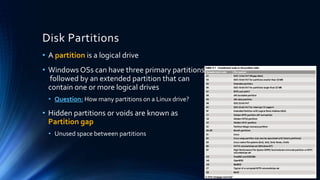
• A partition is a logical drive
• Windows OSs can have three primary partitions
followed by an extended partition that can
contain one or more logical drives
• Question: How many partitions on a Linux drive?
• Hidden partitions or voids are known as
Partition gap
• Unused space between partitions
Disk Partitions
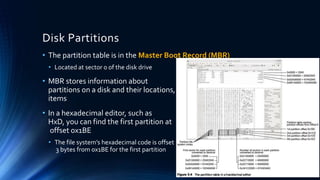
• The partition table is in the Master Boot Record (MBR)
• Located at sector 0 of the disk drive
• MBR stores information about
partitions on a disk and their locations, size, and other important
items
• In a hexadecimal editor, such as
HxD, you can find the first partition at
offset 0x1BE
• The file system’s hexadecimal code is offset
3 bytes from 0x1BE for the first partition
Examining FAT Disks
• File AllocationTable (FAT)
• File structure database that Microsoft originally designed for floppy
disks
• FAT database is typically written to a disk’s outermost track
and contains:
• Filenames, directory names, date and time stamps, the starting cluster
number, and file attributes
• Three current FAT versions
• FAT16, FAT32, and exFAT (Xbox systems)
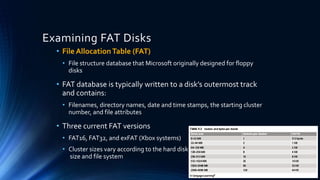
• Cluster sizes vary according to the hard disk
size and file system
Examining FAT Disks
• Microsoft OSs allocate disk space for files by clusters
• Results in drive slack
• Unused space in a cluster between the end of an active file and the end of
the cluster
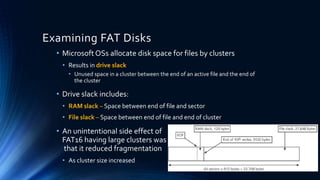
• Drive slack includes:
• RAM slack – Space between end of file and sector
• File slack – Space between end of file and end of cluster
• An unintentional side effect of
FAT16 having large clusters was
that it reduced fragmentation
• As cluster size increased
Examining FAT Disks
• When you run out of room for an allocated cluster
• OS allocates another cluster for your file, which creates more slack space
on the disk
• As files grow and require more disk space, assigned clusters are chained
together
• The chain can be broken or fragmented
• When the OS stores data in a FAT file system, it assigns a starting cluster
position to a file
• Data for the file is written to the first sector of the first assigned cluster
• When this first assigned cluster is filled and runs out of room
• FAT assigns the next available cluster to the file
• If the next available cluster isn’t contiguous to the current cluster
• File becomes fragmented
Deleting FAT Files
• In Microsoft OSs, when a file is deleted
• Directory entry is marked as a deleted file
• With the HEX E5 character replacing the first letter of the
filename
• FAT chain for that file is set to 0
• Data in the file remains on the disk drive
• Area of the disk where the deleted file resides becomes
unallocated disk space
• Available to receive new data from newly created files or other files
needing more space
Examining NTFS Disks
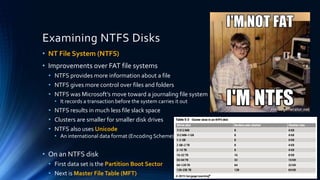
• NT File System (NTFS)
• Improvements over FAT file systems
• NTFS provides more information about a file
• NTFS gives more control over files and folders
• NTFS was Microsoft’s move toward a journaling file system
• It records a transaction before the system carries it out
• NTFS results in much less file slack space
• Clusters are smaller for smaller disk drives
• NTFS also uses Unicode
• An international data format (Encoding Scheme)
• On an NTFS disk
• First data set is the Partition Boot Sector
• Next is Master FileTable (MFT)
NTFS System Files
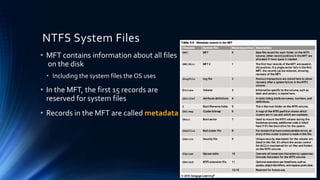
• MFT contains information about all files
on the disk
• Including the system files the OS uses
• In the MFT, the first 15 records are
reserved for system files
• Records in the MFT are called metadata
MFT and File Attributes
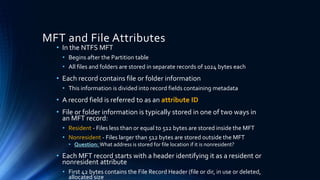
• In the NTFS MFT
• Begins after the Partition table
• All files and folders are stored in separate records of 1024 bytes each
• Each record contains file or folder information
• This information is divided into record fields containing metadata
• A record field is referred to as an attribute ID
• File or folder information is typically stored in one of two ways in
an MFT record:
• Resident - Files less than or equal to 512 bytes are stored inside the MFT
• Nonresident - Files larger than 512 bytes are stored outside the MFT
• Question: What address is stored for file location if it is nonresident?
• Each MFT record starts with a header identifying it as a resident or
nonresident attribute
• First 42 bytes contains the File Record Header (file or dir, in use or deleted,
allocated size
MFT $SIA
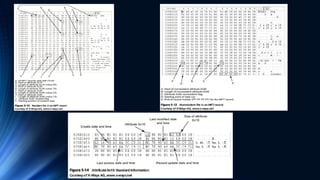
• All have a $STANDARD_INFORMATION_ATTRIBUTE
• 72 Bytes Contains the 64bit timestamps for MAC
• Written in UTC
• Times do not always match the activity
• NTFS delays writing the last accessed time to improve disk performance
• Values stored in the $SIA can be an Indicator of Compromise (IOC)
• Question:Why would the $SIA values indicate a compromise?
MFT $FNA
• All have a $FILE_NAME_ATTRIBUTE
• 66 Bytes of metadata plus the filename
• Contains a reference to the parent directory
NTFS Data Streams
• Each file can contain multiple streams
• Similar to a DVD with multiple language tracks
• Used to store additional file attributes
• Not displayed inWindows Explorer
• Show as attribute 0x80 in
Deleting NTFS Files
• When a file is deleted inWindows NT and later
• The OS renames it and moves it to the Recycle Bin
• Can use the Del (delete) MS-DOS command
• Eliminates the file from the MFT listing in the same way FAT does
Understanding Microsoft Startup Tasks
• Learn what files are accessed when Windows starts
• This information helps you determine when a suspect’s computer was last
accessed
• Important with computers that might have been used after an incident was reported
• When you start aWindows XP NTFS workstation, several files are accessed
immediately
• The last access date and time stamp for the files change to the current date and time
• Destroys any potential evidence
• Startup Files for Windows:
• The Ntldr program inWindows XP used to load the OS has been replaced with these
three boot utilities:
• Bootmgr.exe
• Winload.exe
• Winresume.exe
Summary
• The Master Boot Record (MBR) stores information about partitions
on a disk
• When files are deleted in a FAT file system, the Greek letter sigma
(0x05) is inserted in the first character of the filename in the directory
• NTFS is more versatile because it uses the Master FileTable (MFT) to
track file information
• Records in the MFT contain attribute IDs that store metadata about
files
• Analysis of MFT can provide indicator of compromise (IOC)
• File slack, RAM slack, and drive slack are areas in which valuable
information can reside on a drive

Windows File Systems

  • 1.
  • 2.
    Exploring Microsoft FileStructures • In Microsoft file structures, sectors are grouped to form clusters • Storage allocation units of one or more sectors(blocks) • Clusters range from 512 bytes up to 32,000 bytes each • Combining sectors minimizes the overhead of writing or reading files to a disk • Clusters are numbered sequentially starting at 0 in NTFS and 2 in FAT • First sector of all disks contains a system area, the boot record, and a file structure database • OS assigns these cluster numbers, called logical addresses • Sector numbers are called physical addresses • Clusters and their addresses are specific to a logical disk drive, which is a disk partition
  • 3.
    Disk Partitions • Apartition is a logical drive • Windows OSs can have three primary partitions followed by an extended partition that can contain one or more logical drives • Question: How many partitions on a Linux drive? • Hidden partitions or voids are known as Partition gap • Unused space between partitions
  • 4.
    Disk Partitions • Thepartition table is in the Master Boot Record (MBR) • Located at sector 0 of the disk drive • MBR stores information about partitions on a disk and their locations, size, and other important items • In a hexadecimal editor, such as HxD, you can find the first partition at offset 0x1BE • The file system’s hexadecimal code is offset 3 bytes from 0x1BE for the first partition
  • 5.
    Examining FAT Disks •File AllocationTable (FAT) • File structure database that Microsoft originally designed for floppy disks • FAT database is typically written to a disk’s outermost track and contains: • Filenames, directory names, date and time stamps, the starting cluster number, and file attributes • Three current FAT versions • FAT16, FAT32, and exFAT (Xbox systems) • Cluster sizes vary according to the hard disk size and file system
  • 6.
    Examining FAT Disks •Microsoft OSs allocate disk space for files by clusters • Results in drive slack • Unused space in a cluster between the end of an active file and the end of the cluster • Drive slack includes: • RAM slack – Space between end of file and sector • File slack – Space between end of file and end of cluster • An unintentional side effect of FAT16 having large clusters was that it reduced fragmentation • As cluster size increased
  • 7.
    Examining FAT Disks •When you run out of room for an allocated cluster • OS allocates another cluster for your file, which creates more slack space on the disk • As files grow and require more disk space, assigned clusters are chained together • The chain can be broken or fragmented • When the OS stores data in a FAT file system, it assigns a starting cluster position to a file • Data for the file is written to the first sector of the first assigned cluster • When this first assigned cluster is filled and runs out of room • FAT assigns the next available cluster to the file • If the next available cluster isn’t contiguous to the current cluster • File becomes fragmented
  • 8.
    Deleting FAT Files •In Microsoft OSs, when a file is deleted • Directory entry is marked as a deleted file • With the HEX E5 character replacing the first letter of the filename • FAT chain for that file is set to 0 • Data in the file remains on the disk drive • Area of the disk where the deleted file resides becomes unallocated disk space • Available to receive new data from newly created files or other files needing more space
  • 9.
    Examining NTFS Disks •NT File System (NTFS) • Improvements over FAT file systems • NTFS provides more information about a file • NTFS gives more control over files and folders • NTFS was Microsoft’s move toward a journaling file system • It records a transaction before the system carries it out • NTFS results in much less file slack space • Clusters are smaller for smaller disk drives • NTFS also uses Unicode • An international data format (Encoding Scheme) • On an NTFS disk • First data set is the Partition Boot Sector • Next is Master FileTable (MFT)
  • 10.
    NTFS System Files •MFT contains information about all files on the disk • Including the system files the OS uses • In the MFT, the first 15 records are reserved for system files • Records in the MFT are called metadata
  • 11.
    MFT and FileAttributes • In the NTFS MFT • Begins after the Partition table • All files and folders are stored in separate records of 1024 bytes each • Each record contains file or folder information • This information is divided into record fields containing metadata • A record field is referred to as an attribute ID • File or folder information is typically stored in one of two ways in an MFT record: • Resident - Files less than or equal to 512 bytes are stored inside the MFT • Nonresident - Files larger than 512 bytes are stored outside the MFT • Question: What address is stored for file location if it is nonresident? • Each MFT record starts with a header identifying it as a resident or nonresident attribute • First 42 bytes contains the File Record Header (file or dir, in use or deleted, allocated size
  • 13.
    MFT $SIA • Allhave a $STANDARD_INFORMATION_ATTRIBUTE • 72 Bytes Contains the 64bit timestamps for MAC • Written in UTC • Times do not always match the activity • NTFS delays writing the last accessed time to improve disk performance • Values stored in the $SIA can be an Indicator of Compromise (IOC) • Question:Why would the $SIA values indicate a compromise?
  • 14.
    MFT $FNA • Allhave a $FILE_NAME_ATTRIBUTE • 66 Bytes of metadata plus the filename • Contains a reference to the parent directory
  • 15.
    NTFS Data Streams •Each file can contain multiple streams • Similar to a DVD with multiple language tracks • Used to store additional file attributes • Not displayed inWindows Explorer • Show as attribute 0x80 in
  • 16.
    Deleting NTFS Files •When a file is deleted inWindows NT and later • The OS renames it and moves it to the Recycle Bin • Can use the Del (delete) MS-DOS command • Eliminates the file from the MFT listing in the same way FAT does
  • 17.
    Understanding Microsoft StartupTasks • Learn what files are accessed when Windows starts • This information helps you determine when a suspect’s computer was last accessed • Important with computers that might have been used after an incident was reported • When you start aWindows XP NTFS workstation, several files are accessed immediately • The last access date and time stamp for the files change to the current date and time • Destroys any potential evidence • Startup Files for Windows: • The Ntldr program inWindows XP used to load the OS has been replaced with these three boot utilities: • Bootmgr.exe • Winload.exe • Winresume.exe
  • 18.
    Summary • The MasterBoot Record (MBR) stores information about partitions on a disk • When files are deleted in a FAT file system, the Greek letter sigma (0x05) is inserted in the first character of the filename in the directory • NTFS is more versatile because it uses the Master FileTable (MFT) to track file information • Records in the MFT contain attribute IDs that store metadata about files • Analysis of MFT can provide indicator of compromise (IOC) • File slack, RAM slack, and drive slack are areas in which valuable information can reside on a drive

Editor's Notes

  • #12 Question – cluster or logical address Manipulation of data in the MFT is an anit-forensic activity (used for hiding data and access)