Linux Memory Analysis with Volatility


               Andrew Case
        Digital Forensics Solutions
Purpose of the Talk
• To highlight the Linux analysis capabilities
  integrated into the Volatility framework within
  the last year
• Some of it is implementation of previously
  published works
• The rest is previously never disclosed analysis
  techniques
  – Mostly related to advanced rootkit detection


                                                   2
The General Plugins
• The goal of the general plugins is to recreate
  the set of commands that would be run on a
  Linux system to investigate activity and
  possible compromise
• Recovery of this information has been covered
  in a number of publications by a wide range of
  authors [1]


                                               3
Recovered Process Information
• Process listing (ps aux)
  – Command line arguments are retrieved from
    userland
• Memory Maps (/proc/<pid>/maps)
  – Can also recover (to disk) specific address ranges
• Open Files (/proc/<pid>/fd)


                                                         4
Recovered Networking Information
•   Network interface information (ifconfig)
•   Open and listening sockets (netstat)
•   ARP tables (arp –a)
•   Routing table (route –n)
•   Routing cache (route –C)
•   Queued Packets
•   Netfilter NAT table (/proc/net/nf_conntrack)
    – Src/Dst IP, # of packets sent, and total bytes for
      each NAT’d connection

                                                           5
Recovered Misc. Information
•   Kernel debug buffer (dmesg)
•   Loaded kernel modules (lsmod)
•   Mounted filesystems (mount, /proc/mounts)
•   CPU Info (/proc/cpuinfo)


                                                6
Recovering Historical Information


                                    7
Recovering Historical Information
• Implemented using the kmem_cache analysis
  presented at DFRWS last year [2]
• Briefly, the kmem_cache:
  – Provides a consistent and fast interface to allocate
    objects (C structures) of the same size
  – Keep freelists of previously allocated objects for
    fast allocation
• Walking the freelists provides an orderly
  method to recover previous structures

                                                           8
Results of kmem_cache Analysis
• Can recover a number of useful structures:
  – Processes
  – Memory Maps
  – Networking Information
  – See /proc/slabinfo
• Two limitations:
  – The aggressiveness of the allocator (SLAB / SLUB)
    when removing freelists
  – Needed references being set to NULL or freed on
    deallocation
                                                        9
Rootkit Detection Techniques


                               10
Rootkit Detection Techniques
• Volatility, as well as other projects, has the
  ability to detect boring rootkits techniques:
  – Code (.text) overwriting
  – System Call/IDT hijacking
• Volatility is the only public project to be able
  to detect advanced, data modification-only
  techniques


                                                     11
Leveraging kmem_cache (again)
• We previously discussed using the freelists to
  find historical data
• Can also use the allocated lists to find all
  instances of a particular structure
  – The one caveat is SLUB without debugging on
  – Every distro checked enables SLUB debugging
  – Might be possible to find all references even with
    debugging off


                                                         12
The Idea Behind the Detection
• Dynamic-data rootkit methods work by
  removing structures from lists, hash tables,
  and other data structures
• To detect this tampering, we can take a
  particular cache instance and use this as a
  cross-reference to other stores
• Any structure in the kmem_cache list, but not
  in another, is hidden
  – Inverse holds as well

                                                  13
Live CD Analysis


                   14
Live CD Analysis
• Live CDs present a problem for investigators as
  they run entirely in RAM
  – No disk or filesystem(s) to do forensics analysis on
• Privacy / Anti-Forensics people are aware of
  this – see [5]
  – TAILs privacy live CD that forces all network
    through TOR and discusses avoiding disk forensics
• … but the filesystem is memory!
  – Memory analysis can recover the entire filesystem

                                                       15
Live CD Filesystems
• Live CDs use a stackable filesystem that
  merges multiple filesystems into one view for
  the OS/users
• Live CDs use this to boot off a read-only CD
  and then store all changes in an in-memory
  filesystem (tmpfs)
• Recovery of the in-memory filesystem finds all
  the created & modified files since system boot
  – Immediately reveals the user’s activities
                                                16
Recovering the Filesystem
• Complete details are in [4]
• The recovery plugin recovers the in-memory
  filesystem and writes it to disk
  – Gathers metadata such as MAC times*,
    owner/group, etc
• The recovered FS can be written to a disk
  image using loopback or to other media and
  then mounted read-only for normal
  investigation
                                               17
Android Analysis


                   18
Android Analysis
• If you didn’t know, Android runs Linux
  – Means we can analyze it using similar techniques
• Volatility contains two analysis parts:
  1. Kernel Analysis
  2. Dalvik Analysis


                                                       19
Kernel Analysis
• Same capabilities as discussed throughout
  presentation
• “Porting” to Android (ARM) from Intel only
  required adding an “address space” for the
  architecture
  – Address spaces handle virtual address to physical
    offset translation


                                                        20
Dalvik Analysis
• Dalvik is the software VM for Android
  – Very similar to the JVM
  – Controls all Android applications
• I recently presented on analyzing Dalvik memory
  captures to gather application-specific data [6]
  –   Call Information
  –   Text messages
  –   Emails
  –   And so on…

                                                     21
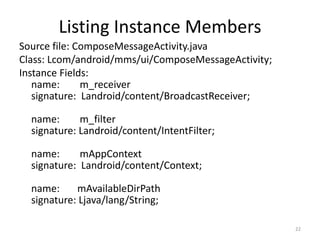
Listing Instance Members
Source file: ComposeMessageActivity.java
Class: Lcom/android/mms/ui/ComposeMessageActivity;
Instance Fields:
   name:      m_receiver
   signature: Landroid/content/BroadcastReceiver;

  name:      m_filter
  signature: Landroid/content/IntentFilter;

  name:      mAppContext
  signature: Landroid/content/Context;

  name:     mAvailableDirPath
  signature: Ljava/lang/String;

                                                     22
Conclusion
• Volatility Linux lives!
   – See the linux-support branch in SVN
   – Support tested on Intel Linux 2.6.9 to 2.6.3x
   – Android/ARM tested on a number of phones
      • Feel free to send me Android tablets if you want
        specific support for them ;)
• Hopefully will have a proper release with all
  the discussed features within the next few
  months

                                                           23
Questions/Comments?
• Contact:
  – andrew@digdeeply.com
  – @attrc


                              24
References
[1] http://4tphi.net/fatkit/
[2] http://dfrws.org/2010/proceedings/2010-305.pdf
[3] http://www.cc.gatech.edu/~brendan/ccs09_siggen.pdf
[4] https://media.blackhat.com/bh-dc-
   11/Case/BlackHat_DC_2011_Case_De-Anonymizing_Live_CDs-
   wp.pdf
[5] http://tails.boum.org/
[6] http://digitalforensicssolutions.com/papers/android-memory-
   analysis.pdf


                                                                  25

Linux Memory Analysis with Volatility

  • 1.
    Linux Memory Analysiswith Volatility Andrew Case Digital Forensics Solutions
  • 2.
    Purpose of theTalk • To highlight the Linux analysis capabilities integrated into the Volatility framework within the last year • Some of it is implementation of previously published works • The rest is previously never disclosed analysis techniques – Mostly related to advanced rootkit detection 2
  • 3.
    The General Plugins •The goal of the general plugins is to recreate the set of commands that would be run on a Linux system to investigate activity and possible compromise • Recovery of this information has been covered in a number of publications by a wide range of authors [1] 3
  • 4.
    Recovered Process Information •Process listing (ps aux) – Command line arguments are retrieved from userland • Memory Maps (/proc/<pid>/maps) – Can also recover (to disk) specific address ranges • Open Files (/proc/<pid>/fd) 4
  • 5.
    Recovered Networking Information • Network interface information (ifconfig) • Open and listening sockets (netstat) • ARP tables (arp –a) • Routing table (route –n) • Routing cache (route –C) • Queued Packets • Netfilter NAT table (/proc/net/nf_conntrack) – Src/Dst IP, # of packets sent, and total bytes for each NAT’d connection 5
  • 6.
    Recovered Misc. Information • Kernel debug buffer (dmesg) • Loaded kernel modules (lsmod) • Mounted filesystems (mount, /proc/mounts) • CPU Info (/proc/cpuinfo) 6
  • 7.
  • 8.
    Recovering Historical Information •Implemented using the kmem_cache analysis presented at DFRWS last year [2] • Briefly, the kmem_cache: – Provides a consistent and fast interface to allocate objects (C structures) of the same size – Keep freelists of previously allocated objects for fast allocation • Walking the freelists provides an orderly method to recover previous structures 8
  • 9.
    Results of kmem_cacheAnalysis • Can recover a number of useful structures: – Processes – Memory Maps – Networking Information – See /proc/slabinfo • Two limitations: – The aggressiveness of the allocator (SLAB / SLUB) when removing freelists – Needed references being set to NULL or freed on deallocation 9
  • 10.
  • 11.
    Rootkit Detection Techniques •Volatility, as well as other projects, has the ability to detect boring rootkits techniques: – Code (.text) overwriting – System Call/IDT hijacking • Volatility is the only public project to be able to detect advanced, data modification-only techniques 11
  • 12.
    Leveraging kmem_cache (again) •We previously discussed using the freelists to find historical data • Can also use the allocated lists to find all instances of a particular structure – The one caveat is SLUB without debugging on – Every distro checked enables SLUB debugging – Might be possible to find all references even with debugging off 12
  • 13.
    The Idea Behindthe Detection • Dynamic-data rootkit methods work by removing structures from lists, hash tables, and other data structures • To detect this tampering, we can take a particular cache instance and use this as a cross-reference to other stores • Any structure in the kmem_cache list, but not in another, is hidden – Inverse holds as well 13
  • 14.
  • 15.
    Live CD Analysis •Live CDs present a problem for investigators as they run entirely in RAM – No disk or filesystem(s) to do forensics analysis on • Privacy / Anti-Forensics people are aware of this – see [5] – TAILs privacy live CD that forces all network through TOR and discusses avoiding disk forensics • … but the filesystem is memory! – Memory analysis can recover the entire filesystem 15
  • 16.
    Live CD Filesystems •Live CDs use a stackable filesystem that merges multiple filesystems into one view for the OS/users • Live CDs use this to boot off a read-only CD and then store all changes in an in-memory filesystem (tmpfs) • Recovery of the in-memory filesystem finds all the created & modified files since system boot – Immediately reveals the user’s activities 16
  • 17.
    Recovering the Filesystem •Complete details are in [4] • The recovery plugin recovers the in-memory filesystem and writes it to disk – Gathers metadata such as MAC times*, owner/group, etc • The recovered FS can be written to a disk image using loopback or to other media and then mounted read-only for normal investigation 17
  • 18.
  • 19.
    Android Analysis • Ifyou didn’t know, Android runs Linux – Means we can analyze it using similar techniques • Volatility contains two analysis parts: 1. Kernel Analysis 2. Dalvik Analysis 19
  • 20.
    Kernel Analysis • Samecapabilities as discussed throughout presentation • “Porting” to Android (ARM) from Intel only required adding an “address space” for the architecture – Address spaces handle virtual address to physical offset translation 20
  • 21.
    Dalvik Analysis • Dalvikis the software VM for Android – Very similar to the JVM – Controls all Android applications • I recently presented on analyzing Dalvik memory captures to gather application-specific data [6] – Call Information – Text messages – Emails – And so on… 21
  • 22.
    Listing Instance Members Sourcefile: ComposeMessageActivity.java Class: Lcom/android/mms/ui/ComposeMessageActivity; Instance Fields: name: m_receiver signature: Landroid/content/BroadcastReceiver; name: m_filter signature: Landroid/content/IntentFilter; name: mAppContext signature: Landroid/content/Context; name: mAvailableDirPath signature: Ljava/lang/String; 22
  • 23.
    Conclusion • Volatility Linuxlives! – See the linux-support branch in SVN – Support tested on Intel Linux 2.6.9 to 2.6.3x – Android/ARM tested on a number of phones • Feel free to send me Android tablets if you want specific support for them ;) • Hopefully will have a proper release with all the discussed features within the next few months 23
  • 24.
    Questions/Comments? • Contact: – andrew@digdeeply.com – @attrc 24
  • 25.
    References [1] http://4tphi.net/fatkit/ [2] http://dfrws.org/2010/proceedings/2010-305.pdf [3]http://www.cc.gatech.edu/~brendan/ccs09_siggen.pdf [4] https://media.blackhat.com/bh-dc- 11/Case/BlackHat_DC_2011_Case_De-Anonymizing_Live_CDs- wp.pdf [5] http://tails.boum.org/ [6] http://digitalforensicssolutions.com/papers/android-memory- analysis.pdf 25