Light and Rays
Reflection and Refraction Key Question: How do we describe the reflection and refraction of light?
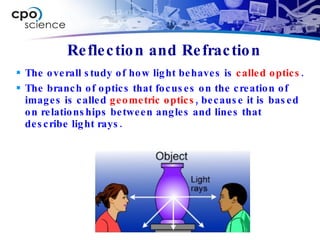
Reflection and Refraction The overall study of how light behaves is  called optics .  The branch of optics that focuses on the creation of images is called  geometric optics , because it is based on relationships between angles and lines that describe light rays.
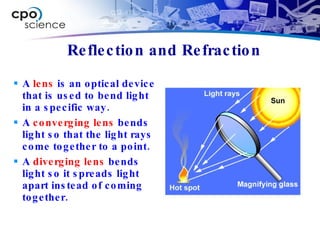
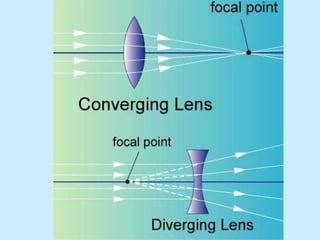
Reflection and Refraction A  lens  is an optical device that is used to bend light in a specific way.  A  converging lens  bends light so that the light rays come together to a point. A  diverging lens  bends light so it spreads light apart instead of coming together.
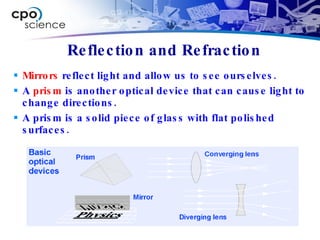
Reflection and Refraction Mirrors  reflect light and allow us to see ourselves. A  prism  is another optical device that can cause light to change directions.  A prism is a solid piece of glass with flat polished surfaces.
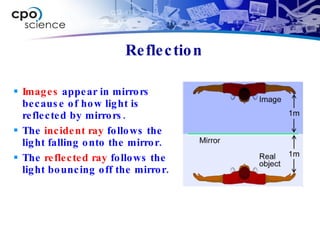
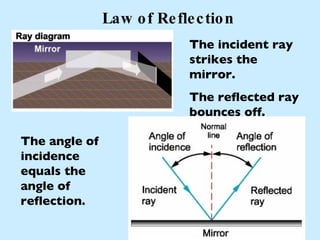
Reflection Images  appear in mirrors because of how light is reflected by mirrors. The  incident ray  follows the light falling onto the mirror.  The  reflected ray  follows the light bouncing off the mirror.
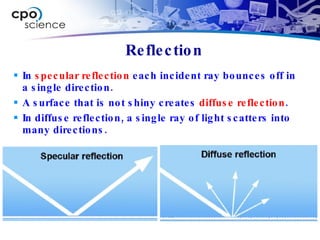
Reflection In  specular reflection  each incident ray bounces off in a single direction. A surface that is not shiny creates  diffuse reflection .  In diffuse reflection, a single ray of light scatters into many directions.
Law of Reflection The angle of incidence equals the angle of reflection. The incident ray strikes the mirror. The reflected ray bounces off.
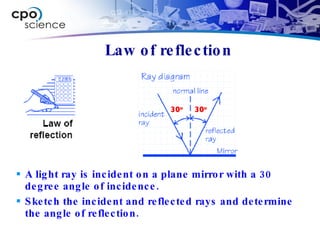
Law of reflection A light ray is incident on a plane mirror with a 30 degree angle of incidence.  Sketch the incident and reflected rays and determine the angle of reflection. 30 o 30 o
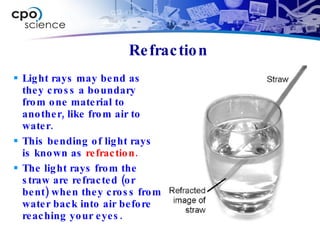
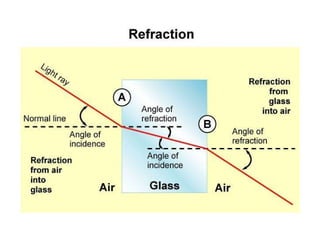
Refraction Light rays may bend as they cross a boundary from one material to another, like from air to water.  This bending of light rays is known as  refraction. The light rays from the straw are refracted (or bent) when they cross from water back into air before reaching your eyes.
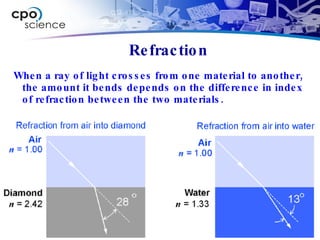
Refraction When a ray of light crosses from one material to another, the amount it bends depends on the difference in index of refraction between the two materials.
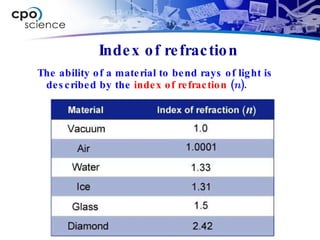
Index of refraction The ability of a material to bend rays of light is described by the  index of refraction  ( n ).
 
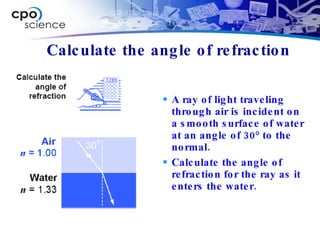
Calculate the angle of refraction A ray of light traveling through air is incident on a smooth surface of water at an angle of 30° to the normal.  Calculate the angle of refraction for the ray as it enters the water.
 
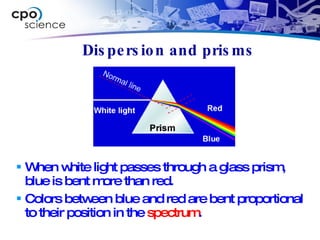
Dispersion and prisms When white light passes through a glass prism, blue is bent more than red. Colors between blue and red are bent proportional to their position in the  spectrum .
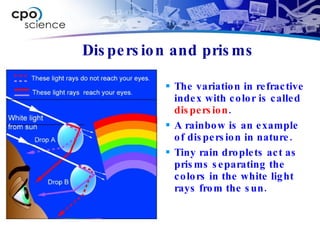
Dispersion and prisms The variation in refractive index with color is called  dispersion . A rainbow is an example of dispersion in nature.  Tiny rain droplets act as prisms separating the colors in the white light rays from the sun.
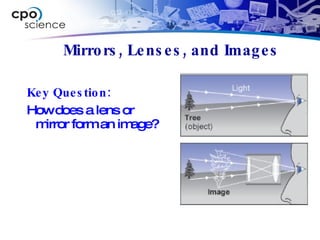
Mirrors, Lenses, and Images Key Question: How does a lens or mirror form an image?
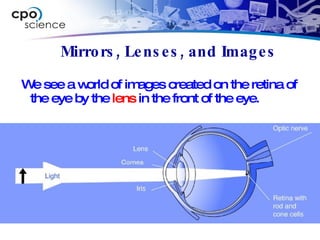
Mirrors, Lenses, and Images We see a world of images created on the retina of the eye by the  lens  in the front of the eye.
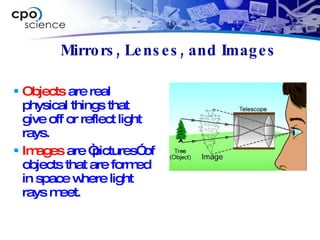
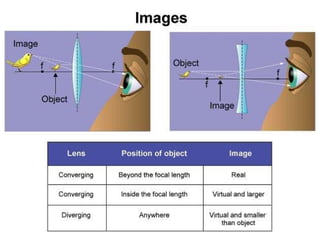
Mirrors, Lenses, and Images Objects  are real physical things that give off or reflect light rays.  Images  are “pictures” of objects that are formed in space where light rays meet.
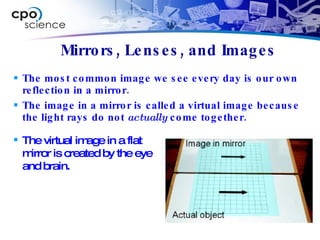
Mirrors, Lenses, and Images The most common image we see every day is our own reflection in a mirror. The image in a mirror is called a virtual image because the light rays do not  actually  come together. The virtual image in a flat mirror is created by the eye and brain.
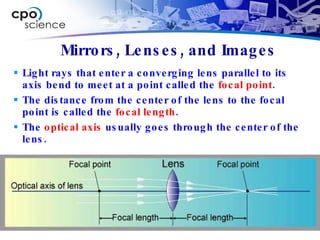
Mirrors, Lenses, and Images Light rays that enter a converging lens parallel to its axis bend to meet at a point called the  focal point . The distance from the center of the lens to the focal point is called the  focal length . The  optical axis  usually goes through the center of the lens.
 
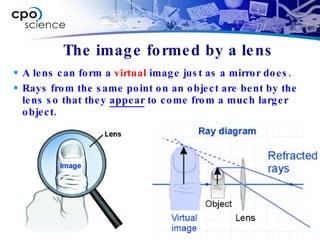
The image formed by a lens A lens can form a  virtual  image just as a mirror does. Rays from the same point on an object are bent by the lens so that they  appear  to come from a much larger object.
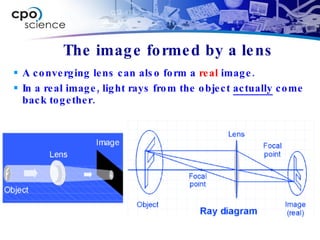
The image formed by a lens A converging lens can also form a  real  image.  In a real image, light rays from the object  actually   come back together.
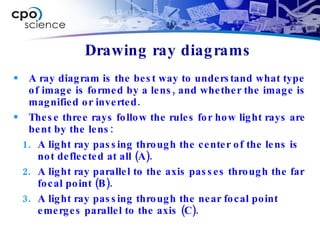
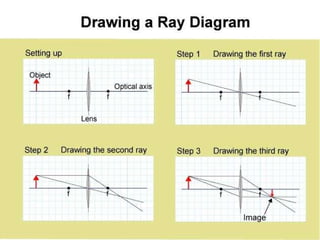
Drawing ray diagrams A ray diagram is the best way to understand what type of image is formed by a lens, and whether the image is magnified or inverted. These three rays follow the rules for how light rays are bent by the lens: A light ray passing through the center of the lens is not deflected at all (A). A light ray parallel to the axis passes through the far focal point (B). A light ray passing through the near focal point emerges parallel to the axis (C).
 
 
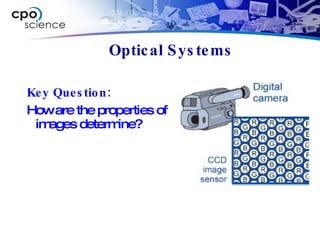
Optical Systems Key Question: How are the properties of images determine?
An  optical system  is a collection of mirrors, lenses, prisms, or other optical elements that performs a useful function with light. Characteristics of optical systems are: The location, type, and magnification of the image. The amount of light that is collected. The accuracy of the image in terms of sharpness, color, and distortion. The ability to change the image, like a telephoto lens on a camera. The ability to record the image on film or electronically. Optical Systems
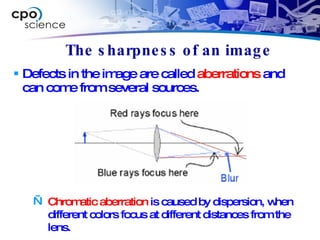
The sharpness of an image Defects in the image are called  aberrations  and can come from several sources. Chromatic aberration  is caused by dispersion, when different colors focus at different distances from the lens.
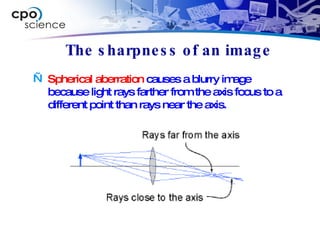
The sharpness of an image Spherical aberration  causes a blurry image because light rays farther from the axis focus to a different point than rays near the axis.
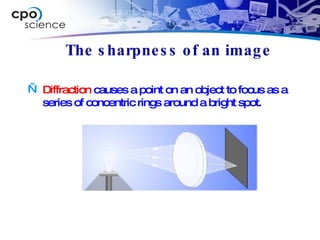
The sharpness of an image Diffraction  causes a point on an object to focus as a series of concentric rings around a bright spot.
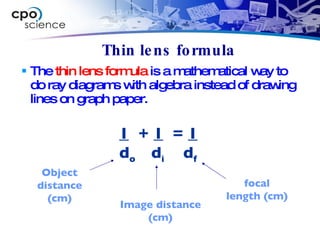
Thin lens formula The  thin lens formula  is a mathematical way to do ray diagrams with algebra instead of drawing lines on graph paper. 1   +  1   =  1 d o   d i d f focal length (cm) Image distance (cm) Object distance (cm)
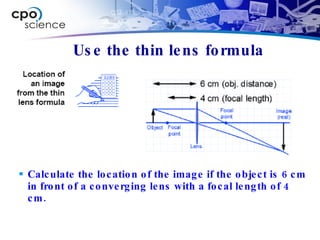
Use the thin lens formula Calculate the location of the image if the object is 6 cm in front of a converging lens with a focal length of 4 cm.
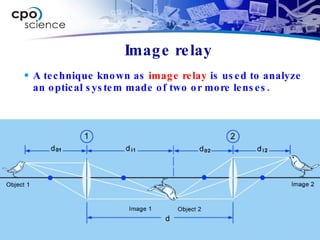
Image relay A technique known as  image relay  is used to analyze an optical system made of two or more lenses.
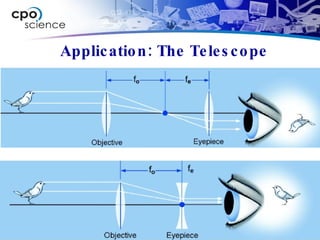
Application: The Telescope

Light rays

  • 1.
  • 2.
    Reflection and RefractionKey Question: How do we describe the reflection and refraction of light?
  • 3.
    Reflection and RefractionThe overall study of how light behaves is called optics . The branch of optics that focuses on the creation of images is called geometric optics , because it is based on relationships between angles and lines that describe light rays.
  • 4.
    Reflection and RefractionA lens is an optical device that is used to bend light in a specific way. A converging lens bends light so that the light rays come together to a point. A diverging lens bends light so it spreads light apart instead of coming together.
  • 5.
    Reflection and RefractionMirrors reflect light and allow us to see ourselves. A prism is another optical device that can cause light to change directions. A prism is a solid piece of glass with flat polished surfaces.
  • 6.
    Reflection Images appear in mirrors because of how light is reflected by mirrors. The incident ray follows the light falling onto the mirror. The reflected ray follows the light bouncing off the mirror.
  • 7.
    Reflection In specular reflection each incident ray bounces off in a single direction. A surface that is not shiny creates diffuse reflection . In diffuse reflection, a single ray of light scatters into many directions.
  • 8.
    Law of ReflectionThe angle of incidence equals the angle of reflection. The incident ray strikes the mirror. The reflected ray bounces off.
  • 9.
    Law of reflectionA light ray is incident on a plane mirror with a 30 degree angle of incidence. Sketch the incident and reflected rays and determine the angle of reflection. 30 o 30 o
  • 10.
    Refraction Light raysmay bend as they cross a boundary from one material to another, like from air to water. This bending of light rays is known as refraction. The light rays from the straw are refracted (or bent) when they cross from water back into air before reaching your eyes.
  • 11.
    Refraction When aray of light crosses from one material to another, the amount it bends depends on the difference in index of refraction between the two materials.
  • 12.
    Index of refractionThe ability of a material to bend rays of light is described by the index of refraction ( n ).
  • 13.
  • 14.
    Calculate the angleof refraction A ray of light traveling through air is incident on a smooth surface of water at an angle of 30° to the normal. Calculate the angle of refraction for the ray as it enters the water.
  • 15.
  • 16.
    Dispersion and prismsWhen white light passes through a glass prism, blue is bent more than red. Colors between blue and red are bent proportional to their position in the spectrum .
  • 17.
    Dispersion and prismsThe variation in refractive index with color is called dispersion . A rainbow is an example of dispersion in nature. Tiny rain droplets act as prisms separating the colors in the white light rays from the sun.
  • 18.
    Mirrors, Lenses, andImages Key Question: How does a lens or mirror form an image?
  • 19.
    Mirrors, Lenses, andImages We see a world of images created on the retina of the eye by the lens in the front of the eye.
  • 20.
    Mirrors, Lenses, andImages Objects are real physical things that give off or reflect light rays. Images are “pictures” of objects that are formed in space where light rays meet.
  • 21.
    Mirrors, Lenses, andImages The most common image we see every day is our own reflection in a mirror. The image in a mirror is called a virtual image because the light rays do not actually come together. The virtual image in a flat mirror is created by the eye and brain.
  • 22.
    Mirrors, Lenses, andImages Light rays that enter a converging lens parallel to its axis bend to meet at a point called the focal point . The distance from the center of the lens to the focal point is called the focal length . The optical axis usually goes through the center of the lens.
  • 23.
  • 24.
    The image formedby a lens A lens can form a virtual image just as a mirror does. Rays from the same point on an object are bent by the lens so that they appear to come from a much larger object.
  • 25.
    The image formedby a lens A converging lens can also form a real image. In a real image, light rays from the object actually come back together.
  • 26.
    Drawing ray diagramsA ray diagram is the best way to understand what type of image is formed by a lens, and whether the image is magnified or inverted. These three rays follow the rules for how light rays are bent by the lens: A light ray passing through the center of the lens is not deflected at all (A). A light ray parallel to the axis passes through the far focal point (B). A light ray passing through the near focal point emerges parallel to the axis (C).
  • 27.
  • 28.
  • 29.
    Optical Systems KeyQuestion: How are the properties of images determine?
  • 30.
    An opticalsystem is a collection of mirrors, lenses, prisms, or other optical elements that performs a useful function with light. Characteristics of optical systems are: The location, type, and magnification of the image. The amount of light that is collected. The accuracy of the image in terms of sharpness, color, and distortion. The ability to change the image, like a telephoto lens on a camera. The ability to record the image on film or electronically. Optical Systems
  • 31.
    The sharpness ofan image Defects in the image are called aberrations and can come from several sources. Chromatic aberration is caused by dispersion, when different colors focus at different distances from the lens.
  • 32.
    The sharpness ofan image Spherical aberration causes a blurry image because light rays farther from the axis focus to a different point than rays near the axis.
  • 33.
    The sharpness ofan image Diffraction causes a point on an object to focus as a series of concentric rings around a bright spot.
  • 34.
    Thin lens formulaThe thin lens formula is a mathematical way to do ray diagrams with algebra instead of drawing lines on graph paper. 1 + 1 = 1 d o d i d f focal length (cm) Image distance (cm) Object distance (cm)
  • 35.
    Use the thinlens formula Calculate the location of the image if the object is 6 cm in front of a converging lens with a focal length of 4 cm.
  • 36.
    Image relay Atechnique known as image relay is used to analyze an optical system made of two or more lenses.
  • 37.

Editor's Notes

  • #10 1) You are asked for a ray diagram and the angle of reflection. 2) You are given the angle of incidence. 3) The law of reflection states the angle of reflection equals the angle of incidence. 4) The angle of reflection is 30°.
  • #15 1) You are asked for the angle of refraction. 2) You are told the ray goes from air into water at 30 degrees. 3) Snell’s law: ni sin(θi) = nr sin(θr) ni = 1.00 (air), nr = 1.33 (water) 4) Apply Snell’s law to find θr. 1.00sin(30°) = 1.33 sin(θr) sin(θr) = 0.5 ÷ 1.33 = 0.376 Use the inverse sine function to find the angle that has a sine of 0.376. θr = sin-1(0.376) = 22°
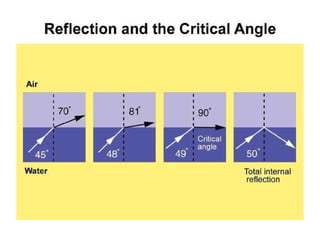
  • #16 The angle at which light begins reflecting back into a refractive material is called the critical angle, and it depends on the index of refraction. The critical angle for water is about 49 degrees.
  • #24 A converging lens bends an incident light ray parallel to the optical axis toward the focal point. A diverging lens bends an incident light ray parallel to the axis outward, away from the focal point
  • #36 1) You are asked for image distance. 2) You are given the focal length and object distance. 3) The thin lens formula applies: 1/di = 1/f — 1/do 4) Solve for di 1/di = 1/4 — 1/6 1/di = 3/12 — 2/12 = 1/12 di = 12 cm The image forms 12 cm to the right of the lens.