A TELESCOPE IS AN INSTRUMENT THAT'S
USED TO LOOK AT OBJECTS THAT ARE FAR
AWAY BY GATHERING LIGHT. IN FACT,
'TELESCOPE' COMES FROM THE GREEK WORD
TELESKOPOS, WHICH MEANS 'FAR-SEEING.'
PEOPLE GENERALLY USE TELESCOPES TO
LOOK AT OBJECTS IN OUTER SPACE, LIKE
PLANETS, STARS AND COMETS. SOMETIMES,
TELESCOPES ARE USED TO OBSERVE THINGS
HERE ON EARTH, LIKE INTERESTING
WILDLIFE, FROM A DISTANCE.
TELESCOPES
TYPES OF TELESCOPES
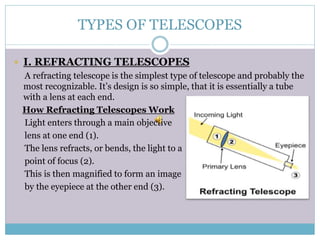
 I. REFRACTING TELESCOPES
A refracting telescope is the simplest type of telescope and probably the
most recognizable. It’s design is so simple, that it is essentially a tube
with a lens at each end.
How Refracting Telescopes Work
Light enters through a main objective
lens at one end (1).
The lens refracts, or bends, the light to a
point of focus (2).
This is then magnified to form an image
by the eyepiece at the other end (3).
TYPES OF TELESCOPES
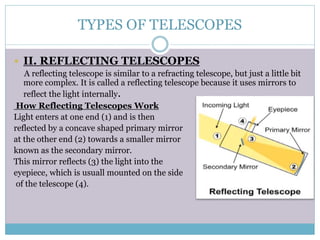
 II. REFLECTING TELESCOPES
A reflecting telescope is similar to a refracting telescope, but just a little bit
more complex. It is called a reflecting telescope because it uses mirrors to
reflect the light internally.
How Reflecting Telescopes Work
Light enters at one end (1) and is then
reflected by a concave shaped primary mirror
at the other end (2) towards a smaller mirror
known as the secondary mirror.
This mirror reflects (3) the light into the
eyepiece, which is usuall mounted on the side
of the telescope (4).
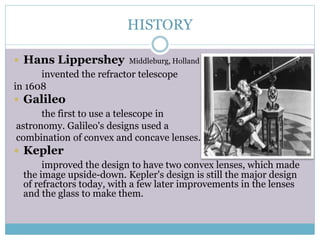
HISTORY
 Hans Lippershey Middleburg, Holland
invented the refractor telescope
in 1608
 Galileo
the first to use a telescope in
astronomy. Galileo's designs used a
combination of convex and concave lenses.
 Kepler
improved the design to have two convex lenses, which made
the image upside-down. Kepler's design is still the major design
of refractors today, with a few later improvements in the lenses
and the glass to make them.
HOW IT WORKS..??
 Why can’t you see an object that is far
away?
The answer is simple: the object does not take up
much space on your eye’s screen (retina).
Using a digital camera analogy, at 150 feet the
writing on a dime does not cover enough pixels on
your retinal sensor for you to read the writing.
This can be corrected by bending the light with
lenses.
How does this apply to telescopes?
 If you had a bigger eye, you could collect more light
from the object. This image could be magnified so it
stretches out over more pixels in your retina.
 In a telescope, two pieces make this possible:
 the primary lens (refractor telescopes) or primary mirror
(reflecting telescopes)
 the eye piece
• The primary lens (in refractors) or primary
mirror (in reflectors) collects lots of light from a
distant object and brings that light, or image, to a
point or focus.
• An eyepiece lens takes the bright light from the
focus of the objective lens or primary mirror and
"spreads it out" (magnifies it) to take up a large
portion of the retina. This is the same principle
that a magnifying glass (lens) uses; it takes a small
image on the paper and spreads it out over the
retina of your eye so that it looks big.
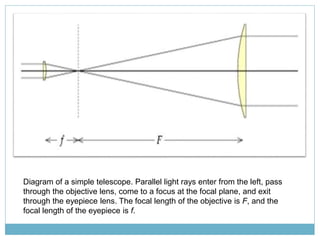
Diagram of a simple telescope. Parallel light rays enter from the left, pass
through the objective lens, come to a focus at the focal plane, and exit
through the eyepiece lens. The focal length of the objective is F, and the
focal length of the eyepiece is f.
When you combine the objective lens or primary mirror
with the eyepiece, you have a telescope.
Again, the basic idea is to collect lots of light to form a
bright image inside the telescope, and then use
something like a magnifying glass to magnify (enlarge)
that bright image so that it takes up a lot of space on
your retina.
HOW TO USE A TELESCOPE.??
 The Aperture
A telescope's ability to collect light is directly related
to the diameter of the lens or mirror -- the aperture
-- that is used to gather light. Generally, the larger
the aperture, the more light the telescope collects
and brings to focus, and the brighter the final image.
MAGNIFICATION
The telescope's magnification, its ability to enlarge
an image, depends on the combination of lenses
used. The eyepiece performs the magnification. Since
any magnification can be achieved by almost any
telescope by using different eyepieces, aperture is a
more important feature than magnification
EYE PIECE
The purposes of the eyepiece are to:
 produce and allow you to change the telescope's
magnification
 produce a sharp image
 provide comfortable eye relief (the distance between your
eye and the eyepiece when the image is in focus)
 determine the telescope's field of view:
 apparent - how much of the sky, in degrees, is seen edge-to-edge
through the eyepiece alone (specified on the eyepiece)
 true or real - how much of the sky can be seen when that eyepiece
is placed in the telescope (true field = apparent field/magnification)
FILTERS
Filters are pieces of glass or plastic that you can place in the
barrel of an eyepiece to restrict the wavelengths of light that
come through in the image.
Filters can be used to:
 enhance the viewing of faint sky objects in light-polluted
skies
 enhance the contrast of fine features and details on the
moon and planets
 safely view the sun
FUTURE
TELESCOPES
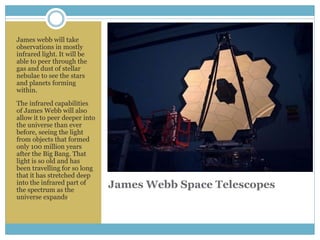
James Webb Space Telescopes
James webb will take
observations in mostly
infrared light. It will be
able to peer through the
gas and dust of stellar
nebulae to see the stars
and planets forming
within.
The infrared capabilities
of James Webb will also
allow it to peer deeper into
the universe than ever
before, seeing the light
from objects that formed
only 100 million years
after the Big Bang. That
light is so old and has
been travelling for so long
that it has stretched deep
into the infrared part of
the spectrum as the
universe expands.
Giant Magellan Telescope
Currently under
construction in the high
Atacama Desert of Chile,
the GMT is expected to
completed by 2025.
The GMT has some
amazing new
technology, called
adaptive optics, to
correct the blurred light
that travels
through Earth's
atmosphere.
Secondary mirrors in the
telescope will be flexible,
and computer-controlled
actuators will warp
those flexible mirrors
hundreds of times per
second to correct for the
blurred light.
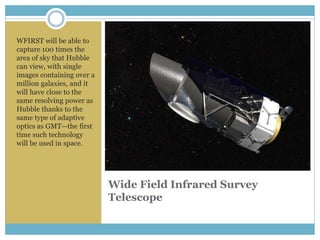
Wide Field Infrared Survey
Telescope
WFIRST will be able to
capture 100 times the
area of sky that Hubble
can view, with single
images containing over a
million galaxies, and it
will have close to the
same resolving power as
Hubble thanks to the
same type of adaptive
optics as GMT—the first
time such technology
will be used in space.
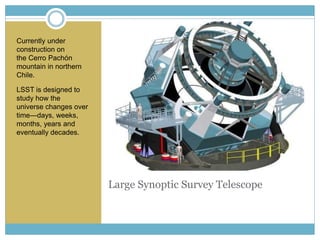
Large Synoptic Survey Telescope
Currently under
construction on
the Cerro Pachón
mountain in northern
Chile.
LSST is designed to
study how the
universe changes over
time—days, weeks,
months, years and
eventually decades.
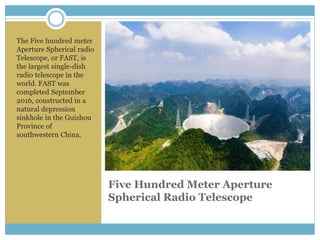
Five Hundred Meter Aperture
Spherical Radio Telescope
The Five hundred meter
Aperture Spherical radio
Telescope, or FAST, is
the largest single-dish
radio telescope in the
world. FAST was
completed September
2016, constructed in a
natural depression
sinkhole in the Guizhou
Province of
southwestern China.
BEST TELESCOPES AT BUDGET PRICE
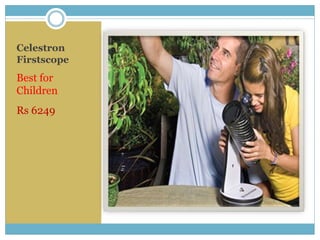
Celestron
Firstscope
Best for
Children
Rs 6249
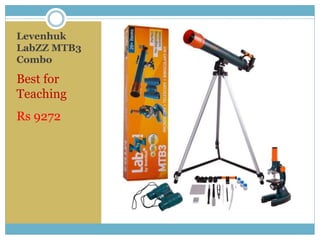
Levenhuk
LabZZ MTB3
Combo
Best for
Teaching
Rs 9272
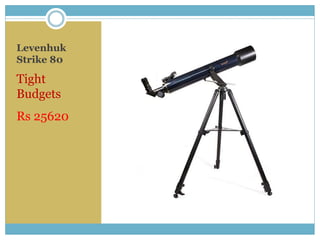
Levenhuk
Strike 80
Tight
Budgets
Rs 25620
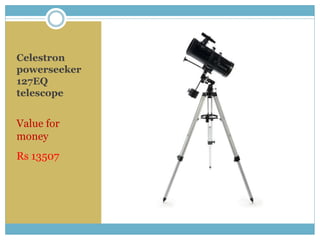
Celestron
powerseeker
127EQ
telescope
Value for
money
Rs 13507

Telescopes power point

  • 1.
    A TELESCOPE ISAN INSTRUMENT THAT'S USED TO LOOK AT OBJECTS THAT ARE FAR AWAY BY GATHERING LIGHT. IN FACT, 'TELESCOPE' COMES FROM THE GREEK WORD TELESKOPOS, WHICH MEANS 'FAR-SEEING.' PEOPLE GENERALLY USE TELESCOPES TO LOOK AT OBJECTS IN OUTER SPACE, LIKE PLANETS, STARS AND COMETS. SOMETIMES, TELESCOPES ARE USED TO OBSERVE THINGS HERE ON EARTH, LIKE INTERESTING WILDLIFE, FROM A DISTANCE. TELESCOPES
  • 2.
    TYPES OF TELESCOPES I. REFRACTING TELESCOPES A refracting telescope is the simplest type of telescope and probably the most recognizable. It’s design is so simple, that it is essentially a tube with a lens at each end. How Refracting Telescopes Work Light enters through a main objective lens at one end (1). The lens refracts, or bends, the light to a point of focus (2). This is then magnified to form an image by the eyepiece at the other end (3).
  • 3.
    TYPES OF TELESCOPES II. REFLECTING TELESCOPES A reflecting telescope is similar to a refracting telescope, but just a little bit more complex. It is called a reflecting telescope because it uses mirrors to reflect the light internally. How Reflecting Telescopes Work Light enters at one end (1) and is then reflected by a concave shaped primary mirror at the other end (2) towards a smaller mirror known as the secondary mirror. This mirror reflects (3) the light into the eyepiece, which is usuall mounted on the side of the telescope (4).
  • 4.
    HISTORY  Hans LippersheyMiddleburg, Holland invented the refractor telescope in 1608  Galileo the first to use a telescope in astronomy. Galileo's designs used a combination of convex and concave lenses.  Kepler improved the design to have two convex lenses, which made the image upside-down. Kepler's design is still the major design of refractors today, with a few later improvements in the lenses and the glass to make them.
  • 5.
    HOW IT WORKS..?? Why can’t you see an object that is far away? The answer is simple: the object does not take up much space on your eye’s screen (retina). Using a digital camera analogy, at 150 feet the writing on a dime does not cover enough pixels on your retinal sensor for you to read the writing. This can be corrected by bending the light with lenses.
  • 6.
    How does thisapply to telescopes?  If you had a bigger eye, you could collect more light from the object. This image could be magnified so it stretches out over more pixels in your retina.  In a telescope, two pieces make this possible:  the primary lens (refractor telescopes) or primary mirror (reflecting telescopes)  the eye piece
  • 7.
    • The primarylens (in refractors) or primary mirror (in reflectors) collects lots of light from a distant object and brings that light, or image, to a point or focus. • An eyepiece lens takes the bright light from the focus of the objective lens or primary mirror and "spreads it out" (magnifies it) to take up a large portion of the retina. This is the same principle that a magnifying glass (lens) uses; it takes a small image on the paper and spreads it out over the retina of your eye so that it looks big.
  • 8.
    Diagram of asimple telescope. Parallel light rays enter from the left, pass through the objective lens, come to a focus at the focal plane, and exit through the eyepiece lens. The focal length of the objective is F, and the focal length of the eyepiece is f.
  • 9.
    When you combinethe objective lens or primary mirror with the eyepiece, you have a telescope. Again, the basic idea is to collect lots of light to form a bright image inside the telescope, and then use something like a magnifying glass to magnify (enlarge) that bright image so that it takes up a lot of space on your retina.
  • 10.
    HOW TO USEA TELESCOPE.??  The Aperture A telescope's ability to collect light is directly related to the diameter of the lens or mirror -- the aperture -- that is used to gather light. Generally, the larger the aperture, the more light the telescope collects and brings to focus, and the brighter the final image.
  • 11.
    MAGNIFICATION The telescope's magnification,its ability to enlarge an image, depends on the combination of lenses used. The eyepiece performs the magnification. Since any magnification can be achieved by almost any telescope by using different eyepieces, aperture is a more important feature than magnification
  • 12.
    EYE PIECE The purposesof the eyepiece are to:  produce and allow you to change the telescope's magnification  produce a sharp image  provide comfortable eye relief (the distance between your eye and the eyepiece when the image is in focus)  determine the telescope's field of view:  apparent - how much of the sky, in degrees, is seen edge-to-edge through the eyepiece alone (specified on the eyepiece)  true or real - how much of the sky can be seen when that eyepiece is placed in the telescope (true field = apparent field/magnification)
  • 13.
    FILTERS Filters are piecesof glass or plastic that you can place in the barrel of an eyepiece to restrict the wavelengths of light that come through in the image. Filters can be used to:  enhance the viewing of faint sky objects in light-polluted skies  enhance the contrast of fine features and details on the moon and planets  safely view the sun
  • 14.
  • 15.
    James Webb SpaceTelescopes James webb will take observations in mostly infrared light. It will be able to peer through the gas and dust of stellar nebulae to see the stars and planets forming within. The infrared capabilities of James Webb will also allow it to peer deeper into the universe than ever before, seeing the light from objects that formed only 100 million years after the Big Bang. That light is so old and has been travelling for so long that it has stretched deep into the infrared part of the spectrum as the universe expands.
  • 16.
    Giant Magellan Telescope Currentlyunder construction in the high Atacama Desert of Chile, the GMT is expected to completed by 2025. The GMT has some amazing new technology, called adaptive optics, to correct the blurred light that travels through Earth's atmosphere. Secondary mirrors in the telescope will be flexible, and computer-controlled actuators will warp those flexible mirrors hundreds of times per second to correct for the blurred light.
  • 17.
    Wide Field InfraredSurvey Telescope WFIRST will be able to capture 100 times the area of sky that Hubble can view, with single images containing over a million galaxies, and it will have close to the same resolving power as Hubble thanks to the same type of adaptive optics as GMT—the first time such technology will be used in space.
  • 18.
    Large Synoptic SurveyTelescope Currently under construction on the Cerro Pachón mountain in northern Chile. LSST is designed to study how the universe changes over time—days, weeks, months, years and eventually decades.
  • 19.
    Five Hundred MeterAperture Spherical Radio Telescope The Five hundred meter Aperture Spherical radio Telescope, or FAST, is the largest single-dish radio telescope in the world. FAST was completed September 2016, constructed in a natural depression sinkhole in the Guizhou Province of southwestern China.
  • 20.
    BEST TELESCOPES ATBUDGET PRICE
  • 21.
  • 22.
  • 23.
  • 24.