Focus questions

What is the wave nature of light?
How does light behave?
What are the primary colors of
 light? of pigments?
How are images formed?
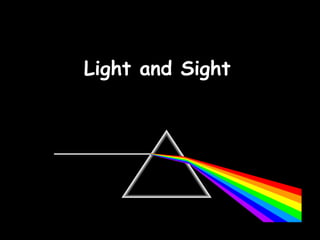
Light and Sight
Light And Sight

Properties of light
Behavior of light
  Reflection
     Formation of images in mirrors
  Refraction
     Color
     Formation of images in lenses
The Human Eye
Light a form of energy
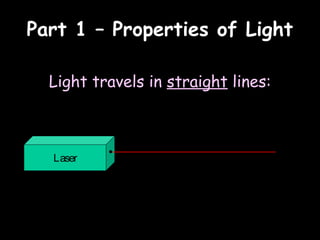
Part 1 – Properties of Light

  Light travels in straight lines:


  Laser
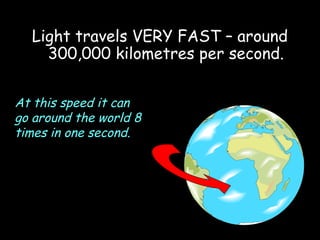
Light travels VERY FAST – around
    300,000 kilometres per second.


At this speed it can
go around the world 8
times in one second.
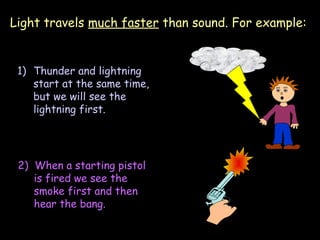
Light travels much faster than sound. For example:


 1) Thunder and lightning
    start at the same time,
    but we will see the
    lightning first.


 2) When a starting pistol
    is fired we see the
    smoke first and then
    hear the bang.
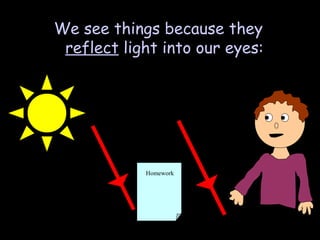
We see things because they
 reflect light into our eyes:


            Homework
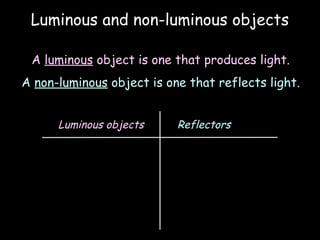
Luminous and non-luminous objects

 A luminous object is one that produces light.
A non-luminous object is one that reflects light.


      Luminous objects     Reflectors
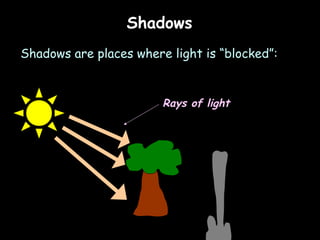
Shadows
Shadows are places where light is “blocked”:


                        Rays of light
Properties of Light summary

1) Light travels in straight lines
2) Light travels much faster than sound
3) We see things because they reflect light
   into our eyes
4) Shadows are formed when light is blocked
   by an object
Behavior of Light:Reflection
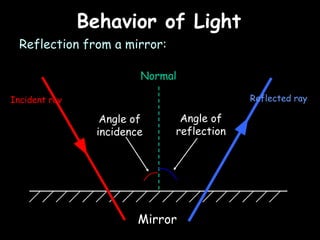
Behavior of Light
  Reflection from a mirror:

                         Normal

Incident ray                               Reflected ray

                  Angle of     Angle of
                 incidence    reflection


                         Mirror
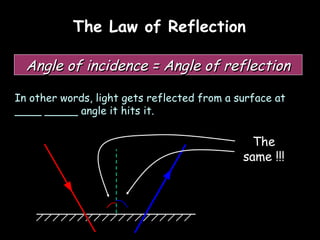
The Law of Reflection

  Angle of incidence = Angle of reflection

In other words, light gets reflected from a surface at
____ _____ angle it hits it.

                                               The
                                             same !!!
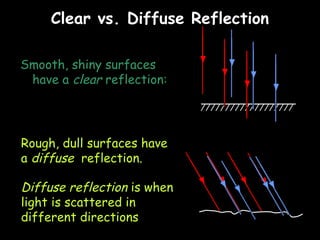
Clear vs. Diffuse Reflection

Smooth, shiny surfaces
 have a clear reflection:


Rough, dull surfaces have
a diffuse reflection.

Diffuse reflection is when
light is scattered in
different directions
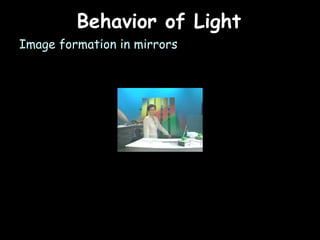
Behavior of Light
Image formation in mirrors
The Law of Reflection
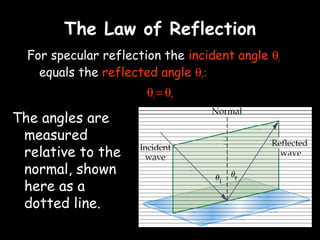
  For specular reflection the incident angle θi
    equals the reflected angle θr:
                       θi = θr

The angles are
 measured
 relative to the
 normal, shown
 here as a
 dotted line.
Image formed by a Plane Mirror
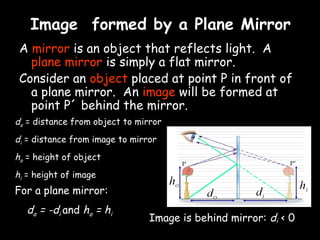
 A mirror is an object that reflects light. A
   plane mirror is simply a flat mirror.
 Consider an object placed at point P in front of
   a plane mirror. An image will be formed at
   point P´ behind the mirror.
do = distance from object to mirror
di = distance from image to mirror
ho = height of object
hi = height of image
For a plane mirror:                                       hi
  do = -di and ho = hi
                                Image is behind mirror: di < 0
Images
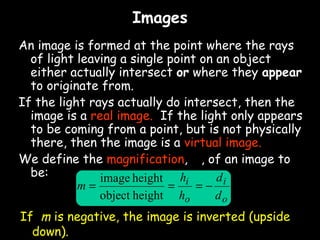
An image is formed at the point where the rays
  of light leaving a single point on an object
  either actually intersect or where they appear
  to originate from.
If the light rays actually do intersect, then the
  image is a real image. If the light only appears
  to be coming from a point, but is not physically
  there, then the image is a virtual image.
We define the magnification, m, of an image to
  be:          image height hi       di
           m=               =    =−
               object height ho      do
If m is negative, the image is inverted (upside
  down).
Plane Mirrors
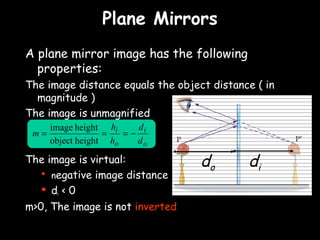
A plane mirror image has the following
  properties:
The image distance equals the object distance ( in
  magnitude )
The image is unmagnified
      image height hi    d
 m=                =   =− i
      object height ho   do

The image is virtual:              do       di
   negative image distance
   di < 0
m>0, The image is not inverted
Curved or Spherical mirrors
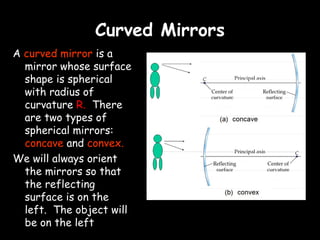
Curved Mirrors
A curved mirror is a
  mirror whose surface
  shape is spherical
  with radius of
  curvature R. There
  are two types of
  spherical mirrors:
  concave and convex.
We will always orient
  the mirrors so that
  the reflecting
  surface is on the
  left. The object will
  be on the left.
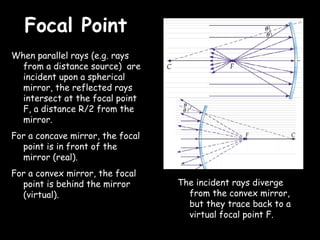
Focal Point
When parallel rays (e.g. rays
  from a distance source) are
  incident upon a spherical
  mirror, the reflected rays
  intersect at the focal point
  F, a distance R/2 from the
  mirror.
For a concave mirror, the focal
  point is in front of the
  mirror (real).
For a convex mirror, the focal
  point is behind the mirror      The incident rays diverge
  (virtual).                        from the convex mirror,
                                    but they trace back to a
                                    virtual focal point F.
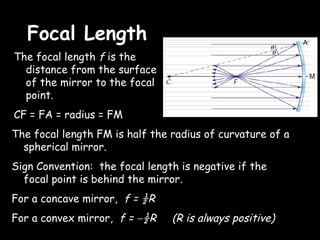
Focal Length
The focal length f is the
  distance from the surface
  of the mirror to the focal
  point.
CF = FA = radius = FM
The focal length FM is half the radius of curvature of a
  spherical mirror.
Sign Convention: the focal length is negative if the
  focal point is behind the mirror.
For a concave mirror, f = ½R
For a convex mirror, f = −½R    (R is always positive)
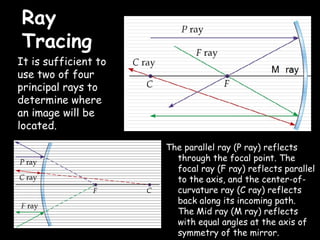
Ray
Tracing
It is sufficient to
use two of four
principal rays to
determine where
an image will be
located.
                      The parallel ray (P ray) reflects
                        through the focal point. The
                        focal ray (F ray) reflects parallel
                        to the axis, and the center-of-
                        curvature ray (C ray) reflects
                        back along its incoming path.
                        The Mid ray (M ray) reflects
                        with equal angles at the axis of
                        symmetry of the mirror.
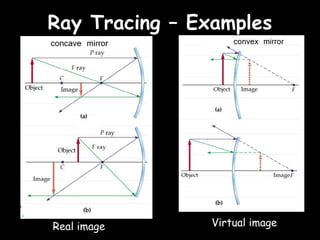
Ray Tracing – Examples


Real image      Virtual image
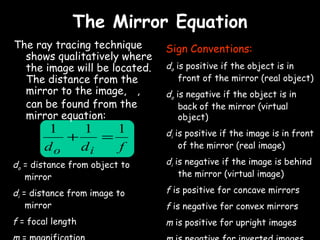
The Mirror Equation
The ray tracing technique      Sign Conventions:
  shows qualitatively where
  the image will be located.   do is positive if the object is in
  The distance from the            front of the mirror (real object)
  mirror to the image, di,     do is negative if the object is in
  can be found from the            back of the mirror (virtual
  mirror equation:                 object)
        1   1    1             di is positive if the image is in front
          +    =
       do   di   f                 of the mirror (real image)

do = distance from object to   di is negative if the image is behind
   mirror                          the mirror (virtual image)

di = distance from image to    f is positive for concave mirrors
    mirror                     f is negative for convex mirrors
                         di
f = focal length m = − d       m is positive for upright images
                          o
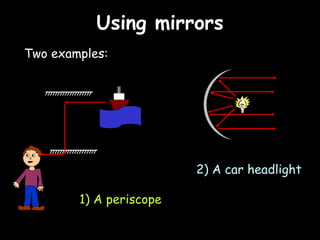
Using mirrors
Two examples:


                         2) A car headlight

        1) A periscope
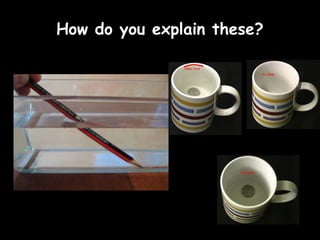
How do you explain these?
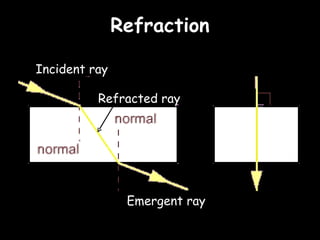
Refraction

Incident ray

          Refracted ray


                Emergent ray
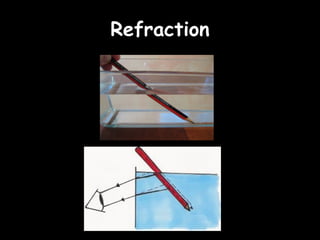
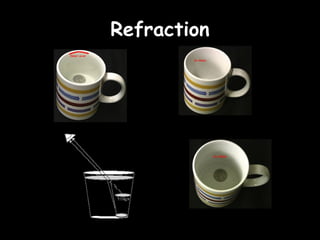
Refraction
Refraction
The Refraction of Light
                                                           The speed of light is
              different in different materials. We define the index of
              refraction, n, of a material to be the ratio of the speed of light in
              vacuum to the speed of light in the material:
                                                                   n = c/v
                                                        When light travels from
              one medium to another its velocity and wavelength change, but its
              frequency remains constant.
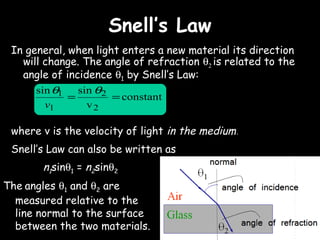
Snell’s Law
 In general, when light enters a new material its direction
   will change. The angle of refraction θ2 is related to the
   angle of incidence θ1 by Snell’s Law:
      sin θ1   sin θ2
            =         = constant
       v1       v2

 where v is the velocity of light in the medium.
 Snell’s Law can also be written as
       n1sinθ1 = n2sinθ2
The angles θ1 and θ2 are
  measured relative to the
  line normal to the surface
  between the two materials.
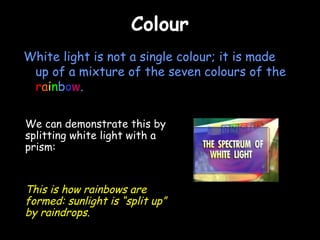
Colour
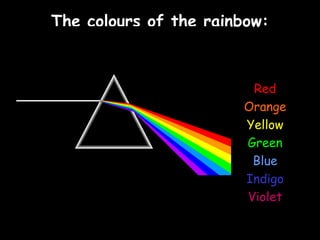
White light is not a single colour; it is made
 up of a mixture of the seven colours of the
 rainbow.

We can demonstrate this by
splitting white light with a
prism:


This is how rainbows are
formed: sunlight is “split up”
by raindrops.
The colours of the rainbow:


                        Red
                       Orange
                       Yellow
                       Green
                        Blue
                       Indigo
                       Violet
Why are objects colored?
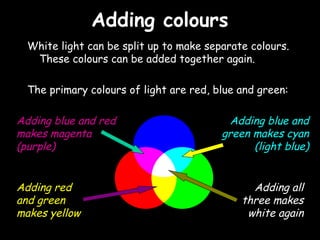
Adding colours
  White light can be split up to make separate colours.
   These colours can be added together again.

  The primary colours of light are red, blue and green:

Adding blue and red                       Adding blue and
makes magenta                            green makes cyan
(purple)                                       (light blue)


Adding red                                     Adding all
and green                                    three makes
makes yellow                                  white again
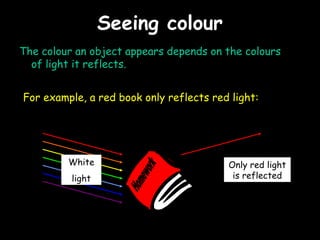
Seeing colour
The colour an object appears depends on the colours
  of light it reflects.


For example, a red book only reflects red light:


         White                           Only red light
          light                           is reflected
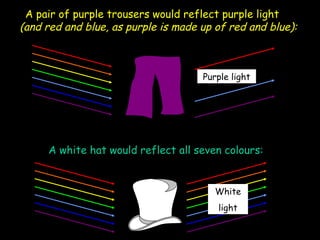
A pair of purple trousers would reflect purple light
(and red and blue, as purple is made up of red and blue):


                                     Purple light


     A white hat would reflect all seven colours:


                                        White
                                        light
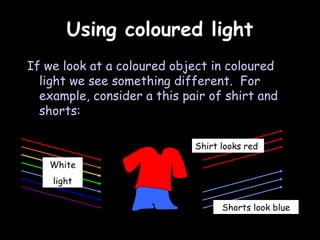
Using coloured light
If we look at a coloured object in coloured
  light we see something different. For
  example, consider a this pair of shirt and
  shorts:

                             Shirt looks red

   White
    light

                                   Shorts look blue
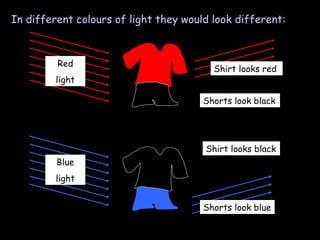
In different colours of light they would look different:


         Red
                                         Shirt looks red
         light

                                       Shorts look black


                                       Shirt looks black
         Blue
         light


                                       Shorts look blue
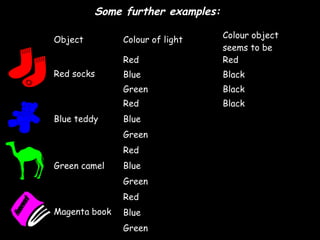
Some further examples:

                                  Colour object
Object         Colour of light
                                  seems to be
               Red                Red
Red socks      Blue               Black
               Green              Black
               Red                Black
Blue teddy     Blue
               Green
               Red
Green camel    Blue
               Green
               Red
Magenta book   Blue
               Green
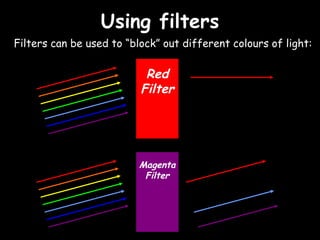
Using filters
Filters can be used to “block” out different colours of light:

                           Red
                          Filter


                          Magenta
                           Filter
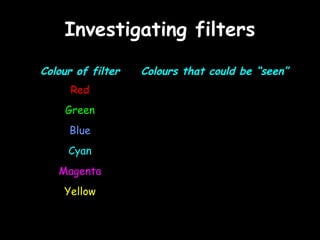
Investigating filters
Colour of filter   Colours that could be “seen”
      Red
     Green
     Blue
     Cyan
   Magenta
    Yellow
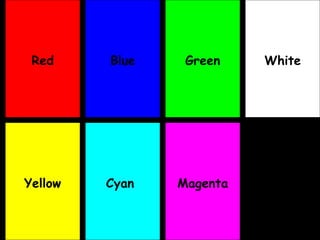
Red     Blue    Green    White


Yellow   Cyan   Magenta
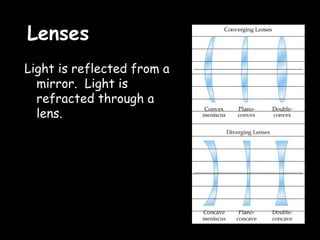
Lenses
Light is reflected from a
  mirror. Light is
  refracted through a
  lens.
Focal Point
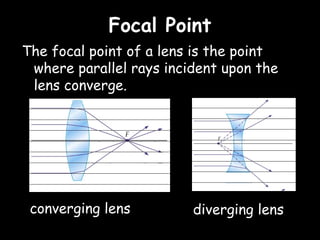
The focal point of a lens is the point
 where parallel rays incident upon the
 lens converge.


 converging lens         diverging lens
How does a lens form an image?
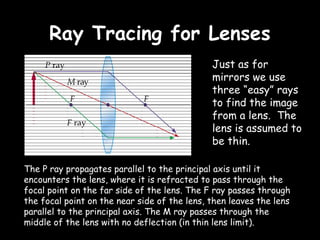
Ray Tracing for Lenses
                                              Just as for
                                              mirrors we use
                                              three “easy” rays
                                              to find the image
                                              from a lens. The
                                              lens is assumed to
                                              be thin.

The P ray propagates parallel to the principal axis until it
encounters the lens, where it is refracted to pass through the
focal point on the far side of the lens. The F ray passes through
the focal point on the near side of the lens, then leaves the lens
parallel to the principal axis. The M ray passes through the
middle of the lens with no deflection (in thin lens limit).
The Lens Equation
http://www.physics.uoguelph.ca/applets/Intro_phy
 
Data and Analysis
 
How does the image distance q of a convex
  lens change as the object distance p is
  decreased?
How does the height of the image change as
  the object distance is decreased?
Write the equation in determining the linear
  magnification m of a convex lens using p
  and q. Call this Eq (1)
 
Data and Analysis
 
Using Excel graph m vs q. What does the graph
  show?. When m is zero, what is q?. This is the q
  intercept. Relate this observation with your
  answer to (c). Compare the value of the q
  intercept with the focal length of the mirror.
  What then is the physical meaning of the q-
  intercept?
Extend your graph until it intersects the vertical
  axis m. Compute the slope of your graph. Compare
  the value of the slope and the q-intercept. How
  are they related?. Express the relationship IN AN
  EQAUTION using the physical meaning of the q –
  intercept you found. Call this Eq (2).
Write the equation of the line graph. Call this Eq (3)
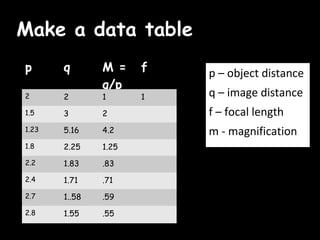
Make a data table
p      q       M =    f   p – object distance
               q/p
2      2       1      1   q – image distance
1.5    3       2          f – focal length
1.23   5.16    4.2        m - magnification
1.8    2.25    1.25
2.2    1.83    .83
2.4    1.71    .71
2.7    1..58   .59
2.8    1.55    .55
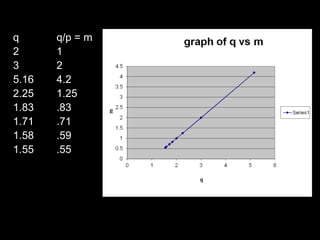
q      q/p = m
2      1
3      2
5.16   4.2
2.25   1.25
1.83   .83
1.71   .71
1.58   .59
1.55   .55
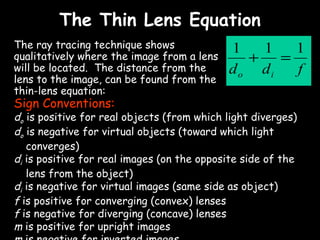
The Thin Lens Equation
The ray tracing technique shows             1    1     1
qualitatively where the image from a lens
will be located. The distance from the
                                              1+ 1 = 1
                                            do + di = f
lens to the image, can be found from the       do di     f
thin-lens equation:
Sign Conventions:
do is positive for real objects (from which light diverges)
do is negative for virtual objects (toward which light
   converges)
di is positive for real images (on the opposite side of the
   lens from the object)
di is negative for virtual images (same side as object)
f is positive for converging (convex) lenses
f is negative for diverging (concave) lenses
m is positive for upright images
The eye and the camera
The eye model
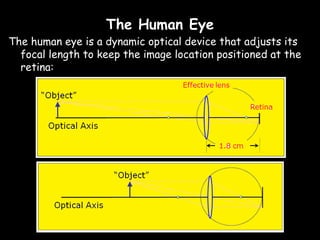
The Human Eye
The human eye is a dynamic optical device that adjusts its
  focal length to keep the image location positioned at the
  retina:
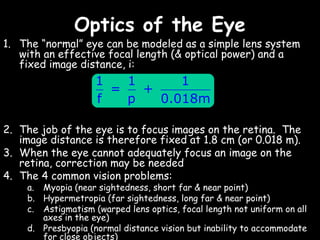
Optics of the Eye
1. The “normal” eye can be modeled as a simple lens system
   with an effective focal length (& optical power) and a
   fixed image distance, i:
                    1   1      1
                      =   +
                    f   p   0.018m

2. The job of the eye is to focus images on the retina. The
   image distance is therefore fixed at 1.8 cm (or 0.018 m).
3. When the eye cannot adequately focus an image on the
   retina, correction may be needed
4. The 4 common vision problems:
    a. Myopia (near sightedness, short far & near point)
    b. Hypermetropia (far sightedness, long far & near point)
    c. Astigmatism (warped lens optics, focal length not uniform on all
       axes in the eye)
    d. Presbyopia (normal distance vision but inability to accommodate
       for close objects)
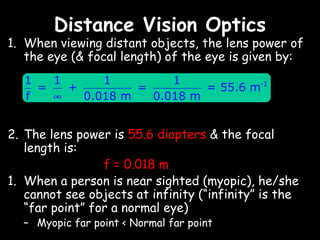
Distance Vision Optics
1. When viewing distant objects, the lens power of
   the eye (& focal length) of the eye is given by:
   1   1      1         1
     =   +         =         = 55.6 m-1
   f   ∞   0.018 m   0.018 m


2. The lens power is 55.6 diopters & the focal
   length is:
                 f = 0.018 m
1. When a person is near sighted (myopic), he/she
   cannot see objects at infinity (“infinity” is the
   “far point” for a normal eye)
  – Myopic far point < Normal far point
Distance Vision Optics
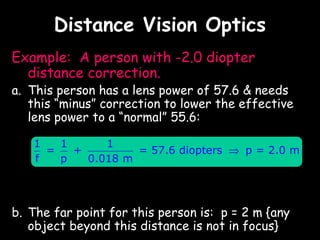
Example: A person with -2.0 diopter
  distance correction.
a. This person has a lens power of 57.6 & needs
   this “minus” correction to lower the effective
   lens power to a “normal” 55.6:

   1   1      1
     =   +         = 57.6 diopters ⇒ p = 2.0 m
   f   p   0.018 m


b. The far point for this person is: p = 2 m {any
   object beyond this distance is not in focus}
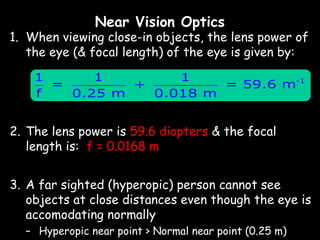
Near Vision Optics
1. When viewing close-in objects, the lens power of
   the eye (& focal length) of the eye is given by:

    1      1        1
      =        +         = 59.6 m-1
    f   0.25 m   0.018 m


2. The lens power is 59.6 diopters & the focal
   length is: f = 0.0168 m


3. A far sighted (hyperopic) person cannot see
   objects at close distances even though the eye is
   accomodating normally
  – Hyperopic near point > Normal near point (0.25 m)
Near Vision Optics
Example: A person with +2.0 diopter vision correction.
a. This person has a (near) lens power of 57.6 & needs
   this “plus” correction to raise the effective lens power
   to a “normal” close distance power of 59.6:

    1   1      1
      =   +         = 57.6 diopters ⇒ p = 0.49 m
    f   p   0.018 m


b. The near point for this person is: p = 0.49 m {any
   object closer is not in focus}

c. People w/presbyopia have normal distance lens power
   but are unable to adjust for closer objects, thus
   needing “reader” glasses

Light and sight

  • 1.
    Focus questions What isthe wave nature of light? How does light behave? What are the primary colors of light? of pigments? How are images formed?
  • 2.
  • 3.
    Light And Sight Propertiesof light Behavior of light Reflection Formation of images in mirrors Refraction Color Formation of images in lenses The Human Eye
  • 4.
    Light a formof energy
  • 5.
    Part 1 –Properties of Light Light travels in straight lines: Laser
  • 6.
    Light travels VERYFAST – around 300,000 kilometres per second. At this speed it can go around the world 8 times in one second.
  • 7.
    Light travels muchfaster than sound. For example: 1) Thunder and lightning start at the same time, but we will see the lightning first. 2) When a starting pistol is fired we see the smoke first and then hear the bang.
  • 8.
    We see thingsbecause they reflect light into our eyes: Homework
  • 9.
    Luminous and non-luminousobjects A luminous object is one that produces light. A non-luminous object is one that reflects light. Luminous objects Reflectors
  • 10.
    Shadows Shadows are placeswhere light is “blocked”: Rays of light
  • 11.
    Properties of Lightsummary 1) Light travels in straight lines 2) Light travels much faster than sound 3) We see things because they reflect light into our eyes 4) Shadows are formed when light is blocked by an object
  • 12.
  • 13.
    Behavior of Light Reflection from a mirror: Normal Incident ray Reflected ray Angle of Angle of incidence reflection Mirror
  • 14.
    The Law ofReflection Angle of incidence = Angle of reflection In other words, light gets reflected from a surface at ____ _____ angle it hits it. The same !!!
  • 15.
    Clear vs. DiffuseReflection Smooth, shiny surfaces have a clear reflection: Rough, dull surfaces have a diffuse reflection. Diffuse reflection is when light is scattered in different directions
  • 16.
    Behavior of Light Imageformation in mirrors
  • 17.
    The Law ofReflection For specular reflection the incident angle θi equals the reflected angle θr: θi = θr The angles are measured relative to the normal, shown here as a dotted line.
  • 18.
    Image formed bya Plane Mirror A mirror is an object that reflects light. A plane mirror is simply a flat mirror. Consider an object placed at point P in front of a plane mirror. An image will be formed at point P´ behind the mirror. do = distance from object to mirror di = distance from image to mirror ho = height of object hi = height of image For a plane mirror: hi do = -di and ho = hi Image is behind mirror: di < 0
  • 19.
    Images An image isformed at the point where the rays of light leaving a single point on an object either actually intersect or where they appear to originate from. If the light rays actually do intersect, then the image is a real image. If the light only appears to be coming from a point, but is not physically there, then the image is a virtual image. We define the magnification, m, of an image to be: image height hi di m= = =− object height ho do If m is negative, the image is inverted (upside down).
  • 20.
    Plane Mirrors A planemirror image has the following properties: The image distance equals the object distance ( in magnitude ) The image is unmagnified image height hi d m= = =− i object height ho do The image is virtual: do di  negative image distance  di < 0 m>0, The image is not inverted
  • 21.
  • 22.
    Curved Mirrors A curvedmirror is a mirror whose surface shape is spherical with radius of curvature R. There are two types of spherical mirrors: concave and convex. We will always orient the mirrors so that the reflecting surface is on the left. The object will be on the left.
  • 23.
    Focal Point When parallelrays (e.g. rays from a distance source) are incident upon a spherical mirror, the reflected rays intersect at the focal point F, a distance R/2 from the mirror. For a concave mirror, the focal point is in front of the mirror (real). For a convex mirror, the focal point is behind the mirror The incident rays diverge (virtual). from the convex mirror, but they trace back to a virtual focal point F.
  • 24.
    Focal Length The focallength f is the distance from the surface of the mirror to the focal point. CF = FA = radius = FM The focal length FM is half the radius of curvature of a spherical mirror. Sign Convention: the focal length is negative if the focal point is behind the mirror. For a concave mirror, f = ½R For a convex mirror, f = −½R (R is always positive)
  • 25.
    Ray Tracing It is sufficientto use two of four principal rays to determine where an image will be located. The parallel ray (P ray) reflects through the focal point. The focal ray (F ray) reflects parallel to the axis, and the center-of- curvature ray (C ray) reflects back along its incoming path. The Mid ray (M ray) reflects with equal angles at the axis of symmetry of the mirror.
  • 26.
    Ray Tracing –Examples Real image Virtual image
  • 27.
    The Mirror Equation Theray tracing technique Sign Conventions: shows qualitatively where the image will be located. do is positive if the object is in The distance from the front of the mirror (real object) mirror to the image, di, do is negative if the object is in can be found from the back of the mirror (virtual mirror equation: object) 1 1 1 di is positive if the image is in front + = do di f of the mirror (real image) do = distance from object to di is negative if the image is behind mirror the mirror (virtual image) di = distance from image to f is positive for concave mirrors mirror f is negative for convex mirrors di f = focal length m = − d m is positive for upright images o
  • 28.
    Using mirrors Two examples: 2) A car headlight 1) A periscope
  • 29.
    How do youexplain these?
  • 30.
    Refraction Incident ray Refracted ray Emergent ray
  • 31.
  • 32.
  • 33.
    The Refraction ofLight The speed of light is different in different materials. We define the index of refraction, n, of a material to be the ratio of the speed of light in vacuum to the speed of light in the material: n = c/v When light travels from one medium to another its velocity and wavelength change, but its frequency remains constant.
  • 34.
    Snell’s Law Ingeneral, when light enters a new material its direction will change. The angle of refraction θ2 is related to the angle of incidence θ1 by Snell’s Law: sin θ1 sin θ2 = = constant v1 v2 where v is the velocity of light in the medium. Snell’s Law can also be written as n1sinθ1 = n2sinθ2 The angles θ1 and θ2 are measured relative to the line normal to the surface between the two materials.
  • 35.
    Colour White light isnot a single colour; it is made up of a mixture of the seven colours of the rainbow. We can demonstrate this by splitting white light with a prism: This is how rainbows are formed: sunlight is “split up” by raindrops.
  • 36.
    The colours ofthe rainbow: Red Orange Yellow Green Blue Indigo Violet
  • 37.
  • 38.
    Adding colours White light can be split up to make separate colours. These colours can be added together again. The primary colours of light are red, blue and green: Adding blue and red Adding blue and makes magenta green makes cyan (purple) (light blue) Adding red Adding all and green three makes makes yellow white again
  • 39.
    Seeing colour The colouran object appears depends on the colours of light it reflects. For example, a red book only reflects red light: White Only red light light is reflected
  • 40.
    A pair ofpurple trousers would reflect purple light (and red and blue, as purple is made up of red and blue): Purple light A white hat would reflect all seven colours: White light
  • 41.
    Using coloured light Ifwe look at a coloured object in coloured light we see something different. For example, consider a this pair of shirt and shorts: Shirt looks red White light Shorts look blue
  • 42.
    In different coloursof light they would look different: Red Shirt looks red light Shorts look black Shirt looks black Blue light Shorts look blue
  • 43.
    Some further examples: Colour object Object Colour of light seems to be Red Red Red socks Blue Black Green Black Red Black Blue teddy Blue Green Red Green camel Blue Green Red Magenta book Blue Green
  • 44.
    Using filters Filters canbe used to “block” out different colours of light: Red Filter Magenta Filter
  • 45.
    Investigating filters Colour offilter Colours that could be “seen” Red Green Blue Cyan Magenta Yellow
  • 46.
    Red Blue Green White Yellow Cyan Magenta
  • 47.
    Lenses Light is reflectedfrom a mirror. Light is refracted through a lens.
  • 49.
    Focal Point The focalpoint of a lens is the point where parallel rays incident upon the lens converge. converging lens diverging lens
  • 50.
    How does alens form an image?
  • 51.
    Ray Tracing forLenses Just as for mirrors we use three “easy” rays to find the image from a lens. The lens is assumed to be thin. The P ray propagates parallel to the principal axis until it encounters the lens, where it is refracted to pass through the focal point on the far side of the lens. The F ray passes through the focal point on the near side of the lens, then leaves the lens parallel to the principal axis. The M ray passes through the middle of the lens with no deflection (in thin lens limit).
  • 52.
  • 53.
    Data and Analysis   Howdoes the image distance q of a convex lens change as the object distance p is decreased? How does the height of the image change as the object distance is decreased? Write the equation in determining the linear magnification m of a convex lens using p and q. Call this Eq (1)  
  • 54.
    Data and Analysis   UsingExcel graph m vs q. What does the graph show?. When m is zero, what is q?. This is the q intercept. Relate this observation with your answer to (c). Compare the value of the q intercept with the focal length of the mirror. What then is the physical meaning of the q- intercept? Extend your graph until it intersects the vertical axis m. Compute the slope of your graph. Compare the value of the slope and the q-intercept. How are they related?. Express the relationship IN AN EQAUTION using the physical meaning of the q – intercept you found. Call this Eq (2). Write the equation of the line graph. Call this Eq (3)
  • 55.
    Make a datatable p q M = f p – object distance q/p 2 2 1 1 q – image distance 1.5 3 2 f – focal length 1.23 5.16 4.2 m - magnification 1.8 2.25 1.25 2.2 1.83 .83 2.4 1.71 .71 2.7 1..58 .59 2.8 1.55 .55
  • 56.
    q q/p = m 2 1 3 2 5.16 4.2 2.25 1.25 1.83 .83 1.71 .71 1.58 .59 1.55 .55
  • 57.
    The Thin LensEquation The ray tracing technique shows 1 1 1 qualitatively where the image from a lens will be located. The distance from the 1+ 1 = 1 do + di = f lens to the image, can be found from the do di f thin-lens equation: Sign Conventions: do is positive for real objects (from which light diverges) do is negative for virtual objects (toward which light converges) di is positive for real images (on the opposite side of the lens from the object) di is negative for virtual images (same side as object) f is positive for converging (convex) lenses f is negative for diverging (concave) lenses m is positive for upright images
  • 58.
    The eye andthe camera
  • 59.
  • 60.
    The Human Eye Thehuman eye is a dynamic optical device that adjusts its focal length to keep the image location positioned at the retina:
  • 61.
    Optics of theEye 1. The “normal” eye can be modeled as a simple lens system with an effective focal length (& optical power) and a fixed image distance, i: 1 1 1 = + f p 0.018m 2. The job of the eye is to focus images on the retina. The image distance is therefore fixed at 1.8 cm (or 0.018 m). 3. When the eye cannot adequately focus an image on the retina, correction may be needed 4. The 4 common vision problems: a. Myopia (near sightedness, short far & near point) b. Hypermetropia (far sightedness, long far & near point) c. Astigmatism (warped lens optics, focal length not uniform on all axes in the eye) d. Presbyopia (normal distance vision but inability to accommodate for close objects)
  • 62.
    Distance Vision Optics 1.When viewing distant objects, the lens power of the eye (& focal length) of the eye is given by: 1 1 1 1 = + = = 55.6 m-1 f ∞ 0.018 m 0.018 m 2. The lens power is 55.6 diopters & the focal length is: f = 0.018 m 1. When a person is near sighted (myopic), he/she cannot see objects at infinity (“infinity” is the “far point” for a normal eye) – Myopic far point < Normal far point
  • 63.
    Distance Vision Optics Example:A person with -2.0 diopter distance correction. a. This person has a lens power of 57.6 & needs this “minus” correction to lower the effective lens power to a “normal” 55.6: 1 1 1 = + = 57.6 diopters ⇒ p = 2.0 m f p 0.018 m b. The far point for this person is: p = 2 m {any object beyond this distance is not in focus}
  • 64.
    Near Vision Optics 1.When viewing close-in objects, the lens power of the eye (& focal length) of the eye is given by: 1 1 1 = + = 59.6 m-1 f 0.25 m 0.018 m 2. The lens power is 59.6 diopters & the focal length is: f = 0.0168 m 3. A far sighted (hyperopic) person cannot see objects at close distances even though the eye is accomodating normally – Hyperopic near point > Normal near point (0.25 m)
  • 65.
    Near Vision Optics Example:A person with +2.0 diopter vision correction. a. This person has a (near) lens power of 57.6 & needs this “plus” correction to raise the effective lens power to a “normal” close distance power of 59.6: 1 1 1 = + = 57.6 diopters ⇒ p = 0.49 m f p 0.018 m b. The near point for this person is: p = 0.49 m {any object closer is not in focus} c. People w/presbyopia have normal distance lens power but are unable to adjust for closer objects, thus needing “reader” glasses