Light, Reflection,
& Mirrors
T- 1-855-694-8886
Email- info@iTutor.com
By iTutor.com
Factsabout Light
 It is a form of Electromagnetic Energy
 It is a part of the Electromagnetic Spectrum and the only part we
can really see
Factsabout Light
The speed of light, c, is constant in a vacuum.
Light can be:
•REFLECTED
•ABSORBED
•REFRACTED
Light is an electromagnetic wave in that it has wave like properties
which can be influenced by electric and magnetic fields.
TheLaw of “REFLECTION”
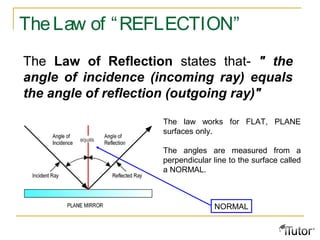
The Law of Reflection states that- " the
angle of incidence (incoming ray) equals
the angle of reflection (outgoing ray)"
The law works for FLAT, PLANE
surfaces only.
The angles are measured from a
perpendicular line to the surface called
a NORMAL.
NORMAL
Virtual Images
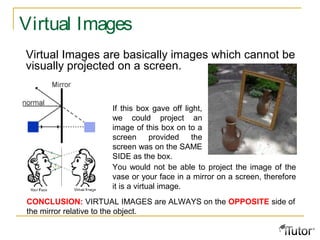
Virtual Images are basically images which cannot be
visually projected on a screen.
If this box gave off light,
we could project an
image of this box on to a
screen provided the
screen was on the SAME
SIDE as the box.
You would not be able to project the image of the
vase or your face in a mirror on a screen, therefore
it is a virtual image.
CONCLUSION: VIRTUAL IMAGES are ALWAYS on the OPPOSITE side of
the mirror relative to the object.
Real Image
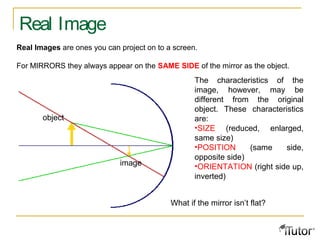
Real Images are ones you can project on to a screen.
For MIRRORS they always appear on the SAME SIDE of the mirror as the object.
object
image
The characteristics of the
image, however, may be
different from the original
object. These characteristics
are:
•SIZE (reduced, enlarged,
same size)
•POSITION (same side,
opposite side)
•ORIENTATION (right side up,
inverted)
What if the mirror isn’t flat?
Spherical Mirrors– Concave& Convex
Also called CONVERGING mirrorAlso called DIVERGING mirror
Converging (Concave) Mirror
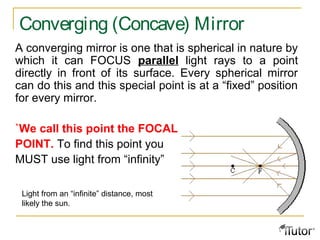
A converging mirror is one that is spherical in nature by
which it can FOCUS parallel light rays to a point
directly in front of its surface. Every spherical mirror
can do this and this special point is at a “fixed” position
for every mirror.
`We call this point the FOCAL
POINT. To find this point you
MUST use light from “infinity”
Light from an “infinite” distance, most
likely the sun.
Converging (Concave) Mirror
Since the mirror is
spherical it technically
has a CENTER OF
CURVATURE, C. The
focal point happens to
be HALF this distance.
We also draw a line through the
center of the mirror and call it the
PRINCIPAL AXIS.
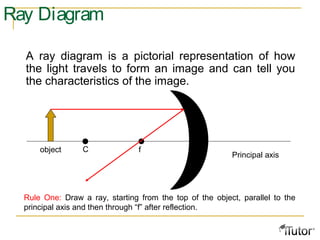
Ray Diagram
A ray diagram is a pictorial representation of how
the light travels to form an image and can tell you
the characteristics of the image.
Principal axis
fCobject
Rule One: Draw a ray, starting from the top of the object, parallel to the
principal axis and then through “f” after reflection.
Ray Diagrams
Principal axis
fCobject
Rule Two: Draw a ray, starting from the top of the object, through the focal
point, then parallel to the principal axis after reflection.
Ray Diagrams
Principal axis
fCobject
Rule Three: Draw a ray, starting from the top of the object, through C, then
back upon itself.
What do you notice about the three lines? THEY INTERSECT
The intersection is the location of the image.
Ray Diagram – ImageCharacteristics
Principal axis
fCobject
After getting the intersection, draw an arrow down from the principal axis to
the point of intersection. Then ask yourself these questions:
1) Is the image on the SAME or OPPOSITE side of the mirror as the object?
Same, therefore it is a REAL IMAGE.
2) Is the image ENLARGED or REDUCED?
3) Is the image INVERTED or RIGHT SIDE UP?
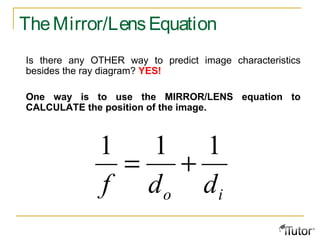
TheMirror/LensEquation
Is there any OTHER way to predict image characteristics
besides the ray diagram? YES!
One way is to use the MIRROR/LENS equation to
CALCULATE the position of the image.
io ddf
111
+=
Mirror/LensEquation
Assume that a certain concave spherical mirror has
a focal length of 10.0 cm. Locate the image for an
object distance of 25 cm and describe the image’s
characteristics.
=
+=→+=
i
iio
d
dddf
1
25
1
10
1111
16.67 cm
What does this tell us? First we know the image is BETWEEN “C” & “f”. Since the
image distance is POSITIVE the image is a REAL IMAGE.
Real image = positive image distance
Virtual image = negative image distance
What about the size and orientation?
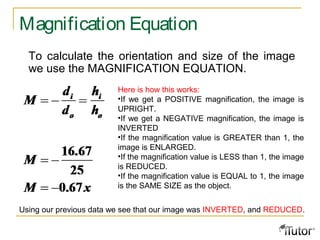
Magnification Equation
To calculate the orientation and size of the image
we use the MAGNIFICATION EQUATION.
Here is how this works:
•If we get a POSITIVE magnification, the image is
UPRIGHT.
•If we get a NEGATIVE magnification, the image is
INVERTED
•If the magnification value is GREATER than 1, the
image is ENLARGED.
•If the magnification value is LESS than 1, the image
is REDUCED.
•If the magnification value is EQUAL to 1, the image
is the SAME SIZE as the object.
Using our previous data we see that our image was INVERTED, and REDUCED.
Example
Assume that a certain concave spherical mirror has a focal
length of 10.0 cm. Locate the image for an object distance of
5 cm and describe the image’s characteristics.
=−=
=
+=→+=
5
1
5
1
10
1111
i
i
iio
d
M
d
dddf
-10 cm
2x
•VIRTUAL (opposite side)
•Enlarged
•Upright
Characteristics?
The End
Call us for more
information:
www.iTutor.com
1-855-694-8886
Visit

Reflection and Mirrors

  • 1.
    Light, Reflection, & Mirrors T-1-855-694-8886 Email- info@iTutor.com By iTutor.com
  • 2.
    Factsabout Light  Itis a form of Electromagnetic Energy  It is a part of the Electromagnetic Spectrum and the only part we can really see
  • 3.
    Factsabout Light The speedof light, c, is constant in a vacuum. Light can be: •REFLECTED •ABSORBED •REFRACTED Light is an electromagnetic wave in that it has wave like properties which can be influenced by electric and magnetic fields.
  • 4.
    TheLaw of “REFLECTION” TheLaw of Reflection states that- " the angle of incidence (incoming ray) equals the angle of reflection (outgoing ray)" The law works for FLAT, PLANE surfaces only. The angles are measured from a perpendicular line to the surface called a NORMAL. NORMAL
  • 5.
    Virtual Images Virtual Imagesare basically images which cannot be visually projected on a screen. If this box gave off light, we could project an image of this box on to a screen provided the screen was on the SAME SIDE as the box. You would not be able to project the image of the vase or your face in a mirror on a screen, therefore it is a virtual image. CONCLUSION: VIRTUAL IMAGES are ALWAYS on the OPPOSITE side of the mirror relative to the object.
  • 6.
    Real Image Real Imagesare ones you can project on to a screen. For MIRRORS they always appear on the SAME SIDE of the mirror as the object. object image The characteristics of the image, however, may be different from the original object. These characteristics are: •SIZE (reduced, enlarged, same size) •POSITION (same side, opposite side) •ORIENTATION (right side up, inverted) What if the mirror isn’t flat?
  • 7.
    Spherical Mirrors– Concave&Convex Also called CONVERGING mirrorAlso called DIVERGING mirror
  • 8.
    Converging (Concave) Mirror Aconverging mirror is one that is spherical in nature by which it can FOCUS parallel light rays to a point directly in front of its surface. Every spherical mirror can do this and this special point is at a “fixed” position for every mirror. `We call this point the FOCAL POINT. To find this point you MUST use light from “infinity” Light from an “infinite” distance, most likely the sun.
  • 9.
    Converging (Concave) Mirror Sincethe mirror is spherical it technically has a CENTER OF CURVATURE, C. The focal point happens to be HALF this distance. We also draw a line through the center of the mirror and call it the PRINCIPAL AXIS.
  • 10.
    Ray Diagram A raydiagram is a pictorial representation of how the light travels to form an image and can tell you the characteristics of the image. Principal axis fCobject Rule One: Draw a ray, starting from the top of the object, parallel to the principal axis and then through “f” after reflection.
  • 11.
    Ray Diagrams Principal axis fCobject RuleTwo: Draw a ray, starting from the top of the object, through the focal point, then parallel to the principal axis after reflection.
  • 12.
    Ray Diagrams Principal axis fCobject RuleThree: Draw a ray, starting from the top of the object, through C, then back upon itself. What do you notice about the three lines? THEY INTERSECT The intersection is the location of the image.
  • 13.
    Ray Diagram –ImageCharacteristics Principal axis fCobject After getting the intersection, draw an arrow down from the principal axis to the point of intersection. Then ask yourself these questions: 1) Is the image on the SAME or OPPOSITE side of the mirror as the object? Same, therefore it is a REAL IMAGE. 2) Is the image ENLARGED or REDUCED? 3) Is the image INVERTED or RIGHT SIDE UP?
  • 14.
    TheMirror/LensEquation Is there anyOTHER way to predict image characteristics besides the ray diagram? YES! One way is to use the MIRROR/LENS equation to CALCULATE the position of the image. io ddf 111 +=
  • 15.
    Mirror/LensEquation Assume that acertain concave spherical mirror has a focal length of 10.0 cm. Locate the image for an object distance of 25 cm and describe the image’s characteristics. = +=→+= i iio d dddf 1 25 1 10 1111 16.67 cm What does this tell us? First we know the image is BETWEEN “C” & “f”. Since the image distance is POSITIVE the image is a REAL IMAGE. Real image = positive image distance Virtual image = negative image distance What about the size and orientation?
  • 16.
    Magnification Equation To calculatethe orientation and size of the image we use the MAGNIFICATION EQUATION. Here is how this works: •If we get a POSITIVE magnification, the image is UPRIGHT. •If we get a NEGATIVE magnification, the image is INVERTED •If the magnification value is GREATER than 1, the image is ENLARGED. •If the magnification value is LESS than 1, the image is REDUCED. •If the magnification value is EQUAL to 1, the image is the SAME SIZE as the object. Using our previous data we see that our image was INVERTED, and REDUCED.
  • 17.
    Example Assume that acertain concave spherical mirror has a focal length of 10.0 cm. Locate the image for an object distance of 5 cm and describe the image’s characteristics. =−= = +=→+= 5 1 5 1 10 1111 i i iio d M d dddf -10 cm 2x •VIRTUAL (opposite side) •Enlarged •Upright Characteristics?
  • 18.
    The End Call usfor more information: www.iTutor.com 1-855-694-8886 Visit