The Life Of A STAR!
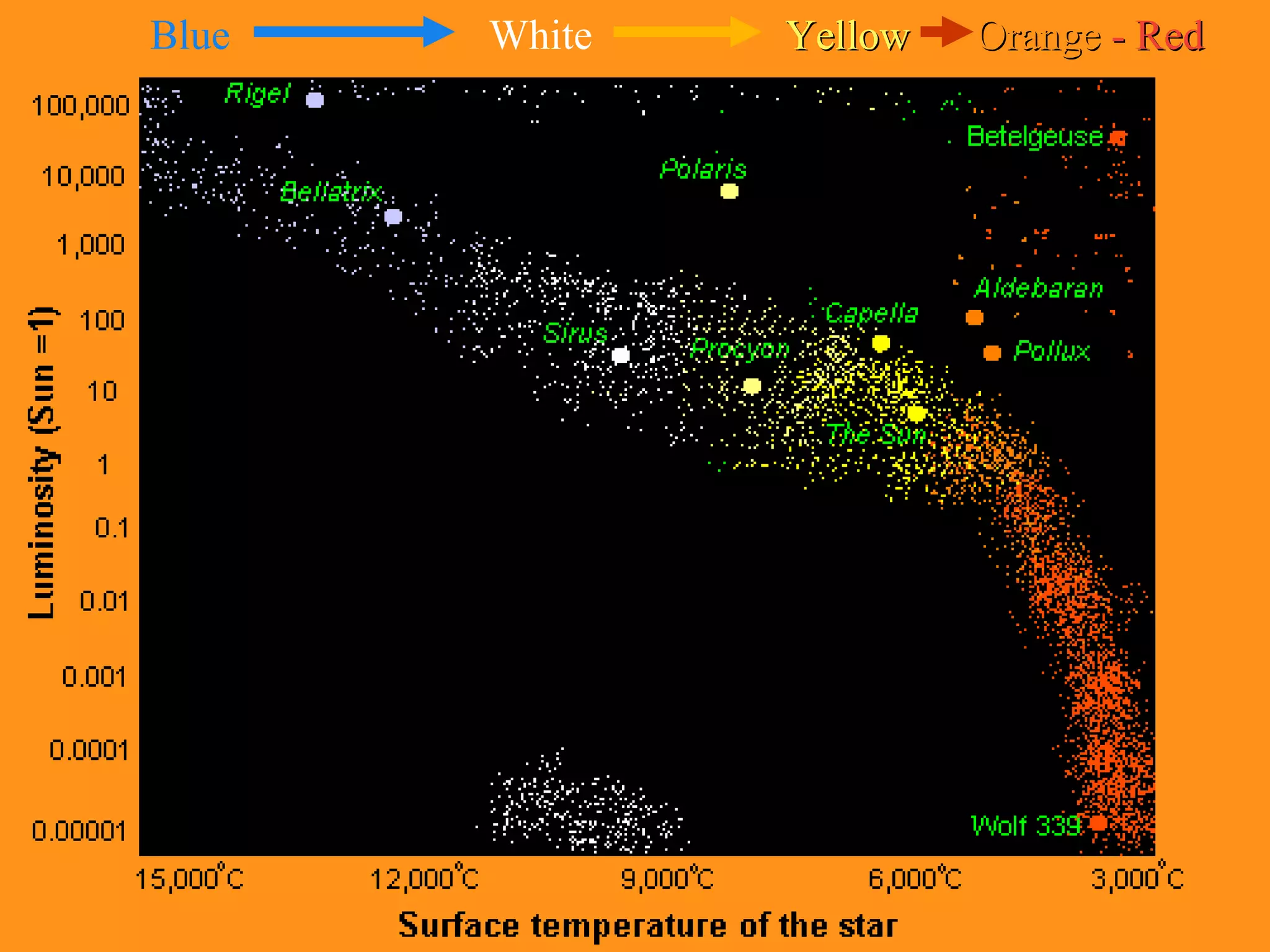
Blue White Yellow Orange  - Red
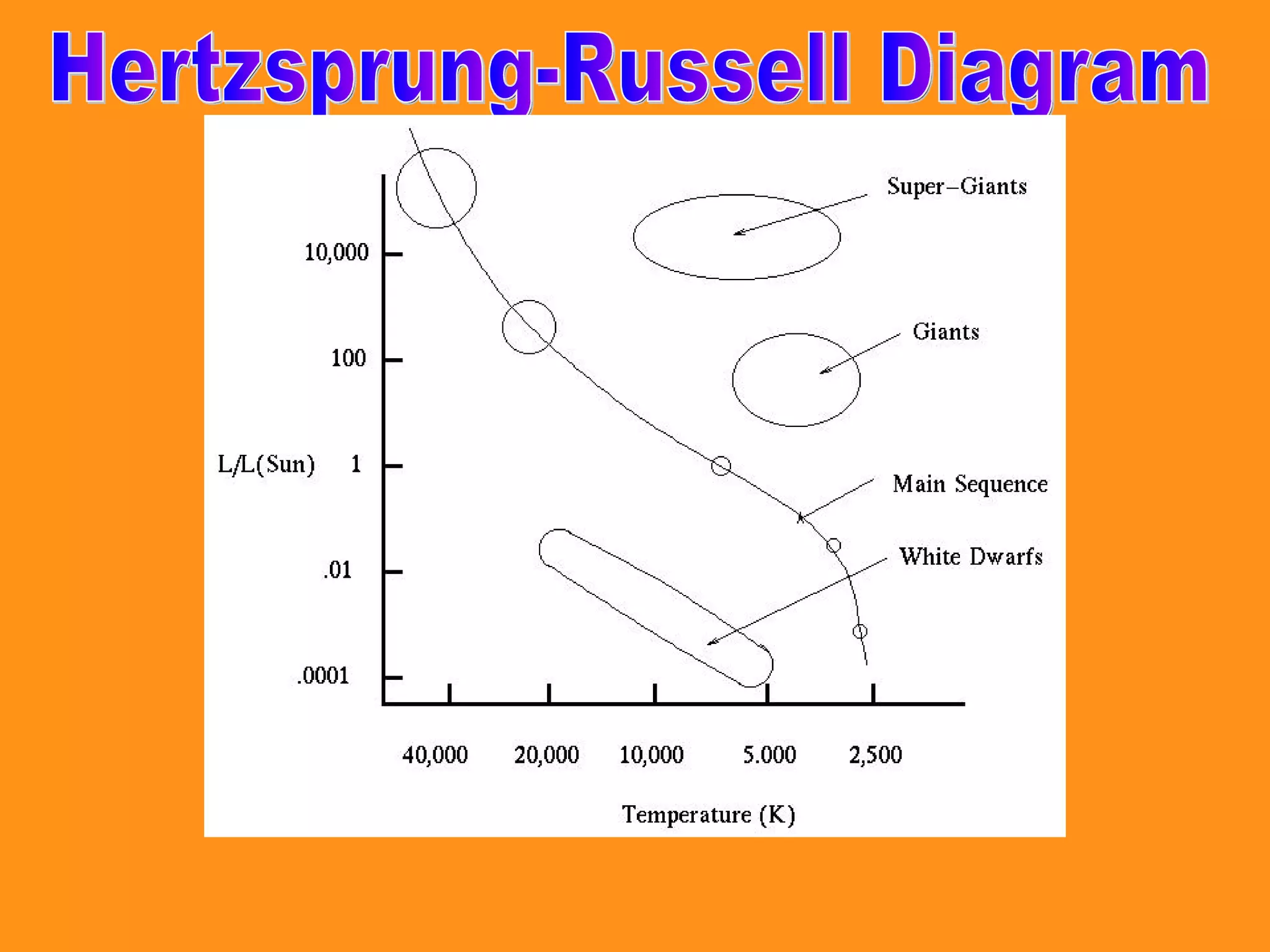
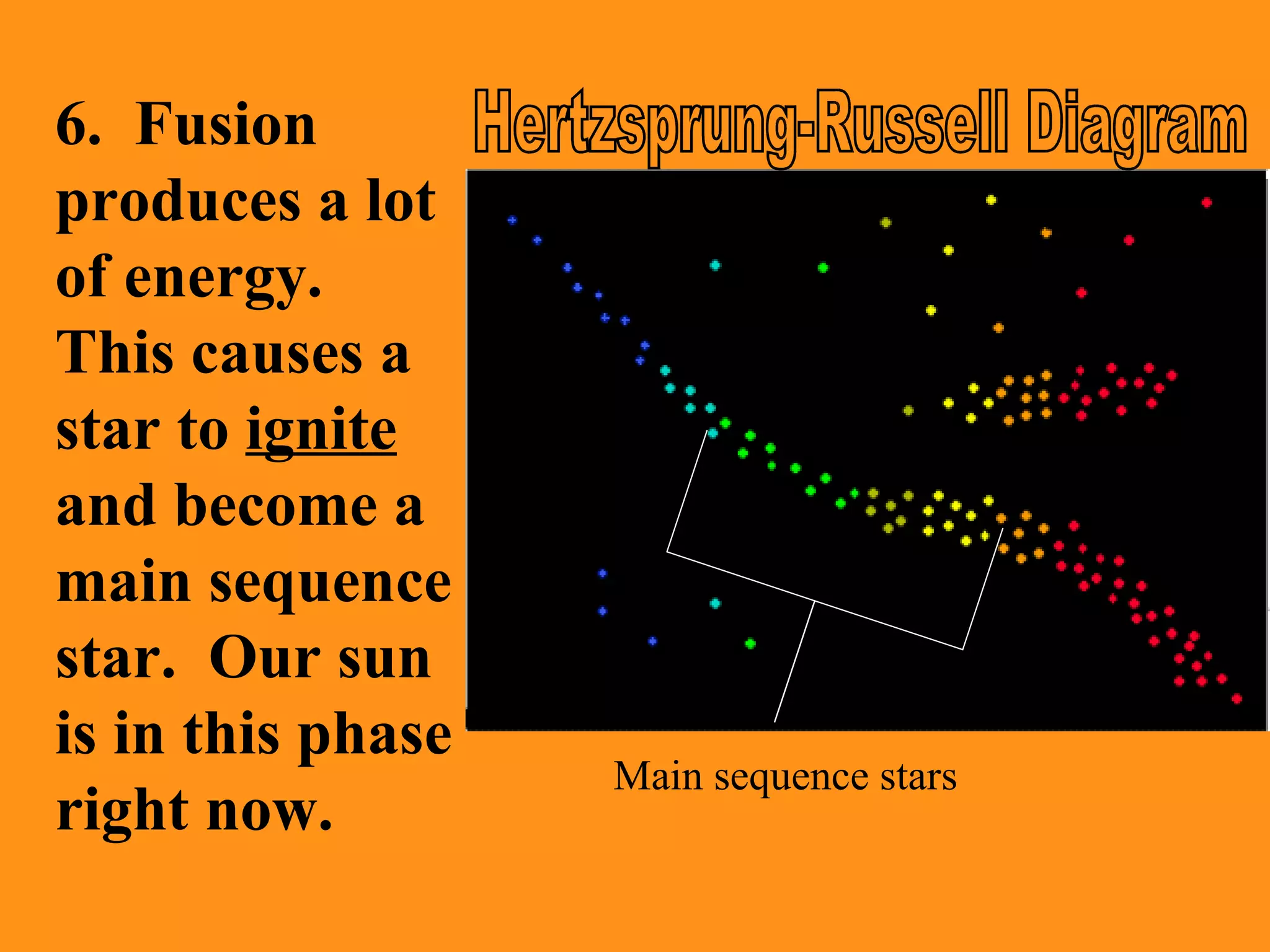
Hertzsprung-Russell Diagram
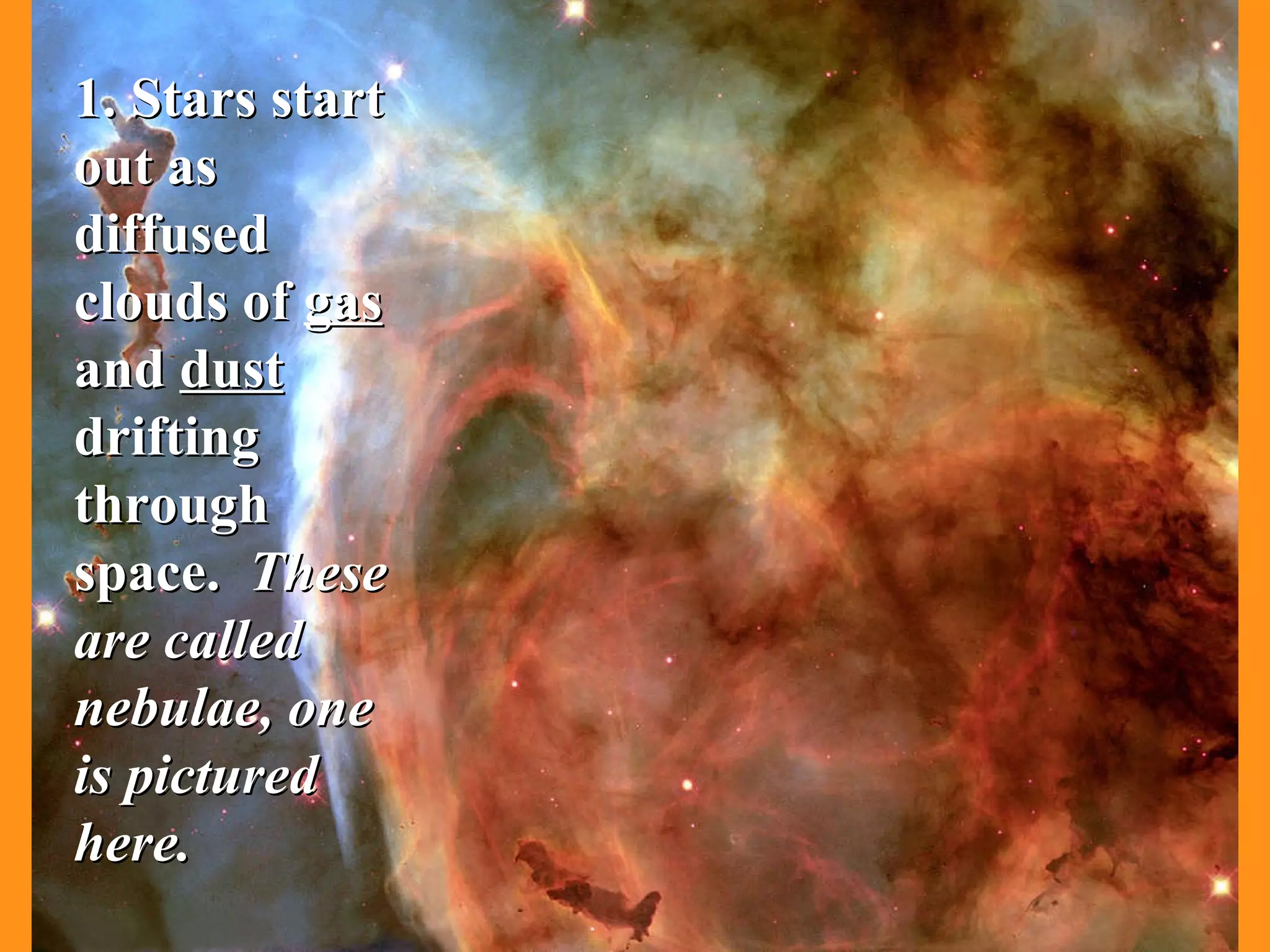
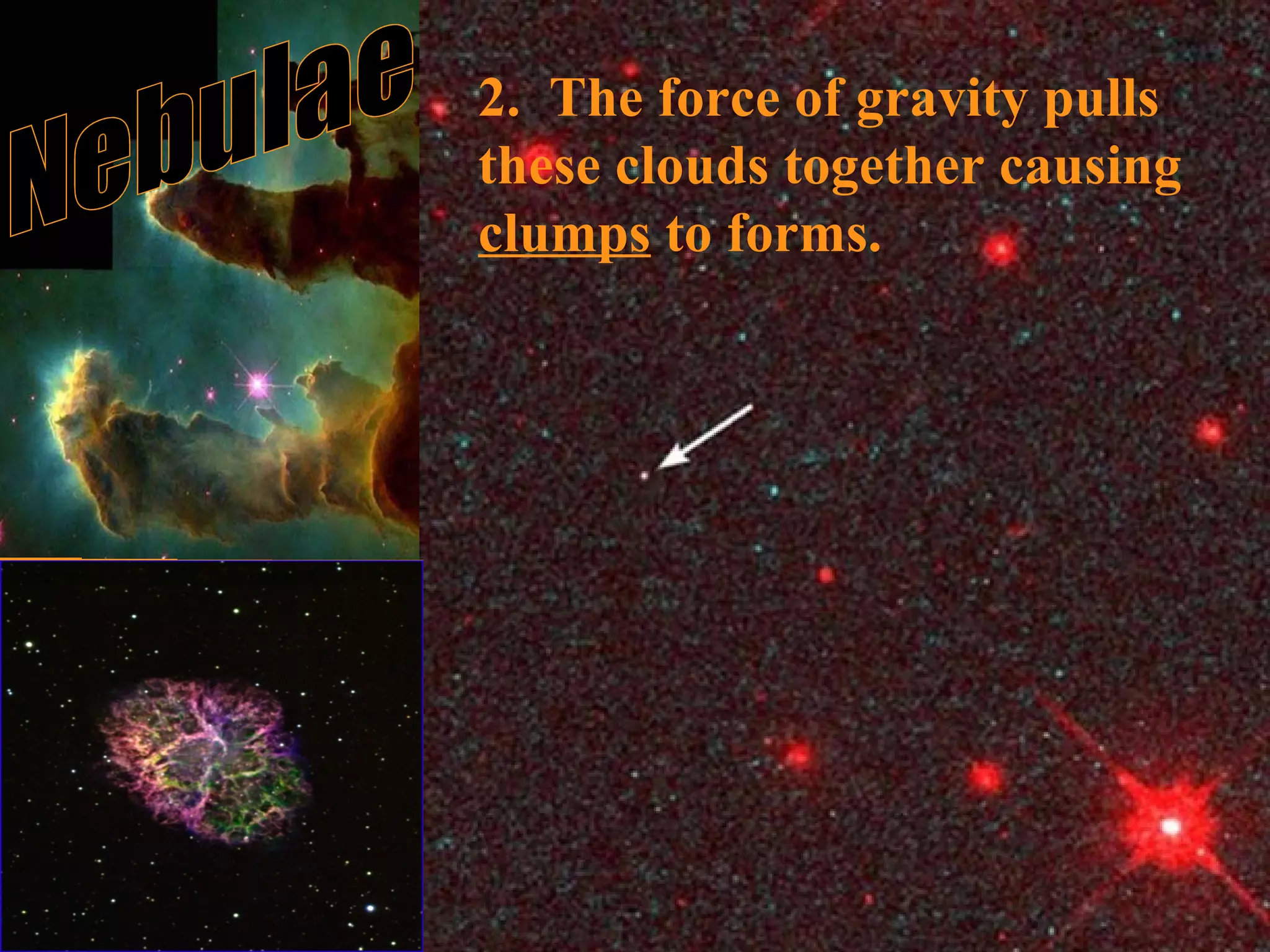
1. Stars start out as diffused clouds of  gas  and  dust  drifting through space.  These are called nebulae, one is pictured here.
Nebulae 2.  The force of gravity pulls these clouds together causing  clumps  to forms.
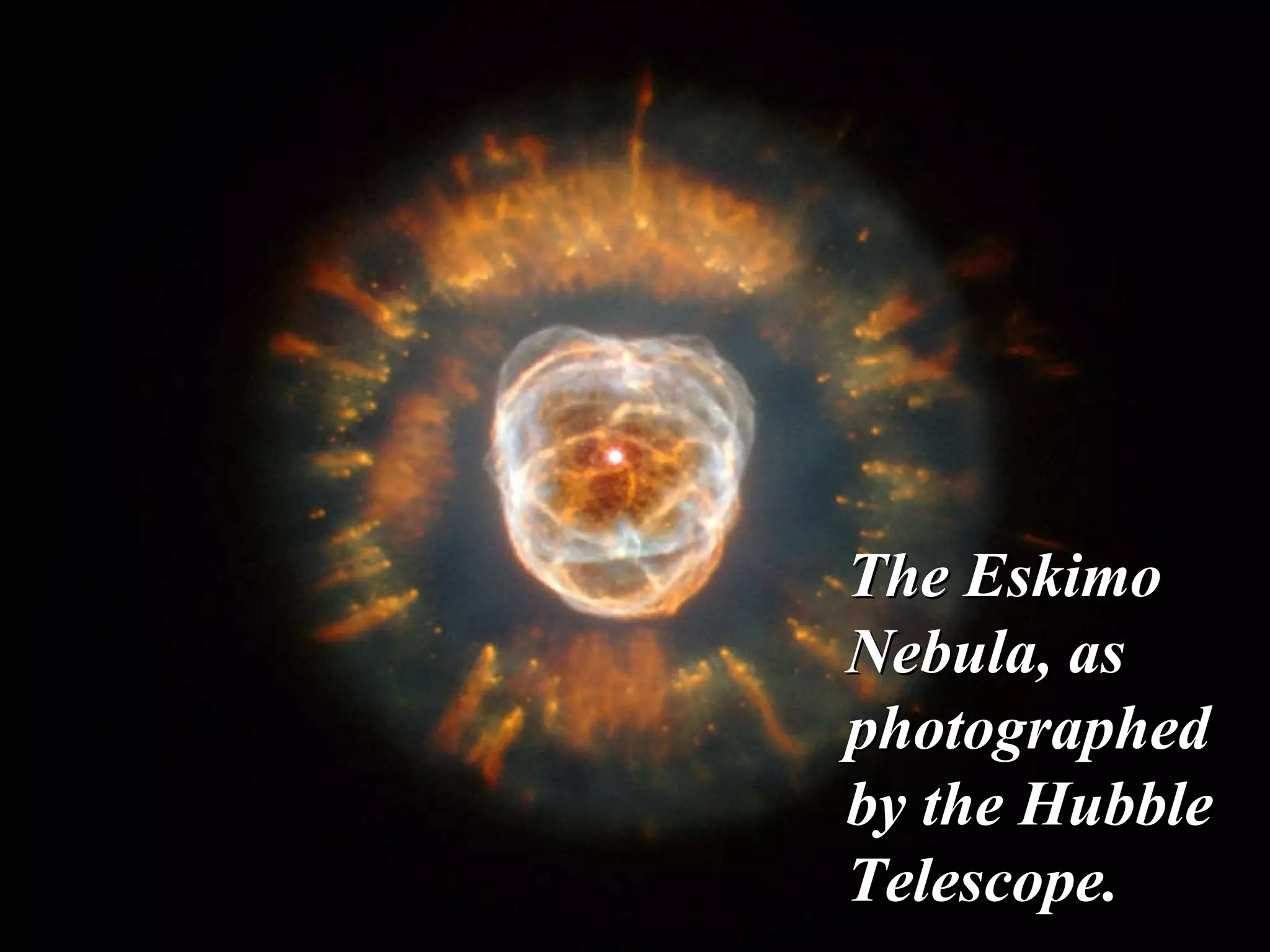
The Eskimo Nebula, as photographed by the Hubble Telescope.
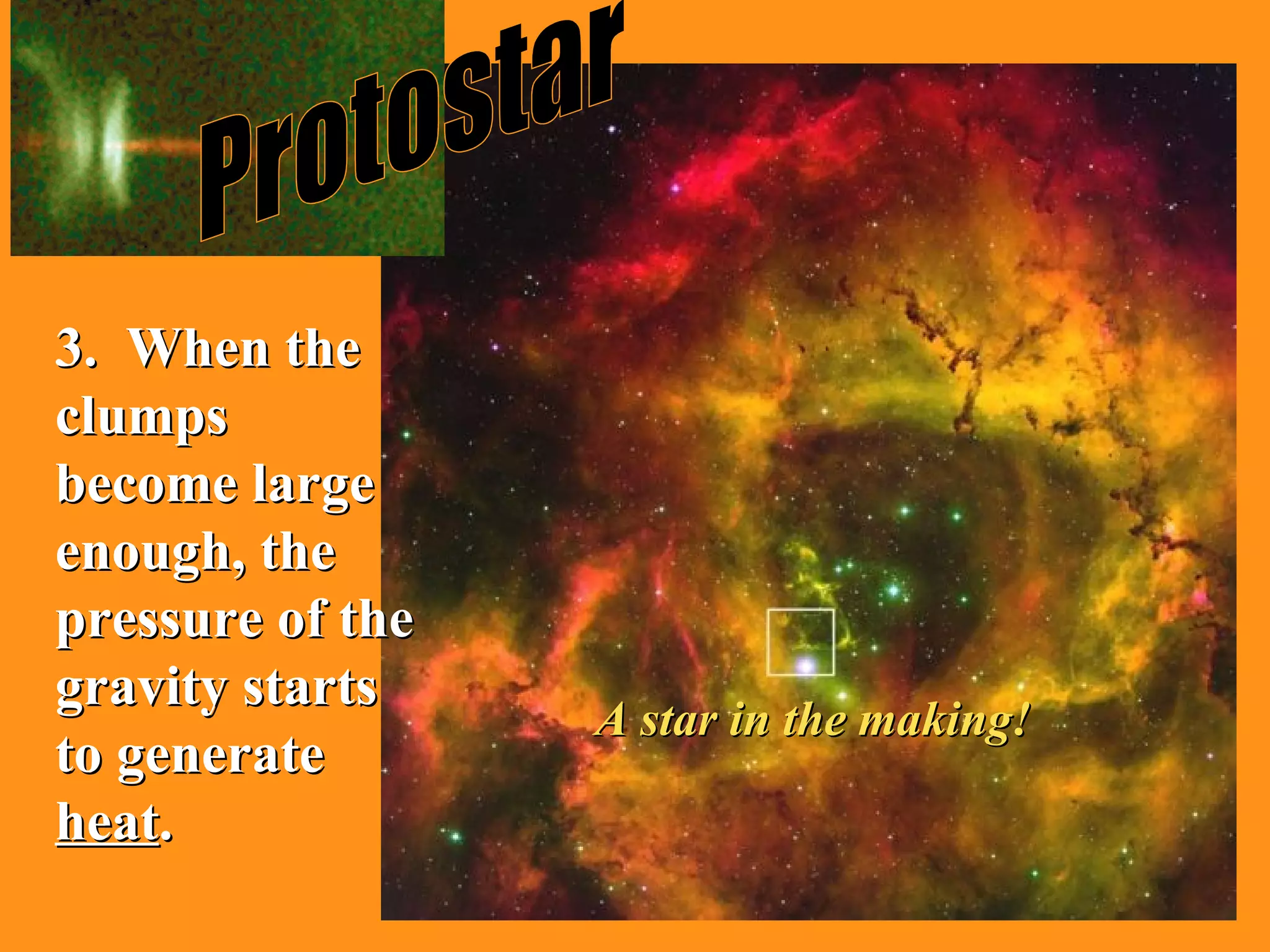
Protostar 3.  When the clumps become large enough, the pressure of the gravity starts to generate  heat . A star in the making!
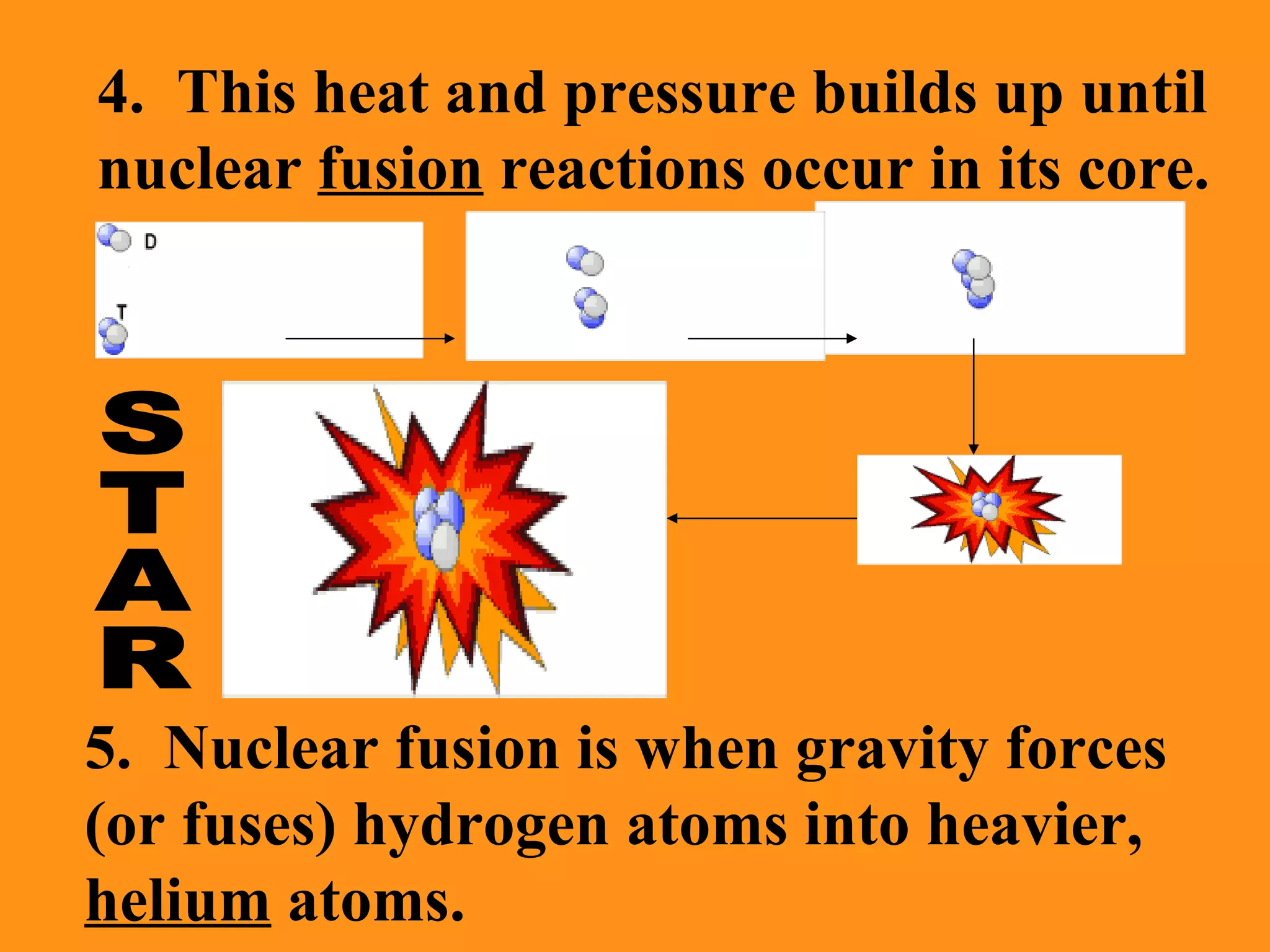
4.  This heat and pressure builds up until nuclear  fusion  reactions occur in its core. STAR 5.  Nuclear fusion is when gravity forces (or fuses) hydrogen atoms into heavier,  helium  atoms.
Luminosity Temperature 6.  Fusion produces a lot of energy.  This causes a star to  ignite  and become a main sequence star.  Our sun is in this phase right now. Main sequence stars Hertzsprung-Russell Diagram
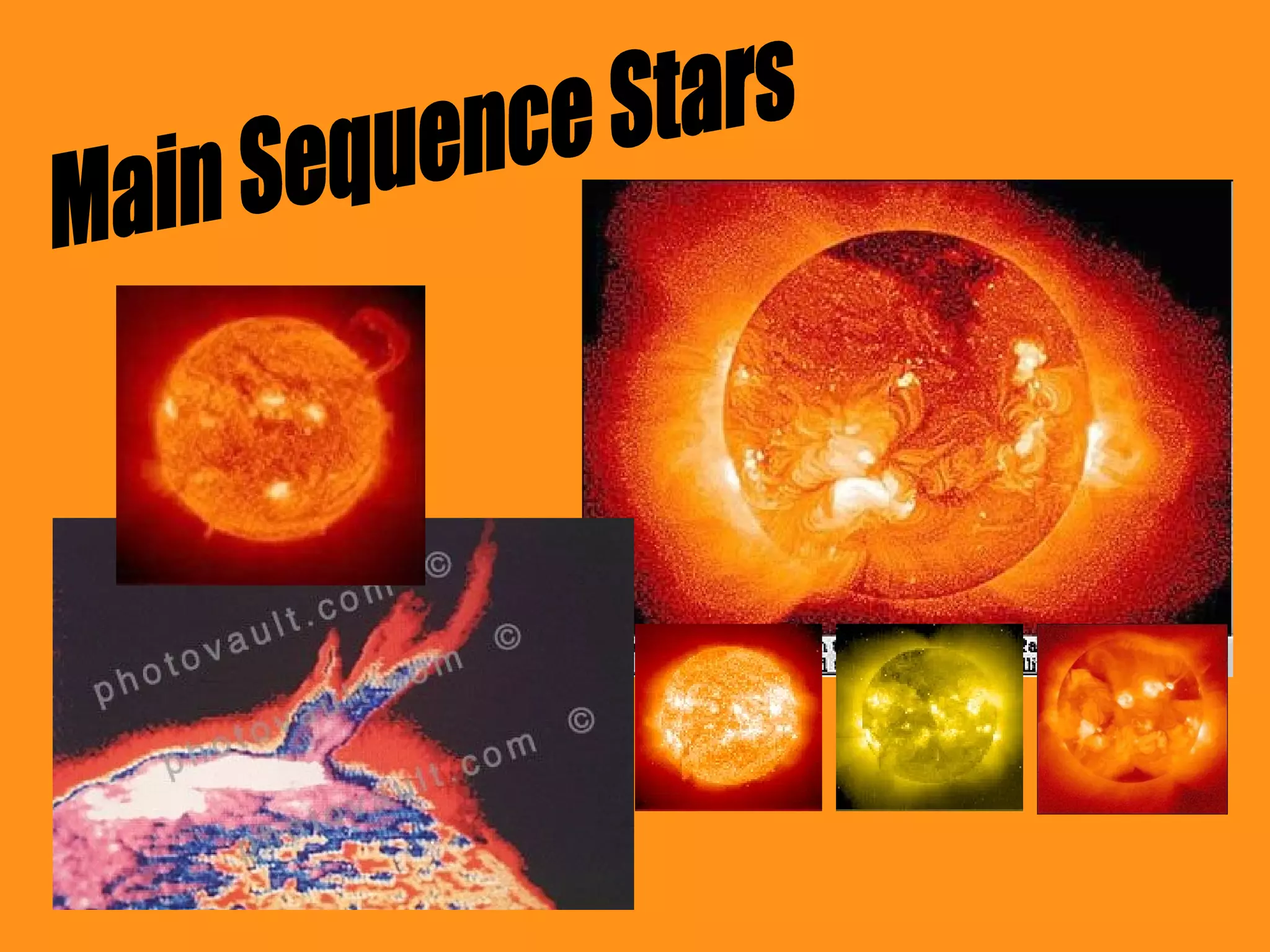
Main Sequence Stars
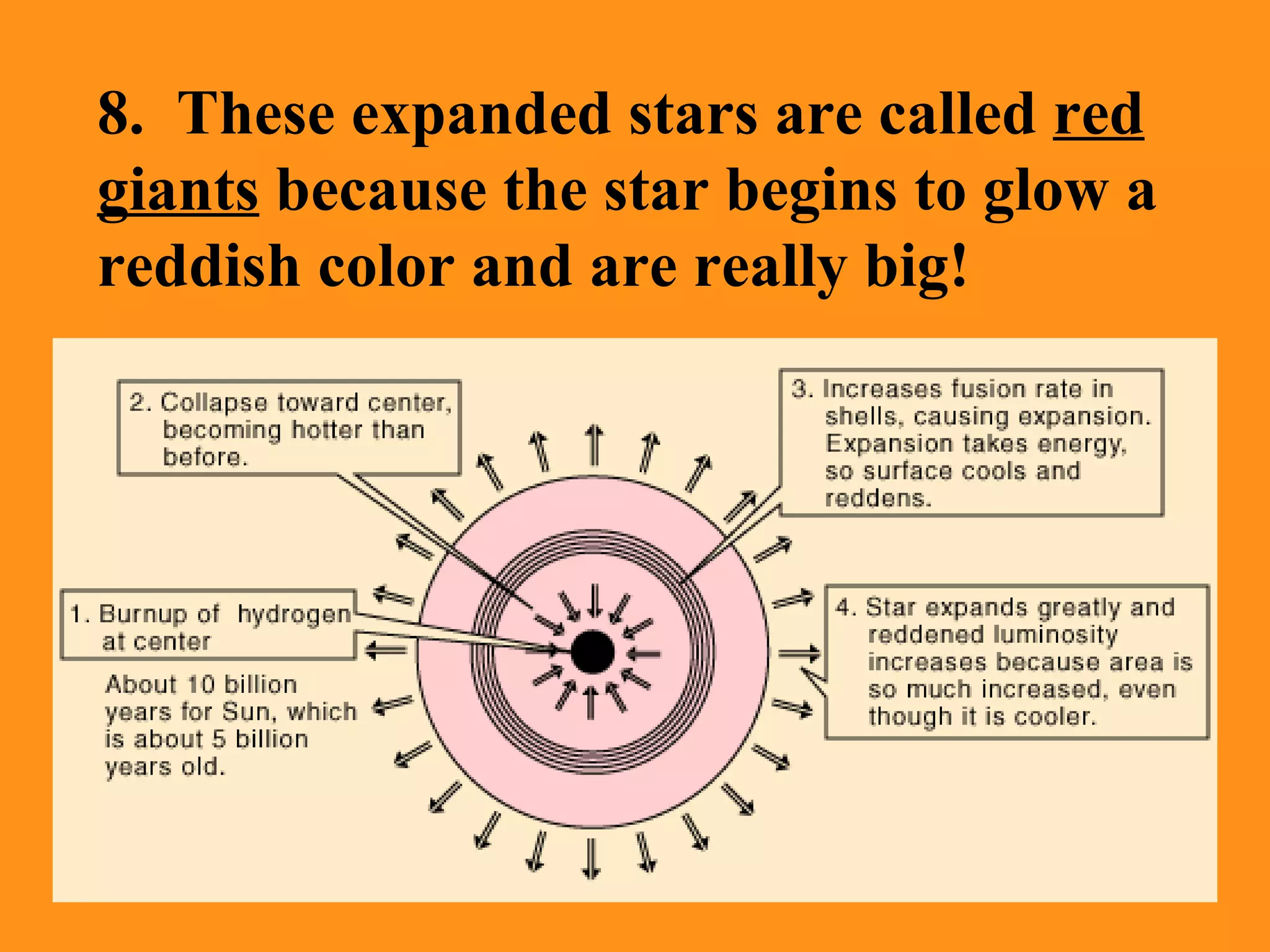
Our Sun 7.  Eventually, the sun will use up its hydrogen ( fuel  for the sun), which will cause it to expand.
8.  These expanded stars are called  red giants  because the star begins to glow a reddish color and are really big!
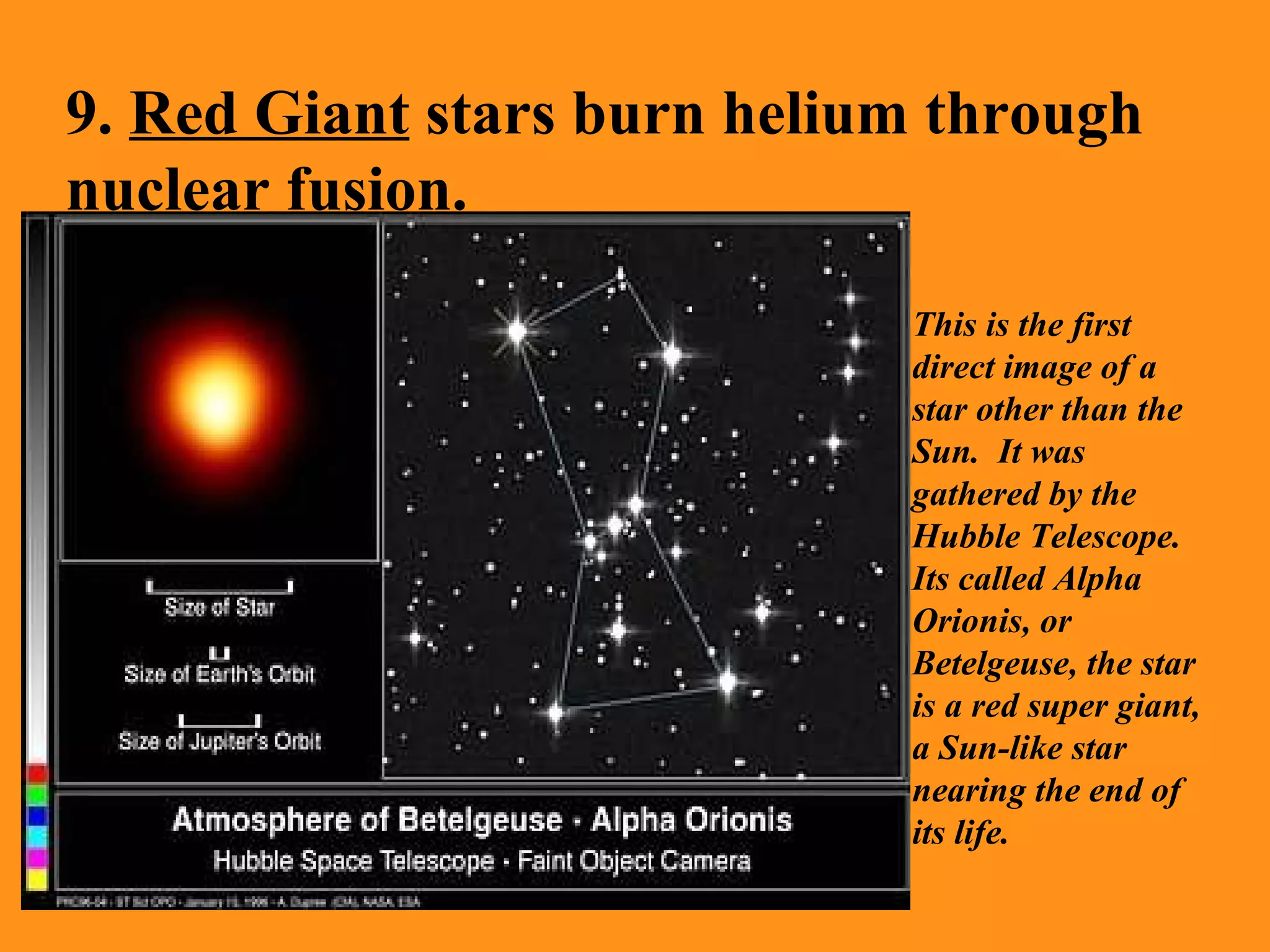
9.  Red Giant  stars burn helium through nuclear fusion. This is the first direct image of a star other than the Sun.  It was gathered by the Hubble Telescope. Its called Alpha Orionis, or Betelgeuse, the star is a red super giant, a Sun-like star nearing the end of its life.
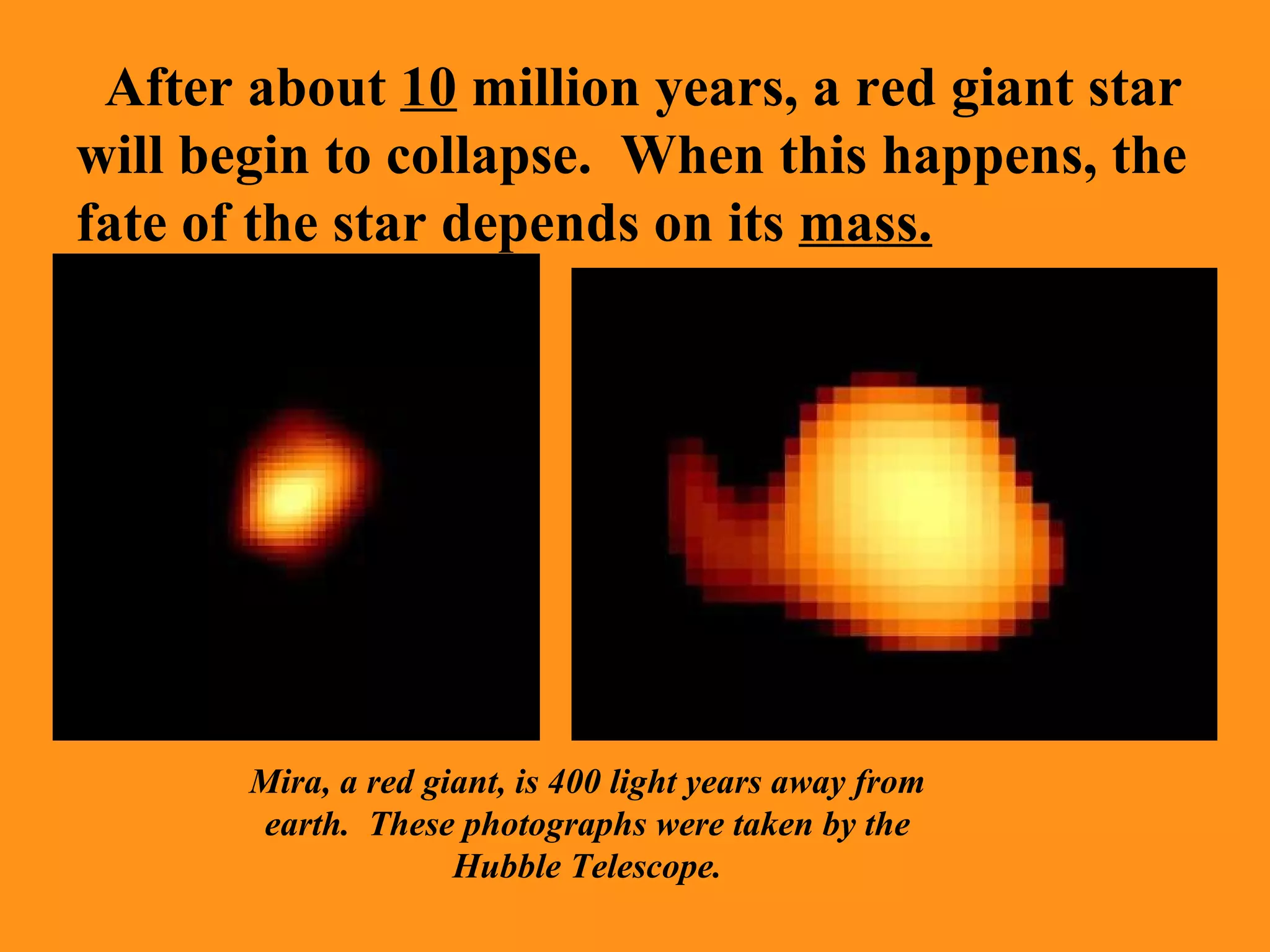
After about  10  million years, a red giant star will begin to collapse.  When this happens, the fate of the star depends on its  mass. Mira, a red giant, is 400 light years away from earth.  These photographs were taken by the Hubble Telescope.
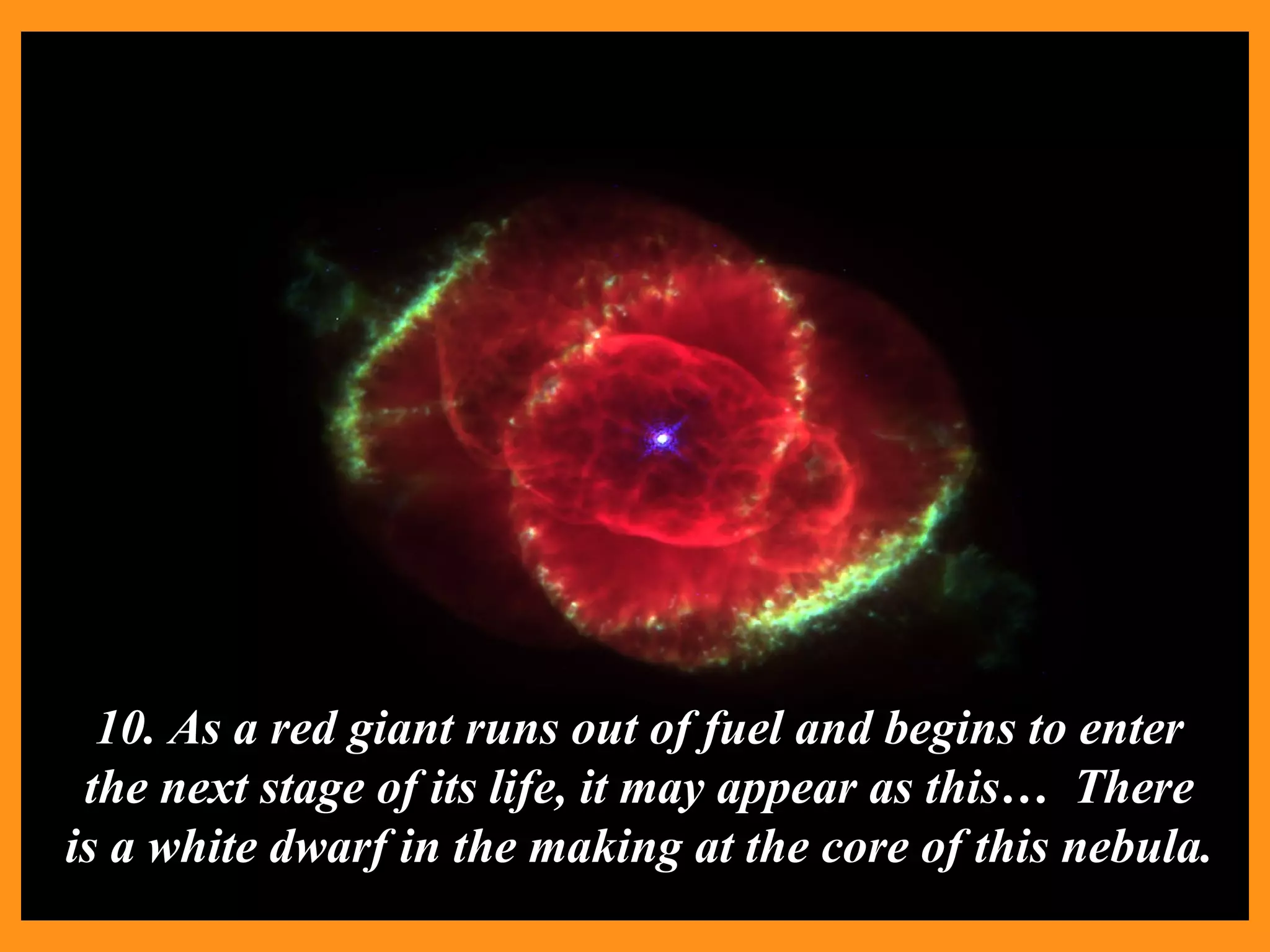
10. As a red giant runs out of fuel and begins to enter the next stage of its life, it may appear as this…  There is a white dwarf in the making at the core of this nebula.
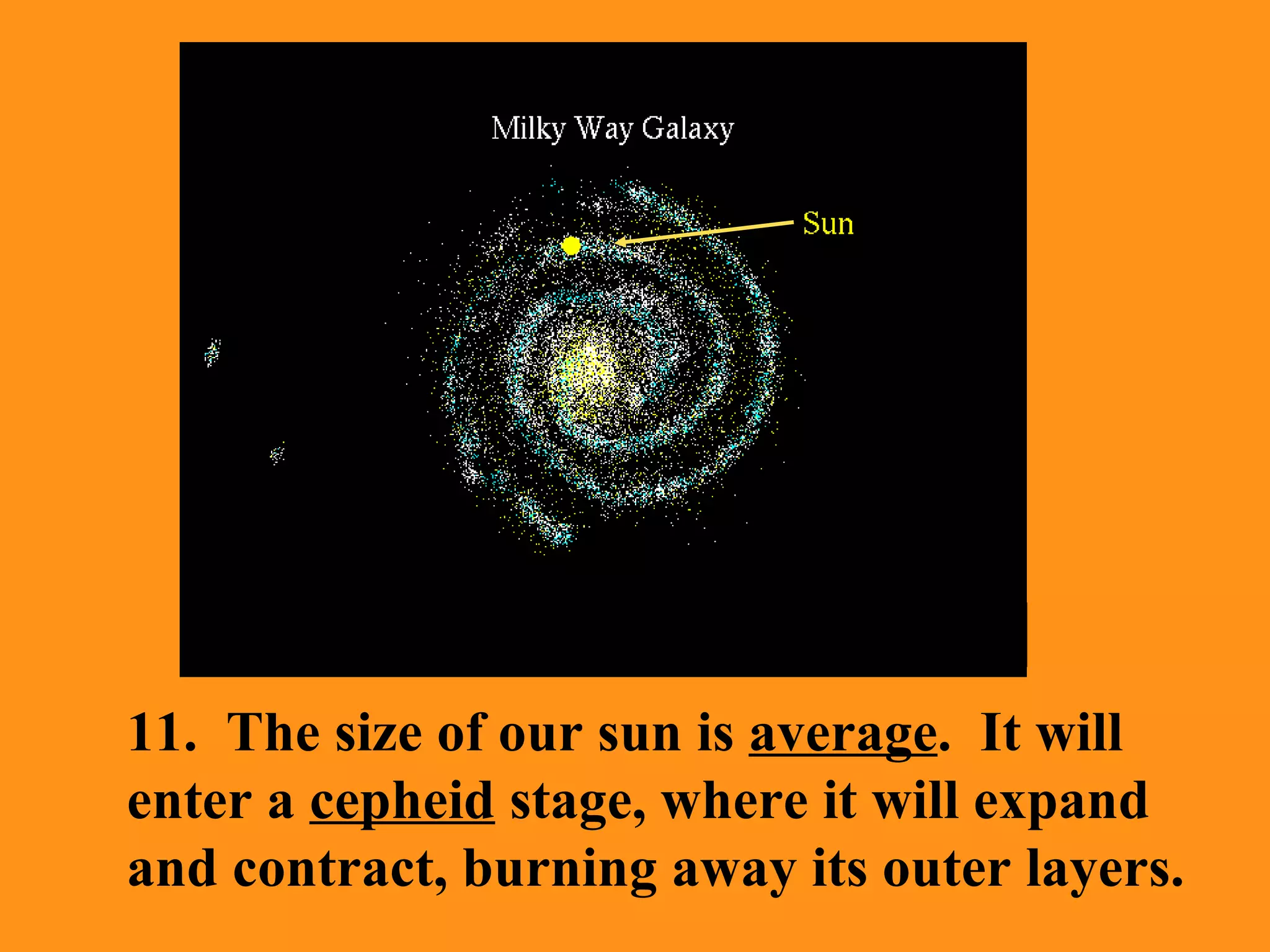
11.  The size of our sun is  average .  It will enter a  cepheid  stage, where it will expand and contract, burning away its outer layers.
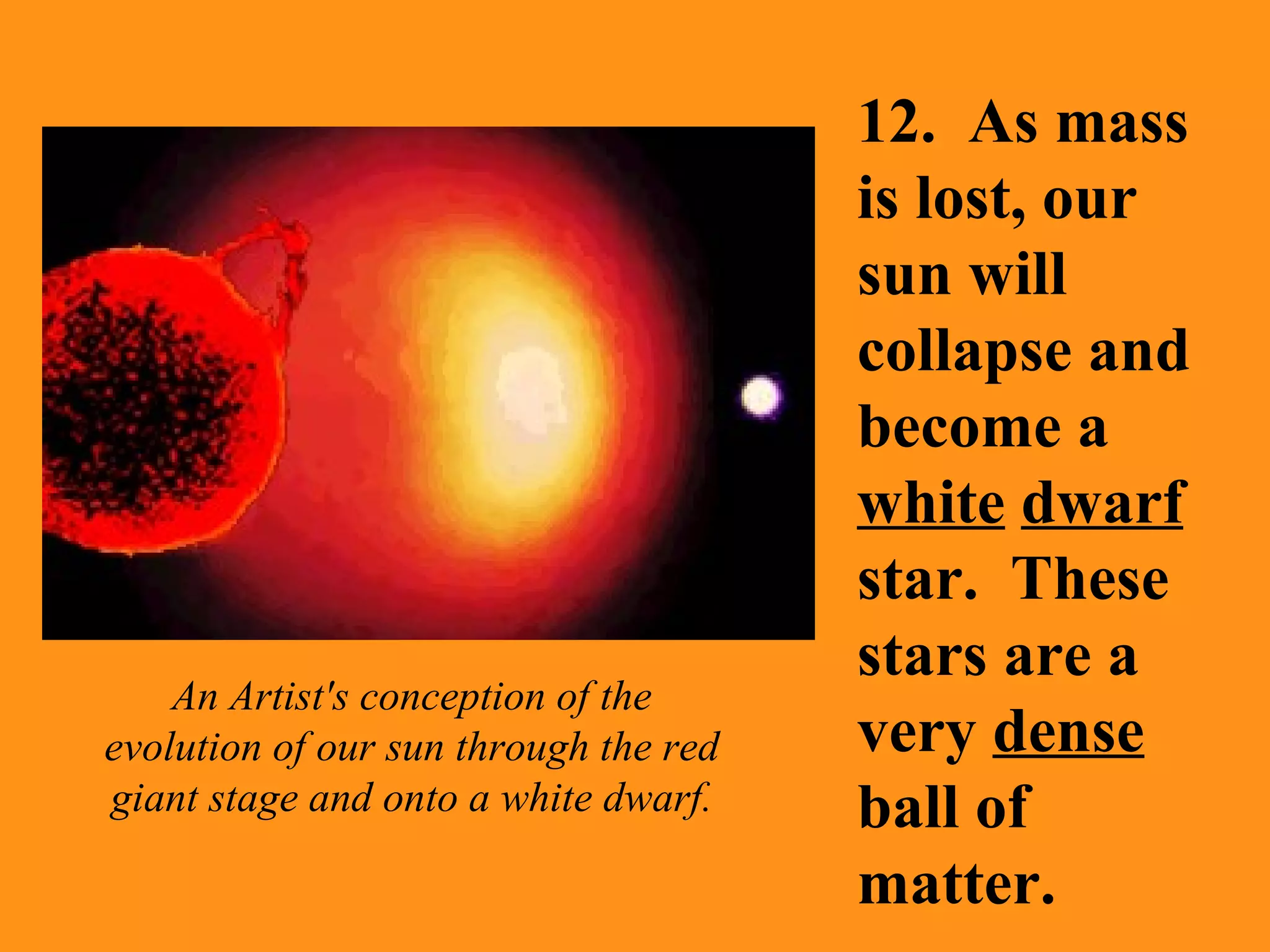
12.  As mass is lost, our sun will collapse and become a  white   dwarf  star.  These stars are a very  dense  ball of matter. An Artist's conception of the evolution of our sun through the red giant stage and onto a white dwarf.
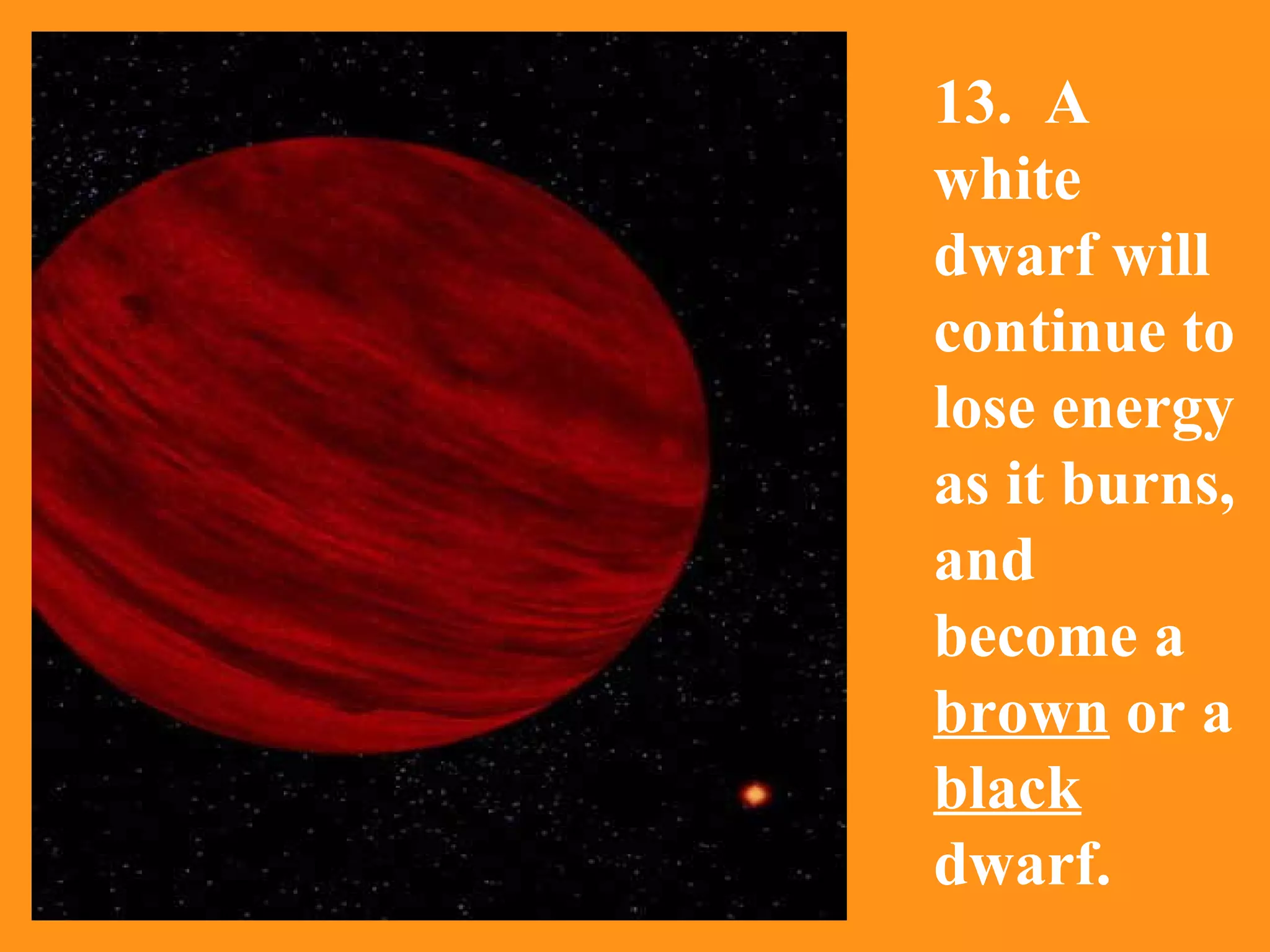
13.  A white dwarf will continue to lose energy as it burns, and become a  brown  or a  black  dwarf. Artist’s Depiction of a Brown Dwarf
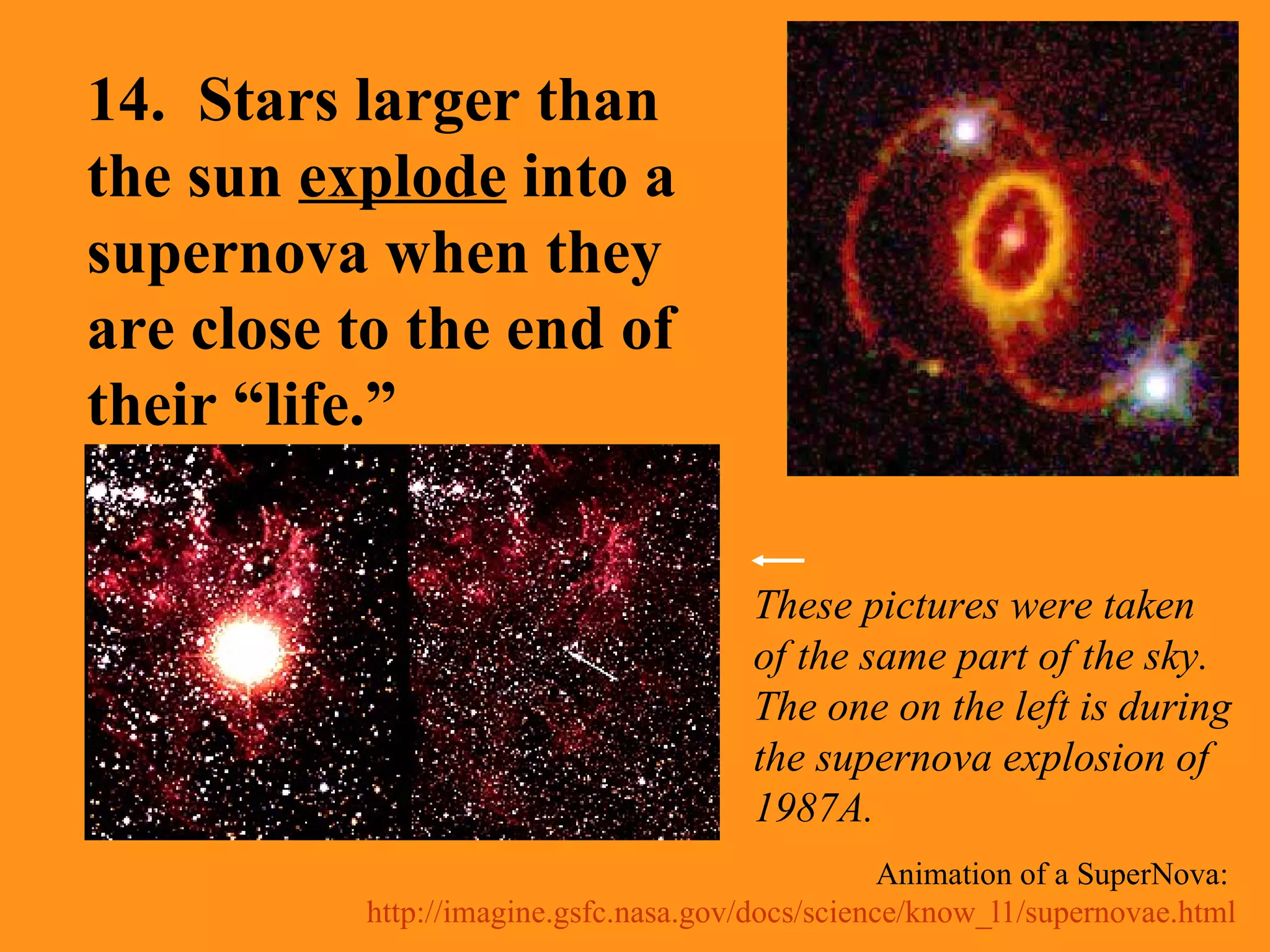
Animation of a SuperNova:  http://imagine.gsfc.nasa.gov/docs/science/know_l1/supernovae.html 14.  Stars larger than the sun  explode  into a supernova when they are close to the end of their “life.” These pictures were taken of the same part of the sky.  The one on the left is during the supernova explosion of 1987A.
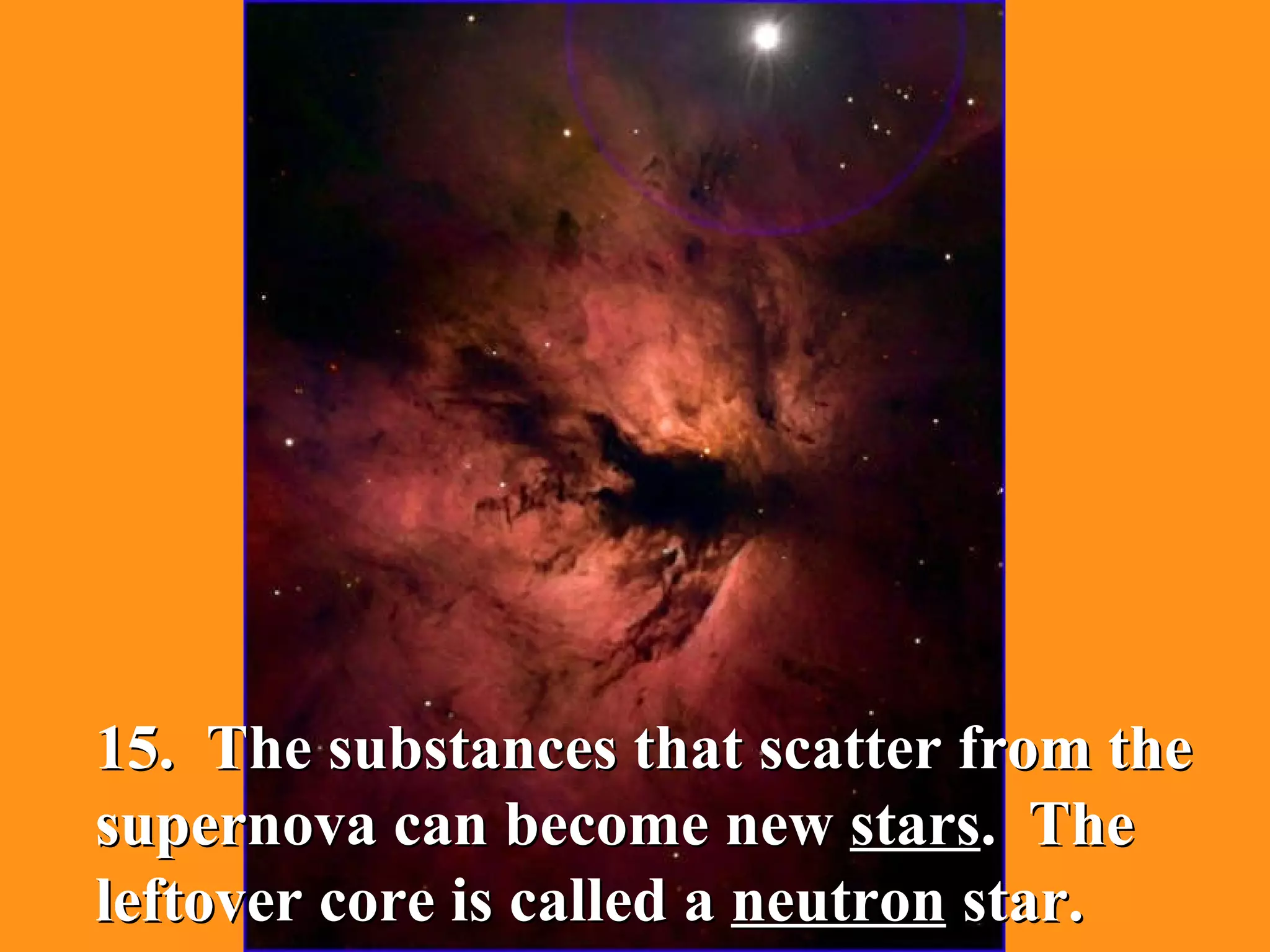
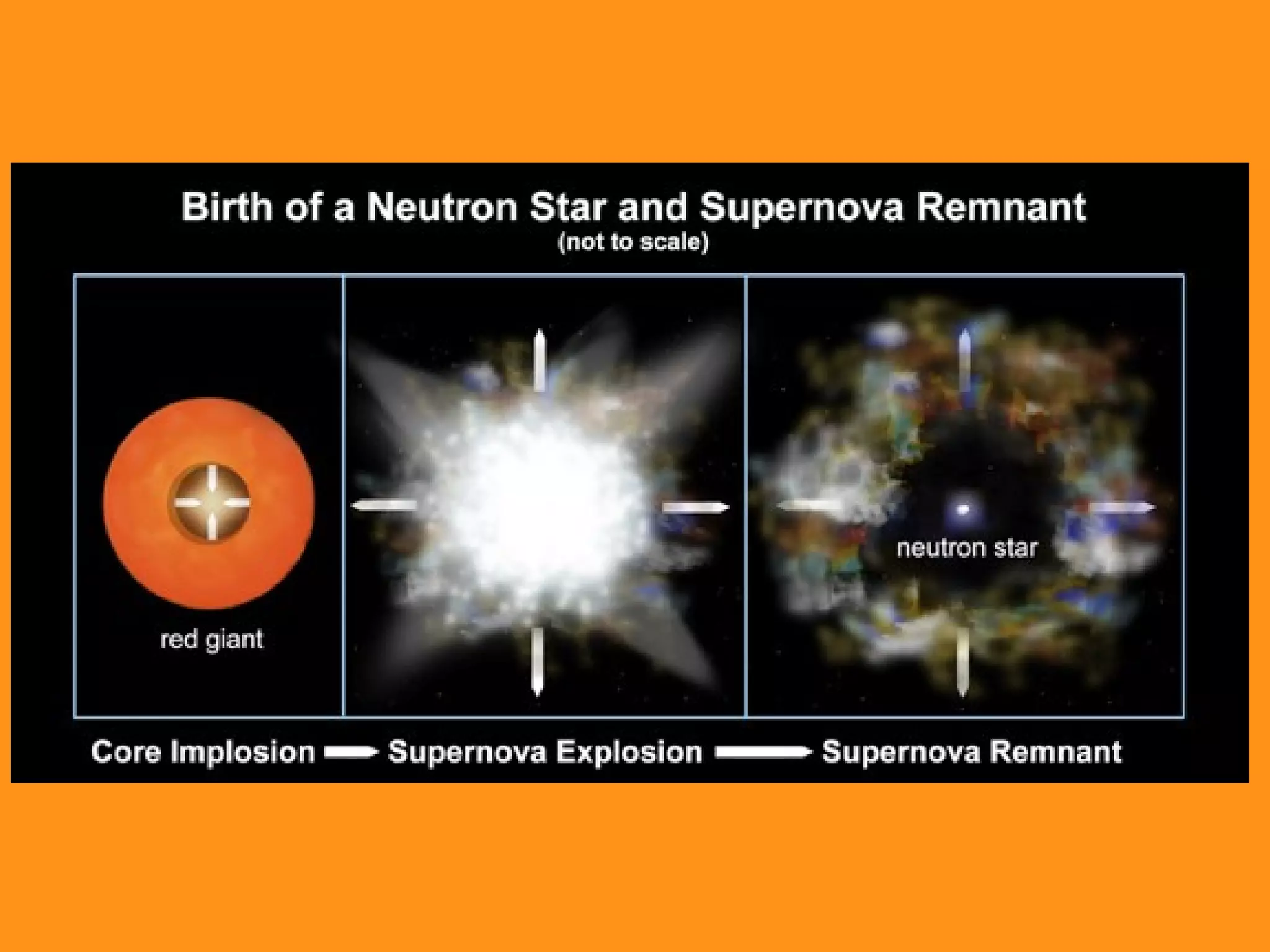
15.  The substances that scatter from the supernova can become new  stars .  The leftover core is called a  neutron  star.
 
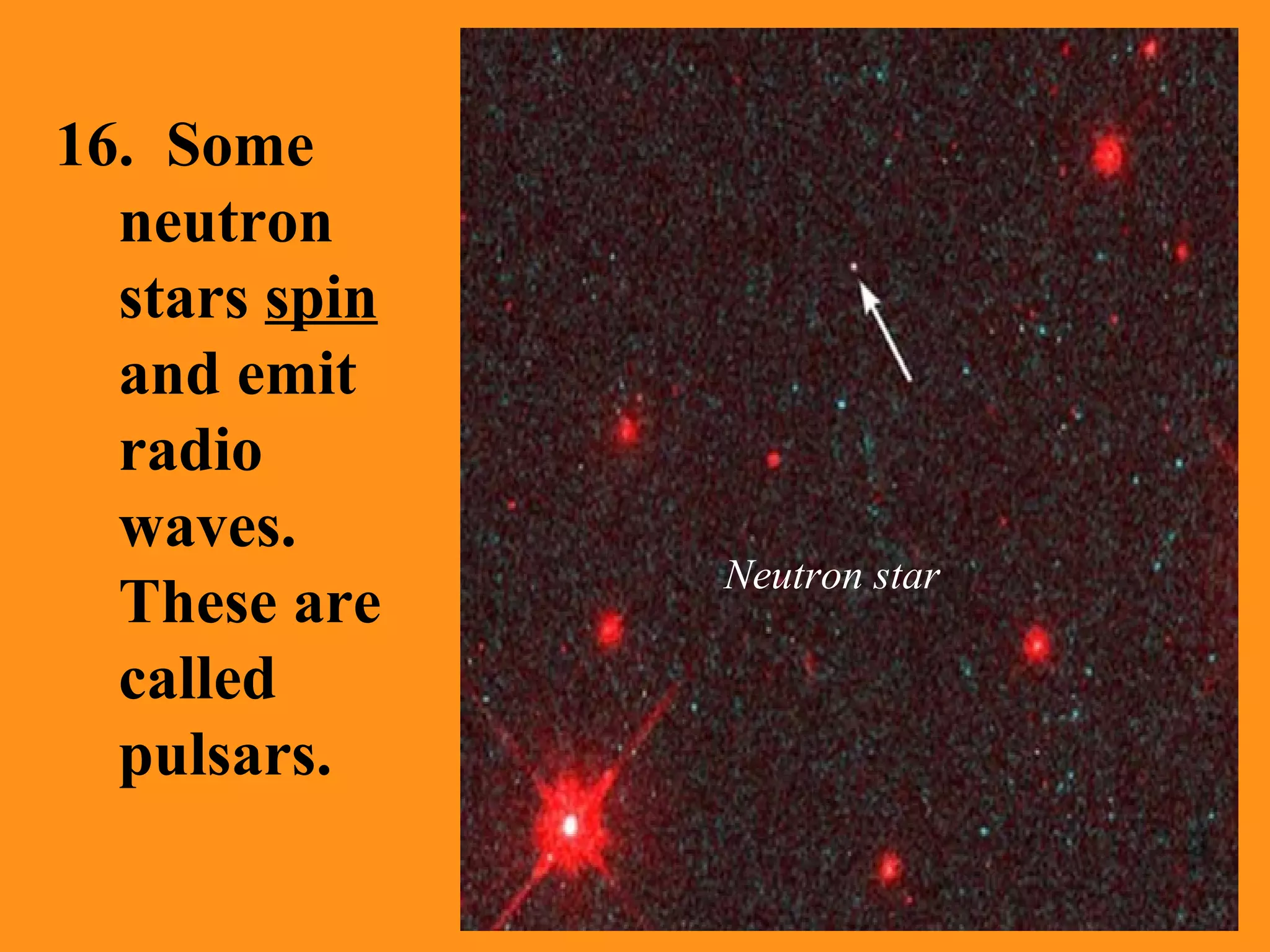
16.  Some neutron stars  spin  and emit radio waves.  These are called pulsars. Neutron star
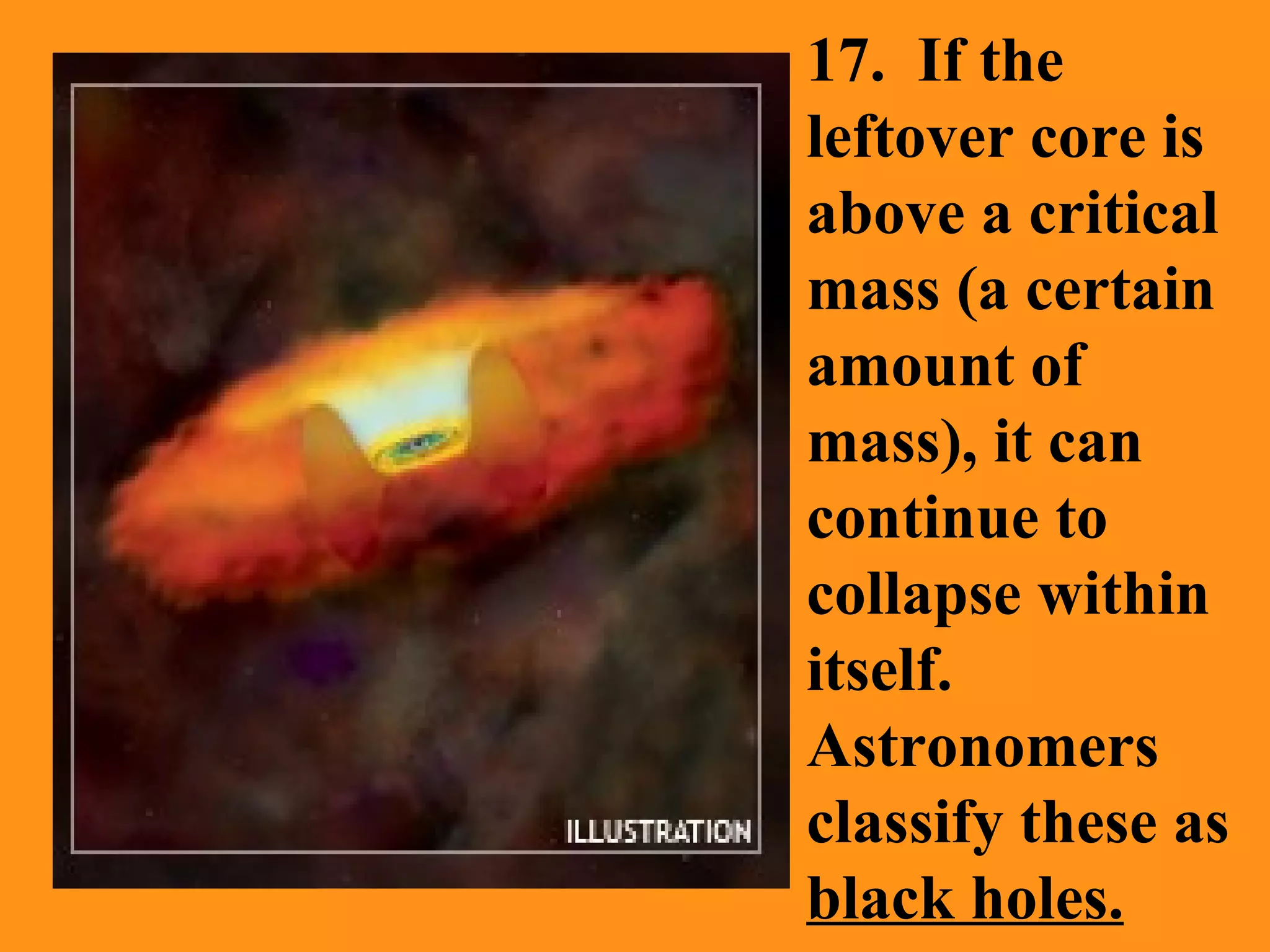
17.  If the leftover core is above a critical mass (a certain amount of mass), it can continue to collapse within itself.  Astronomers classify these as  black holes.
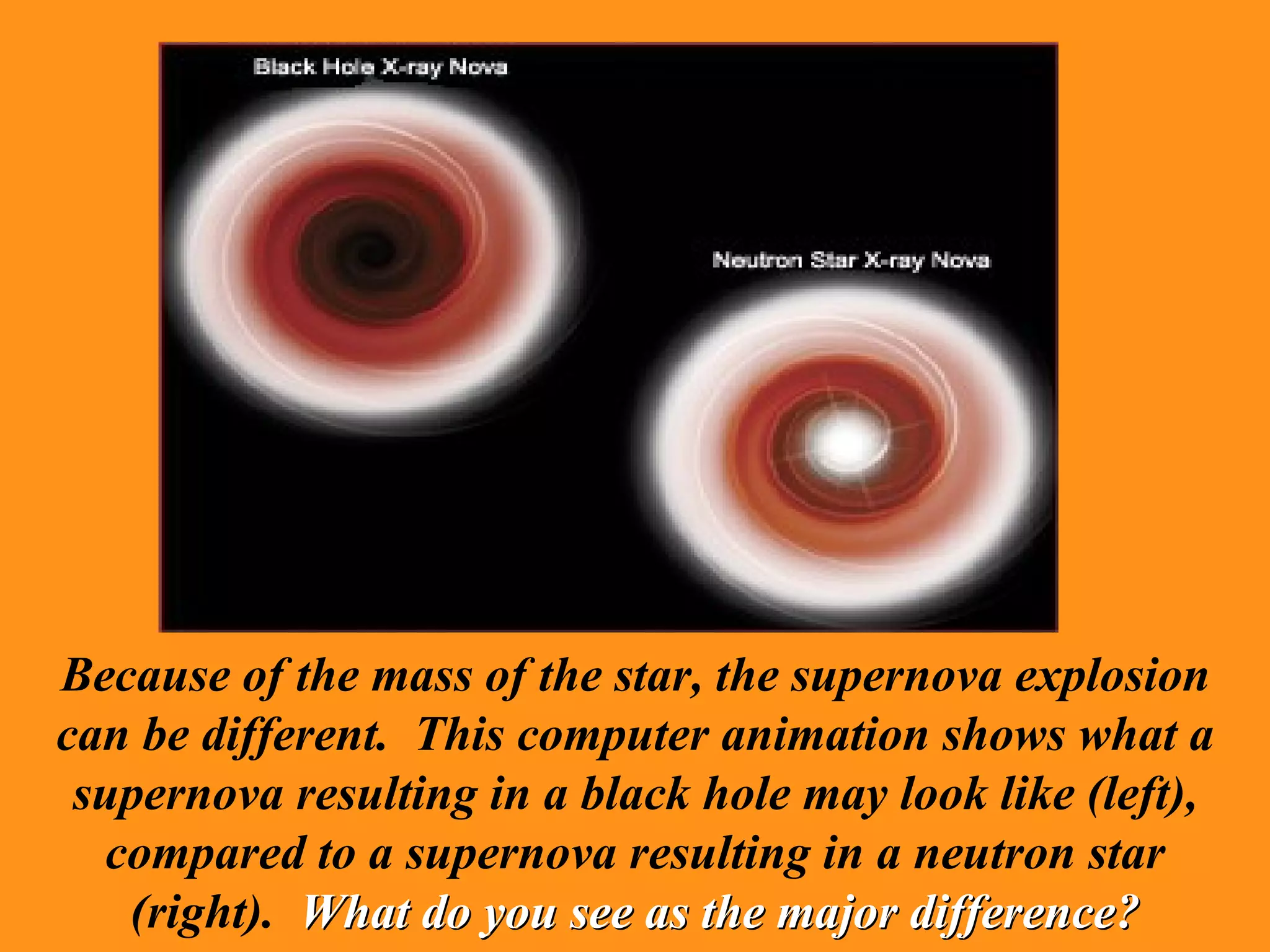
Because of the mass of the star, the supernova explosion can be different.  This computer animation shows what a supernova resulting in a black hole may look like (left), compared to a supernova resulting in a neutron star (right).  What do you see as the major difference?
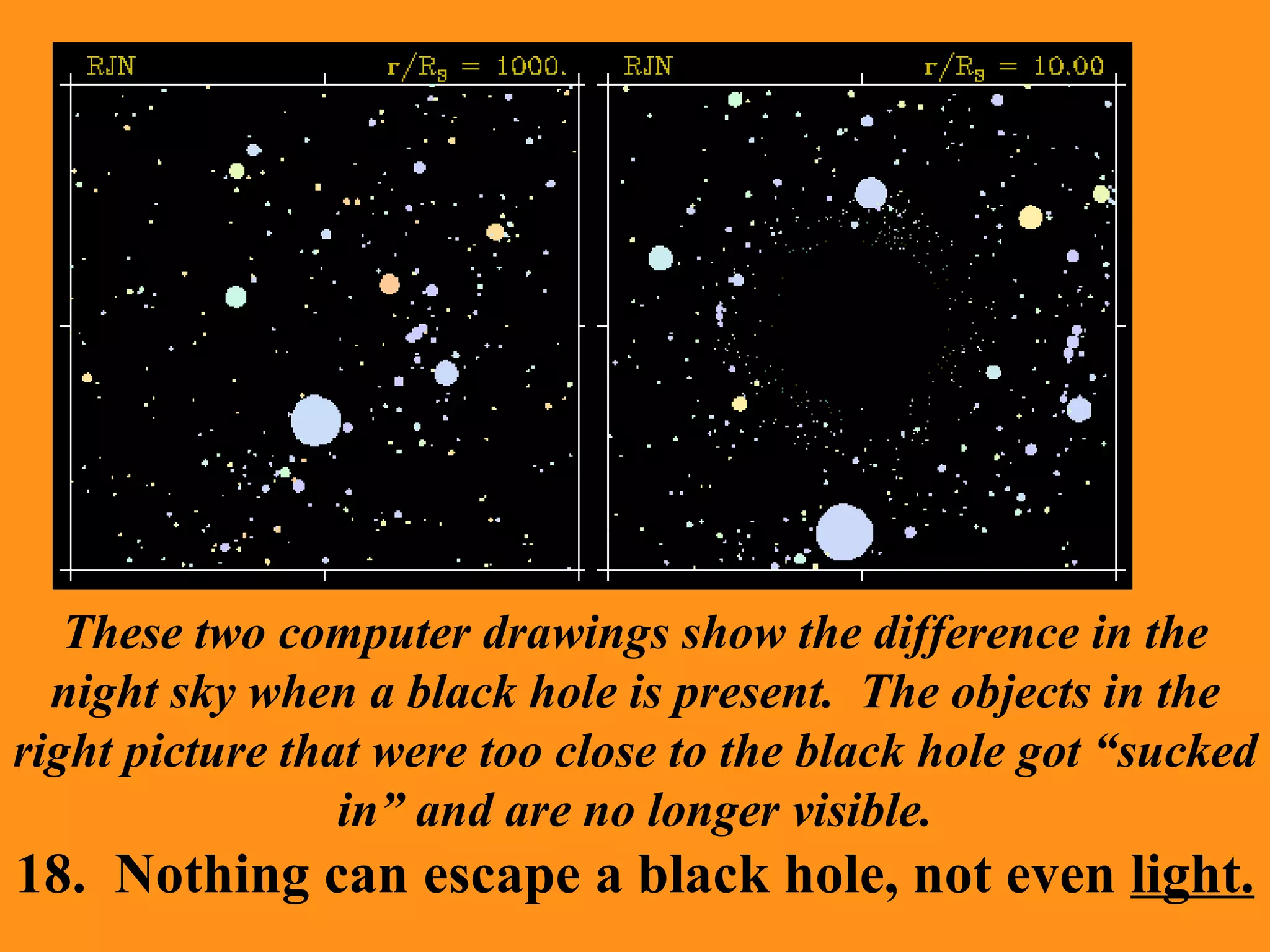
These two computer drawings show the difference in the night sky when a black hole is present.  The objects in the right picture that were too close to the black hole got “sucked in” and are no longer visible. 18.  Nothing can escape a black hole, not even  light.
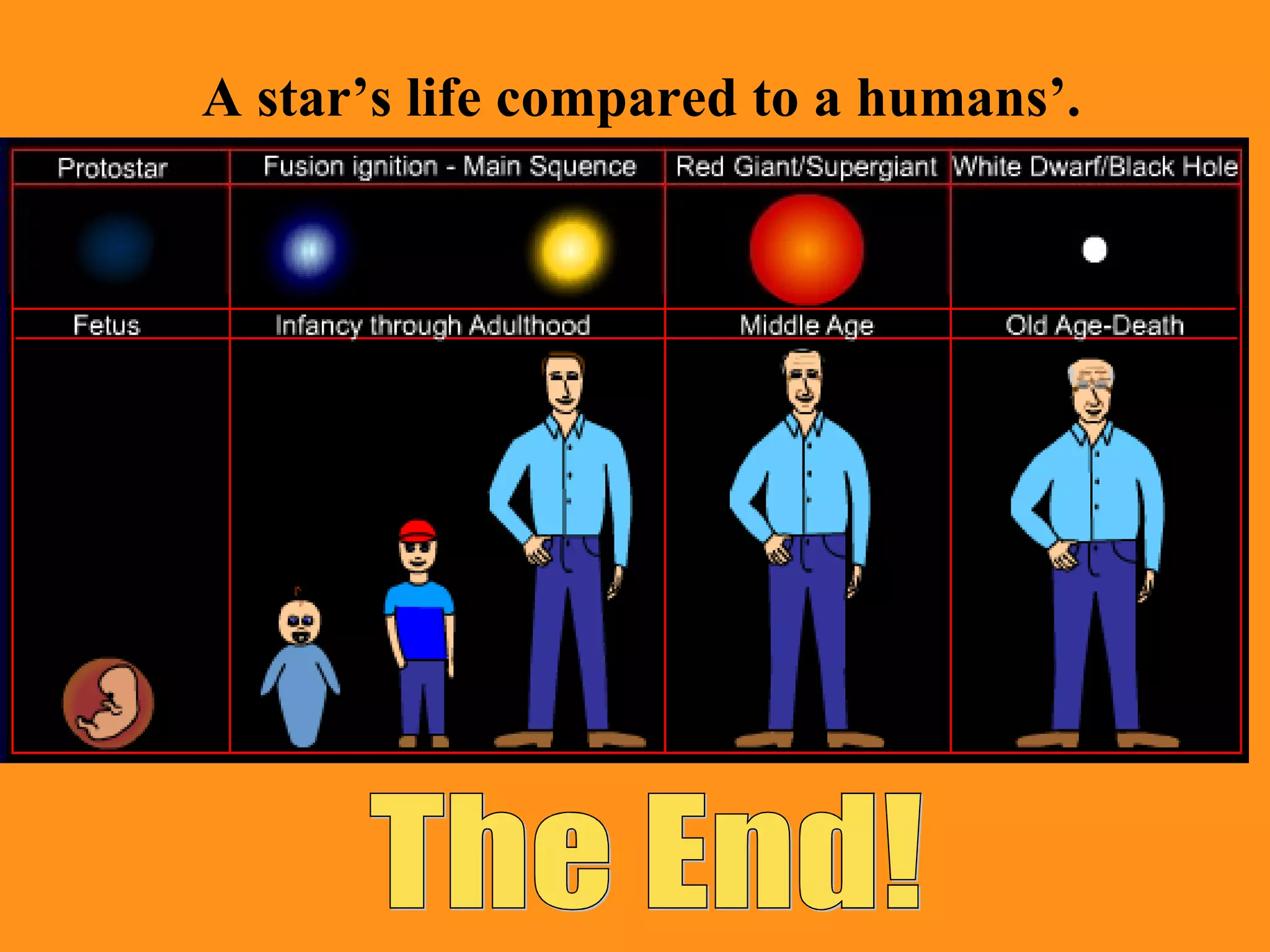
A star’s life compared to a humans’. The End!

The Life Of A Star

  • 1.
    The Life OfA STAR!
  • 2.
    Blue White YellowOrange - Red
  • 3.
  • 4.
    1. Stars startout as diffused clouds of gas and dust drifting through space. These are called nebulae, one is pictured here.
  • 5.
    Nebulae 2. The force of gravity pulls these clouds together causing clumps to forms.
  • 6.
    The Eskimo Nebula,as photographed by the Hubble Telescope.
  • 7.
    Protostar 3. When the clumps become large enough, the pressure of the gravity starts to generate heat . A star in the making!
  • 8.
    4. Thisheat and pressure builds up until nuclear fusion reactions occur in its core. STAR 5. Nuclear fusion is when gravity forces (or fuses) hydrogen atoms into heavier, helium atoms.
  • 9.
    Luminosity Temperature 6. Fusion produces a lot of energy. This causes a star to ignite and become a main sequence star. Our sun is in this phase right now. Main sequence stars Hertzsprung-Russell Diagram
  • 10.
  • 11.
    Our Sun 7. Eventually, the sun will use up its hydrogen ( fuel for the sun), which will cause it to expand.
  • 12.
    8. Theseexpanded stars are called red giants because the star begins to glow a reddish color and are really big!
  • 13.
    9. RedGiant stars burn helium through nuclear fusion. This is the first direct image of a star other than the Sun. It was gathered by the Hubble Telescope. Its called Alpha Orionis, or Betelgeuse, the star is a red super giant, a Sun-like star nearing the end of its life.
  • 14.
    After about 10 million years, a red giant star will begin to collapse. When this happens, the fate of the star depends on its mass. Mira, a red giant, is 400 light years away from earth. These photographs were taken by the Hubble Telescope.
  • 15.
    10. As ared giant runs out of fuel and begins to enter the next stage of its life, it may appear as this… There is a white dwarf in the making at the core of this nebula.
  • 16.
    11. Thesize of our sun is average . It will enter a cepheid stage, where it will expand and contract, burning away its outer layers.
  • 17.
    12. Asmass is lost, our sun will collapse and become a white dwarf star. These stars are a very dense ball of matter. An Artist's conception of the evolution of our sun through the red giant stage and onto a white dwarf.
  • 18.
    13. Awhite dwarf will continue to lose energy as it burns, and become a brown or a black dwarf. Artist’s Depiction of a Brown Dwarf
  • 19.
    Animation of aSuperNova: http://imagine.gsfc.nasa.gov/docs/science/know_l1/supernovae.html 14. Stars larger than the sun explode into a supernova when they are close to the end of their “life.” These pictures were taken of the same part of the sky. The one on the left is during the supernova explosion of 1987A.
  • 20.
    15. Thesubstances that scatter from the supernova can become new stars . The leftover core is called a neutron star.
  • 21.
  • 22.
    16. Someneutron stars spin and emit radio waves. These are called pulsars. Neutron star
  • 23.
    17. Ifthe leftover core is above a critical mass (a certain amount of mass), it can continue to collapse within itself. Astronomers classify these as black holes.
  • 24.
    Because of themass of the star, the supernova explosion can be different. This computer animation shows what a supernova resulting in a black hole may look like (left), compared to a supernova resulting in a neutron star (right). What do you see as the major difference?
  • 25.
    These two computerdrawings show the difference in the night sky when a black hole is present. The objects in the right picture that were too close to the black hole got “sucked in” and are no longer visible. 18. Nothing can escape a black hole, not even light.
  • 26.
    A star’s lifecompared to a humans’. The End!