What are Waves?
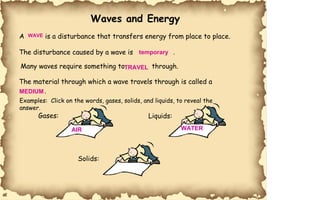
Waves and Energy A is a disturbance that transfers energy from place to place. The disturbance caused by a wave is . Many waves require something to  through. The material through which a wave travels through is called a  . Examples:  Click on the words, gases, solids, and liquids, to reveal the  answer. Gases: Liquids: Solids: WAVE temporary TRAVEL MEDIUM AIR WATER
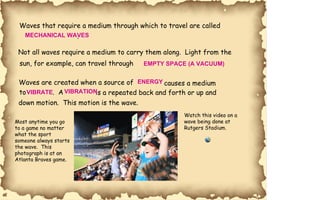
Waves that require a medium through which to travel are called  . Not all waves require a medium to carry them along.  Light from the sun, for example, can travel through . Waves are created when a source of  causes a medium to .  A is a repeated back and forth or up and  down motion.  This motion is the wave. Watch this video on a  wave being done at  Rutgers Stadium. Most anytime you go  to a game no matter  what the sport  someone always starts  the wave.  This  photograph is at an  Atlanta Braves game. MECHANICAL WAVES EMPTY SPACE (A VACUUM) ENERGY VIBRATE VIBRATION
Types of Waves Waves are classified according to how they  .  There are types of waves. Watch this short clip on the Nature of Waves. MOVE TRANSVERSE LONGITUDINAL SURFACE
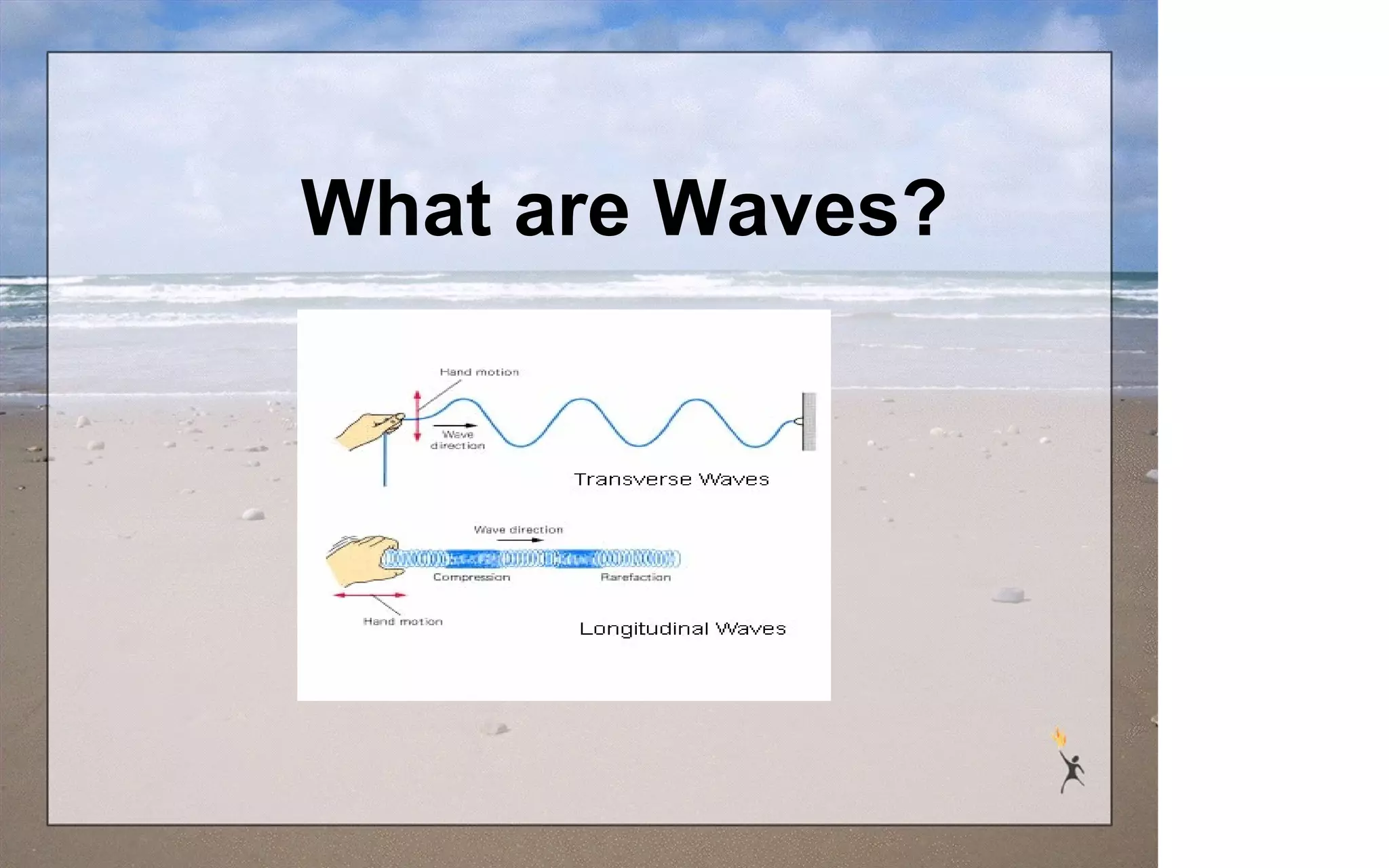
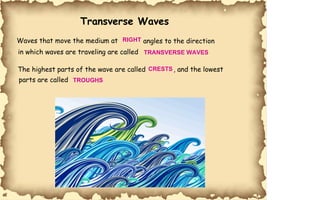
Waves that move the medium at angles to the direction in which waves are traveling are called . Transverse Waves The highest parts of the wave are called , and the lowest parts are called . RIGHT TRANSVERSE WAVES CRESTS TROUGHS
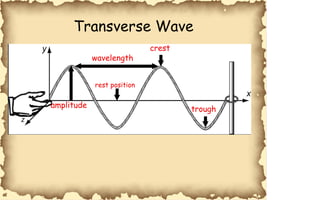
rest position crest amplitude trough wavelength Transverse Wave
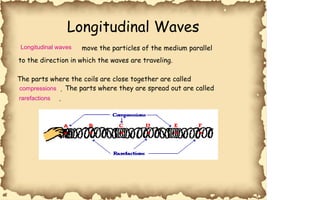
Longitudinal Waves move the particles of the medium parallel to the direction in which the waves are traveling. The parts where the coils are close together are called . The parts where they are spread out are called . Longitudinal waves compressions rarefactions
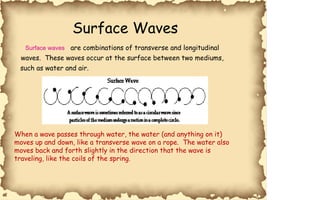
Surface Waves are combinations of transverse and longitudinal waves.  These waves occur at the surface between two mediums, such as water and air. When a wave passes through water, the water (and anything on it)  moves up and down, like a transverse wave on a rope.  The water also  moves back and forth slightly in the direction that the wave is  traveling, like the coils of the spring. Surface waves
Fini Wave good – bye – you are done

What are waves

  • 1.
  • 2.
    Waves and EnergyA is a disturbance that transfers energy from place to place. The disturbance caused by a wave is . Many waves require something to through. The material through which a wave travels through is called a . Examples: Click on the words, gases, solids, and liquids, to reveal the answer. Gases: Liquids: Solids: WAVE temporary TRAVEL MEDIUM AIR WATER
  • 3.
    Waves that requirea medium through which to travel are called . Not all waves require a medium to carry them along. Light from the sun, for example, can travel through . Waves are created when a source of causes a medium to . A is a repeated back and forth or up and down motion. This motion is the wave. Watch this video on a wave being done at Rutgers Stadium. Most anytime you go to a game no matter what the sport someone always starts the wave. This photograph is at an Atlanta Braves game. MECHANICAL WAVES EMPTY SPACE (A VACUUM) ENERGY VIBRATE VIBRATION
  • 4.
    Types of WavesWaves are classified according to how they . There are types of waves. Watch this short clip on the Nature of Waves. MOVE TRANSVERSE LONGITUDINAL SURFACE
  • 5.
    Waves that movethe medium at angles to the direction in which waves are traveling are called . Transverse Waves The highest parts of the wave are called , and the lowest parts are called . RIGHT TRANSVERSE WAVES CRESTS TROUGHS
  • 6.
    rest position crestamplitude trough wavelength Transverse Wave
  • 7.
    Longitudinal Waves movethe particles of the medium parallel to the direction in which the waves are traveling. The parts where the coils are close together are called . The parts where they are spread out are called . Longitudinal waves compressions rarefactions
  • 8.
    Surface Waves arecombinations of transverse and longitudinal waves. These waves occur at the surface between two mediums, such as water and air. When a wave passes through water, the water (and anything on it) moves up and down, like a transverse wave on a rope. The water also moves back and forth slightly in the direction that the wave is traveling, like the coils of the spring. Surface waves
  • 9.
    Fini Wave good– bye – you are done