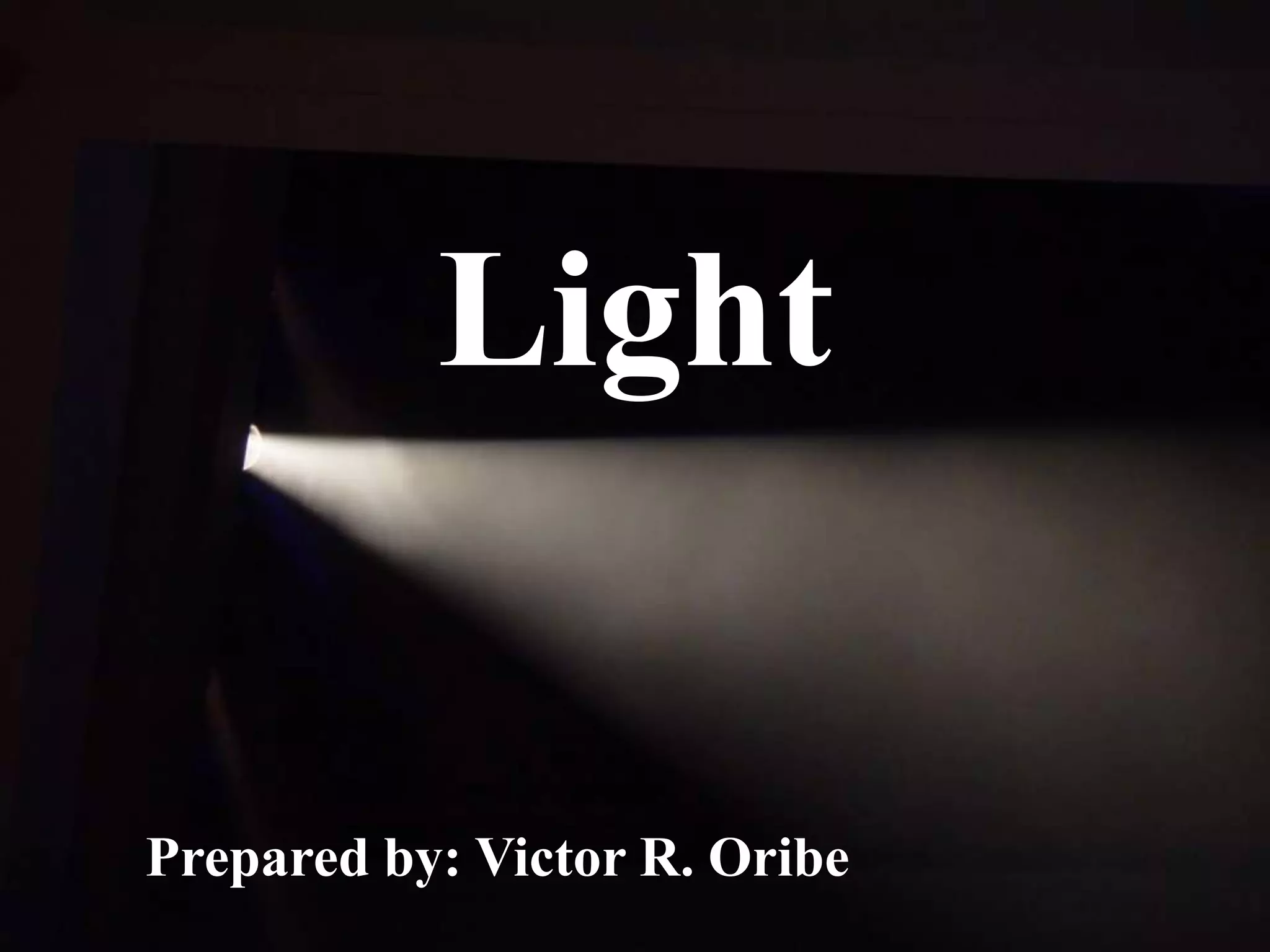
Light


Prepared by: Victor R. Oribe
Light: Particle or Wave?

Sir Isaac Newton advocated the particle theory
that light consists of tiny particles of matter
emitted by a source and spreads outwards in
straight lines called rays.

Christian Huygens, Dutch mathematician and
scientist, theorized that light consists of a
series of waves with their wave fronts at right
angles to the path of the rays
Five properties of light were
developed:
    a. rectilinear propagation of light
    b. Reflection of waves
    c. refraction of light
    d. interference
    e. diffraction
Rectilinear propagation inside an unchanging
medium.
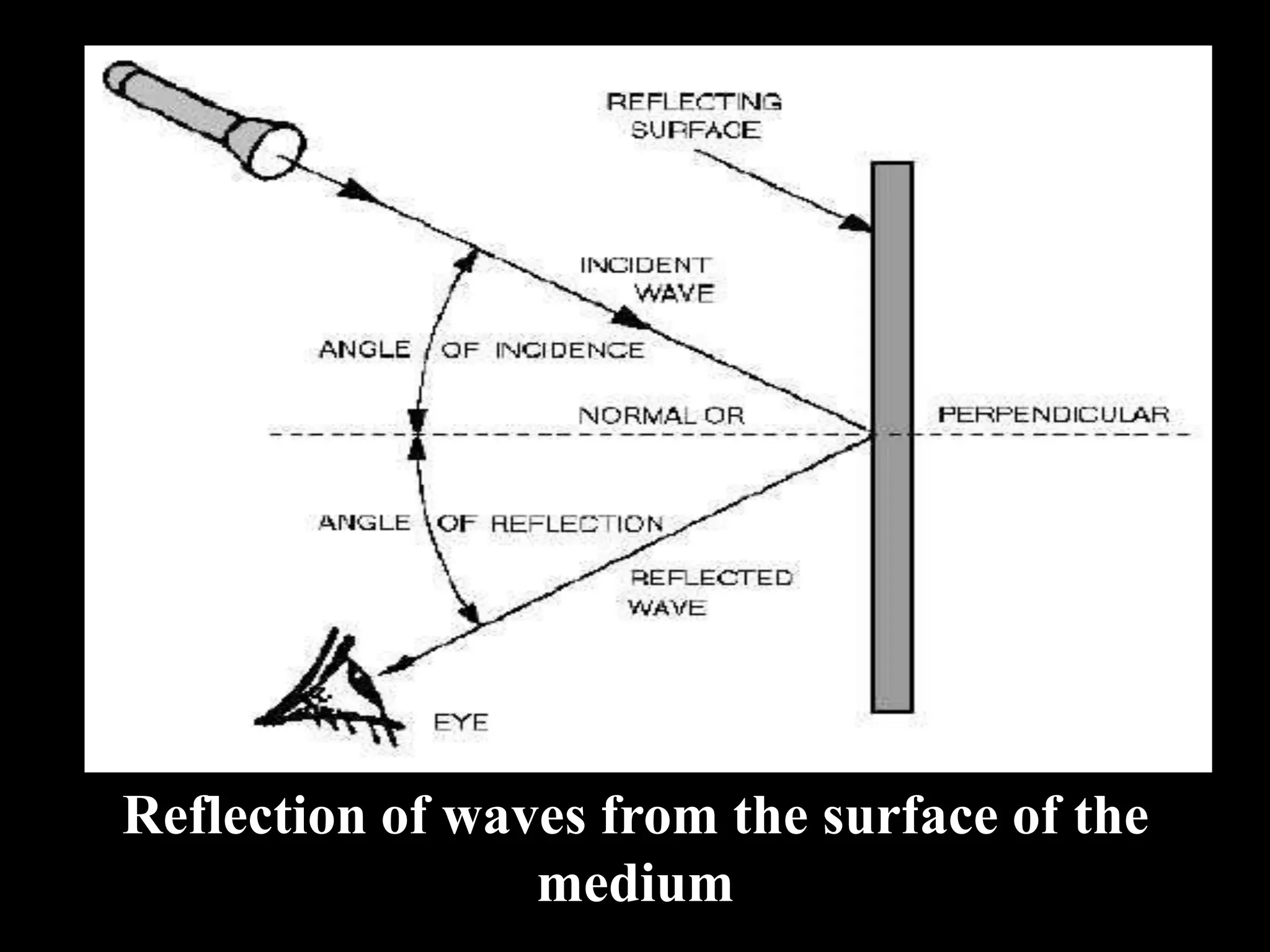
Reflection of waves from the surface of the
                 medium
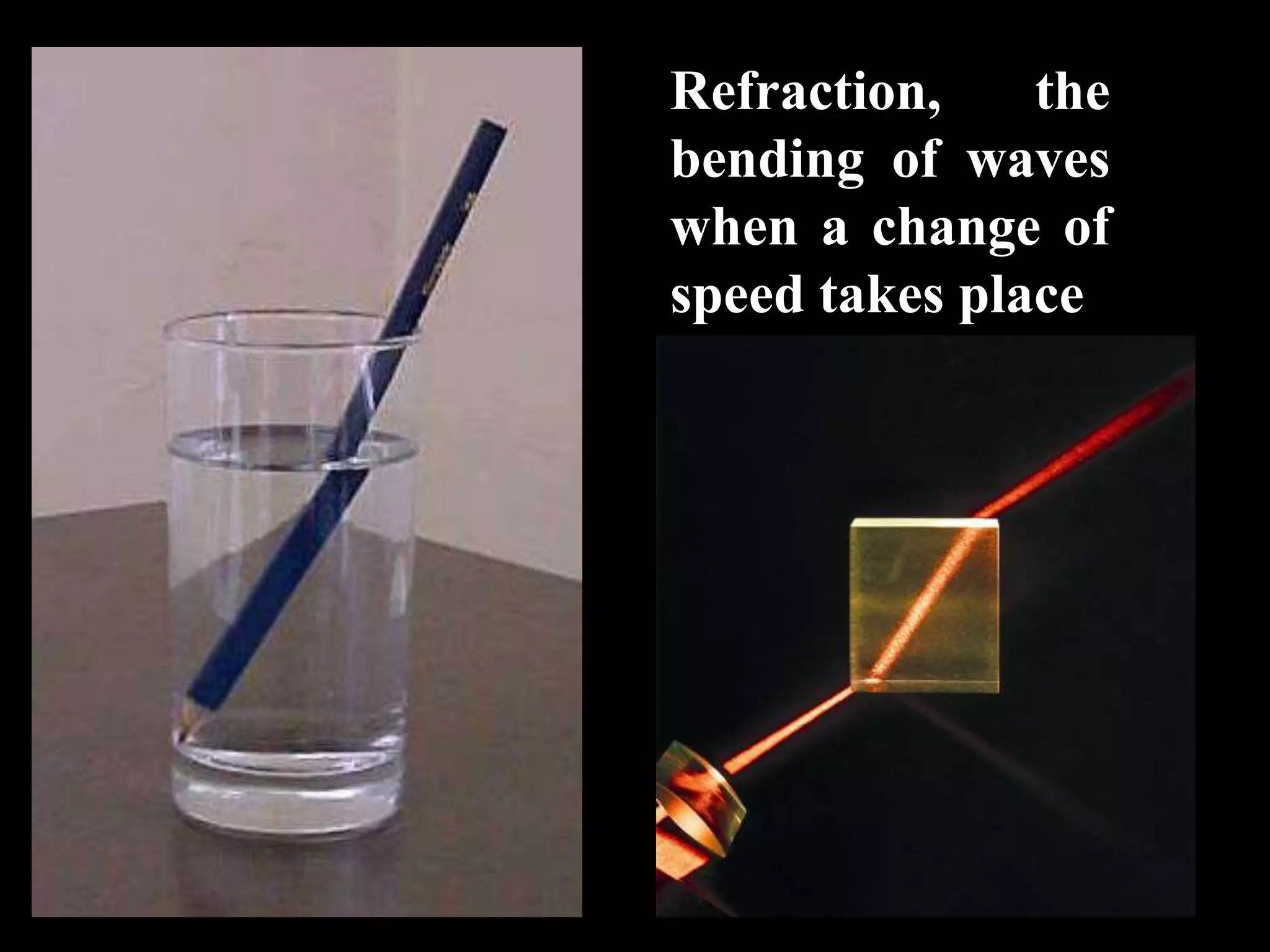
Refraction,    the
bending of waves
when a change of
speed takes place
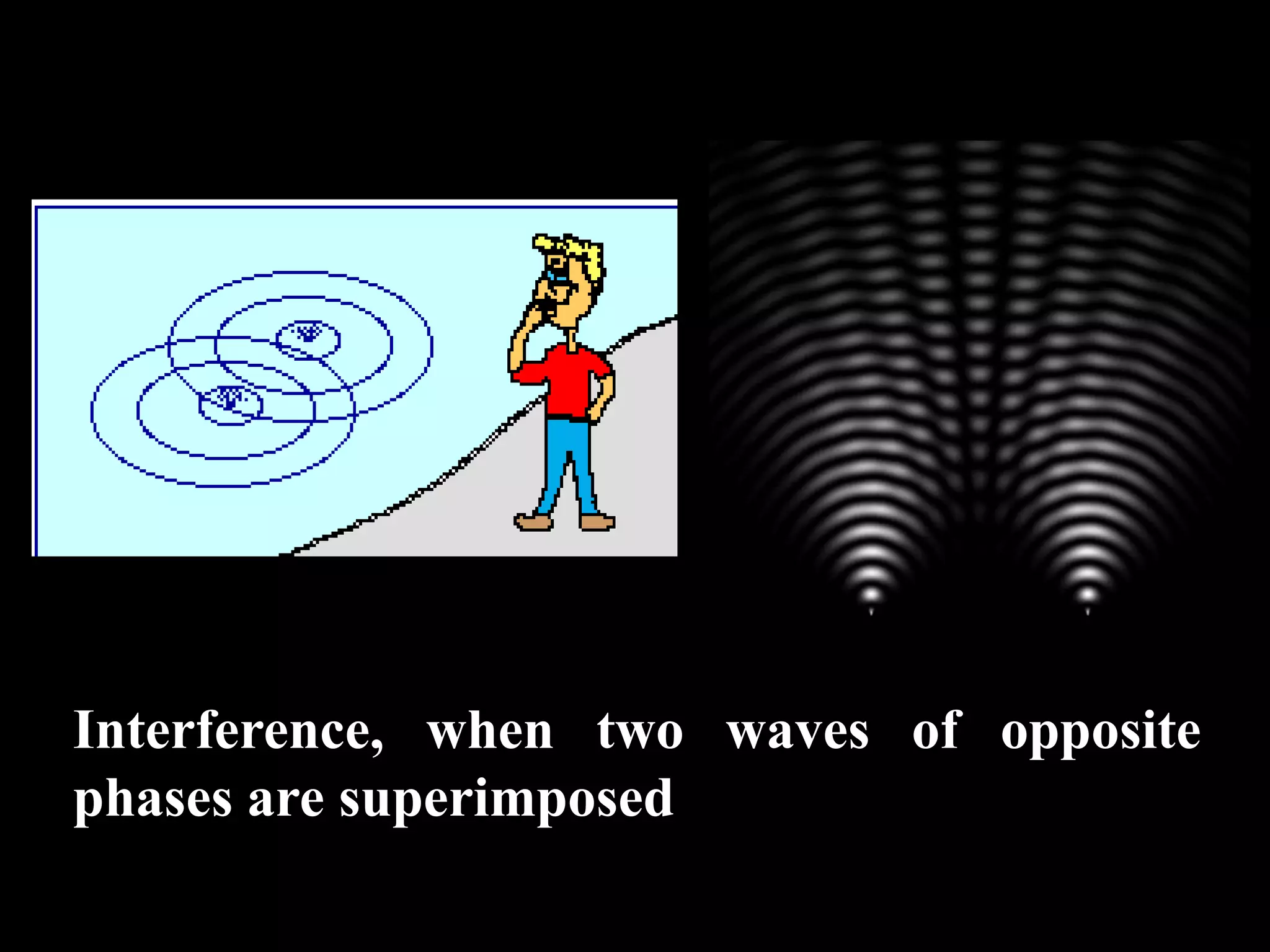
Interference, when two waves of opposite
phases are superimposed
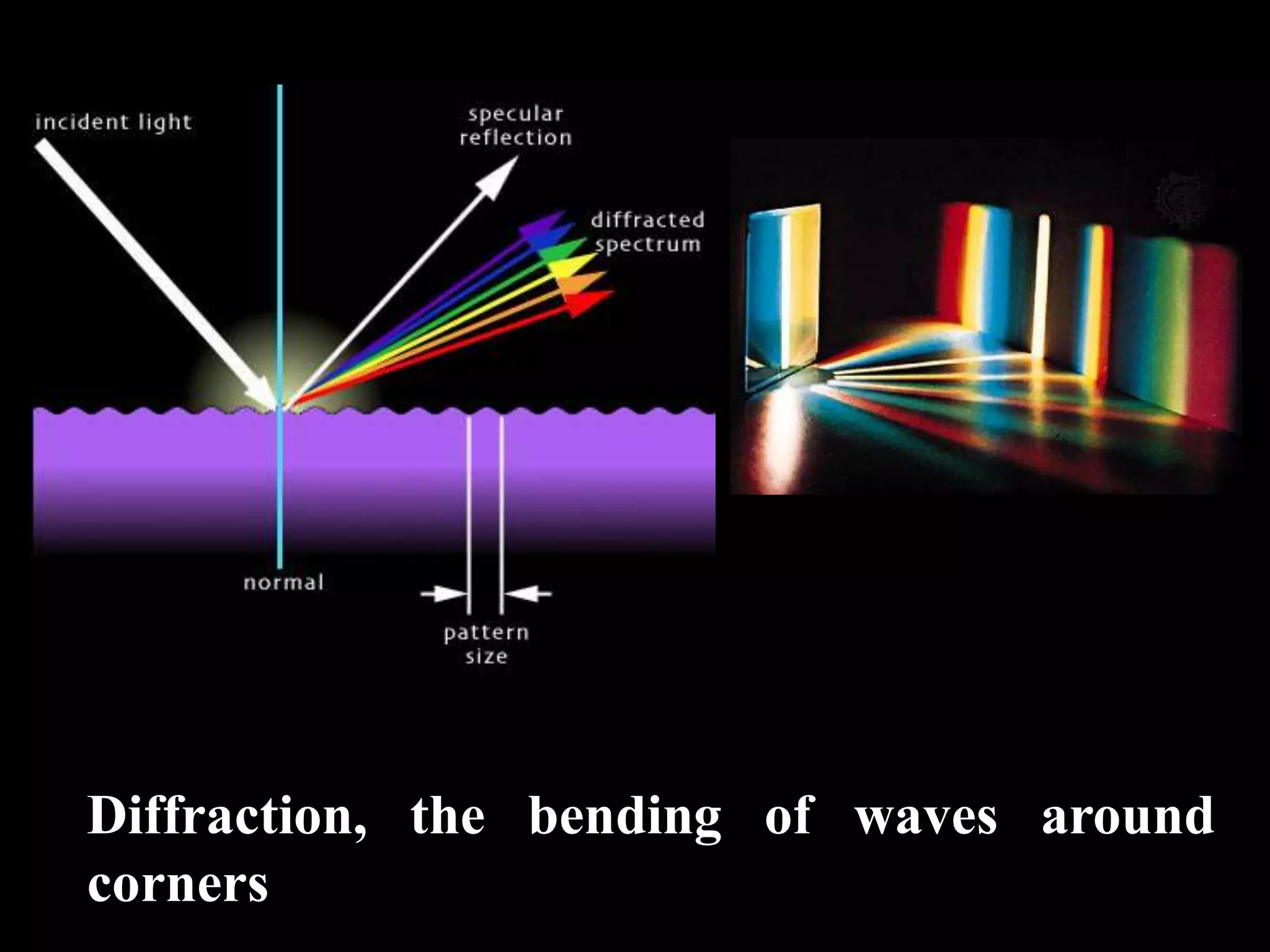
Diffraction, the bending of waves around
corners
During the time of Newton and
Huygens, only the first three
were recognized and observed.

   a) Rectilinear
   b) Reflection
   c) Refraction
Spite of scientific discussions in defense of the
theories, the problems were unresolved for
more than a hundred years.

In the early 19th century, the last two
properties of light, interference and
diffraction, were observed for the first time

Since these two unusual occurrences could not
be clarified and explained by the particle
theory, the wave theory become more
acceptable.
The Photoelectric Effect
At the turn of the 20th century, it was observed
that electrons were emitted by some metals
whenever light with certain frequency was
made to shine on their surface.

                         It was also observed
                         that the greater the
                         intensity of the light
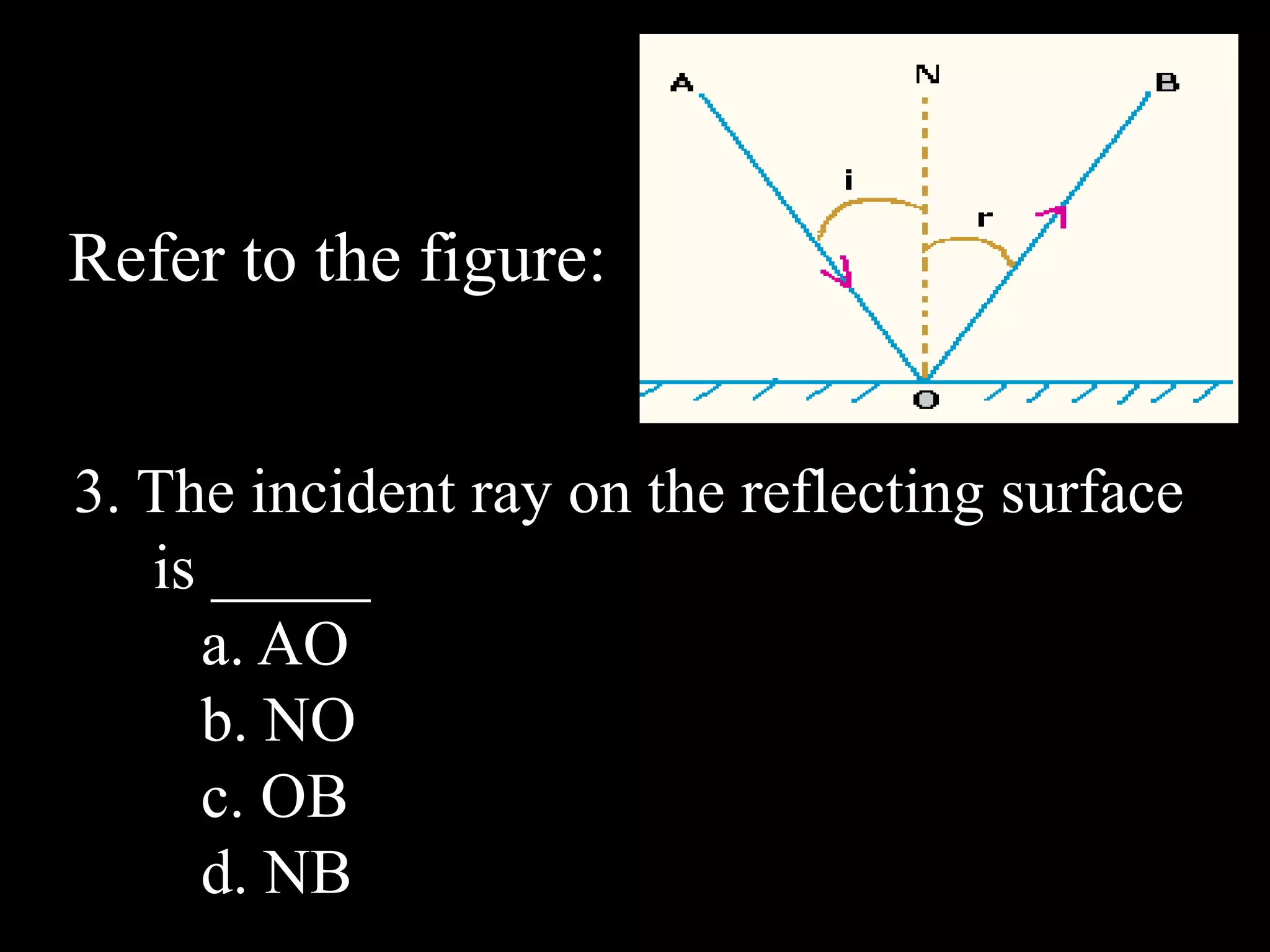
                         that shone on the
                         metals, the greater
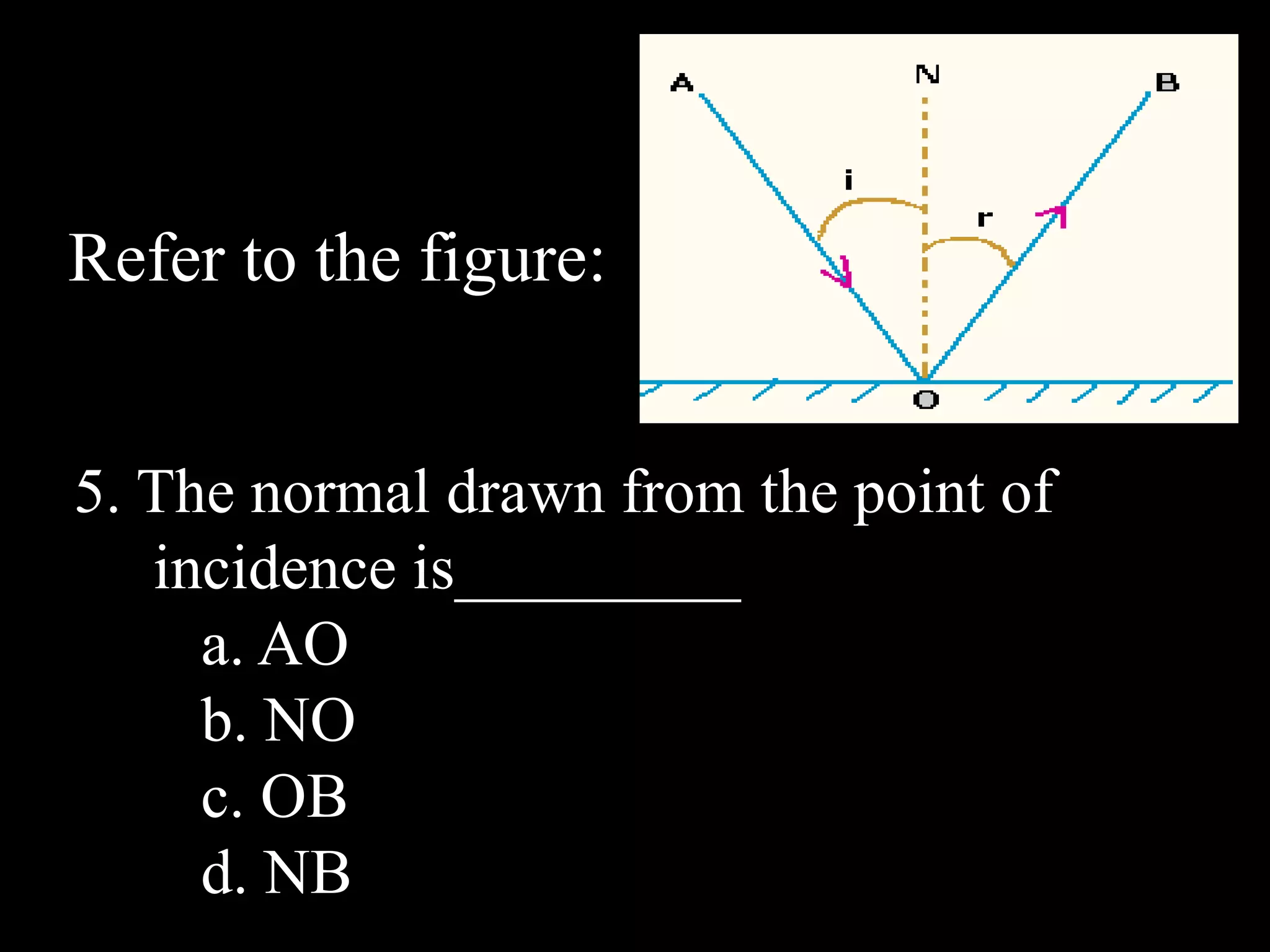
                         the rate of emission.
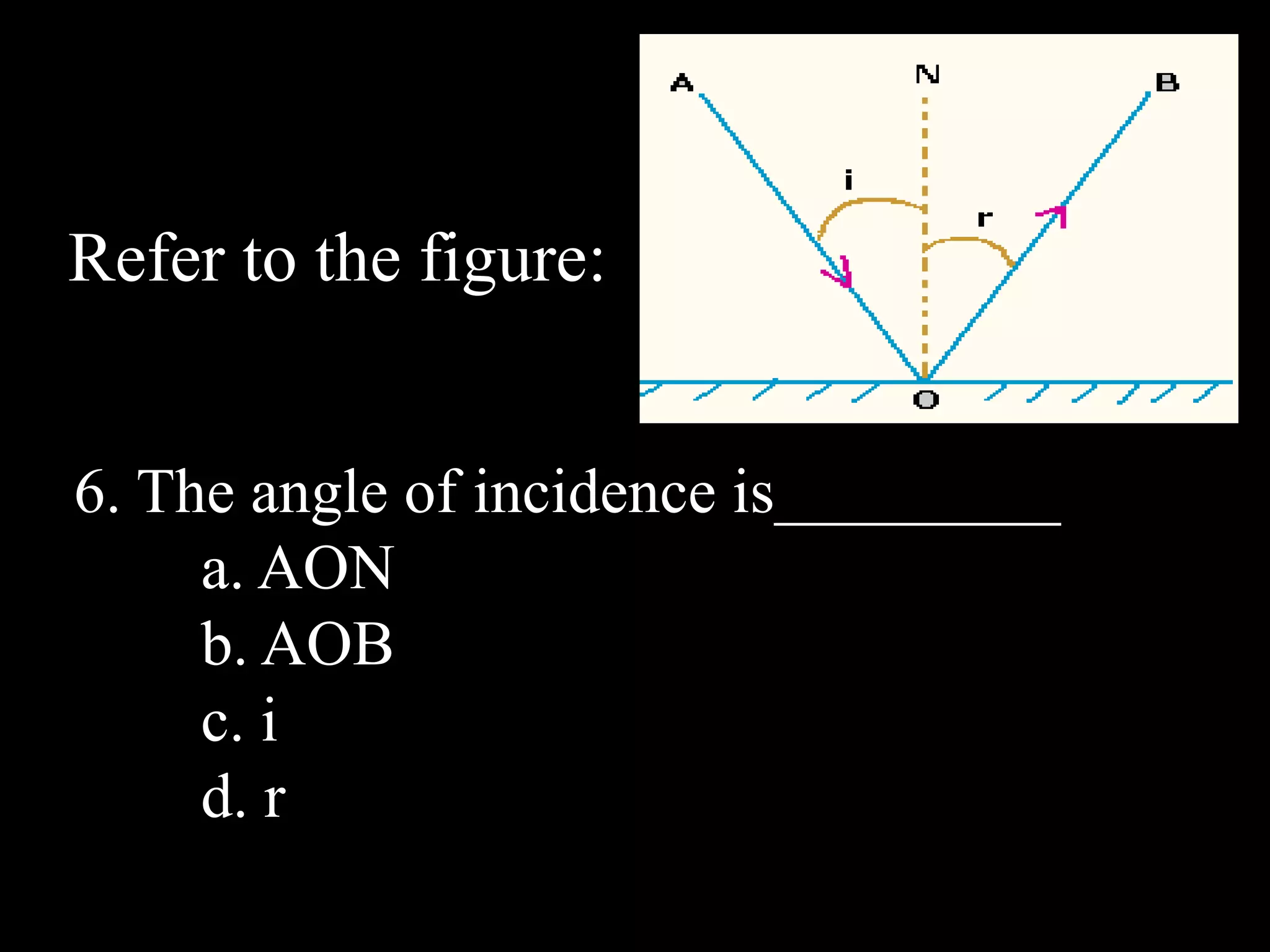
The photoelectric effect weakened the wave theory.
An increase in light intensity is a result in the
increase in the velocity of the photoelectrons,
according to Huygens's theory.
This did not happen. Instead an increase in intensity
increased the number of electron emitted and their
velocities are the same as those emitted at lower light
intensity.
Even Newton’s theory could not explain why
velocities of the electrons remained constant in spite
of an increase in intensity of the light.
Photoelectric effect did not help in solving the
dilemma of which theory was correct.
In spite of these apparent contradicting theories of
light, technological advances have been made.

Florescent lamp have been invented making use of
the photon theories of Max Planck and Albert
Einstein.

                              The      photon      theory
                              explains the activation of
                              particles by light energy
                              into higher energy level
                              and the emission of the
                              same amount of energy in
                              the form of light as the
                              particle fall back to their
                              natural level
The laser, proposed in 1958 by A. L. Schawlow and
C. H. Townes, consists of an active material which is
excited by an external source to disturb the normal
distribution of electrons in the material and move
them to higher energy levels.


As the electrons fall back to their lower levels, they
give off excess energy in the form of radiation.


When the energy is lost by absorption               or
transmission, the laser beam oscillates.
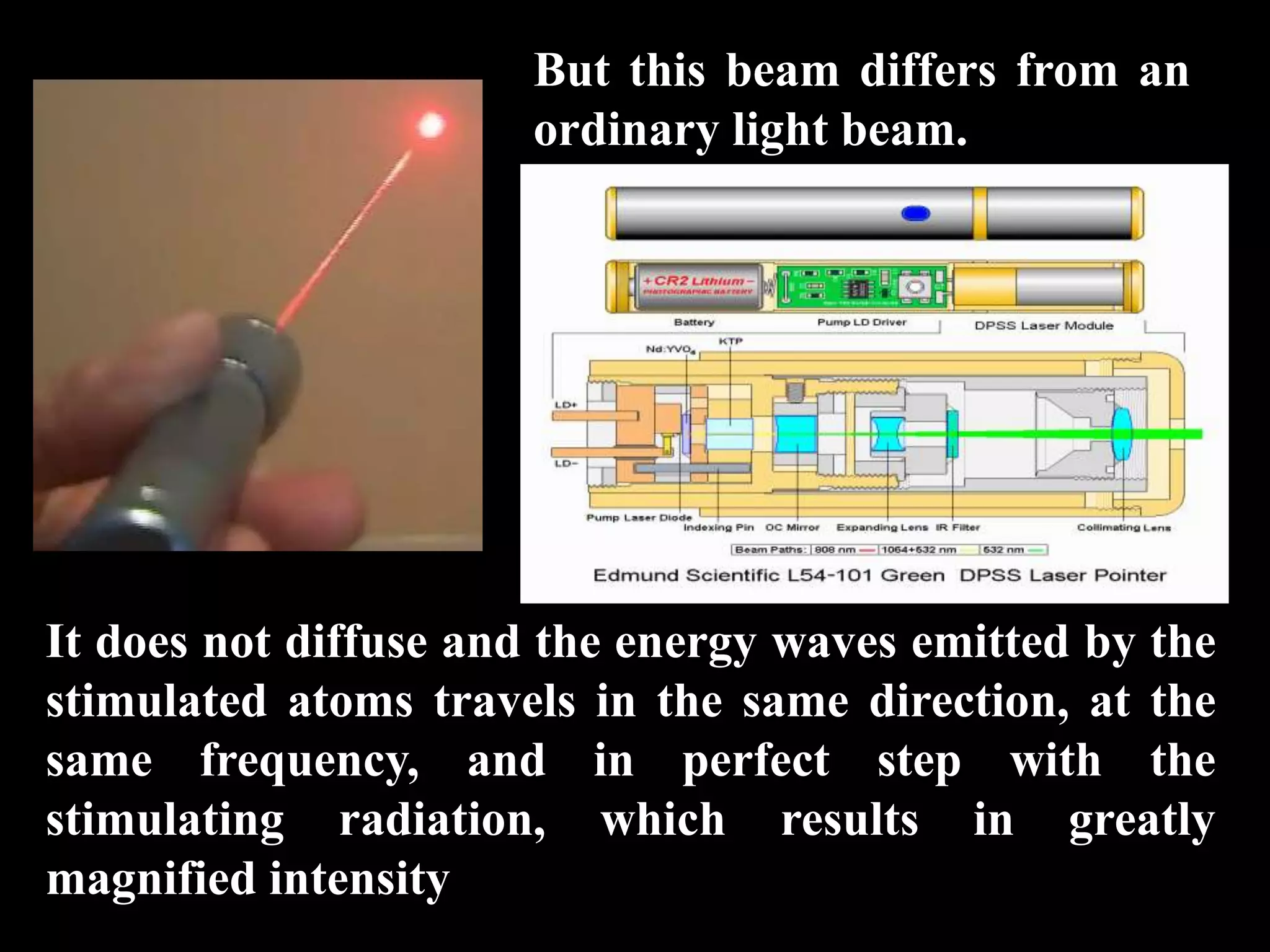
But this beam differs from an
                      ordinary light beam.


It does not diffuse and the energy waves emitted by the
stimulated atoms travels in the same direction, at the
same frequency, and in perfect step with the
stimulating radiation, which results in greatly
magnified intensity
The Quantum Theory
Max Planck presented the theory that electrons
absorbed energy only in discrete quantities
proportional to their frequencies.

Albert Einstein adopted Planck's concept and
formulated the quantum theory which helped Niels
Bohr build a workable and acceptable model of the
atomic structure.

Bohr’s concept of discrete energy levels provided the
French physicist Louis de Broglie with the theory of
the dual nature of light.
De Broglie suggested that light had both
particles and wavelike properties.
This theory of De Broglie is known as
wave mechanics.
Wave Mechanics accepted Einstein’s idea
of the interchangeability of mass and
energy (E=mc2 )
Einstein said that in every mechanical
system, waves are associated with mass
particles.
Speed of Light
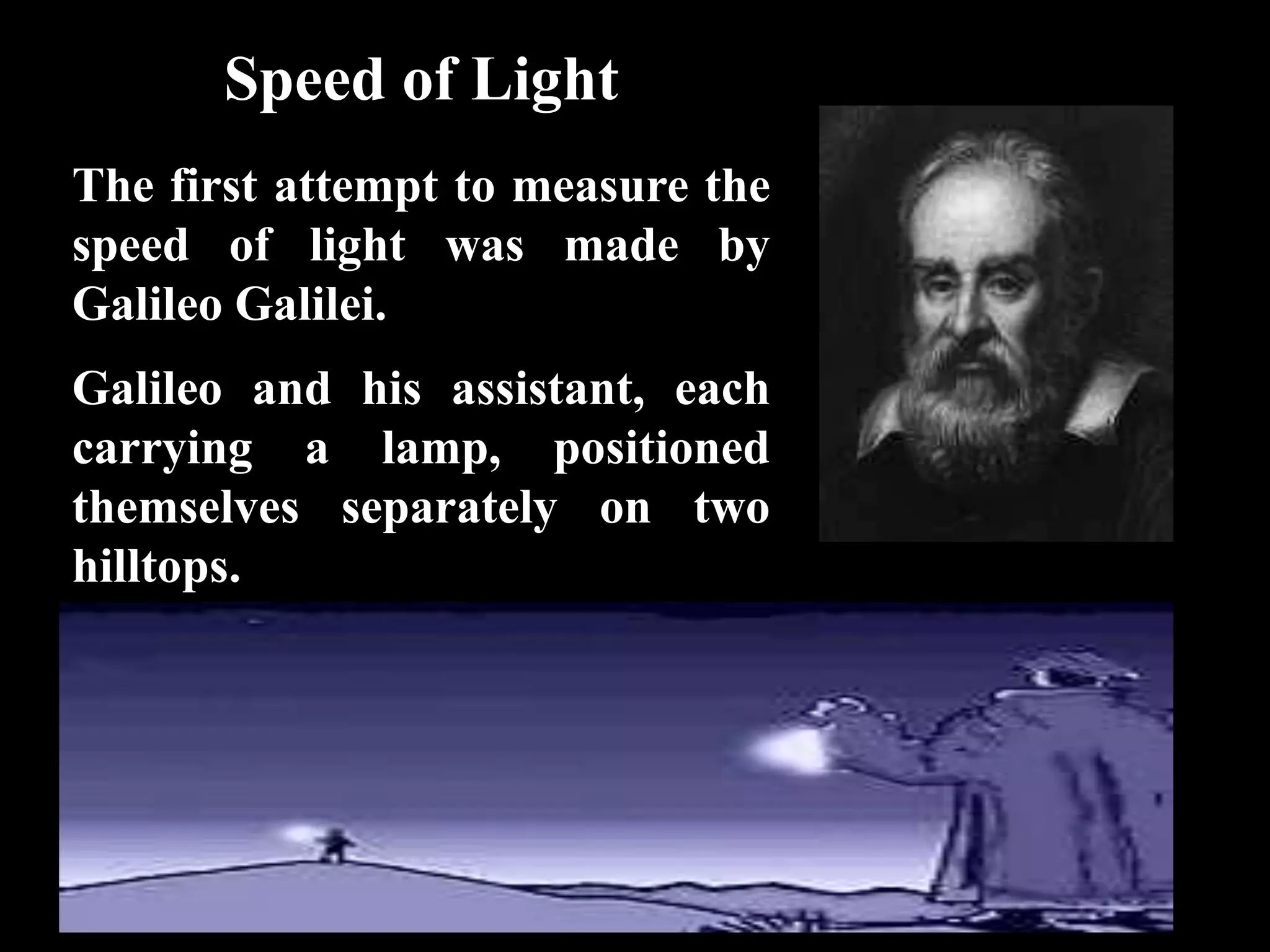
The first attempt to measure the
speed of light was made by
Galileo Galilei.
Galileo and his assistant, each
carrying a lamp, positioned
themselves separately on two
hilltops.
They tried to measure the time it takes the light from
one lamp to travel between the two hilltops.

The assistant was to flash his lantern as soon as he
saw Galileo flash his. Galileo tried to measure the
time between the flash of his lantern and the time
when he received the light from his assistant’s
lantern.

The experiment was not successful because light
traveled so fast that for distances on the earth’s
surface within one’s visual range, the time involved in
its transmission was so short as to be negligible and
not noticeable.
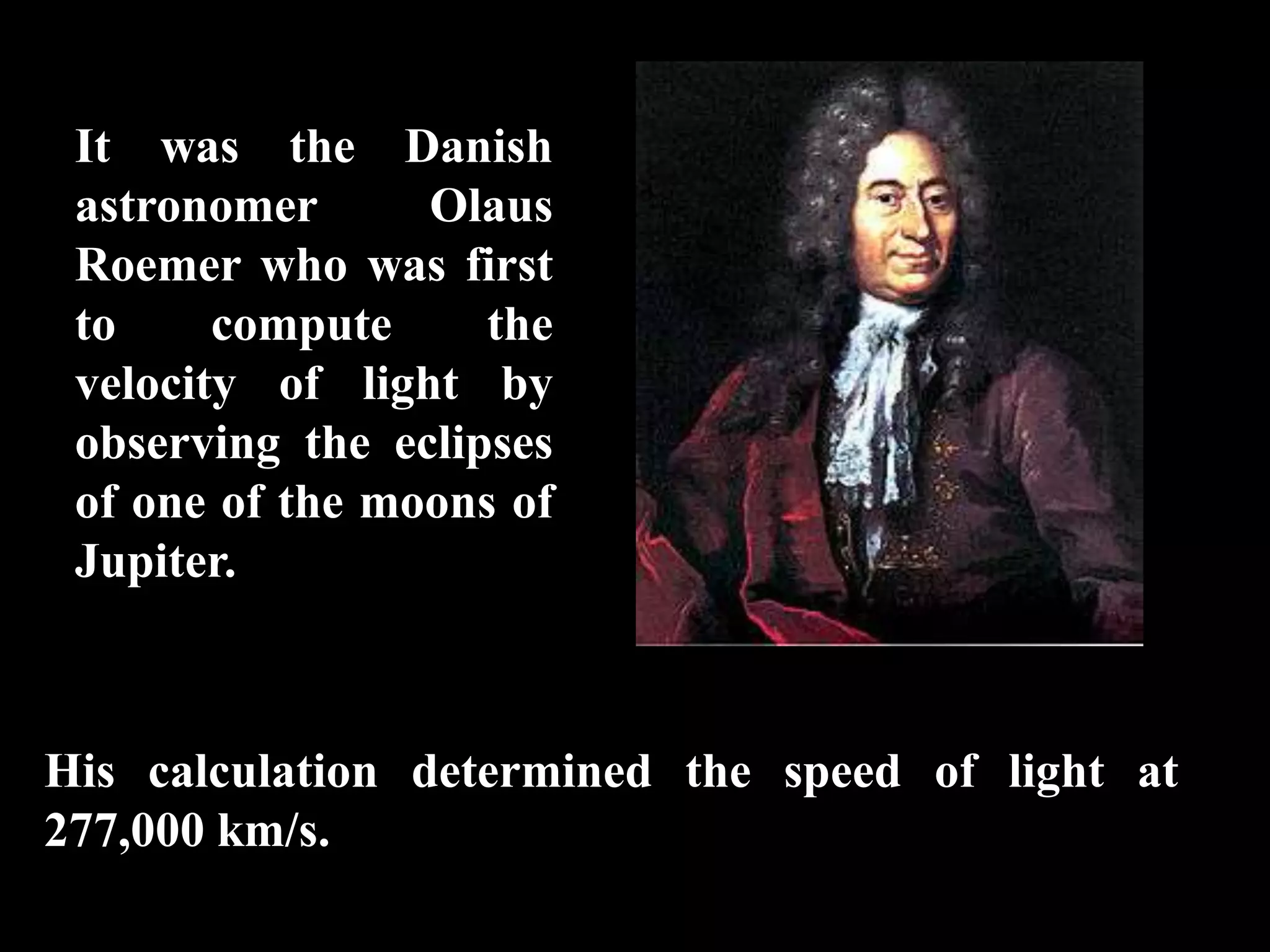
It was the Danish
 astronomer      Olaus
 Roemer who was first
 to     compute     the
 velocity of light by
 observing the eclipses
 of one of the moons of
 Jupiter.


His calculation determined the speed of light at
277,000 km/s.
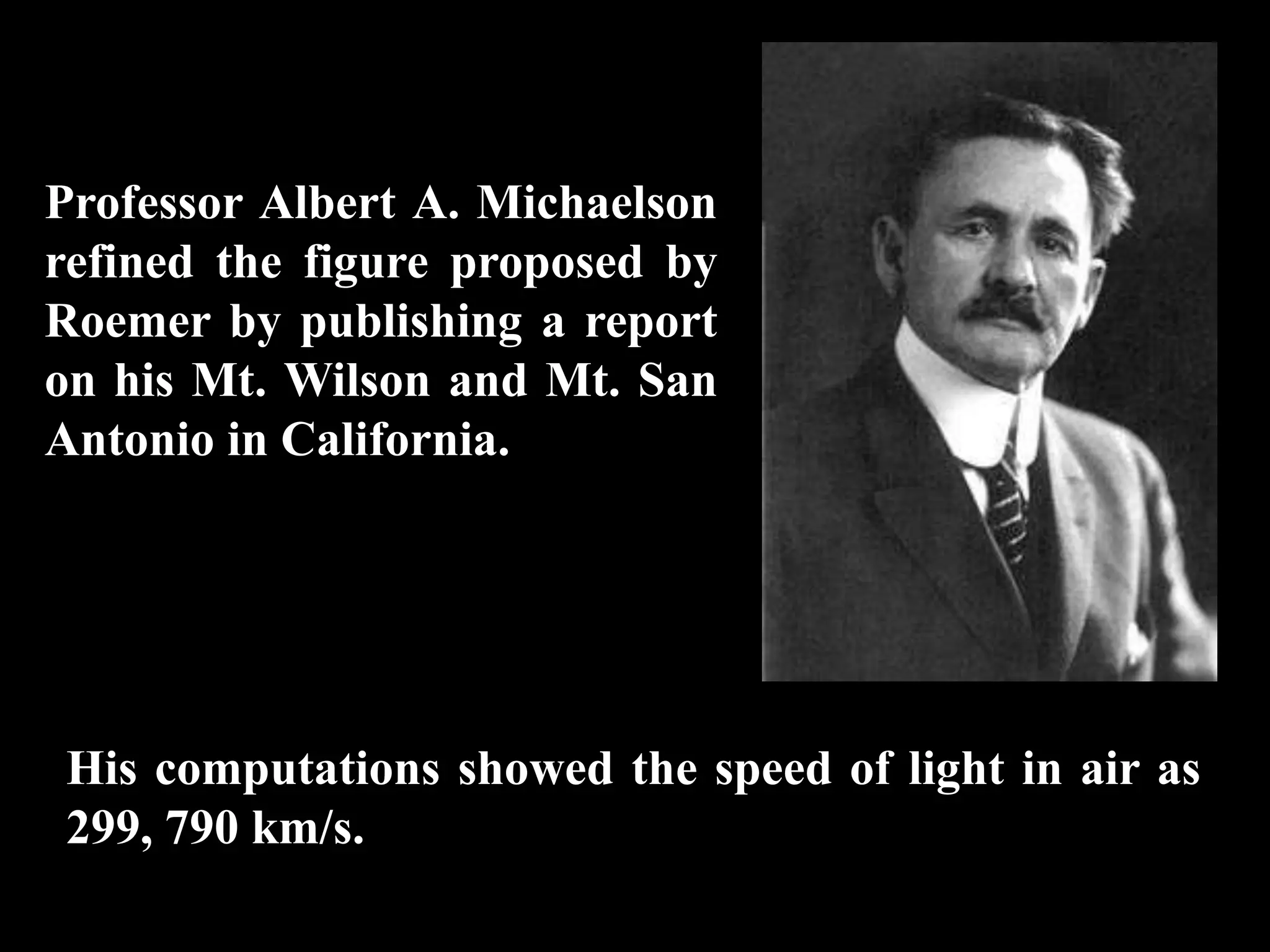
Professor Albert A. Michaelson
refined the figure proposed by
Roemer by publishing a report
on his Mt. Wilson and Mt. San
Antonio in California.


His computations showed the speed of light in air as
299, 790 km/s.
In a vacuum the speed of light is slightly faster at
299,792.8 km/s
The common value of 300,000 km/s or 3.0 x 10⁸ m/s
may be used in ordinary computations with very little
error.


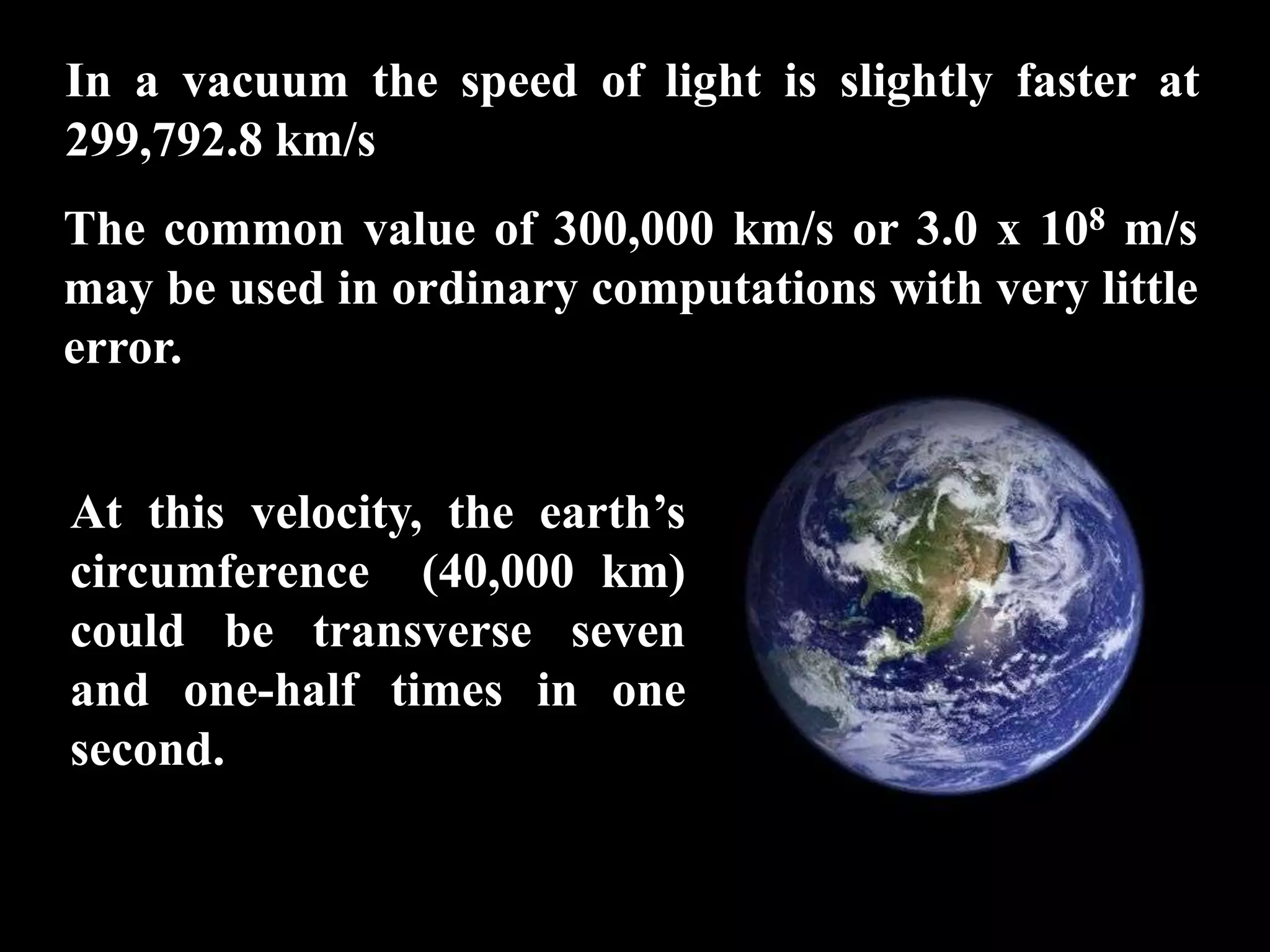
At this velocity, the earth’s
circumference (40,000 km)
could be transverse seven
and one-half times in one
second.
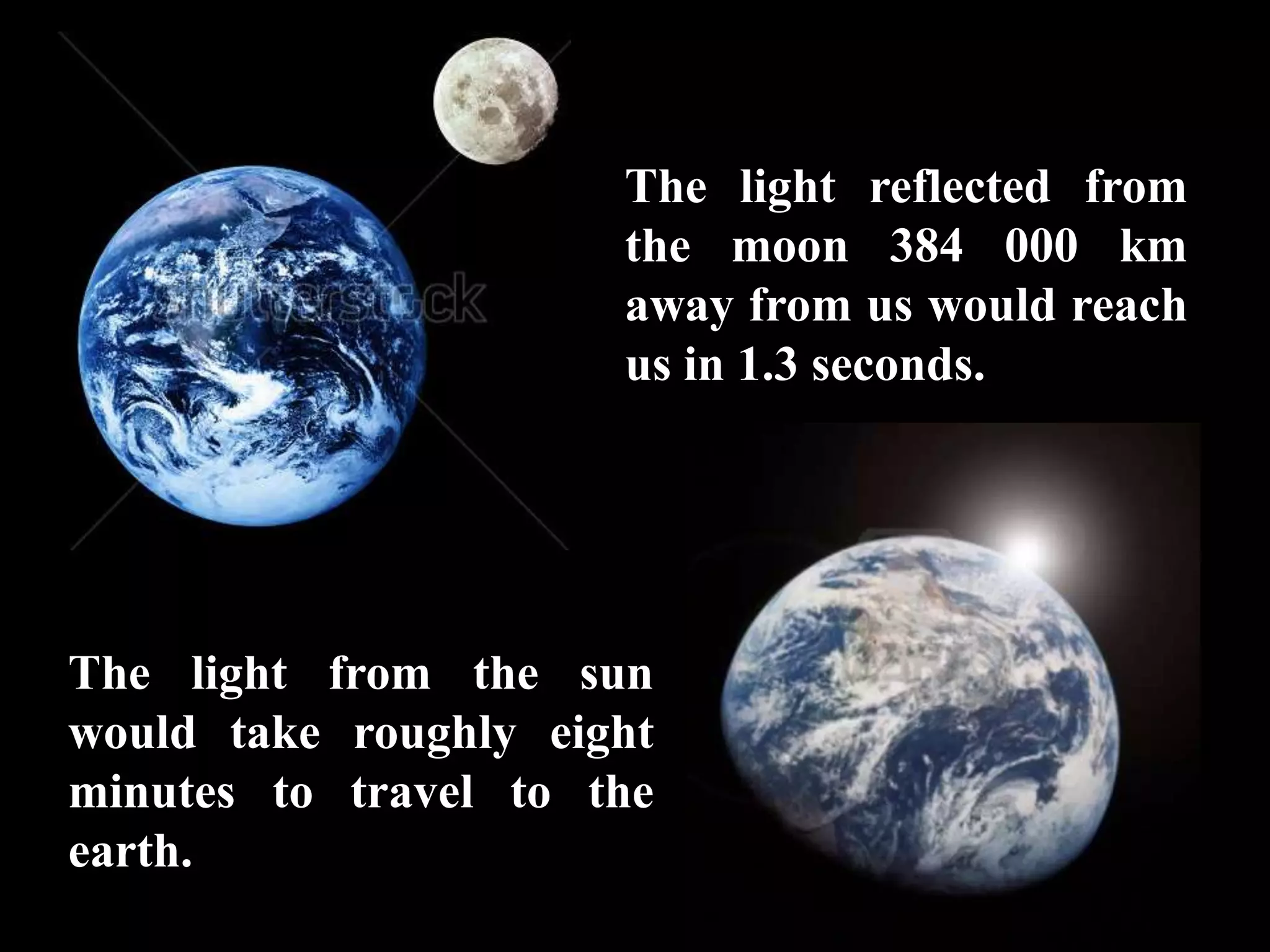
The light reflected from
                      the moon 384 000 km
                      away from us would reach
                      us in 1.3 seconds.


The light from the sun
would take roughly eight
minutes to travel to the
earth.
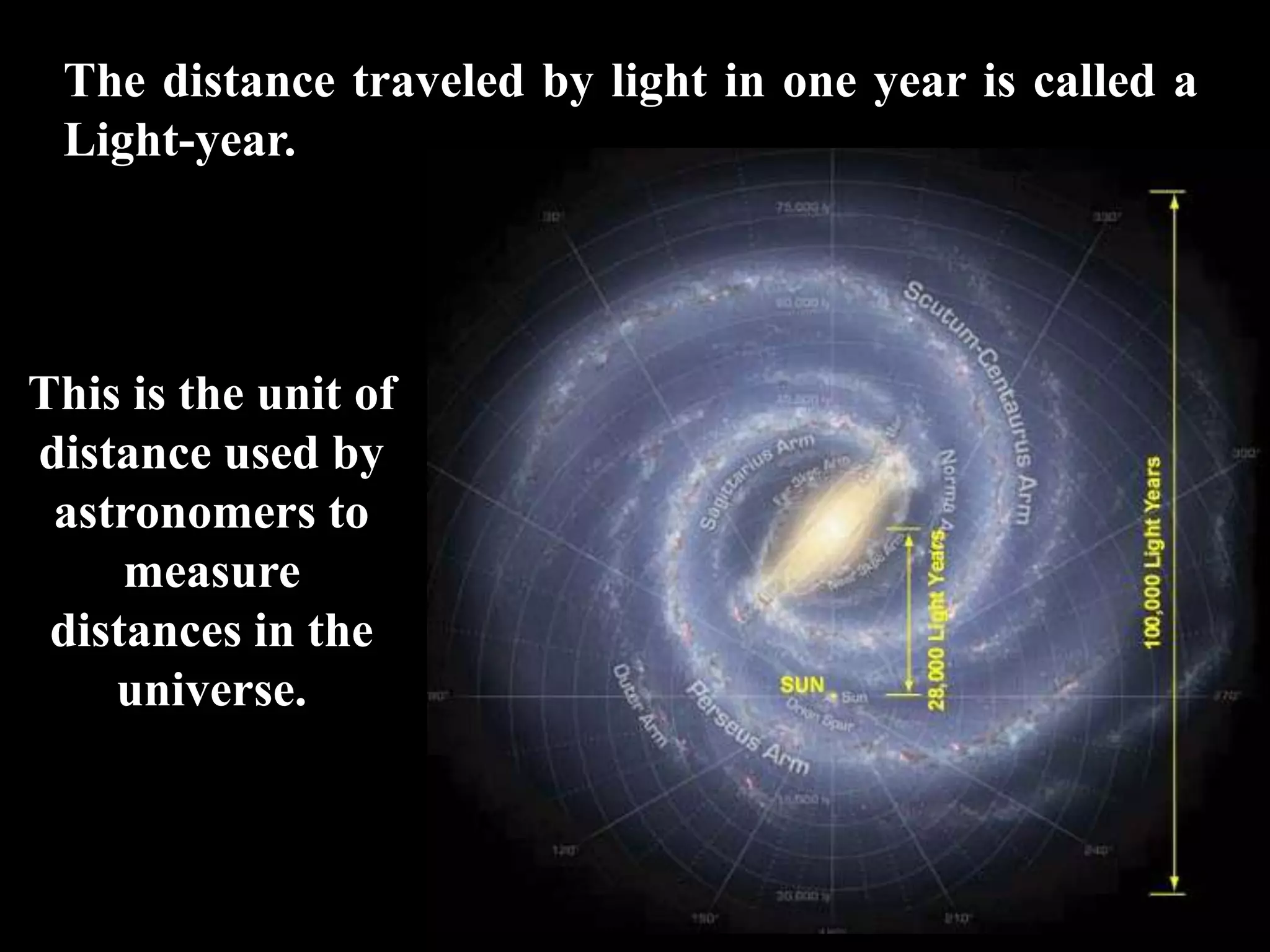
The distance traveled by light in one year is called a
 Light-year.


This is the unit of
distance used by
 astronomers to
     measure
 distances in the
    universe.
Light :
An Electromagnetic Wave
Electromagnetic wave tells us
that electric and magnetic fields
are present in light.

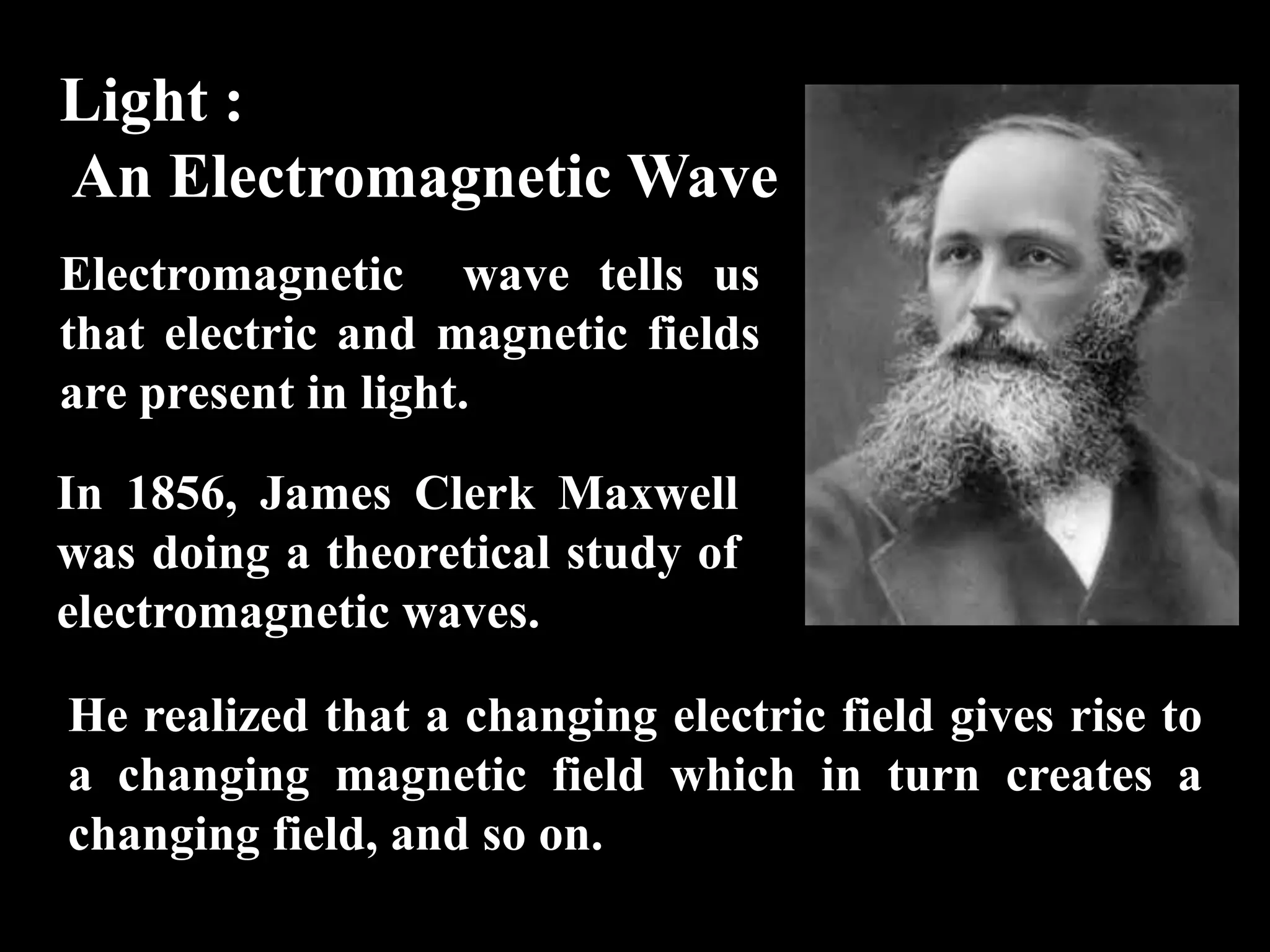
In 1856, James Clerk Maxwell
was doing a theoretical study of
electromagnetic waves.

He realized that a changing electric field gives rise to
a changing magnetic field which in turn creates a
changing field, and so on.
James Clerk Maxwell developed equations showing
the relationship of electricity and magnetism.
Based from these equations, he found that the net
result of these interchanging fields was to create a
train of invisible waves of electric and magnetic fields
that could propagate through space.

These waves are called electromagnetic (EM) waves.

Using the equations developed by Maxwell they
found out that EM waves travels at the speed of 3.0 x
108 m/s, the same as the measured speed of light in a
vacuum.
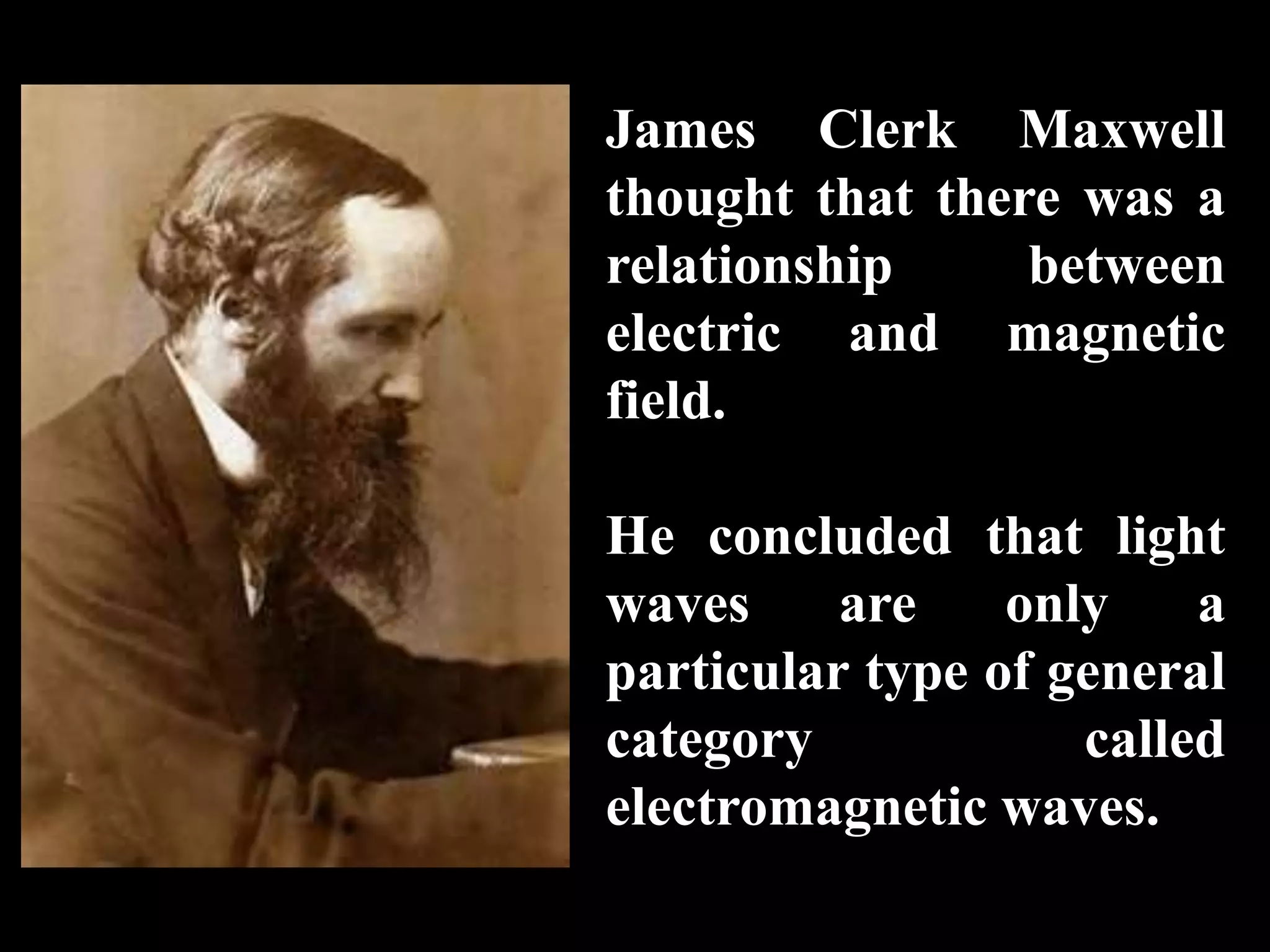
James Clerk Maxwell
thought that there was a
relationship     between
electric and magnetic
field.

He concluded that light
waves     are    only    a
particular type of general
category            called
electromagnetic waves.
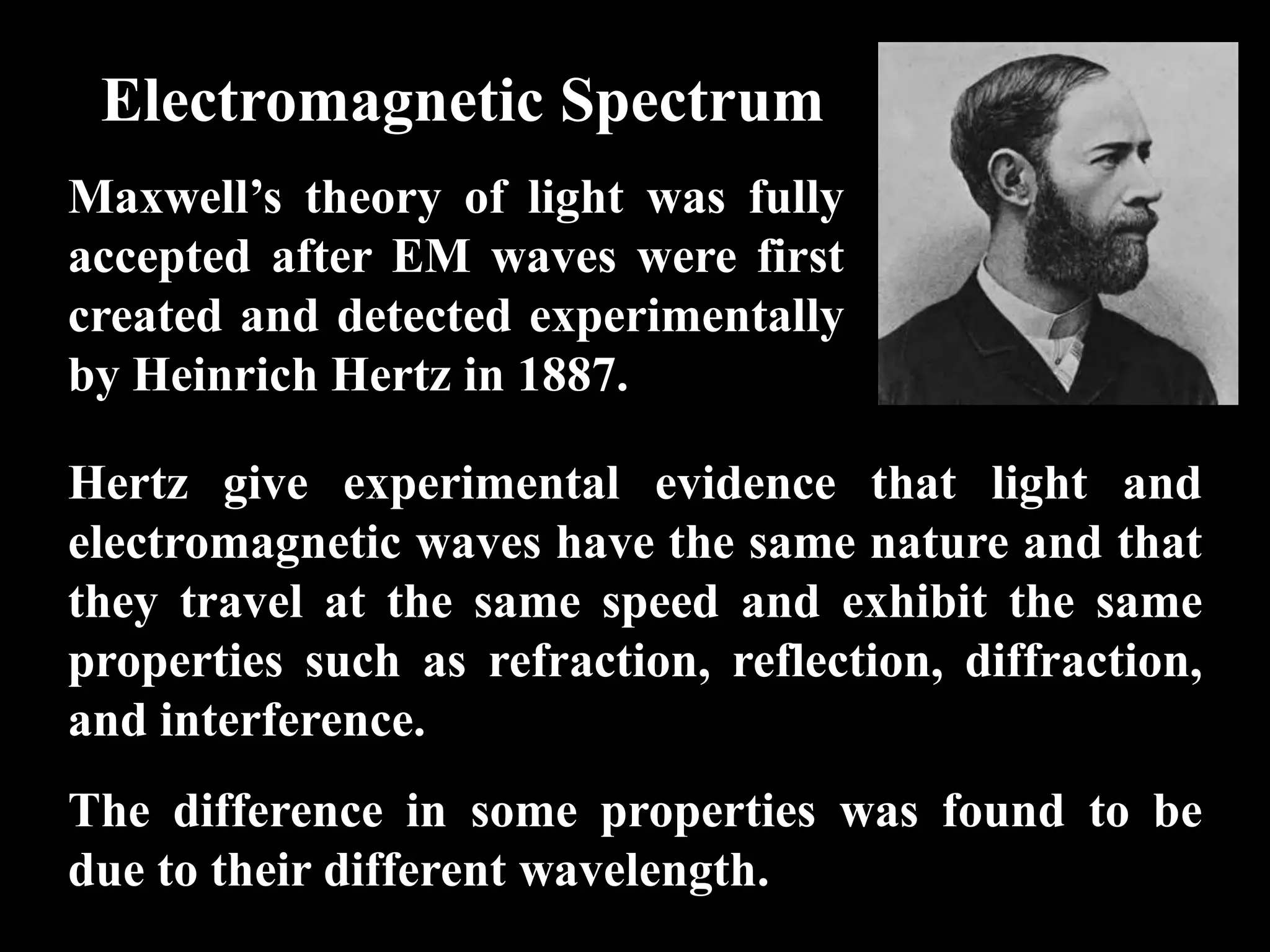
Electromagnetic Spectrum
Maxwell’s theory of light was fully
accepted after EM waves were first
created and detected experimentally
by Heinrich Hertz in 1887.

Hertz give experimental evidence that light and
electromagnetic waves have the same nature and that
they travel at the same speed and exhibit the same
properties such as refraction, reflection, diffraction,
and interference.
The difference in some properties was found to be
due to their different wavelength.
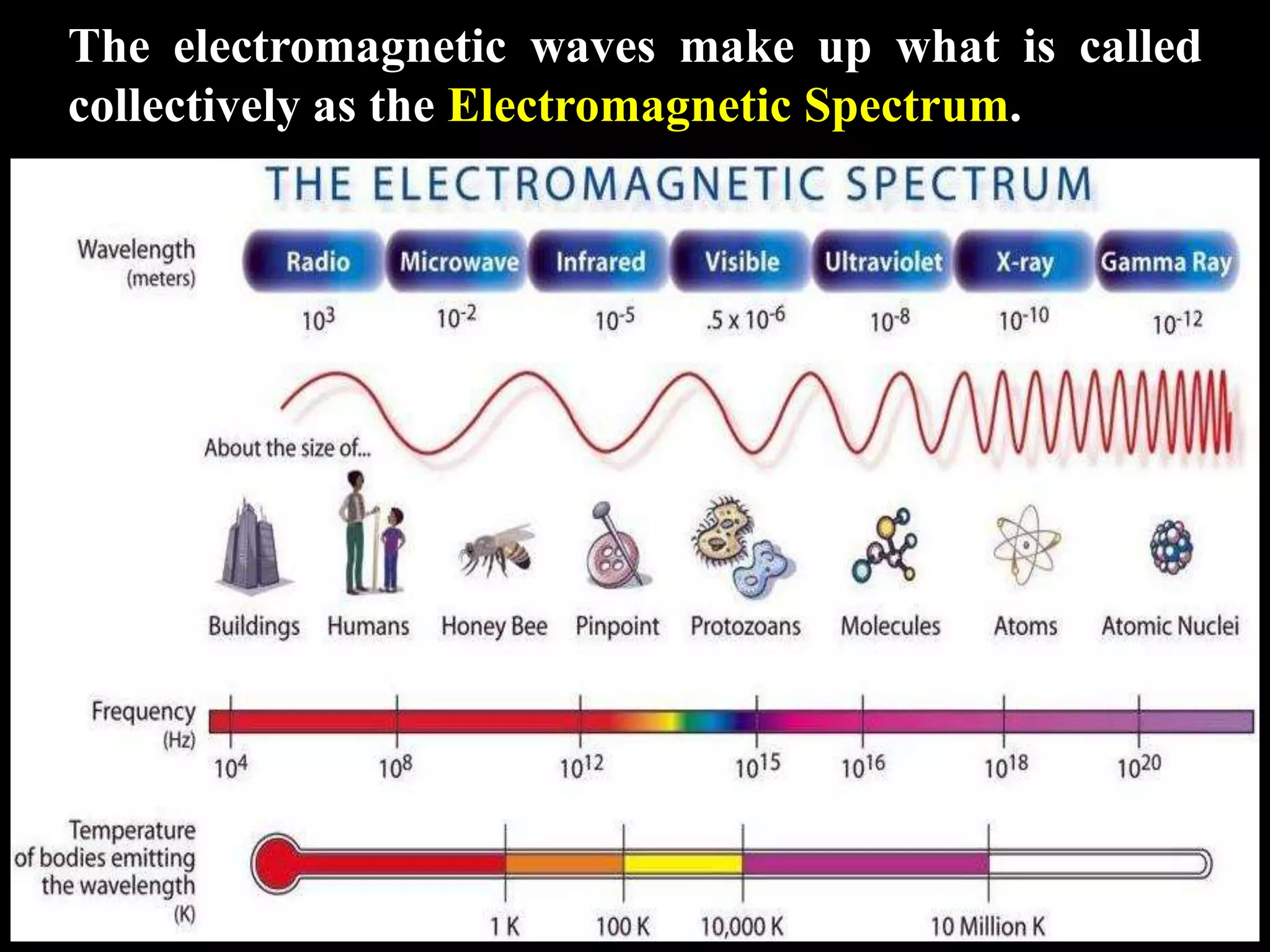
The electromagnetic waves make up what is called
collectively as the Electromagnetic Spectrum.
Each wavelength is different from another in
its wavelength, but all waves travel in vacuum
with the speed of light.

The wavelengths vary from 3 x 10⁷ m at high
frequencies.
In Angstrom unit (A0 ), the common unit to
measure wavelengths is from 3 x 10¹⁷ A0 (1 A0
= 1.0 X 10⁻¹⁰ m).
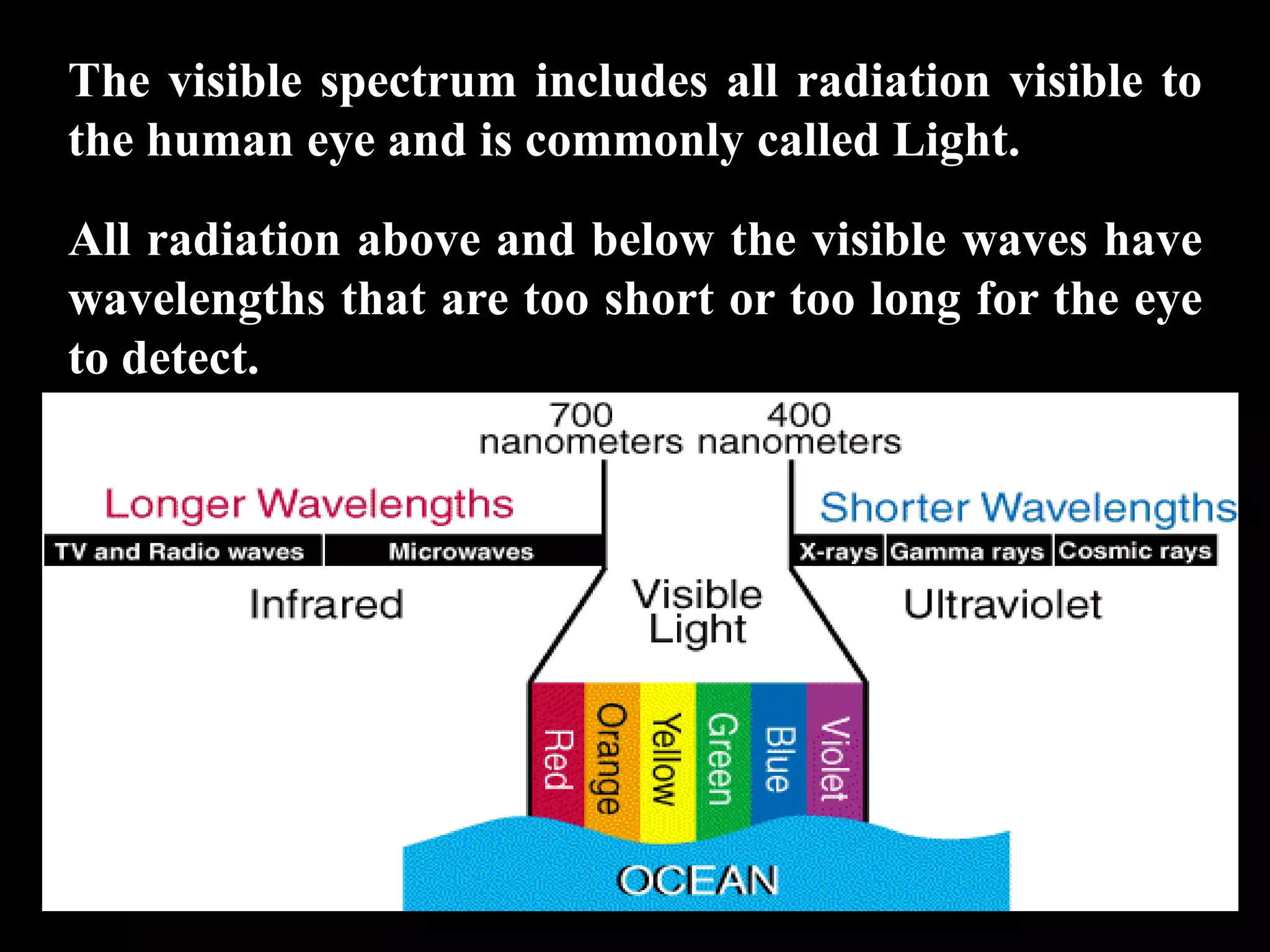
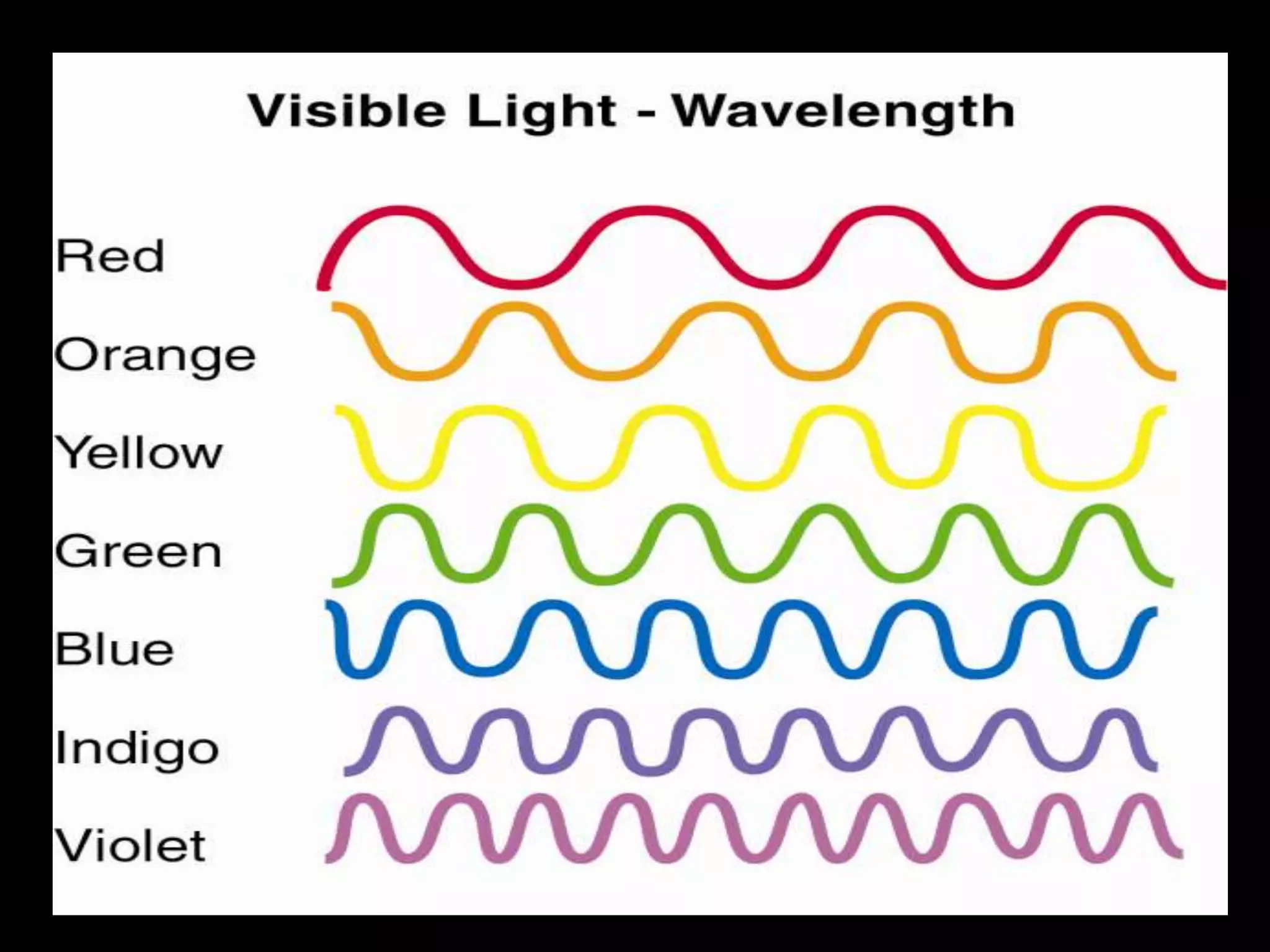
It is found that the wavelength of visible light
range from 3.5 x 10⁻⁷ m to 7.5 x 10⁻⁷ m (3500 A0
to 7500 A0 )
The visible spectrum includes all radiation visible to
the human eye and is commonly called Light.

All radiation above and below the visible waves have
wavelengths that are too short or too long for the eye
to detect.
How much have you learned?
1. According to James Clerk Maxwell,
   what is the relationship between light
   and EM waves?
2. What is the main difference between
   light waves and EM waves?
3. Approximately, what part of the
   whole EM spectrum does our visible
   spectrum occupy?
Luminous and
Illuminated Objects
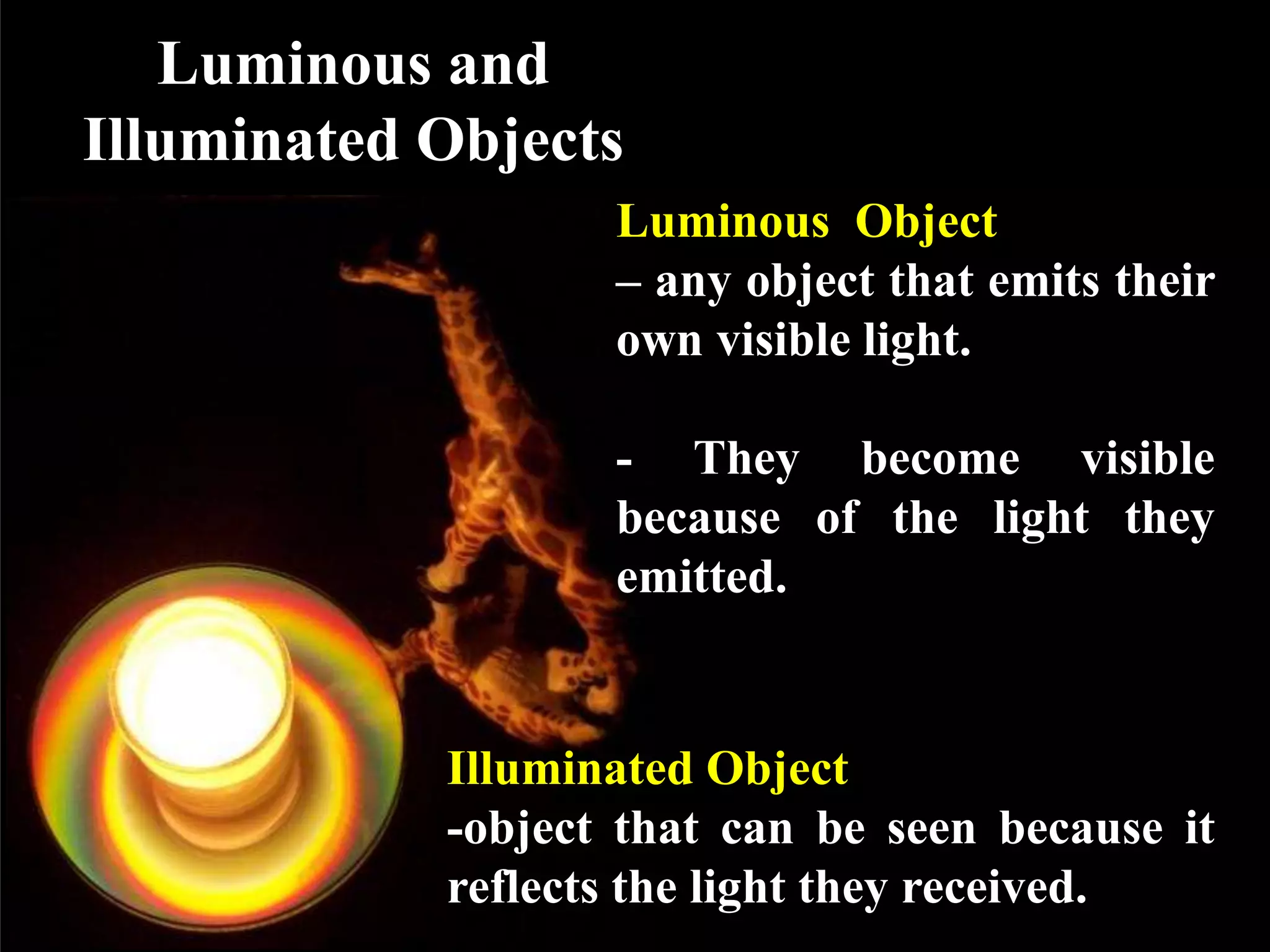
                   Luminous Object
                   – any object that emits their
                   own visible light.

                   - They become visible
                   because of the light they
                   emitted.


            Illuminated Object
            -object that can be seen because it
            reflects the light they received.
What happens to light when it falls on the
        surface of the object?
Light from a source travels in all direction.
This decreases the amount of light that falls on a
certain area.

When light strikes the surface of an object, several
things may happen.

If the radiation is turned back by the
surface without entering the object, the
light is said to be REFLECTED.
Most of the objects around us are not emitters
of light but instead as reflectors of light.

Some of the light that falls on an object may be
absorbed.

The radiant energy is transformed into
molecular motion which warms the object.

All objects that absorb light experience a rise
in temperature.
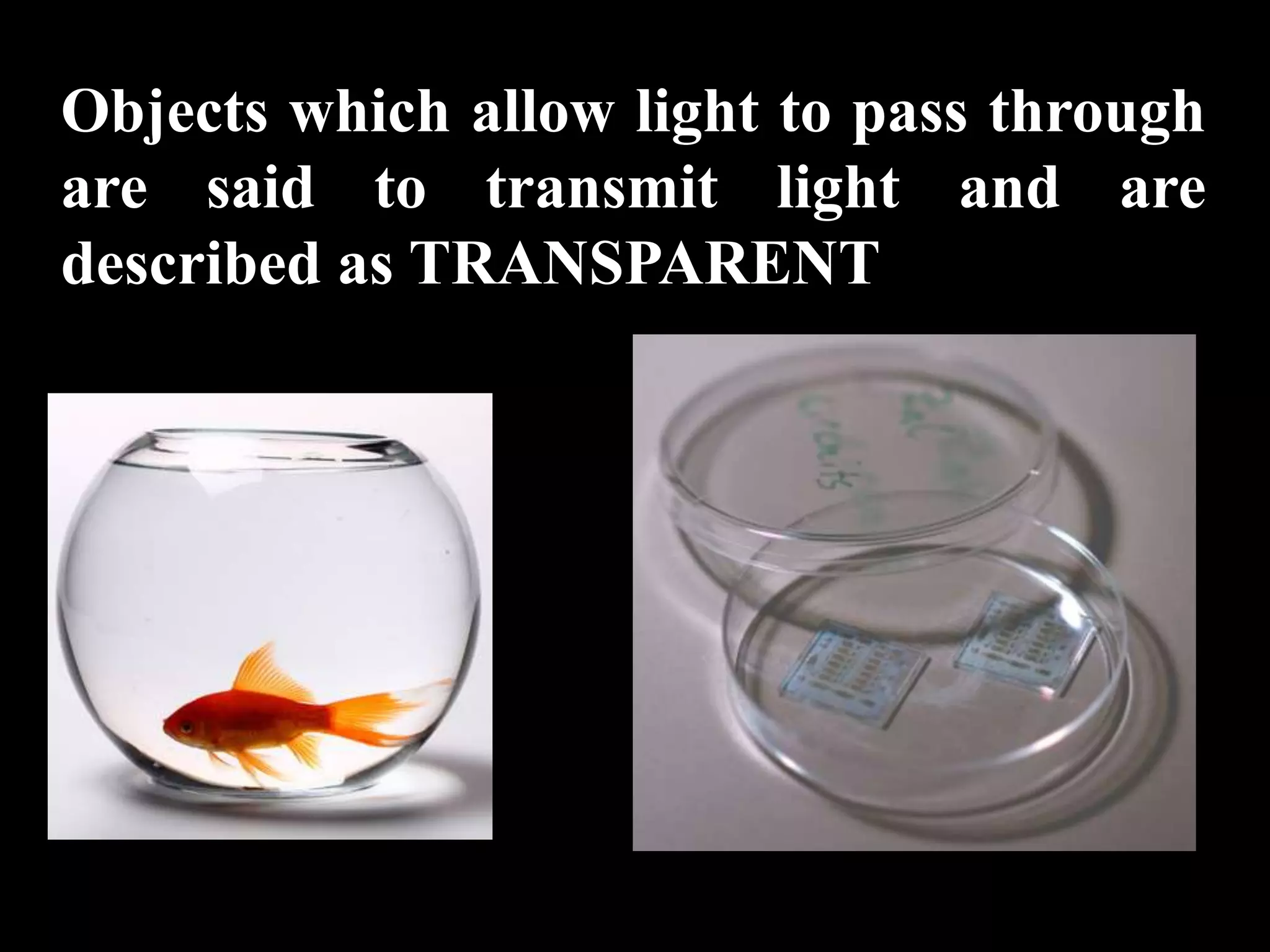
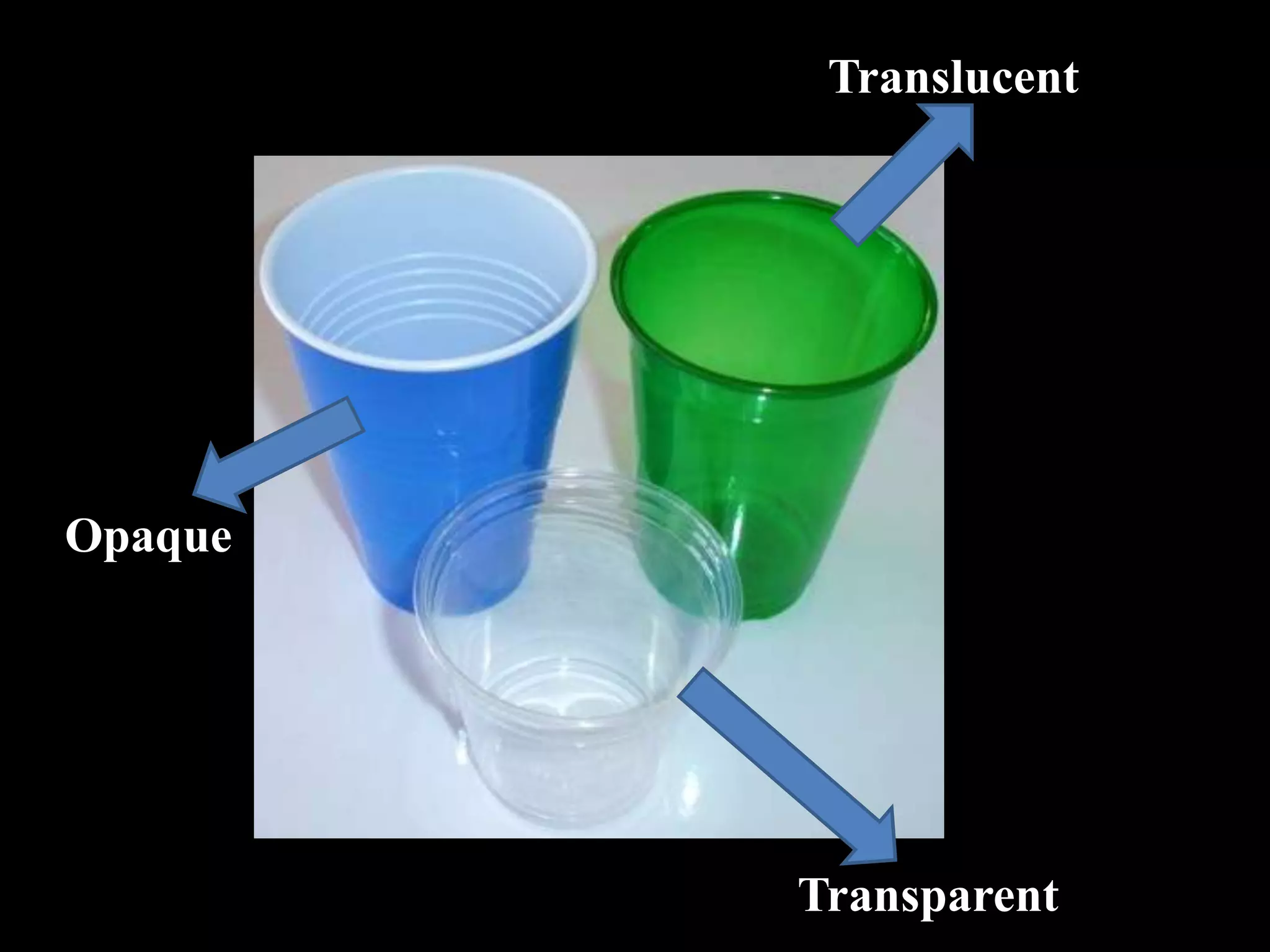
Objects which allow light to pass through
are said to transmit light and are
described as TRANSPARENT
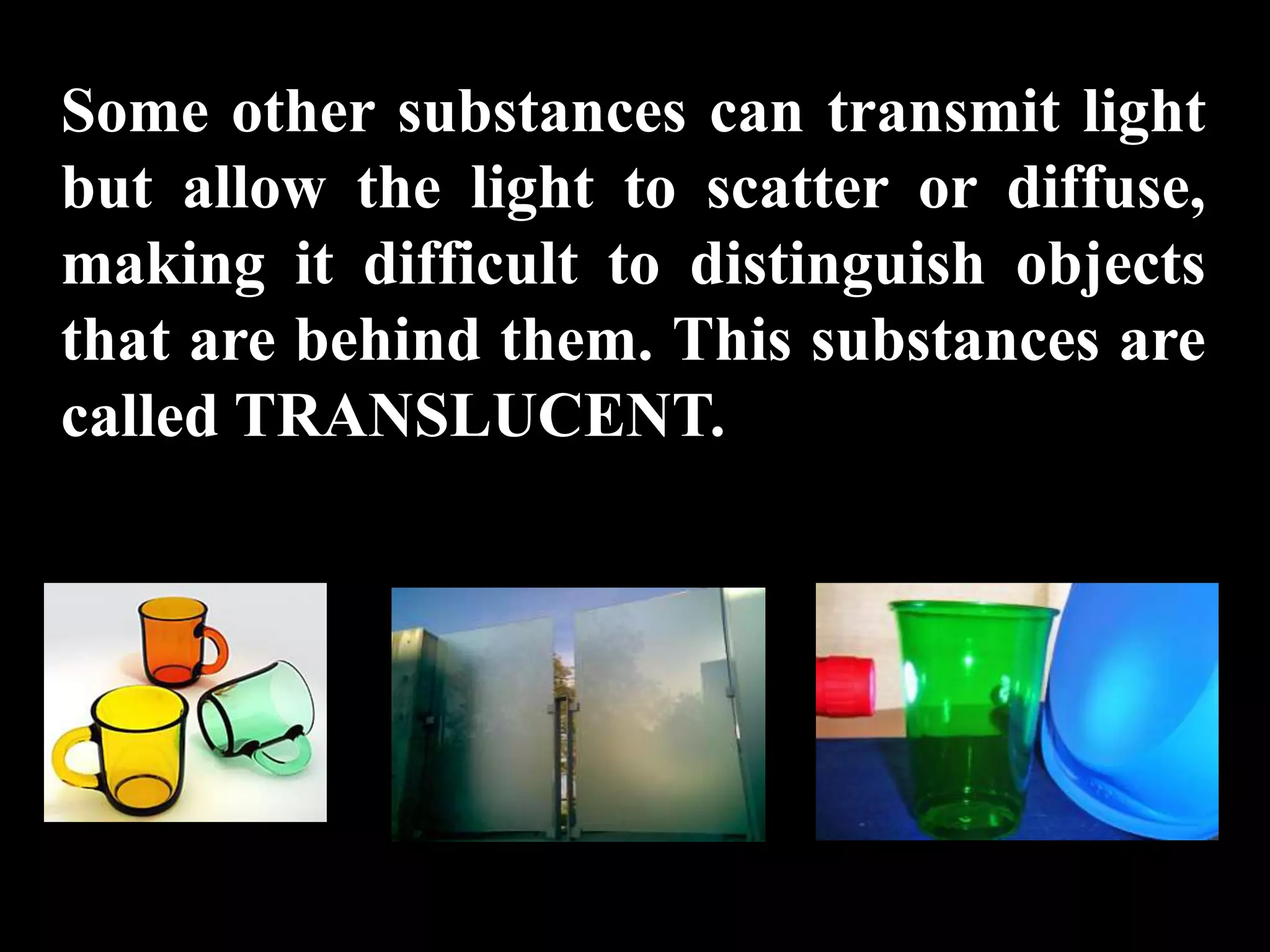
Some other substances can transmit light
but allow the light to scatter or diffuse,
making it difficult to distinguish objects
that are behind them. This substances are
called TRANSLUCENT.
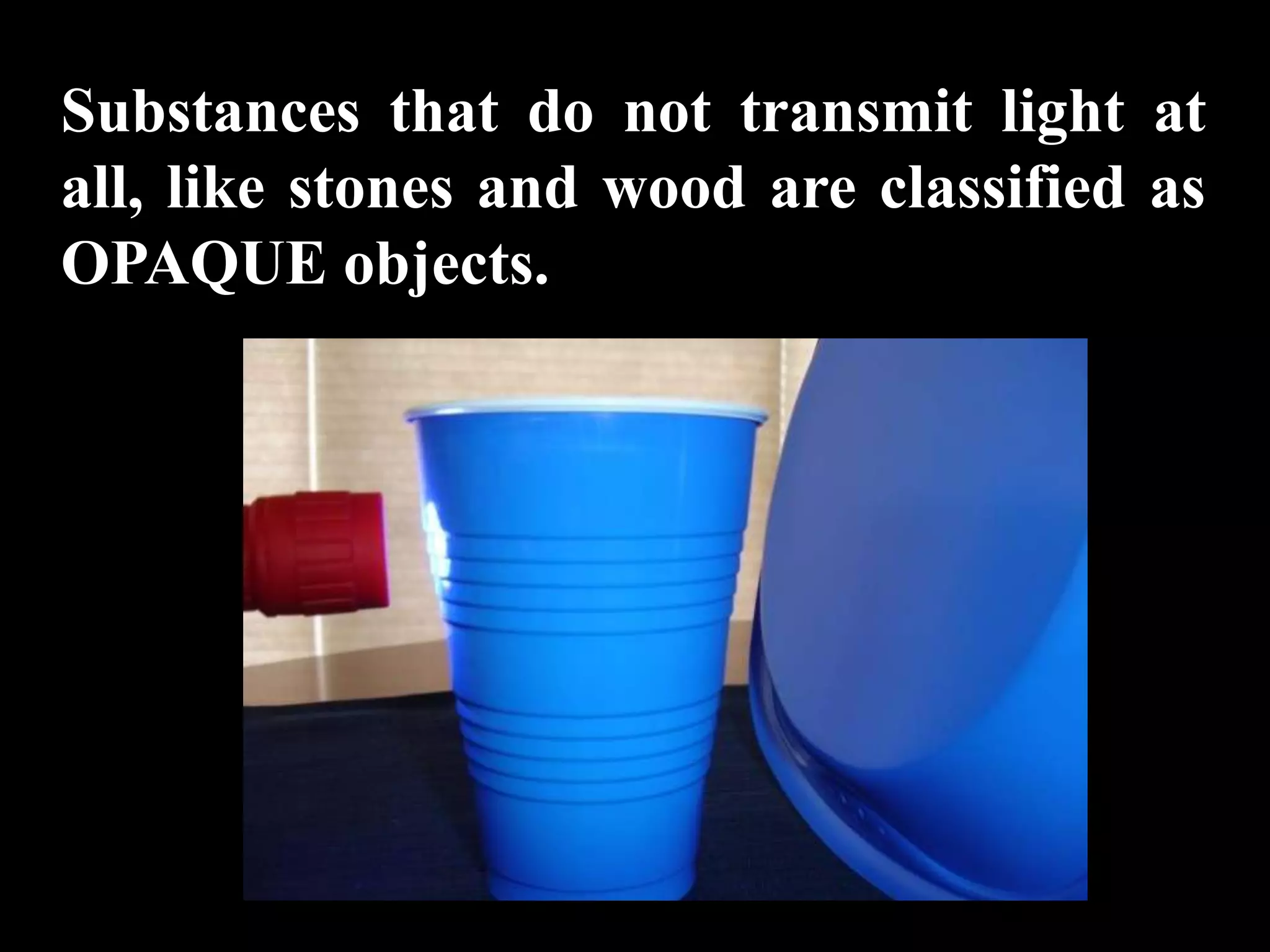
Substances that do not transmit light at
all, like stones and wood are classified as
OPAQUE objects.
Translucent


Opaque


         Transparent
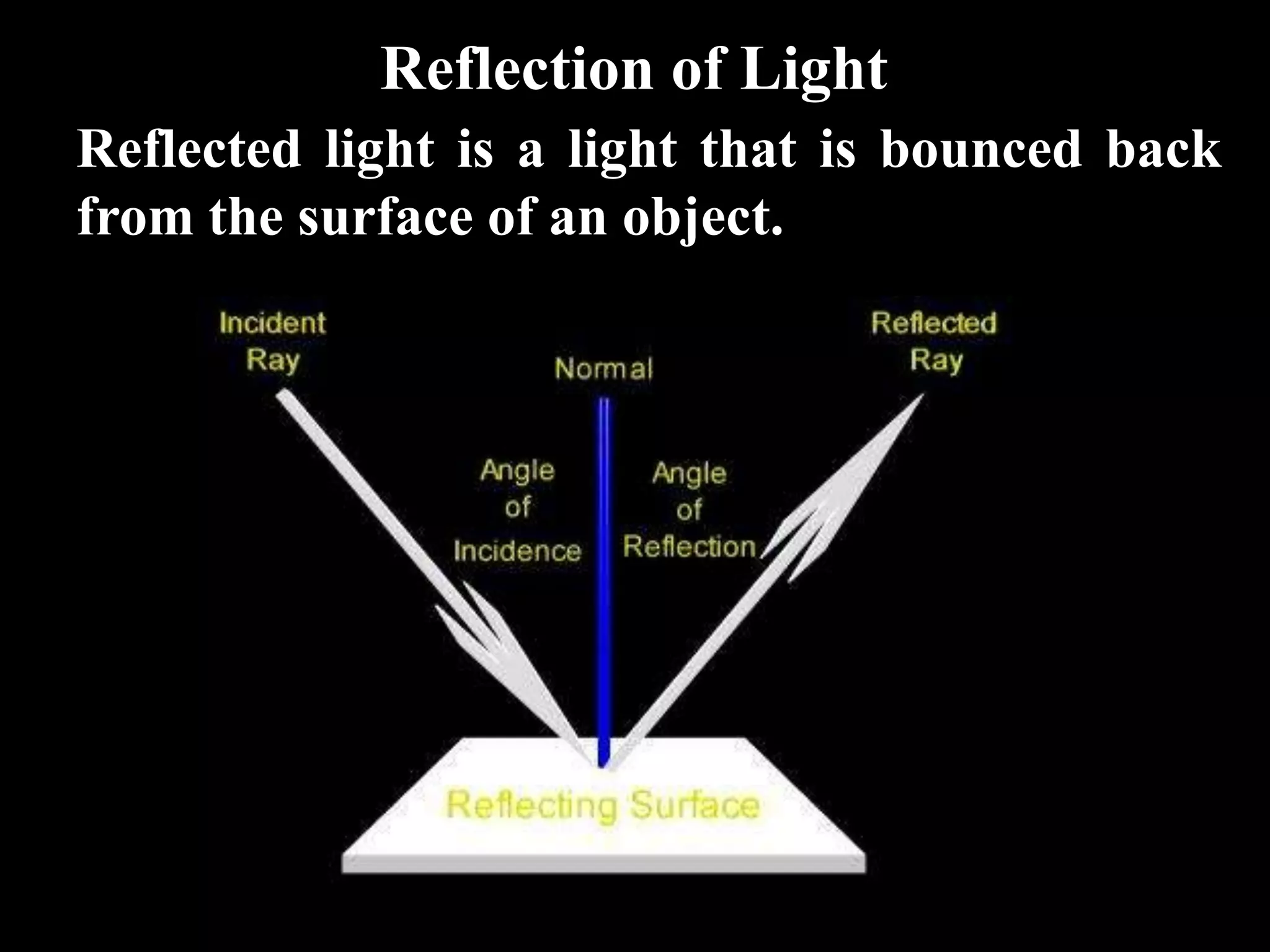
Reflection of Light
Reflected light is a light that is bounced back
from the surface of an object.
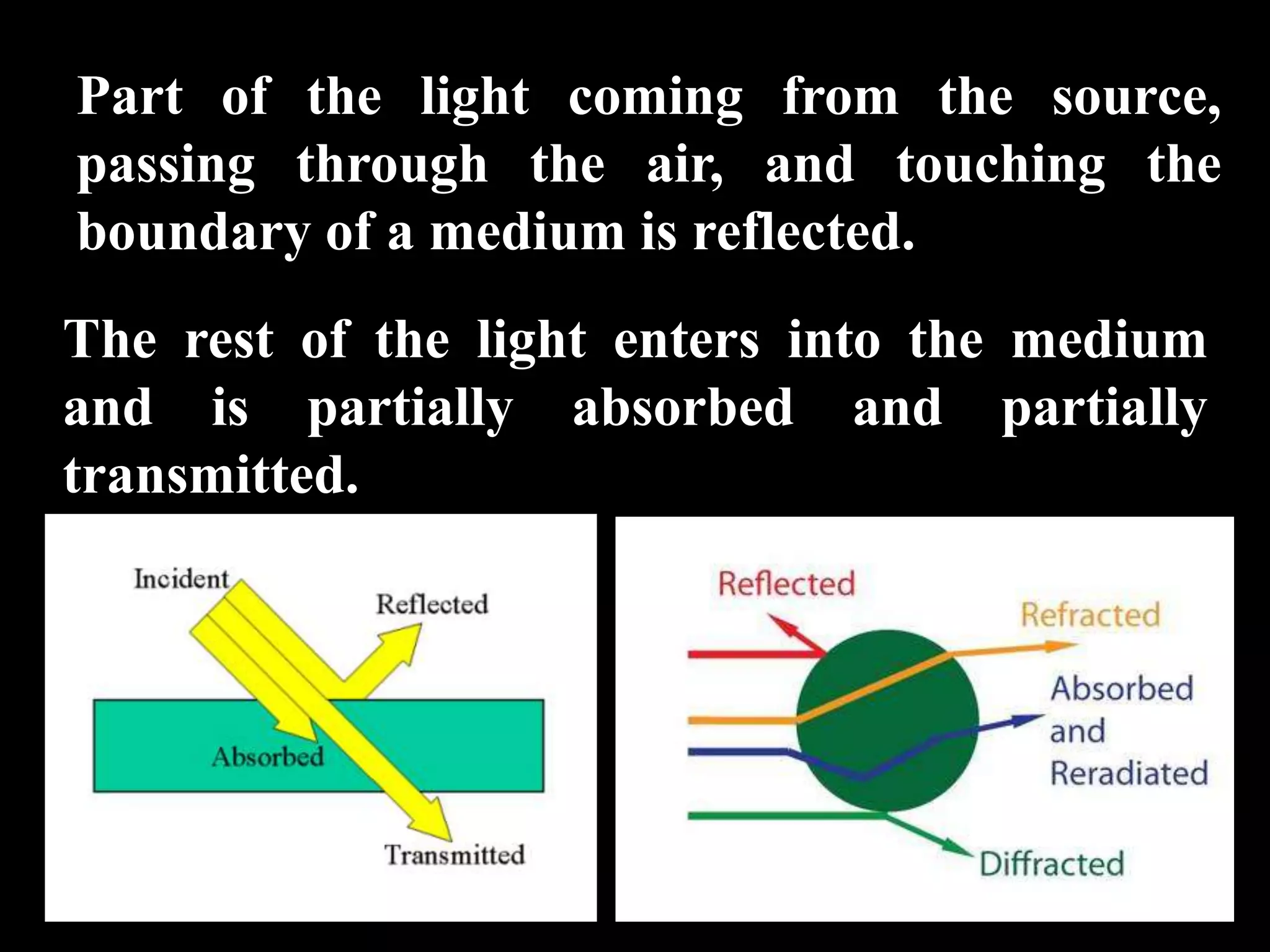
Part of the light coming from the source,
passing through the air, and touching the
boundary of a medium is reflected.
The rest of the light enters into the medium
and is partially absorbed and partially
transmitted.
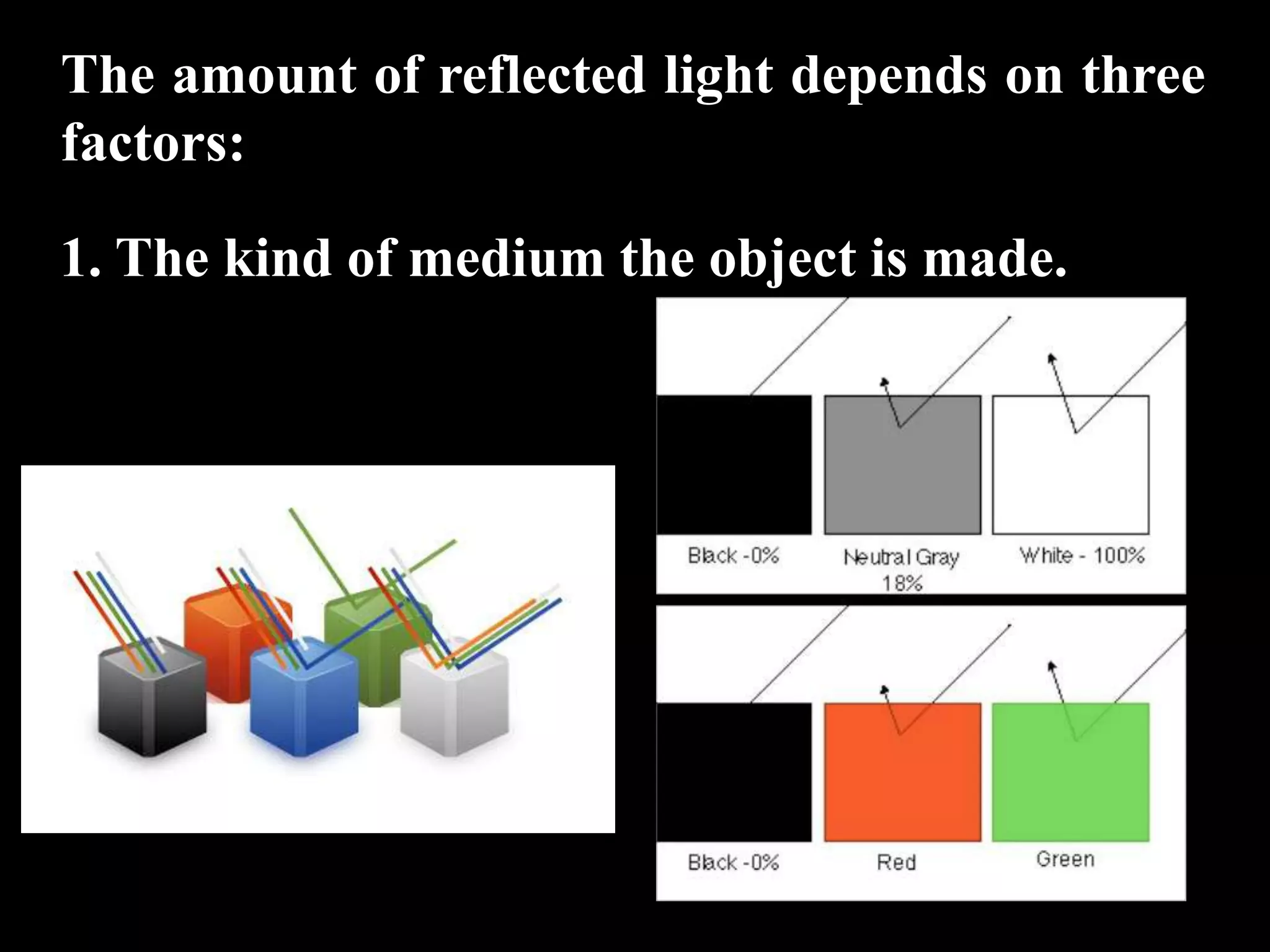
The amount of reflected light depends on three
factors:

1. The kind of medium the object is made.
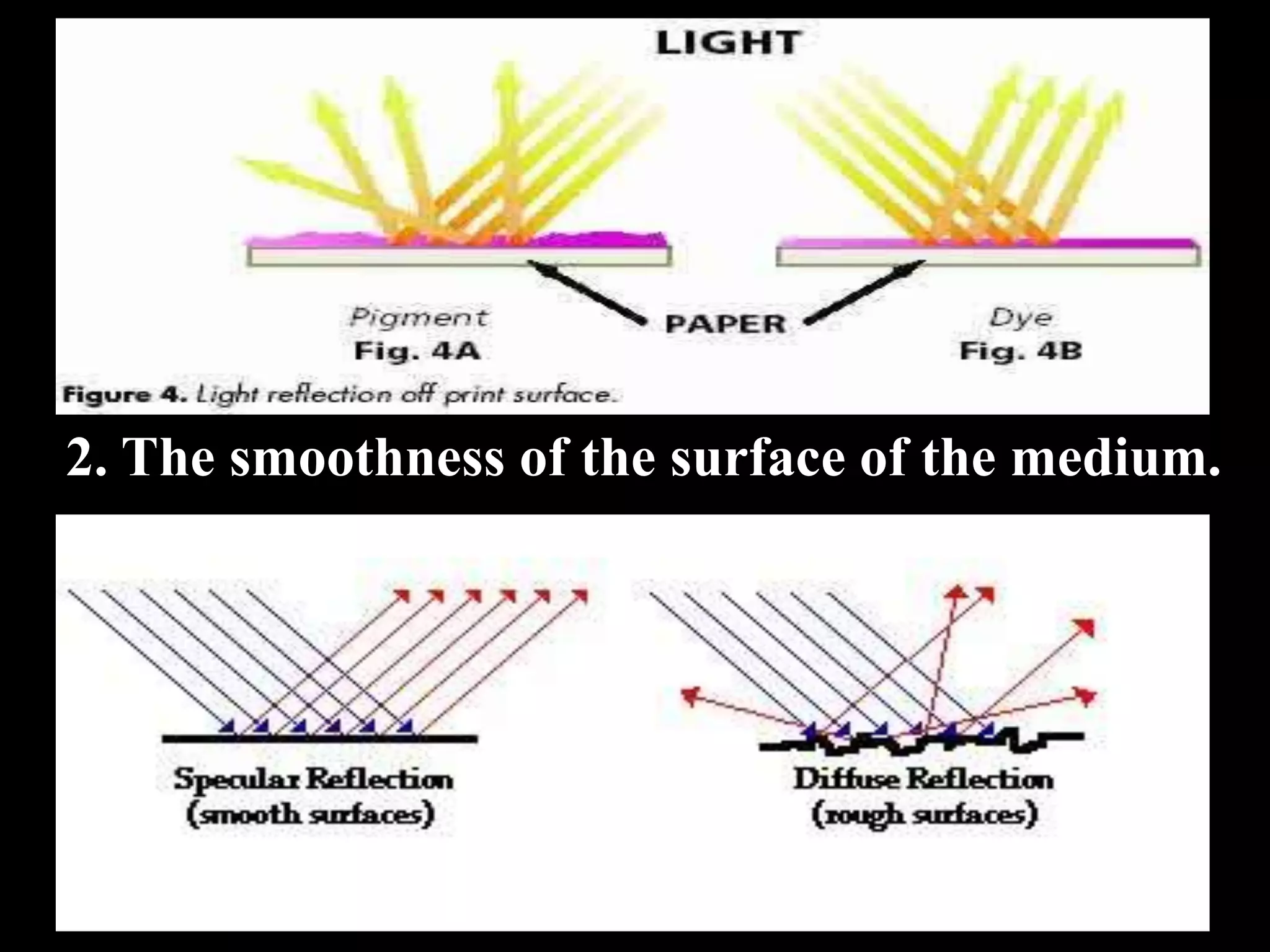
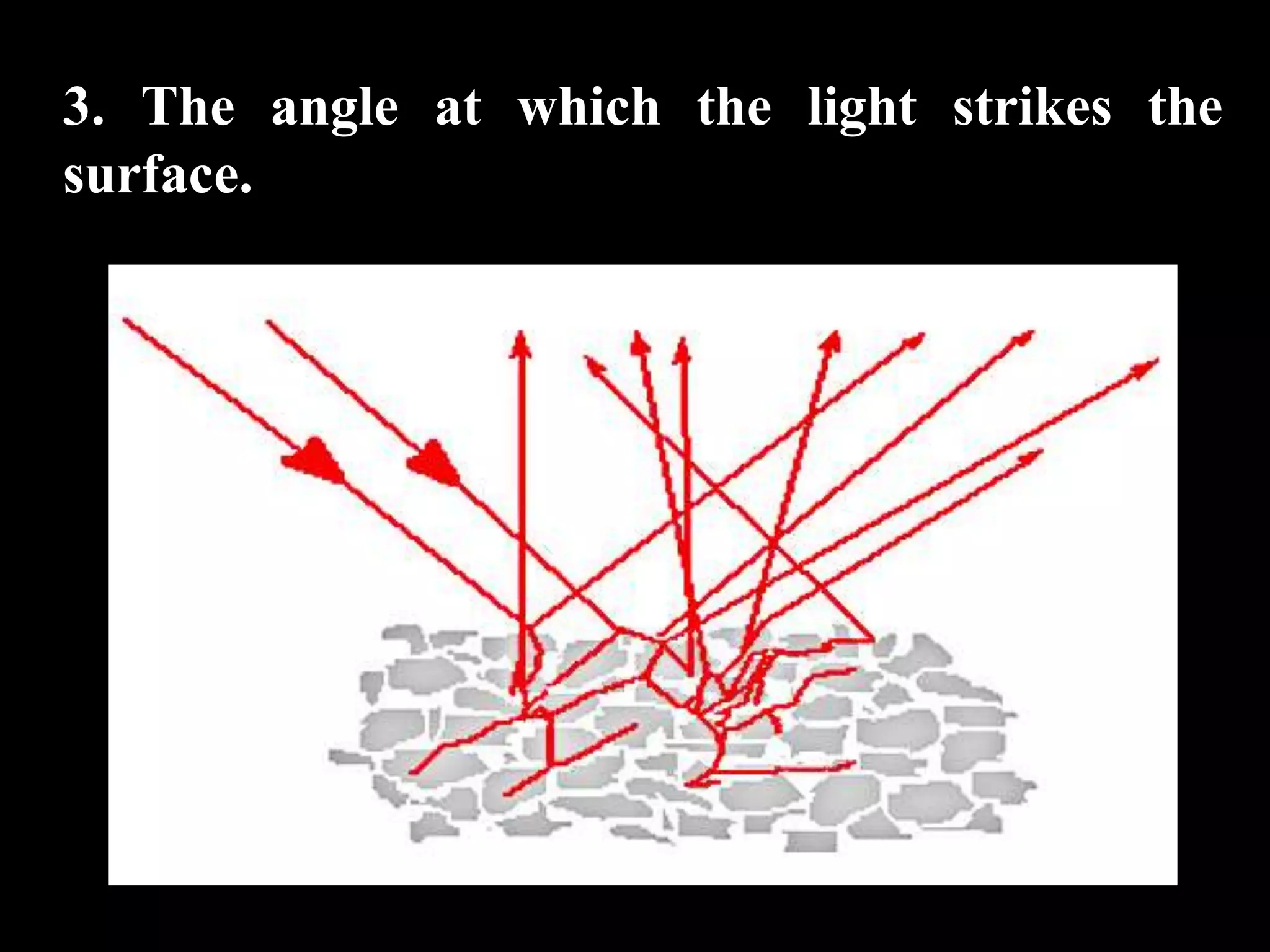
2. The smoothness of the surface of the medium.
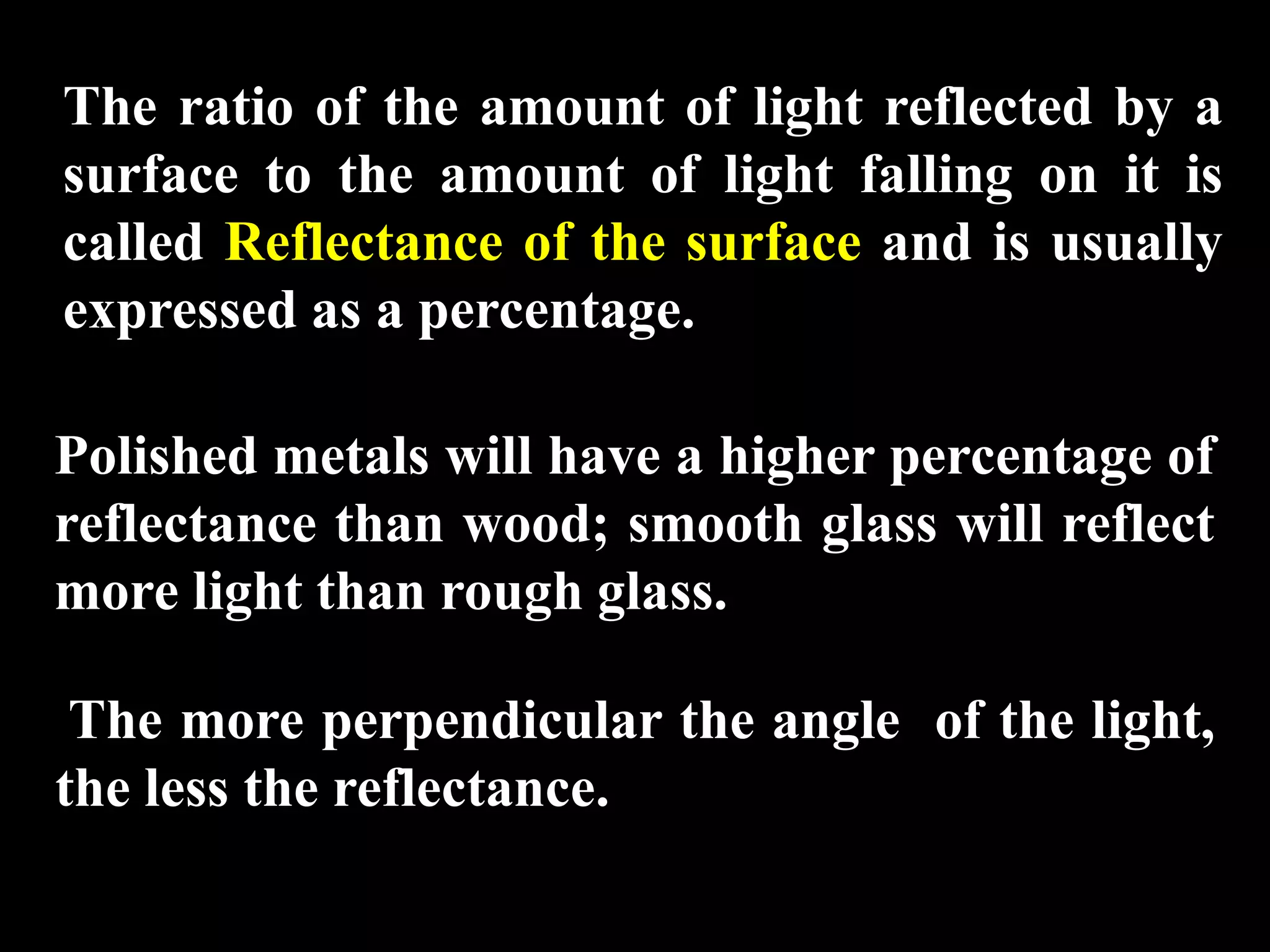
3. The angle at which the light strikes the
surface.
The ratio of the amount of light reflected by a
surface to the amount of light falling on it is
called Reflectance of the surface and is usually
expressed as a percentage.

Polished metals will have a higher percentage of
reflectance than wood; smooth glass will reflect
more light than rough glass.

 The more perpendicular the angle of the light,
the less the reflectance.
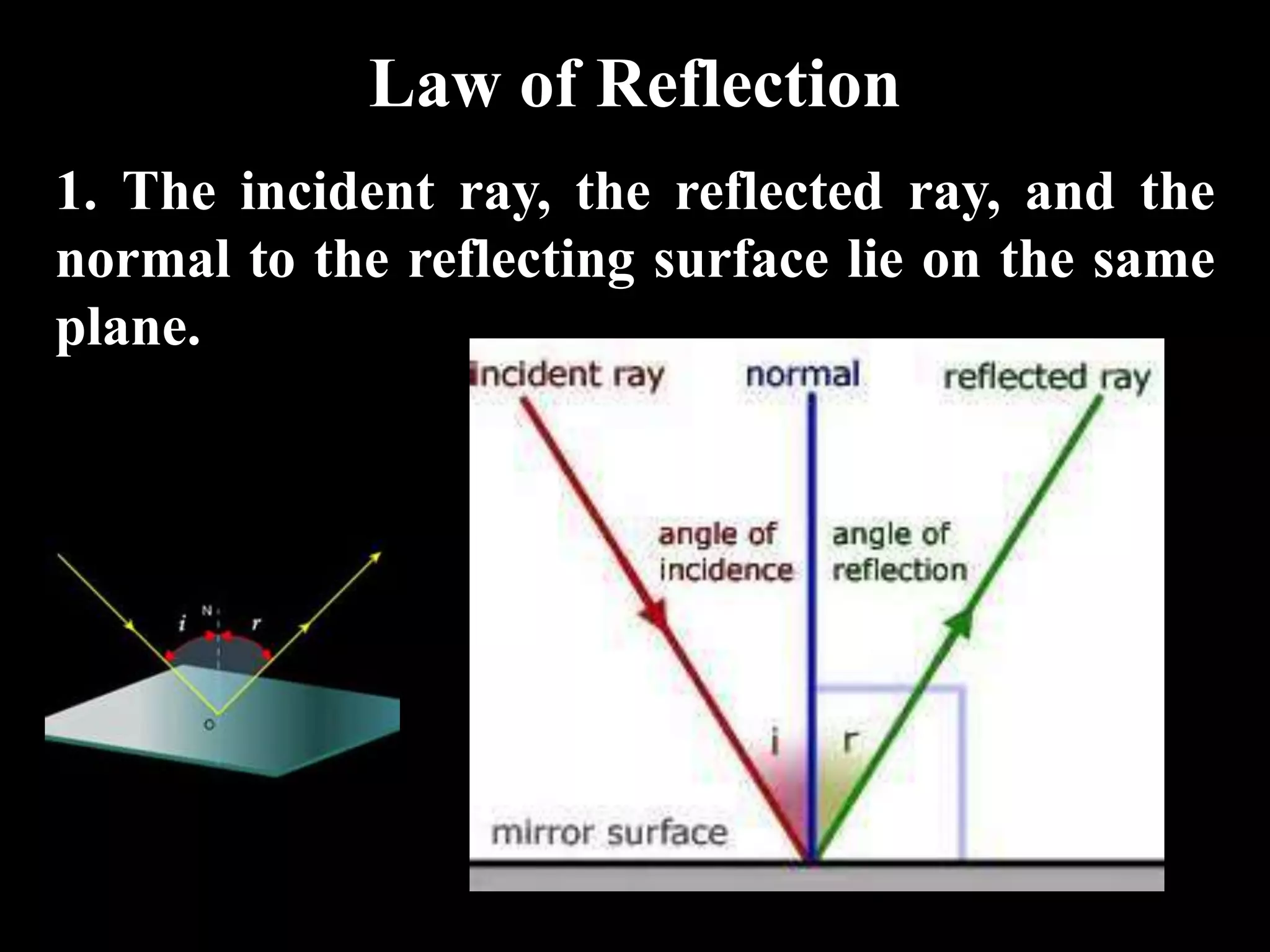
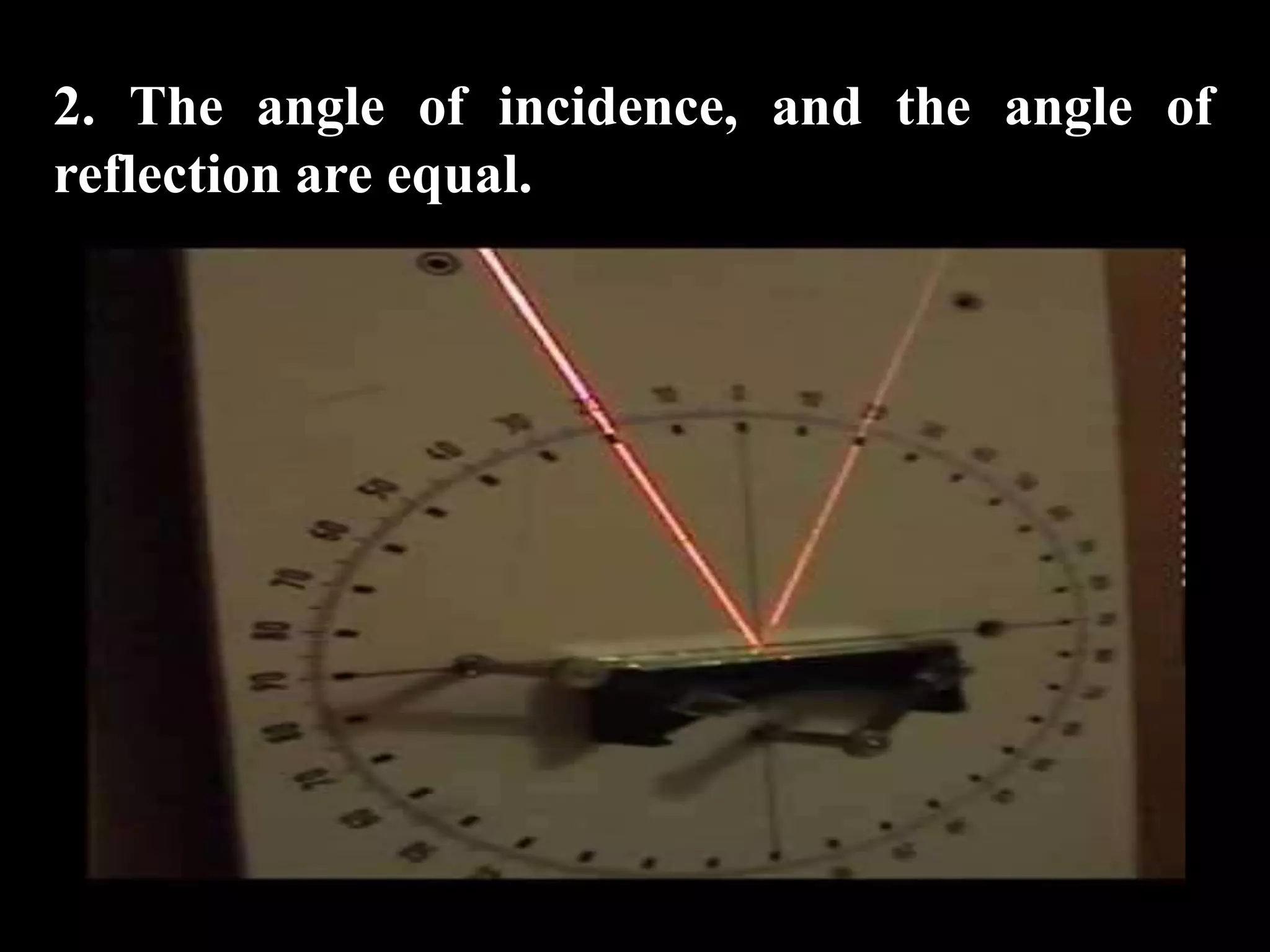
Law of Reflection
1. The incident ray, the reflected ray, and the
normal to the reflecting surface lie on the same
plane.
2. The angle of incidence, and the angle of
reflection are equal.
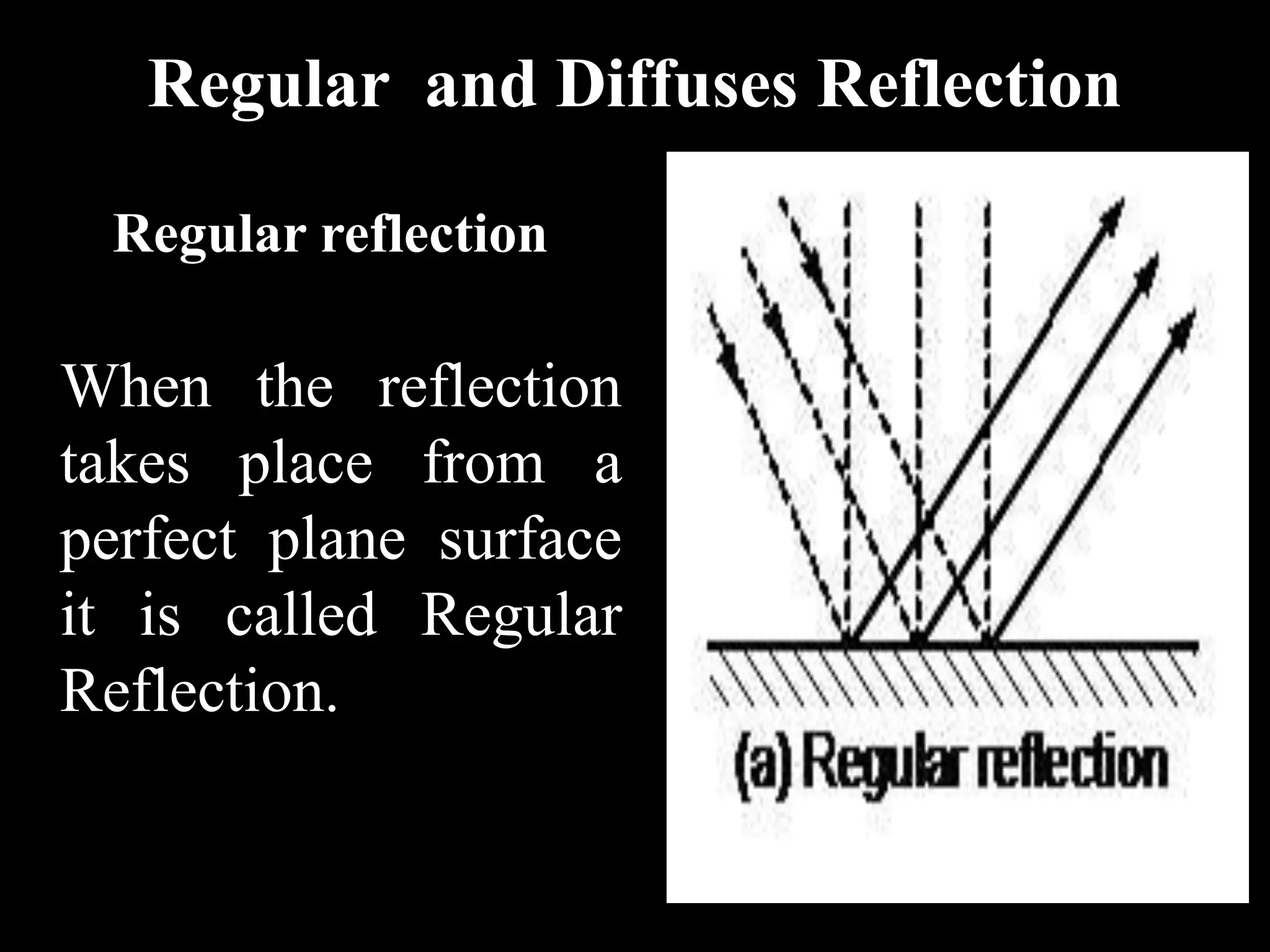
Regular and Diffuses Reflection

 Regular reflection

When the reflection
takes place from a
perfect plane surface
it is called Regular
Reflection.
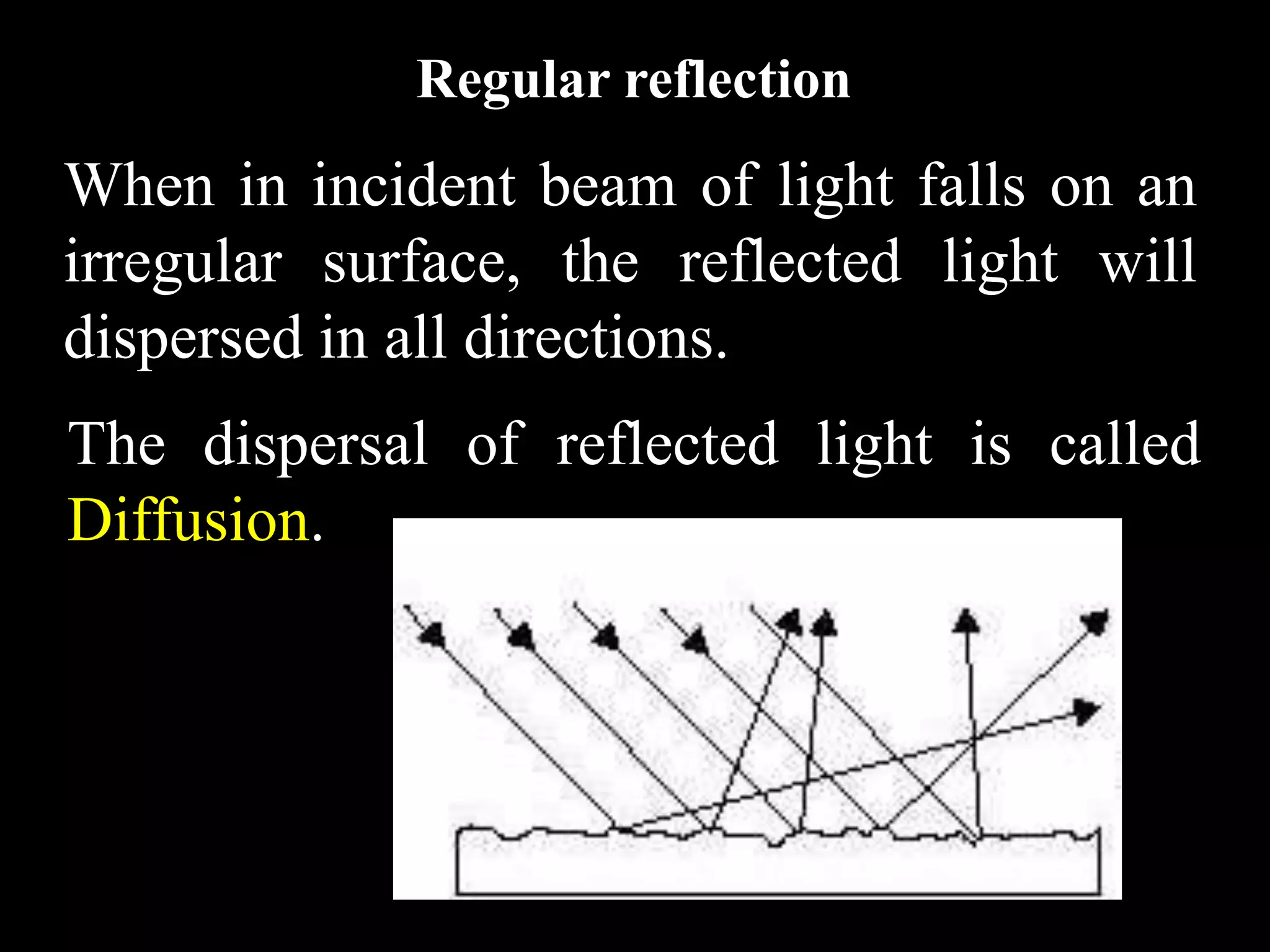
Regular reflection
When in incident beam of light falls on an
irregular surface, the reflected light will
dispersed in all directions.
The dispersal of reflected light is called
Diffusion.
Quiz
1. Mirrors affect    light    by
   _____________

      a. refracting it
      b. reflecting it
      c. changing its speed
      d. changing its color
2. Rainbow formation is due to
   __________.
   a. reflection of sunlight in the sky.
   b. refraction of sunlight in the sky.
   c. reflection and refraction of sunlight
      in the sky.
   d. reflection and refraction of sunlight
      in a raindrops.
Refer to the figure:


3. The incident ray on the reflecting surface
   is _____
     a. AO
     b. NO
     c. OB
     d. NB
Refer to the figure:


4. The reflected ray on the reflecting surface
   is _____
     a. AO
     b. NO
     c. OB
     d. NB
Refer to the figure:


5. The normal drawn from the point of
   incidence is_________
     a. AO
     b. NO
     c. OB
     d. NB
Refer to the figure:


6. The angle of incidence is_________
     a. AON
     b. AOB
     c. i
     d. r
Write A if the object is Luminous
and B if the object is Illuminated.

7. Planets
8. Comet
9. Star
10. Asteroid
11. A meteor
12. He advocated the particle theory that
light consists of tiny particles of matter
emitted by a source and spread outward in
straight lines.
13. He theorized that light is consists of
series of waves with their wave fronts at
right angles to the path of the rays.
14. The speed of light in a vacuum is
equivalent to ___________
     a. 227,000 km/s
     b. 299, 790 km/s
     c. 300, 000 km/s
     d. 299, 792.8 km/s
15. All radiation visible to the human eyes
is called ______
      a. microwave
      b. light
      c. infrared
      d. electromagnetic spectrum
Reference:
You and the Natural World, Science 7
Lilia G. Vengco, Teresita F. Religioso, Carmelita M. Capco,
Gilbert C. Yang, Estrella E. Mendoza, Delia Cordero-Navaza,
Bienvenido J. Valdez.   2012, Phoenix Publishing
House Inc.
Light

  • 1.
  • 2.
    Light: Particle orWave? Sir Isaac Newton advocated the particle theory that light consists of tiny particles of matter emitted by a source and spreads outwards in straight lines called rays. Christian Huygens, Dutch mathematician and scientist, theorized that light consists of a series of waves with their wave fronts at right angles to the path of the rays
  • 3.
    Five properties oflight were developed: a. rectilinear propagation of light b. Reflection of waves c. refraction of light d. interference e. diffraction
  • 4.
    Rectilinear propagation insidean unchanging medium.
  • 5.
    Reflection of wavesfrom the surface of the medium
  • 6.
    Refraction, the bending of waves when a change of speed takes place
  • 7.
    Interference, when twowaves of opposite phases are superimposed
  • 8.
    Diffraction, the bendingof waves around corners
  • 9.
    During the timeof Newton and Huygens, only the first three were recognized and observed. a) Rectilinear b) Reflection c) Refraction
  • 10.
    Spite of scientificdiscussions in defense of the theories, the problems were unresolved for more than a hundred years. In the early 19th century, the last two properties of light, interference and diffraction, were observed for the first time Since these two unusual occurrences could not be clarified and explained by the particle theory, the wave theory become more acceptable.
  • 11.
    The Photoelectric Effect Atthe turn of the 20th century, it was observed that electrons were emitted by some metals whenever light with certain frequency was made to shine on their surface. It was also observed that the greater the intensity of the light that shone on the metals, the greater the rate of emission.
  • 12.
    The photoelectric effectweakened the wave theory. An increase in light intensity is a result in the increase in the velocity of the photoelectrons, according to Huygens's theory. This did not happen. Instead an increase in intensity increased the number of electron emitted and their velocities are the same as those emitted at lower light intensity. Even Newton’s theory could not explain why velocities of the electrons remained constant in spite of an increase in intensity of the light. Photoelectric effect did not help in solving the dilemma of which theory was correct.
  • 13.
    In spite ofthese apparent contradicting theories of light, technological advances have been made. Florescent lamp have been invented making use of the photon theories of Max Planck and Albert Einstein. The photon theory explains the activation of particles by light energy into higher energy level and the emission of the same amount of energy in the form of light as the particle fall back to their natural level
  • 14.
    The laser, proposedin 1958 by A. L. Schawlow and C. H. Townes, consists of an active material which is excited by an external source to disturb the normal distribution of electrons in the material and move them to higher energy levels. As the electrons fall back to their lower levels, they give off excess energy in the form of radiation. When the energy is lost by absorption or transmission, the laser beam oscillates.
  • 15.
    But this beamdiffers from an ordinary light beam. It does not diffuse and the energy waves emitted by the stimulated atoms travels in the same direction, at the same frequency, and in perfect step with the stimulating radiation, which results in greatly magnified intensity
  • 16.
    The Quantum Theory MaxPlanck presented the theory that electrons absorbed energy only in discrete quantities proportional to their frequencies. Albert Einstein adopted Planck's concept and formulated the quantum theory which helped Niels Bohr build a workable and acceptable model of the atomic structure. Bohr’s concept of discrete energy levels provided the French physicist Louis de Broglie with the theory of the dual nature of light.
  • 17.
    De Broglie suggestedthat light had both particles and wavelike properties. This theory of De Broglie is known as wave mechanics. Wave Mechanics accepted Einstein’s idea of the interchangeability of mass and energy (E=mc2 ) Einstein said that in every mechanical system, waves are associated with mass particles.
  • 18.
    Speed of Light Thefirst attempt to measure the speed of light was made by Galileo Galilei. Galileo and his assistant, each carrying a lamp, positioned themselves separately on two hilltops.
  • 19.
    They tried tomeasure the time it takes the light from one lamp to travel between the two hilltops. The assistant was to flash his lantern as soon as he saw Galileo flash his. Galileo tried to measure the time between the flash of his lantern and the time when he received the light from his assistant’s lantern. The experiment was not successful because light traveled so fast that for distances on the earth’s surface within one’s visual range, the time involved in its transmission was so short as to be negligible and not noticeable.
  • 20.
    It was theDanish astronomer Olaus Roemer who was first to compute the velocity of light by observing the eclipses of one of the moons of Jupiter. His calculation determined the speed of light at 277,000 km/s.
  • 21.
    Professor Albert A.Michaelson refined the figure proposed by Roemer by publishing a report on his Mt. Wilson and Mt. San Antonio in California. His computations showed the speed of light in air as 299, 790 km/s.
  • 22.
    In a vacuumthe speed of light is slightly faster at 299,792.8 km/s The common value of 300,000 km/s or 3.0 x 10⁸ m/s may be used in ordinary computations with very little error. At this velocity, the earth’s circumference (40,000 km) could be transverse seven and one-half times in one second.
  • 23.
    The light reflectedfrom the moon 384 000 km away from us would reach us in 1.3 seconds. The light from the sun would take roughly eight minutes to travel to the earth.
  • 24.
    The distance traveledby light in one year is called a Light-year. This is the unit of distance used by astronomers to measure distances in the universe.
  • 25.
    Light : An ElectromagneticWave Electromagnetic wave tells us that electric and magnetic fields are present in light. In 1856, James Clerk Maxwell was doing a theoretical study of electromagnetic waves. He realized that a changing electric field gives rise to a changing magnetic field which in turn creates a changing field, and so on.
  • 26.
    James Clerk Maxwelldeveloped equations showing the relationship of electricity and magnetism. Based from these equations, he found that the net result of these interchanging fields was to create a train of invisible waves of electric and magnetic fields that could propagate through space. These waves are called electromagnetic (EM) waves. Using the equations developed by Maxwell they found out that EM waves travels at the speed of 3.0 x 10⁸ m/s, the same as the measured speed of light in a vacuum.
  • 27.
    James Clerk Maxwell thoughtthat there was a relationship between electric and magnetic field. He concluded that light waves are only a particular type of general category called electromagnetic waves.
  • 28.
    Electromagnetic Spectrum Maxwell’s theoryof light was fully accepted after EM waves were first created and detected experimentally by Heinrich Hertz in 1887. Hertz give experimental evidence that light and electromagnetic waves have the same nature and that they travel at the same speed and exhibit the same properties such as refraction, reflection, diffraction, and interference. The difference in some properties was found to be due to their different wavelength.
  • 29.
    The electromagnetic wavesmake up what is called collectively as the Electromagnetic Spectrum.
  • 30.
    Each wavelength isdifferent from another in its wavelength, but all waves travel in vacuum with the speed of light. The wavelengths vary from 3 x 10⁷ m at high frequencies. In Angstrom unit (A0 ), the common unit to measure wavelengths is from 3 x 10¹⁷ A0 (1 A0 = 1.0 X 10⁻¹⁰ m). It is found that the wavelength of visible light range from 3.5 x 10⁻⁷ m to 7.5 x 10⁻⁷ m (3500 A0 to 7500 A0 )
  • 31.
    The visible spectrumincludes all radiation visible to the human eye and is commonly called Light. All radiation above and below the visible waves have wavelengths that are too short or too long for the eye to detect.
  • 33.
    How much haveyou learned? 1. According to James Clerk Maxwell, what is the relationship between light and EM waves? 2. What is the main difference between light waves and EM waves? 3. Approximately, what part of the whole EM spectrum does our visible spectrum occupy?
  • 34.
    Luminous and Illuminated Objects Luminous Object – any object that emits their own visible light. - They become visible because of the light they emitted. Illuminated Object -object that can be seen because it reflects the light they received.
  • 35.
    What happens tolight when it falls on the surface of the object? Light from a source travels in all direction. This decreases the amount of light that falls on a certain area. When light strikes the surface of an object, several things may happen. If the radiation is turned back by the surface without entering the object, the light is said to be REFLECTED.
  • 36.
    Most of theobjects around us are not emitters of light but instead as reflectors of light. Some of the light that falls on an object may be absorbed. The radiant energy is transformed into molecular motion which warms the object. All objects that absorb light experience a rise in temperature.
  • 37.
    Objects which allowlight to pass through are said to transmit light and are described as TRANSPARENT
  • 38.
    Some other substancescan transmit light but allow the light to scatter or diffuse, making it difficult to distinguish objects that are behind them. This substances are called TRANSLUCENT.
  • 39.
    Substances that donot transmit light at all, like stones and wood are classified as OPAQUE objects.
  • 40.
  • 41.
    Reflection of Light Reflectedlight is a light that is bounced back from the surface of an object.
  • 42.
    Part of thelight coming from the source, passing through the air, and touching the boundary of a medium is reflected. The rest of the light enters into the medium and is partially absorbed and partially transmitted.
  • 43.
    The amount ofreflected light depends on three factors: 1. The kind of medium the object is made.
  • 44.
    2. The smoothnessof the surface of the medium.
  • 45.
    3. The angleat which the light strikes the surface.
  • 46.
    The ratio ofthe amount of light reflected by a surface to the amount of light falling on it is called Reflectance of the surface and is usually expressed as a percentage. Polished metals will have a higher percentage of reflectance than wood; smooth glass will reflect more light than rough glass. The more perpendicular the angle of the light, the less the reflectance.
  • 47.
    Law of Reflection 1.The incident ray, the reflected ray, and the normal to the reflecting surface lie on the same plane.
  • 48.
    2. The angleof incidence, and the angle of reflection are equal.
  • 49.
    Regular and DiffusesReflection Regular reflection When the reflection takes place from a perfect plane surface it is called Regular Reflection.
  • 50.
    Regular reflection When inincident beam of light falls on an irregular surface, the reflected light will dispersed in all directions. The dispersal of reflected light is called Diffusion.
  • 51.
  • 52.
    1. Mirrors affect light by _____________ a. refracting it b. reflecting it c. changing its speed d. changing its color
  • 53.
    2. Rainbow formationis due to __________. a. reflection of sunlight in the sky. b. refraction of sunlight in the sky. c. reflection and refraction of sunlight in the sky. d. reflection and refraction of sunlight in a raindrops.
  • 54.
    Refer to thefigure: 3. The incident ray on the reflecting surface is _____ a. AO b. NO c. OB d. NB
  • 55.
    Refer to thefigure: 4. The reflected ray on the reflecting surface is _____ a. AO b. NO c. OB d. NB
  • 56.
    Refer to thefigure: 5. The normal drawn from the point of incidence is_________ a. AO b. NO c. OB d. NB
  • 57.
    Refer to thefigure: 6. The angle of incidence is_________ a. AON b. AOB c. i d. r
  • 58.
    Write A ifthe object is Luminous and B if the object is Illuminated. 7. Planets 8. Comet 9. Star 10. Asteroid 11. A meteor
  • 59.
    12. He advocatedthe particle theory that light consists of tiny particles of matter emitted by a source and spread outward in straight lines.
  • 60.
    13. He theorizedthat light is consists of series of waves with their wave fronts at right angles to the path of the rays.
  • 61.
    14. The speedof light in a vacuum is equivalent to ___________ a. 227,000 km/s b. 299, 790 km/s c. 300, 000 km/s d. 299, 792.8 km/s
  • 62.
    15. All radiationvisible to the human eyes is called ______ a. microwave b. light c. infrared d. electromagnetic spectrum
  • 63.
    Reference: You and theNatural World, Science 7 Lilia G. Vengco, Teresita F. Religioso, Carmelita M. Capco, Gilbert C. Yang, Estrella E. Mendoza, Delia Cordero-Navaza, Bienvenido J. Valdez. 2012, Phoenix Publishing House Inc.