ENERGY What is energy?
Energy Energy is the ability to do work to cause change Energy is required for motion
Kinetic energy Kinetic energy is the energy of matter in motion Types of kinetic energy Chemical Nuclear Electromagnetic Thermal Mechanical
Kinetic Energy Kinetic Energy (KE) = ½ mass x velocity 2 KE = 1/2mv 2 Unit = JOULE (J) = 1kg/m 2 /s 2
Energy Energy cannot be created or destroyed only changed or transformed Hand  to  Ball  to  Hand Chemical to mechanical to heat to mechanical to chemical
Potential energy Potential energy is stored energy An object at rest has the  potential  to have motion Kinetic – energy of motion Potential – stored energy
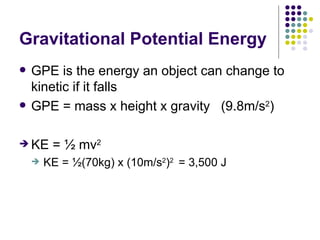
Gravitational Potential Energy GPE is the energy an object can change to kinetic if it falls GPE = mass x height x gravity  (9.8m/s 2 ) KE = ½ mv 2 KE = ½(70kg) x (10m/s 2 ) 2  = 3,500 J
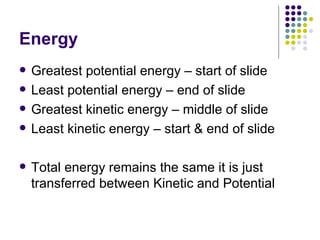
Energy Greatest potential energy – start of slide Least potential energy – end of slide Greatest kinetic energy – middle of slide Least kinetic energy – start & end of slide Total energy remains the same it is just transferred between Kinetic and Potential
Forces on a roller coaster http://www.glenbrook.k12.il.us/gbssci/phys/mmedia/energy/ce.html   http://science.howstuffworks.com/roller-coaster3.htm
Roller coaster forces
Energy Problems ½ (6) x 10 2  = 300 J  (3 x 100) 30 x 9.8 x 15 = 4410 J 1 x 9.8 x 2 = 19.6 J ½ (1) x (2.2) 2  = 2.42 J  (.5 x 4.84) ½ (1,000) x 20 2  = 200,000 J  (500x400) ½ (1,000) x 40 2  = 800,000 J  (500x1,600)
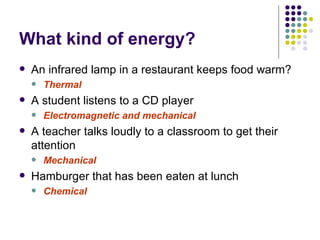
What kind of energy? An infrared lamp in a restaurant keeps food warm? Thermal A student listens to a CD player Electromagnetic and mechanical A teacher talks loudly to a classroom to get their attention Mechanical Hamburger that has been eaten at lunch Chemical

Energy

  • 1.
  • 2.
    Energy Energy isthe ability to do work to cause change Energy is required for motion
  • 3.
    Kinetic energy Kineticenergy is the energy of matter in motion Types of kinetic energy Chemical Nuclear Electromagnetic Thermal Mechanical
  • 4.
    Kinetic Energy KineticEnergy (KE) = ½ mass x velocity 2 KE = 1/2mv 2 Unit = JOULE (J) = 1kg/m 2 /s 2
  • 5.
    Energy Energy cannotbe created or destroyed only changed or transformed Hand to Ball to Hand Chemical to mechanical to heat to mechanical to chemical
  • 6.
    Potential energy Potentialenergy is stored energy An object at rest has the potential to have motion Kinetic – energy of motion Potential – stored energy
  • 7.
    Gravitational Potential EnergyGPE is the energy an object can change to kinetic if it falls GPE = mass x height x gravity (9.8m/s 2 ) KE = ½ mv 2 KE = ½(70kg) x (10m/s 2 ) 2 = 3,500 J
  • 8.
    Energy Greatest potentialenergy – start of slide Least potential energy – end of slide Greatest kinetic energy – middle of slide Least kinetic energy – start & end of slide Total energy remains the same it is just transferred between Kinetic and Potential
  • 9.
    Forces on aroller coaster http://www.glenbrook.k12.il.us/gbssci/phys/mmedia/energy/ce.html http://science.howstuffworks.com/roller-coaster3.htm
  • 10.
  • 11.
    Energy Problems ½(6) x 10 2 = 300 J (3 x 100) 30 x 9.8 x 15 = 4410 J 1 x 9.8 x 2 = 19.6 J ½ (1) x (2.2) 2 = 2.42 J (.5 x 4.84) ½ (1,000) x 20 2 = 200,000 J (500x400) ½ (1,000) x 40 2 = 800,000 J (500x1,600)
  • 12.
    What kind ofenergy? An infrared lamp in a restaurant keeps food warm? Thermal A student listens to a CD player Electromagnetic and mechanical A teacher talks loudly to a classroom to get their attention Mechanical Hamburger that has been eaten at lunch Chemical