1
2
MYOPIA
• Short sightedness
• Myopia is a greek word meaning *close
  the eye*
• Refractive error I
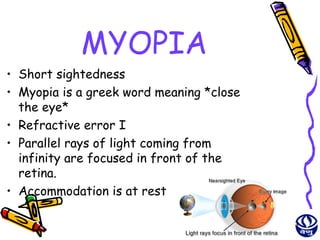
• Parallel rays of light coming from
  infinity are focused in front of the
  retina.
• Accommodation is at rest

                                          3
 Mechanism of production

•   Axial
•   Curvatural
•   Positional
•   Index
•   Myopia due to excessive accommodation


                                            4
 Optics of myopia
• Far point is finite (In front of the eye)
• Emmetropic eye it is at infinity
• Higher the myopia the shorter the distance
• Far point is 1mt from the eye ,there is 1D of
  myopia
• Nodal point is further away from retina
       Accommodation need not develop
       normally resulting in
       Convergence insufficiency
       Exophoria
                                                  5
TYPES OF
    CLASSIFICATION
• Clinical
  Classification
• Degree of Myopia
• Age of Onset


                     6
Clinical Classification
•   Congenital Myopia
•   Simple Myopia
•   Degenerative Myopia
•   Nocturnal Myopia
•   Pseudo Myopia
•   Induced Myopia


                               7
Degree of Myopia

• Low Myopia(<3D)
• Medium
  Myopia(3-6D)
• High Myopia(>6D)


                         8
AGE OF ONSET
• Congenital Myopia
• Youth-Onset
  Myopia(<20 yrs of age)
• Early Adult-Onset
  Myopia(20-40 yrs of
  age)
• Late Adult-Onset
  Myopia(>40 yrs of age)


                           9
Congenital myopia
 Frequently seen in
 Premature babies
 Marfan’s syndrome
 Homocystinuria
 Increase in axial length
 Increase inOverall globe size
 Since birth, diagnosed at age 2-3 years
 If unilateral, as anisometropia, may develop
  amblyopia, strabismus
 Usually 8-10 D, remain constant
 Bilateral- difficulty in distant vision, hold
                                                  10
  things very close
 Associated conditions
 Convergent squint
 Cataract
 Microphthalmos
 Aniridia
 Megalocornea
 Congenital Separation of retina
Management
 Early Correction is desirable
 Retinoscopy under full cycloplegia
 Early full correction desirable
 Poor prognosis
                                       11
• Simple / developmental myopia

 Physiological error not associated with any
  disease of the eye

 Etiology :
 Normal biological variation in development of
  eye
 Inheritence


                                                  12
 Associated factors


 Role of diet


 Theory of excessive near work

                                  13
 Clinical picture

 Rarely present at birth

 Rather born hypermetropic, become myopic

 Begins at 7-10 years, stabilizing around mid
  teens

 Usually around 5D, never exceeds 8D

                                                 14
Symptoms

 Poor vision for distance
 Asthenopic symptoms develop due to
  dissociation between accommodation and
  convergence
Convergence weakness, exophoria,
  suppression
Excessive accommodation inducing ciliary
  spasm and artificially increasing the amount
  of myopia
 Psychological outlook                     15
 Signs

 Large and prominent
 Deep AC
 Large, sluggishly reacting pupils
 Normal fundus, rarely crescent
 Usually doesn't exceed 6-8D

• Retinoscopy under full cycloplegia

                                       16
• Pathological / degenerative /
  progressive myopia
 Rapidly progressive associated with
  degenerative changes in the eye

 Etiology
 Rapid axial growth of the eyeball outside the
  normal biological variations of development
 Role of heredity
 Role of general growth process

                                              17
Genetic factors          General growth
  process

         More growth of retina

         Stretching of sclera

         Increased axial length

        Degeneration of choroid

         Degeneration of retina
                                          18
 Symptoms

 Defective vision

 Muscae volitantes / floating black
  opacities


                                       19
Signs

 EYE Large, prominent eyes simulating
  exophthalmos
 CORNEA large
 ANTERIOR CHAMBER deep
 LENS show opacities at the posterior pole
  due to aberration of lenticular metabolism
  and due to overstretching anterior
  dislocation may also occur

                                           20
 VITEROUS degeneration,viterous
  liquefication,vitreous detachment present
  as WEISS REFLEX

 SCLERA thinning resulting in formation of
  STAPHYLOMA

 VISUAL FIELD DEFECTS show Contraction
  and in some ring scotomas present

                                         21
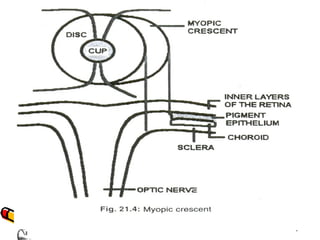
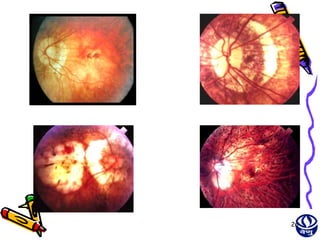
 DISC
 Large in size
 Myopic Crescent on the temporal side of the
  disc
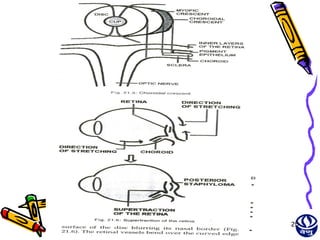
 Choroidal Crescent
 Supertraction of the retina
 Inverse myopia Myopic crescent situated
  nasally and supertraction of the retina
  temporally
 called as INVERSE CRESCENT
 Peripapillary Atrophy


                                                22
 MACULA
  Foster-Fuchs fleck

 RETINAL DETACHMENT
 POSTERIOR STAPHYLOMA
 RETINAL HOLES
 TESSELATED FUNDUS


                         23
24
25
26
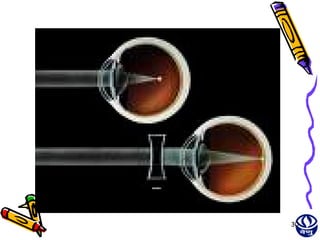
Treatment
 Optical treatment

 Appropriate concave lenses

 Minimum acceptance providing maximum
  vision


                                     27
Guidelines
LOW DEGREES OF MYOPIA (Up to -6D)

 IN YOUNG SUBJECTS
  Defect should never be overcorrected and advised for
 constant use to avoid squinting and develop a normal
 ACCOMMODATION-CONVERGENCE reflex

 IN ADULTS
  Receiving spectacle for the first time,have the ciliary
  muscle that are unaccostomed to accommodate
  efficiently so that lens of slightly lower power(1 or 2 D)
  may be prescribed for reading,especially if engaged in to
  any greater extent.Above the age of 40 years,when
  accommodation fails physiologically, a weaker glass for
                                                        28
  near work is essential
HIGH DEGREES OF MYOPIA

Full correction rarely be tolerated so we attempt to
reduce the correction as little as is compatible with
comfort for binocular vision. We prescribe the lens
with which the greatest visual acuity is obtained
without distress


                                                        29
30
ADVANTAGES OF SPECTACLES
 Economical
 Allow incorporation of prism,bifocals,pal
  which can be used for the management
  of esophoria or any accommodative
  disorders accompanying myopia
 Spectacles require less accommodation
  than contact lens for myopia that
  likelihood of accommodative asthenopia
  or near point blur in patients
  approaching presbyopia may be less

                                          31
DISPENSING SPECTACLES IN HIGH
 MYOPIA

•   High index lens materials
•   Lighter lens materials
•   Reduced eyesize of selected frames
•   Minus lenticular lens designs


                                         32
ADVANTAGES OF CONTACT LENS


• Contact lens provides cosmosis


• Large retinal image size and slightly better visual
  acuity in severe myopia


                                                        33
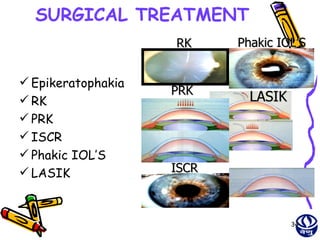
SURGICAL TREATMENT
                    RK     Phakic IOL’S


 Epikeratophakia
                    PRK
 RK                         LASIK
 PRK
 ISCR
 Phakic IOL’S
 LASIK             ISCR


                                     34
Photorefractive
         Keratectomy
             (PRK)
• Involves direct laser ablation of corneal
  stroma after removal of corneal epithelium
  mechanically or using a laser beam.
• Done using Excimer laser
• MUNNERLYN EQN: depth of ablation
  (micrometer)=[diameter of optical
  zone(mm)]² × 1/3power(Diopter)
• For myopic a large amount of ablation is
  done in central cornea than in the
  periphery.
• Give good results for -2D to -6D of myopia 35
LASIK
       Laser Assisted In situ
          Keratomileusis
• Method:Anterior flap of cornea is lifted with a keratome and
  excimer laser is used to sculpt the stromal bed to change the
  refractive error of eye
• Corrects 0.5 to 12D of myopia and upto 8D of astigmatism
• Guidelines:Age more than 18yrs
             BCVA better than 6/12
             Stable refraction for last 1yr
             Absence of corneal disease & ectasia
• Note:
• (1) In no case the residual bed thickness after the ablation
  should measure 250microns so as to avoid central corneal
  ectasia
• (2) Ideally the ablation should be done within 30sec of the
  preparation of flap
                                                                  36
LASEK
     Laser subepithelial
       Keratomileusis
• Indications:
• Low myopia
• Irregular astigmatism
• LASIK complications in contralateral
  eye
• Thin corneal pachymetry
• Predisposition to trauma
• Glaucoma suspect                       37
• Method:
• Simple inexpensive procedure that
  involves creation of epithelial flap after
  exposure to 18% alcohol for 25sec &
  subsequent replacement of flap after
  laser ablation


                                           38
RK
        Radial Keratotomy
• It refers to making deep corneal incisions(initially
  16,now down to 4) in the peripheral part of cornea
  leaving about 4mm central optical zone
• The incisions are made almost down to the level of
  Descemet’s Membrane
• These incisions on healing flatten the central
  cornea thereby reducing its refractive power
• For low to moderate degree of myopia(-1.5 to
  -6D of myopia)


                                                         39
Epikeratophakia
• For high degree of myopia (upto 20D)
• Method:
• The epithelium is removed & then a
  pocket is fashioned under the edge
  of the remaining epithelium & into
  this is inserted the cryolathed donor
  homograft
• Preserved material can also be used
                                          40
NON CORNEAL
       INTERVENTIONS
• (A) REMOVAL OF CLEAR LENS
• We know that an aphakic eye is strongly
  hypermetropic
• If an eye with an axial myopia of -24D is deprived
  of its lens it will become emmetropic without any
  correcting lens
• Note:
• Whenever surgery on clear lens is contemplated
  the eye is examined thoroughly for abnormalties
  like Raised IOP,Vitreous & retinal degeneration
  etc

                                                       41
• (b)Phakic intraocular lenses
• An IOL of appropriate power is implanted
  inside the eye without touching normal
  crystalline lens thus without disturbing
  accomodation
• Method can be used to correct both myopia &
  hypermetropia
• Phakic IOL types:
• PC IOL
• Angle supported IOL
• Iris claw lens

                                            42
INTRA CORNEAL
        RING(ICR)
      IMPLANTATION
• ICR implantation into the peripheral
  cornea approx.upto 2/3rd of stromal
  depth can also be considered for
  correction of myopia
• It results in a vaulting effect that
  flattens the central cornea
  decreasing the myopia
• The procedure has the advantage of
  being reversible                       43
For Further Queries Contact :
Ms. Priyanka Singh
Head – Optometry Service
Email – optometry@venueyeinstitute.org


                                     44
Thank you
            45

Myopia

  • 1.
  • 2.
  • 3.
    MYOPIA • Short sightedness •Myopia is a greek word meaning *close the eye* • Refractive error I • Parallel rays of light coming from infinity are focused in front of the retina. • Accommodation is at rest 3
  • 4.
     Mechanism ofproduction • Axial • Curvatural • Positional • Index • Myopia due to excessive accommodation 4
  • 5.
     Optics ofmyopia • Far point is finite (In front of the eye) • Emmetropic eye it is at infinity • Higher the myopia the shorter the distance • Far point is 1mt from the eye ,there is 1D of myopia • Nodal point is further away from retina Accommodation need not develop normally resulting in Convergence insufficiency Exophoria 5
  • 6.
    TYPES OF CLASSIFICATION • Clinical Classification • Degree of Myopia • Age of Onset 6
  • 7.
    Clinical Classification • Congenital Myopia • Simple Myopia • Degenerative Myopia • Nocturnal Myopia • Pseudo Myopia • Induced Myopia 7
  • 8.
    Degree of Myopia •Low Myopia(<3D) • Medium Myopia(3-6D) • High Myopia(>6D) 8
  • 9.
    AGE OF ONSET •Congenital Myopia • Youth-Onset Myopia(<20 yrs of age) • Early Adult-Onset Myopia(20-40 yrs of age) • Late Adult-Onset Myopia(>40 yrs of age) 9
  • 10.
    Congenital myopia  Frequentlyseen in  Premature babies  Marfan’s syndrome  Homocystinuria  Increase in axial length  Increase inOverall globe size  Since birth, diagnosed at age 2-3 years  If unilateral, as anisometropia, may develop amblyopia, strabismus  Usually 8-10 D, remain constant  Bilateral- difficulty in distant vision, hold 10 things very close
  • 11.
     Associated conditions Convergent squint  Cataract  Microphthalmos  Aniridia  Megalocornea  Congenital Separation of retina Management  Early Correction is desirable  Retinoscopy under full cycloplegia  Early full correction desirable  Poor prognosis 11
  • 12.
    • Simple /developmental myopia  Physiological error not associated with any disease of the eye  Etiology :  Normal biological variation in development of eye  Inheritence 12
  • 13.
     Associated factors Role of diet  Theory of excessive near work 13
  • 14.
     Clinical picture Rarely present at birth  Rather born hypermetropic, become myopic  Begins at 7-10 years, stabilizing around mid teens  Usually around 5D, never exceeds 8D 14
  • 15.
    Symptoms  Poor visionfor distance  Asthenopic symptoms develop due to dissociation between accommodation and convergence Convergence weakness, exophoria, suppression Excessive accommodation inducing ciliary spasm and artificially increasing the amount of myopia  Psychological outlook 15
  • 16.
     Signs  Largeand prominent  Deep AC  Large, sluggishly reacting pupils  Normal fundus, rarely crescent  Usually doesn't exceed 6-8D • Retinoscopy under full cycloplegia 16
  • 17.
    • Pathological /degenerative / progressive myopia  Rapidly progressive associated with degenerative changes in the eye  Etiology  Rapid axial growth of the eyeball outside the normal biological variations of development  Role of heredity  Role of general growth process 17
  • 18.
    Genetic factors General growth process More growth of retina Stretching of sclera Increased axial length Degeneration of choroid Degeneration of retina 18
  • 19.
     Symptoms  Defectivevision  Muscae volitantes / floating black opacities 19
  • 20.
    Signs  EYE Large,prominent eyes simulating exophthalmos  CORNEA large  ANTERIOR CHAMBER deep  LENS show opacities at the posterior pole due to aberration of lenticular metabolism and due to overstretching anterior dislocation may also occur 20
  • 21.
     VITEROUS degeneration,viterous liquefication,vitreous detachment present as WEISS REFLEX  SCLERA thinning resulting in formation of STAPHYLOMA  VISUAL FIELD DEFECTS show Contraction and in some ring scotomas present 21
  • 22.
     DISC  Largein size  Myopic Crescent on the temporal side of the disc  Choroidal Crescent  Supertraction of the retina  Inverse myopia Myopic crescent situated nasally and supertraction of the retina temporally  called as INVERSE CRESCENT  Peripapillary Atrophy 22
  • 23.
     MACULA Foster-Fuchs fleck  RETINAL DETACHMENT  POSTERIOR STAPHYLOMA  RETINAL HOLES  TESSELATED FUNDUS 23
  • 24.
  • 25.
  • 26.
  • 27.
    Treatment Optical treatment Appropriate concave lenses  Minimum acceptance providing maximum vision 27
  • 28.
    Guidelines LOW DEGREES OFMYOPIA (Up to -6D)  IN YOUNG SUBJECTS Defect should never be overcorrected and advised for constant use to avoid squinting and develop a normal ACCOMMODATION-CONVERGENCE reflex  IN ADULTS Receiving spectacle for the first time,have the ciliary muscle that are unaccostomed to accommodate efficiently so that lens of slightly lower power(1 or 2 D) may be prescribed for reading,especially if engaged in to any greater extent.Above the age of 40 years,when accommodation fails physiologically, a weaker glass for 28 near work is essential
  • 29.
    HIGH DEGREES OFMYOPIA Full correction rarely be tolerated so we attempt to reduce the correction as little as is compatible with comfort for binocular vision. We prescribe the lens with which the greatest visual acuity is obtained without distress 29
  • 30.
  • 31.
    ADVANTAGES OF SPECTACLES Economical  Allow incorporation of prism,bifocals,pal which can be used for the management of esophoria or any accommodative disorders accompanying myopia  Spectacles require less accommodation than contact lens for myopia that likelihood of accommodative asthenopia or near point blur in patients approaching presbyopia may be less 31
  • 32.
    DISPENSING SPECTACLES INHIGH MYOPIA • High index lens materials • Lighter lens materials • Reduced eyesize of selected frames • Minus lenticular lens designs 32
  • 33.
    ADVANTAGES OF CONTACTLENS • Contact lens provides cosmosis • Large retinal image size and slightly better visual acuity in severe myopia 33
  • 34.
    SURGICAL TREATMENT RK Phakic IOL’S  Epikeratophakia PRK  RK LASIK  PRK  ISCR  Phakic IOL’S  LASIK ISCR 34
  • 35.
    Photorefractive Keratectomy (PRK) • Involves direct laser ablation of corneal stroma after removal of corneal epithelium mechanically or using a laser beam. • Done using Excimer laser • MUNNERLYN EQN: depth of ablation (micrometer)=[diameter of optical zone(mm)]² × 1/3power(Diopter) • For myopic a large amount of ablation is done in central cornea than in the periphery. • Give good results for -2D to -6D of myopia 35
  • 36.
    LASIK Laser Assisted In situ Keratomileusis • Method:Anterior flap of cornea is lifted with a keratome and excimer laser is used to sculpt the stromal bed to change the refractive error of eye • Corrects 0.5 to 12D of myopia and upto 8D of astigmatism • Guidelines:Age more than 18yrs BCVA better than 6/12 Stable refraction for last 1yr Absence of corneal disease & ectasia • Note: • (1) In no case the residual bed thickness after the ablation should measure 250microns so as to avoid central corneal ectasia • (2) Ideally the ablation should be done within 30sec of the preparation of flap 36
  • 37.
    LASEK Laser subepithelial Keratomileusis • Indications: • Low myopia • Irregular astigmatism • LASIK complications in contralateral eye • Thin corneal pachymetry • Predisposition to trauma • Glaucoma suspect 37
  • 38.
    • Method: • Simpleinexpensive procedure that involves creation of epithelial flap after exposure to 18% alcohol for 25sec & subsequent replacement of flap after laser ablation 38
  • 39.
    RK Radial Keratotomy • It refers to making deep corneal incisions(initially 16,now down to 4) in the peripheral part of cornea leaving about 4mm central optical zone • The incisions are made almost down to the level of Descemet’s Membrane • These incisions on healing flatten the central cornea thereby reducing its refractive power • For low to moderate degree of myopia(-1.5 to -6D of myopia) 39
  • 40.
    Epikeratophakia • For highdegree of myopia (upto 20D) • Method: • The epithelium is removed & then a pocket is fashioned under the edge of the remaining epithelium & into this is inserted the cryolathed donor homograft • Preserved material can also be used 40
  • 41.
    NON CORNEAL INTERVENTIONS • (A) REMOVAL OF CLEAR LENS • We know that an aphakic eye is strongly hypermetropic • If an eye with an axial myopia of -24D is deprived of its lens it will become emmetropic without any correcting lens • Note: • Whenever surgery on clear lens is contemplated the eye is examined thoroughly for abnormalties like Raised IOP,Vitreous & retinal degeneration etc 41
  • 42.
    • (b)Phakic intraocularlenses • An IOL of appropriate power is implanted inside the eye without touching normal crystalline lens thus without disturbing accomodation • Method can be used to correct both myopia & hypermetropia • Phakic IOL types: • PC IOL • Angle supported IOL • Iris claw lens 42
  • 43.
    INTRA CORNEAL RING(ICR) IMPLANTATION • ICR implantation into the peripheral cornea approx.upto 2/3rd of stromal depth can also be considered for correction of myopia • It results in a vaulting effect that flattens the central cornea decreasing the myopia • The procedure has the advantage of being reversible 43
  • 44.
    For Further QueriesContact : Ms. Priyanka Singh Head – Optometry Service Email – optometry@venueyeinstitute.org 44
  • 45.