 Definition:
Conjunctival hyperaemia associated with
discharge which may be water, mucoid,
mucopurulent or purulent.
A. Infective Conjunctivitis
1. Bacterial Conjunctivitis
-Acute bacterial conjunctivitis
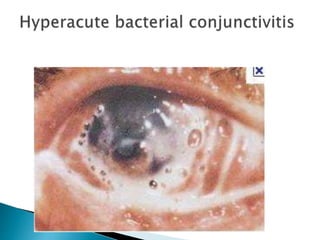
-Hyperacute bacterial conjunctivitis
-Chronic bacterial conjunctivitis
-Angular bacterial conjunctivitis
Predisposing factors:-
 Flies
 Poor hygienic conditions
 Hot dry climate
 Poor sanitation
Causative organisms:-
 Staph. aureus
 Koch-Weeks Bacillus (H. influenzae)
 Pneumococcus
 Streptococcus
 Moraxella
 N. gonorrhoea
Mode of infection:-
 Exogenous infections: directly,
vectortransmission,
material transfer.
 Local spread: infected lacrimal sac, lids
and nasopharynx.
 Endogenous infections: blood
Symptoms:
 Discomfort and foreign body sensation,
 Mild photophobia,
 Hyperaemia and Mucopurulent discharge,
 Sticking together of lid margins,
 Slight blurring of vision,
 Coloured halos
Signs:
 Flakes of mucopus seen at fornices, canthi
and lid margins,
 Conjunctival congestion,
 Chemosis,
 Papillae of fine type seen,
 Oedematous eyelids,
 Petechial hemorrhages,
 Matted cilia with yellow crusts
 Superficial punctate epitheliopathy,
 Marginal corneal ulceration,
 Superficial keratitis,
 Blepharitis,
 Dacryocystitis
 Etiology: Neisseria species,
most commonly N. gonorrhoeae
 Presentation: copious, purulent discharge
with rapidly progressive symptoms (12-24
hrs) pain which is moderate to severe,lid
swelling, and tender and enlarged
preauricular LNs.
 Symptoms-
• Burning and grittiness in eyes
• Mild chronic redness
• Feeling of heat and dryness in lid margins
• Mild mucoid discharge
 Signs- Congestion of post. Conunctival
vessels, mild papillary hypertrophy of
palpebral conjunctiva and congested lid
margins
 Mild inflammation near angles and
maceration of surrounding skin
 Causative organism- Moraxella axenfeld
 SOI- Usually nasal cavity
 Symptoms- Irritation in angles, h/o collection
of dirty white foamy discharge at angles,
redness at angles
 Signs- hyperaemia of bulbar conjunctiva near
canthi and of lid margins, excoriation of skin
around angles and foamy mucopurulent
discharge.
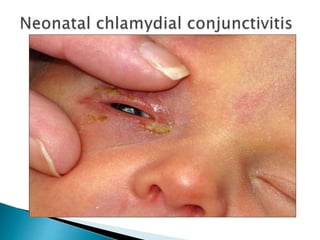
2. Chlamydial Conjunctivitis
- Trachoma
- Adult inclusion conjunctivitis
- Neonatal chlamydial conjunctivitis
 WHO classification
F- T.inflammation Follicular
I- T.inflammation Intense
S- T.Scarring
T- T.Trichiasis
O- Corneal Opacity
 Conjunctival signs
• Congestion of upper tarsal and forniceal
conjunctiva
• Conjuntival follicles
• Papillary hyperplasia
• Conjunctival scarring
• Concretions
 Corneal signs
• Superficial keratitis
• Herbert follicles
• Pannus
• Corneal ulcers
• Herbert pits
• Corneal opacity
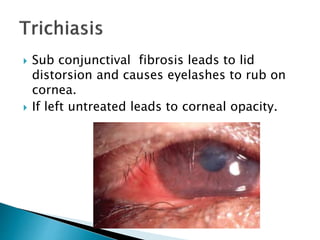
 Sub conjunctival fibrosis leads to lid
distorsion and causes eyelashes to rub on
cornea.
 If left untreated leads to corneal opacity.
 C/f: follicular and papillary hypertrophy,
superficial keratitis with ocassional pannus
 Preauricular lymphadenopathy usually found
3. Viral Conjunctivitis
- Adenovirus conjunctivitis
>Epidemic keratoconjunctivitis
>Pharyngoconjunctival fever
- Enterovirus conjunctivitis
- Molluscum contagiosum conjunctivitis
- Herpes simplex conjunctivitis
 Common in all age groups.
 Most common cause : Adenovirus
 Others- Herpes simplex keratoconjunctivitis
 Pox virus conjunctivitis
 Myxovirus conjunctivitis
 Paramyxovirus conjunctivitis
 Arbovirus conjunctivitis
 Mostly , epithelium is affected (both of cornea
& conjunctiva) so, typical viral lesion is
Keratocunjunctivitis
 Acute Haemorrhagic Conjunctivitis
 Acute Follicular Conjunctivitis
 Acute catarrhal conjunctivitis.
 Associated with marked follicular hyperplasia
especially of lower fornix & lower palpebral
conjunctiva.
 Acute inflammation of conjunctiva
characterized by :
a) Multiple Conjunctival Haemorrhages
b) Conjunctival Hyperaemia
c) Mild Follicular Hyperplasia.
4. Opthalmia Neonatorum
 Risk factors
oPrematurity
oMaternal infections harboured in birth
canal
oExposure to infectious organism (eg- N.
gonorrheae, S. aureus, S. pneumoniae, C.
trachomatis)
oOccular trauma during delivery.
oPoor prenatal care
oPoor hygienic delivery conditions
oSilver nitrate exposure
 Bilateral inflammation of conjunctiva in an
infant less than 30 days old
 Signs and Symptoms-
• Pain and tendernedd in eyeball
• Conjunctival discharge
• Swollen lids
• Hyperemia and chemosis
Causative agent Incubation period
Chemical 4-6 hours
Gonococcal 2-4 days
Other Bacterial 4-5 days
Neonatal Inclusion conjunctivitis 5-14 days
Herpes simplex 5-7 days
5. Granulomatous Conjunctivitis
 Proliferative lesions
 Usually localised to one eye
 Regional lymphadenitis
 Common granulomatous conjunctival
inflammations- TB of conjunctiva, sarcoidosis
of conjunctiva, syphilitic conjunctivitis,
leprotic conjunctivitis, opthalmia nodosa
B. Allergic Conjunctivitis
1. Simplex Allergic Conjunctivitis
- Rhinoconjunctivitis
- Seasonal Allergic Conjunctivitis
- Perennial Allergic Conjunctivitis
 Most commonly seasonal allergic
rhinoconjunctivitis, also called hay fever
rhinoconjunctivitis
 IgE mediated hypersensitivity reaction
precipitated by small airborne allergens local
mast cell degranulation  release of chemical
mediators (histamine, eosinophil chemotactic
factors, PAF, etc)
 Presentation: bilateral, pruritis, redness, watery
discharge, rhinorrhea/congestion
 Patients often have h/o atopy, seasonal allergy
or specific allergy
2. Vernal keratoconjunctivitis
3. Atopic Keratoconjunctivitis
4. Giant Papillary Conjunctivitis
5. Phlyctenular Conjunctivitis
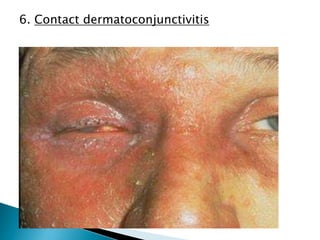
6. Contact dermatoconjunctivitis
C. Cicatricial conjunctivitis
1. Ocular mucous membrane pemphigoid
2. Stevens Johnson Syndrome
3. Toxic Epidermal Necrolysis
4. Secondary Cicatricial Conjunctivitis
D. Toxic Conjunctivitis
1. Secondary to Molluscum Contagiosum
2. Chemical Toxic Conjunctivitis
Conjunctivitis
Conjunctivitis

Conjunctivitis

  • 2.
     Definition: Conjunctival hyperaemiaassociated with discharge which may be water, mucoid, mucopurulent or purulent.
  • 3.
    A. Infective Conjunctivitis 1.Bacterial Conjunctivitis -Acute bacterial conjunctivitis -Hyperacute bacterial conjunctivitis -Chronic bacterial conjunctivitis -Angular bacterial conjunctivitis
  • 5.
    Predisposing factors:-  Flies Poor hygienic conditions  Hot dry climate  Poor sanitation
  • 6.
    Causative organisms:-  Staph.aureus  Koch-Weeks Bacillus (H. influenzae)  Pneumococcus  Streptococcus  Moraxella  N. gonorrhoea
  • 7.
    Mode of infection:- Exogenous infections: directly, vectortransmission, material transfer.  Local spread: infected lacrimal sac, lids and nasopharynx.  Endogenous infections: blood
  • 8.
    Symptoms:  Discomfort andforeign body sensation,  Mild photophobia,  Hyperaemia and Mucopurulent discharge,  Sticking together of lid margins,  Slight blurring of vision,  Coloured halos
  • 9.
    Signs:  Flakes ofmucopus seen at fornices, canthi and lid margins,  Conjunctival congestion,  Chemosis,  Papillae of fine type seen,  Oedematous eyelids,  Petechial hemorrhages,  Matted cilia with yellow crusts
  • 10.
     Superficial punctateepitheliopathy,  Marginal corneal ulceration,  Superficial keratitis,  Blepharitis,  Dacryocystitis
  • 12.
     Etiology: Neisseriaspecies, most commonly N. gonorrhoeae  Presentation: copious, purulent discharge with rapidly progressive symptoms (12-24 hrs) pain which is moderate to severe,lid swelling, and tender and enlarged preauricular LNs.
  • 14.
     Symptoms- • Burningand grittiness in eyes • Mild chronic redness • Feeling of heat and dryness in lid margins • Mild mucoid discharge  Signs- Congestion of post. Conunctival vessels, mild papillary hypertrophy of palpebral conjunctiva and congested lid margins
  • 16.
     Mild inflammationnear angles and maceration of surrounding skin  Causative organism- Moraxella axenfeld  SOI- Usually nasal cavity  Symptoms- Irritation in angles, h/o collection of dirty white foamy discharge at angles, redness at angles  Signs- hyperaemia of bulbar conjunctiva near canthi and of lid margins, excoriation of skin around angles and foamy mucopurulent discharge.
  • 17.
    2. Chlamydial Conjunctivitis -Trachoma - Adult inclusion conjunctivitis - Neonatal chlamydial conjunctivitis
  • 20.
     WHO classification F-T.inflammation Follicular I- T.inflammation Intense S- T.Scarring T- T.Trichiasis O- Corneal Opacity
  • 21.
     Conjunctival signs •Congestion of upper tarsal and forniceal conjunctiva • Conjuntival follicles • Papillary hyperplasia • Conjunctival scarring • Concretions
  • 22.
     Corneal signs •Superficial keratitis • Herbert follicles • Pannus • Corneal ulcers • Herbert pits • Corneal opacity
  • 27.
     Sub conjunctivalfibrosis leads to lid distorsion and causes eyelashes to rub on cornea.  If left untreated leads to corneal opacity.
  • 30.
     C/f: follicularand papillary hypertrophy, superficial keratitis with ocassional pannus  Preauricular lymphadenopathy usually found
  • 32.
    3. Viral Conjunctivitis -Adenovirus conjunctivitis >Epidemic keratoconjunctivitis >Pharyngoconjunctival fever - Enterovirus conjunctivitis - Molluscum contagiosum conjunctivitis - Herpes simplex conjunctivitis
  • 33.
     Common inall age groups.  Most common cause : Adenovirus  Others- Herpes simplex keratoconjunctivitis  Pox virus conjunctivitis  Myxovirus conjunctivitis  Paramyxovirus conjunctivitis  Arbovirus conjunctivitis  Mostly , epithelium is affected (both of cornea & conjunctiva) so, typical viral lesion is Keratocunjunctivitis
  • 34.
     Acute HaemorrhagicConjunctivitis  Acute Follicular Conjunctivitis
  • 35.
     Acute catarrhalconjunctivitis.  Associated with marked follicular hyperplasia especially of lower fornix & lower palpebral conjunctiva.
  • 36.
     Acute inflammationof conjunctiva characterized by : a) Multiple Conjunctival Haemorrhages b) Conjunctival Hyperaemia c) Mild Follicular Hyperplasia.
  • 42.
  • 43.
     Risk factors oPrematurity oMaternalinfections harboured in birth canal oExposure to infectious organism (eg- N. gonorrheae, S. aureus, S. pneumoniae, C. trachomatis) oOccular trauma during delivery. oPoor prenatal care oPoor hygienic delivery conditions oSilver nitrate exposure
  • 44.
     Bilateral inflammationof conjunctiva in an infant less than 30 days old  Signs and Symptoms- • Pain and tendernedd in eyeball • Conjunctival discharge • Swollen lids • Hyperemia and chemosis
  • 45.
    Causative agent Incubationperiod Chemical 4-6 hours Gonococcal 2-4 days Other Bacterial 4-5 days Neonatal Inclusion conjunctivitis 5-14 days Herpes simplex 5-7 days
  • 46.
  • 47.
     Proliferative lesions Usually localised to one eye  Regional lymphadenitis  Common granulomatous conjunctival inflammations- TB of conjunctiva, sarcoidosis of conjunctiva, syphilitic conjunctivitis, leprotic conjunctivitis, opthalmia nodosa
  • 48.
    B. Allergic Conjunctivitis 1.Simplex Allergic Conjunctivitis - Rhinoconjunctivitis - Seasonal Allergic Conjunctivitis - Perennial Allergic Conjunctivitis
  • 49.
     Most commonlyseasonal allergic rhinoconjunctivitis, also called hay fever rhinoconjunctivitis  IgE mediated hypersensitivity reaction precipitated by small airborne allergens local mast cell degranulation  release of chemical mediators (histamine, eosinophil chemotactic factors, PAF, etc)  Presentation: bilateral, pruritis, redness, watery discharge, rhinorrhea/congestion  Patients often have h/o atopy, seasonal allergy or specific allergy
  • 50.
  • 51.
  • 52.
    4. Giant PapillaryConjunctivitis
  • 53.
  • 54.
  • 55.
    C. Cicatricial conjunctivitis 1.Ocular mucous membrane pemphigoid 2. Stevens Johnson Syndrome 3. Toxic Epidermal Necrolysis 4. Secondary Cicatricial Conjunctivitis
  • 60.
    D. Toxic Conjunctivitis 1.Secondary to Molluscum Contagiosum 2. Chemical Toxic Conjunctivitis