Conjunctivitis
        “Pink Eye”

By: Laura Brown, Sarah Afiz,
      and Nick Olson
            P.1
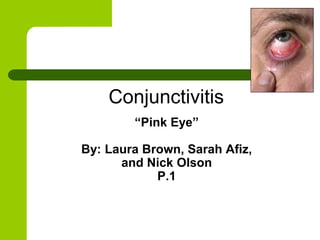
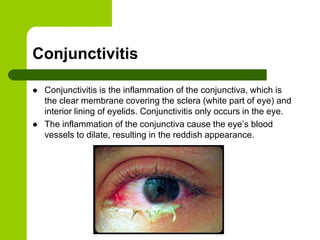
Conjunctivitis

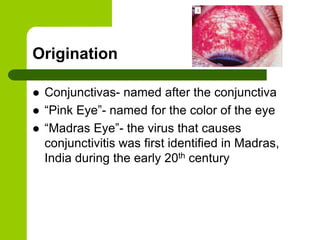
   Conjunctivitis is the inflammation of the conjunctiva, which is
    the clear membrane covering the sclera (white part of eye) and
    interior lining of eyelids. Conjunctivitis only occurs in the eye.
   The inflammation of the conjunctiva cause the eye’s blood
    vessels to dilate, resulting in the reddish appearance.
Forms of Conjunctivitis

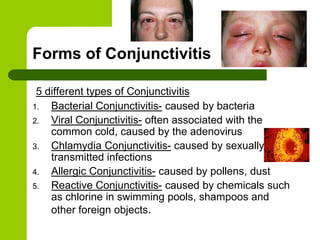
 5 different types of Conjunctivitis
1.  Bacterial Conjunctivitis- caused by bacteria
2.  Viral Conjunctivitis- often associated with the
    common cold, caused by the adenovirus
3.  Chlamydia Conjunctivitis- caused by sexually
    transmitted infections
4.  Allergic Conjunctivitis- caused by pollens, dust
5.  Reactive Conjunctivitis- caused by chemicals such
    as chlorine in swimming pools, shampoos and
    other foreign objects.
People Affected

   Conjunctivitis can affect any age person of either
    sex.
   It also can affect any race.
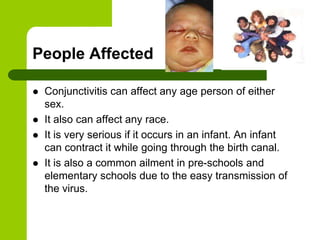
   It is very serious if it occurs in an infant. An infant
    can contract it while going through the birth canal.
   It is also a common ailment in pre-schools and
    elementary schools due to the easy transmission of
    the virus.
Symptoms

The symptoms of conjunctivitis are varied depending
  on the cause of it:
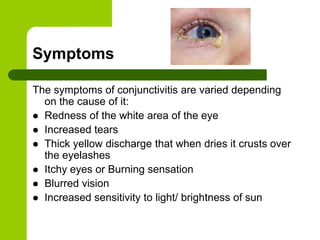
 Redness of the white area of the eye
 Increased tears
 Thick yellow discharge that when dries it crusts over
  the eyelashes
 Itchy eyes or Burning sensation
 Blurred vision
 Increased sensitivity to light/ brightness of sun
Disease Appearance

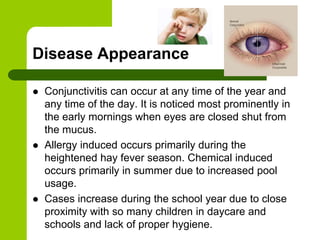
   Conjunctivitis can occur at any time of the year and
    any time of the day. It is noticed most prominently in
    the early mornings when eyes are closed shut from
    the mucus.
   Allergy induced occurs primarily during the
    heightened hay fever season. Chemical induced
    occurs primarily in summer due to increased pool
    usage.
   Cases increase during the school year due to close
    proximity with so many children in daycare and
    schools and lack of proper hygiene.
Incubation

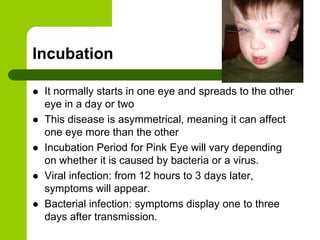
   It normally starts in one eye and spreads to the other
    eye in a day or two
   This disease is asymmetrical, meaning it can affect
    one eye more than the other
   Incubation Period for Pink Eye will vary depending
    on whether it is caused by bacteria or a virus.
   Viral infection: from 12 hours to 3 days later,
    symptoms will appear.
   Bacterial infection: symptoms display one to three
    days after transmission.
Treatments

Treatments vary depending on type:
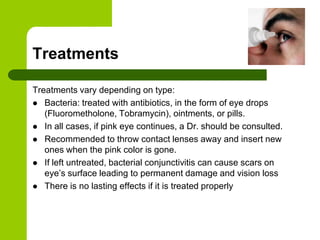
 Bacteria: treated with antibiotics, in the form of eye drops
   (Fluorometholone, Tobramycin), ointments, or pills.
 In all cases, if pink eye continues, a Dr. should be consulted.
 Recommended to throw contact lenses away and insert new
   ones when the pink color is gone.
 If left untreated, bacterial conjunctivitis can cause scars on
   eye’s surface leading to permanent damage and vision loss
 There is no lasting effects if it is treated properly
Origination

   Conjunctivas- named after the conjunctiva
   “Pink Eye”- named for the color of the eye
   “Madras Eye”- the virus that causes
    conjunctivitis was first identified in Madras,
    India during the early 20th century
Resources

   webmd.com. (2005). Retrieved from
    http://www.webmd.com/eye-health/tc/pinkeye-topic-overview
   (2011). Retrieved from
    http://www.google.com/advanced_image_search
   Victor Tse, M. (2010, Apr 27). Medscape reference. Retrieved
    from http://emedicine.medscape.com
   Yeung, K. (2011, November 3). Bacterial conjuctivitis. Retrieved
    from http://emedicine.medscape.com/article/1191730-overview
   Stöppler, M. C. (2011, 8 7). Pink eye (conjunctivitis). Retrieved
    from http://www.medicinenet.com/pink_eye/article.htm

Conjunctivitis final presentation

  • 1.
    Conjunctivitis “Pink Eye” By: Laura Brown, Sarah Afiz, and Nick Olson P.1
  • 2.
    Conjunctivitis  Conjunctivitis is the inflammation of the conjunctiva, which is the clear membrane covering the sclera (white part of eye) and interior lining of eyelids. Conjunctivitis only occurs in the eye.  The inflammation of the conjunctiva cause the eye’s blood vessels to dilate, resulting in the reddish appearance.
  • 3.
    Forms of Conjunctivitis 5 different types of Conjunctivitis 1. Bacterial Conjunctivitis- caused by bacteria 2. Viral Conjunctivitis- often associated with the common cold, caused by the adenovirus 3. Chlamydia Conjunctivitis- caused by sexually transmitted infections 4. Allergic Conjunctivitis- caused by pollens, dust 5. Reactive Conjunctivitis- caused by chemicals such as chlorine in swimming pools, shampoos and other foreign objects.
  • 4.
    People Affected  Conjunctivitis can affect any age person of either sex.  It also can affect any race.  It is very serious if it occurs in an infant. An infant can contract it while going through the birth canal.  It is also a common ailment in pre-schools and elementary schools due to the easy transmission of the virus.
  • 5.
    Symptoms The symptoms ofconjunctivitis are varied depending on the cause of it:  Redness of the white area of the eye  Increased tears  Thick yellow discharge that when dries it crusts over the eyelashes  Itchy eyes or Burning sensation  Blurred vision  Increased sensitivity to light/ brightness of sun
  • 6.
    Disease Appearance  Conjunctivitis can occur at any time of the year and any time of the day. It is noticed most prominently in the early mornings when eyes are closed shut from the mucus.  Allergy induced occurs primarily during the heightened hay fever season. Chemical induced occurs primarily in summer due to increased pool usage.  Cases increase during the school year due to close proximity with so many children in daycare and schools and lack of proper hygiene.
  • 7.
    Incubation  It normally starts in one eye and spreads to the other eye in a day or two  This disease is asymmetrical, meaning it can affect one eye more than the other  Incubation Period for Pink Eye will vary depending on whether it is caused by bacteria or a virus.  Viral infection: from 12 hours to 3 days later, symptoms will appear.  Bacterial infection: symptoms display one to three days after transmission.
  • 8.
    Treatments Treatments vary dependingon type:  Bacteria: treated with antibiotics, in the form of eye drops (Fluorometholone, Tobramycin), ointments, or pills.  In all cases, if pink eye continues, a Dr. should be consulted.  Recommended to throw contact lenses away and insert new ones when the pink color is gone.  If left untreated, bacterial conjunctivitis can cause scars on eye’s surface leading to permanent damage and vision loss  There is no lasting effects if it is treated properly
  • 9.
    Origination  Conjunctivas- named after the conjunctiva  “Pink Eye”- named for the color of the eye  “Madras Eye”- the virus that causes conjunctivitis was first identified in Madras, India during the early 20th century
  • 10.
    Resources  webmd.com. (2005). Retrieved from http://www.webmd.com/eye-health/tc/pinkeye-topic-overview  (2011). Retrieved from http://www.google.com/advanced_image_search  Victor Tse, M. (2010, Apr 27). Medscape reference. Retrieved from http://emedicine.medscape.com  Yeung, K. (2011, November 3). Bacterial conjuctivitis. Retrieved from http://emedicine.medscape.com/article/1191730-overview  Stöppler, M. C. (2011, 8 7). Pink eye (conjunctivitis). Retrieved from http://www.medicinenet.com/pink_eye/article.htm