Ptosis ( in greek means to fall) is the
abnormal drooping of the upper eyelid.
Normally upper lid covers about upper
one sixth of the cornea i.e about 2mm.
Therefore in ptosis it covers more than
2 mm.
Congenital
Acquired
Pseudotosis
Neurogenic
Myogenic
Aponeurotic
Mechanical
Neurotoxic
ETIOLOGY:
It is associated with congenital weakness of the LPS.
CHARACTERISTIC FEATURES:
- Drooping of one or both upper lids more often since
birth of variable severity ( mild,moderate or severe).
- Lid lag on downgaze( i.e. ptotic lid is higher than the
normal) due to tethering effect of abnormal LPS
muscle. This is in contrast to acquired ptosis in which
ptotic lid is lower than the normal in downgaze also.
- LPS function may be poor, fair or good depending upon the
degree of weakness.
ASSOCIATED
FEATURES
Simple congenital
ptosis
Congenital
ptosis
Blepharophimosis
Congenital
synkinetic
ptosis
1.) SIMPLE CONGENITAL
PTOSIS:
- Not associated with any
other anomaly.
2.) CONGENITAL PTOSIS:
- Associated with weakness of superior rectus
muscle.
3.) BLEPHAROPHIMOSIS SYNDROME:
- Rare congenital disorder.
- Short horizontal palpebral aperture.
- Telecanthus:
Lateral displacement of medial
canthus.
- Epicanthus inversus:
Lower lid fold larger than upper lid.
- Lateral inferior ectropion.
- Poorly developed nasal bridge and
hypoplasia of superior orbital rims.
4.) CONGENITAL SYNKINETIC PTOSIS ( MARCUS
GUNN JAW-WINKING PTOSIS):
- This condition is characterized as a synkinesis:
when two or more muscles that are
independently innervated have either
simultaneous or coordinated movements.
IN MARCUS GUNN PHENOMENON:
- The stimulation of the trigeminal nerve by
contraction of the pterygoid muscles of
jaw results in the excitation of the branch
of the oculomotor nerve that innervates
the LPS ipsilaterally, so the patient will have
rhythmic upward jerking of their upper
eyelid.
MARCUS GUNN JAW-WINKING SYNDROME:
- Accounts for about 5% of all cases of
congenital ptosis.
- Retraction or wink of ptotic lid in
conjunction with stimulation of ipsilateral
pterygoid muscles.
- Congenital or acquired .
- Eyeball is turned down, out slightly intorted due to actions
of lateral rectus and superior oblique muscles.
- ocular movements restricted in all directions except
outward.
- pupil is fixed and dilated due to paralysis of spinchter
pupillae muscle.
- accommodation is completely lost due to paralysis of ciliary
muscle.
1. NEUROGENIC PTOSIS
ETIOLOGY:
A) THIRD NERVE PALSY
- Rare, unilateral
- Pupil is occasionally involved
- Bizarre movements of upper lid accompany eye
movements
B) THIRD NERVE MISDIRECTION:
- Used to describe any oculosympathetic paresis,
wherever the lesion may be.
- Characterized by classic triad of:
Mild ptosis ( due to paralysis of muller’s muscle)
Miosis ( due to paralysis of dilator puppillae)
Reduced ipsilateral sweating ( anhydrosis)
- Other features include mild enophthalmos, loss of
cilio- spinal reflex ,heterochromia, i.e., ipsilateral
iris is lighter in colour, pupil is slow to dilate, and
there occurs slight elevation of the lower eyelid.
C) HORNER SYNDROME:
- rare eye disorder, previously called a
“complicated migraine” which is also
recognized as cranial neuralgia by the
internal classification of Headache
Disorders (HIS II).
- most commonly presents itself in early
childhood or infancy.
- To date there is no conclusive hypothesis as
to the etiology of this disorder.
D) OPTHALMOPLEGIC MIGRAINE:
- Characterized by:
~ Severe headaches
~ Weakening of muscles around the eye.
~ These headache commonly precede
episodes of partial paralysis of one or more
ocular nerve ( most commonly the third
cranial nerve).
~ Drooping of eyelid
~ Double vision
~ Dilation of pupils
- Due to supranuclear lesions.
- Unilateral cerebral ptosis occurs with lesions ,
usually ischemic, of the opposite
hemisphere, and is more common with right
hemisphere lesions.
- Bilateral supranuclear ptosis may occur with
unilateral or bilateral hemispheric lesions.
- Ptosis has been reported in as many as
37.5% of patients with hemispheric strokes.
E) CEREBRAL PTOSIS:
2) MYOGENIC PTOSIS:
- It is due to acquired disorders of the LPS muscle
or of the myoneural junction.
- It may be seen in patient having:
A) MYASTHENIA GRAVIS:
- Ptosis is frequently assymetric and may be
unilateral, though it will tend to shift from side
to side .
- Characteristically fluctuates from moment to
moment and is worsened by prolonged
upgaze (fatiguable ptosis).
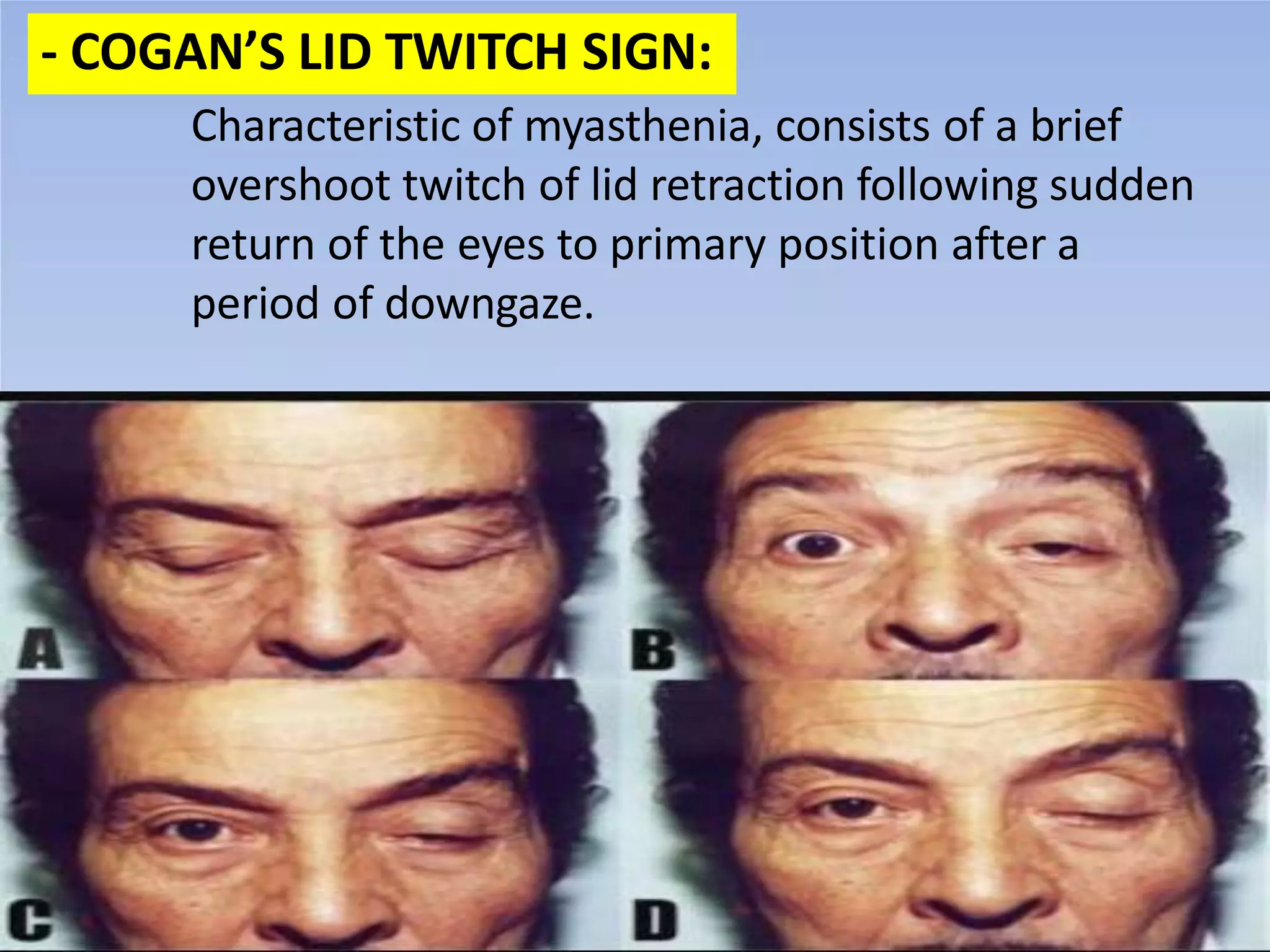
- COGAN’S LID TWITCH SIGN:
Characteristic of myasthenia, consists of a brief
overshoot twitch of lid retraction following sudden
return of the eyes to primary position after a
period of downgaze.
Edrophonium chloride inhibits acetylcholine at the
neuromuscular junction.
This results in enhanced muscle strength.
Positive result:
Elevation of
eyelids in 2-5
min post
administration
of Tensilon.
Negative
result:
No
improvement
within 3 min.
False Positive
result:
Occur in patient
with Lambert-Eaton
Myasthenic
Syndrome
Amyothrophic
Lateral Sclerosis
Localized
intracranial mass
lesion.
Side Effects due to
overactivation of
parasympathetic system:
fainting, dizziness,
involuntary defecation,
severe bradycardia, and
even cardiac arrest.
important to have
atropine if such side effect
occur.
INVESTIGATION:
(a) Edrophonium( Tensilon) Test:
(b) Electromyography to confirm fatique
(c) Antibodies to acetylcholine receptors
(d) CT or MRI for presence of thymoma
- Medical – anticholinesterases,
steroids and azathioprine
- Thymectomy
TREATMENT OPTIONS:
D) OCULOPHARYNGEAL
MUSCULAR DYSTROPHY
E) LAMBERT-EATON MYASTHENIA
SYNDROME
- Develops due to defects of the levator aponeurosis in
the presence of a normal functioning muscle.
- It includes:
• Very common. Asymmetric lids and redundant
lid tissue in the elderly.
• The levator aponeurosis attaches the levator
muscle to tarsal plate which forms the eyelid.
Involutional(senile)
ptosis
• Ptosis due to aponeurotic weakness associated
with blepharochalasis.
• Blepharochalasis is an inflammation of the
eyelid that is characterized by exacerbations and
remissions of eyelid edema, which results in a
stretching and subsequent atrophy of the eyelid
tissue resulting in redundant folds over the lid
margin.
Postoperative
ptosis
Posttraumatic dehiscence
or disinsertion of the
aponeurosis.
3.) APONEUROTIC PTOSIS:
4.) MECHANICAL PTOSIS:
- Due to excessive weight on upper lid as seen in
patients with:
Lid tumours
Multiple Chalazia
Lid oedema
- Also occur due to scarring (Cicatricial ptosis) as
seen in patient with:
Ocular pemphigoid
Trachoma
Envenomation by elapids such as cobras or kraits.
- Bilateral ptosis is usually accompanied by
diplopia, dysphagia and progressive muscular
paralysis.
- Regardless, neurotoxic ptosis is a precursor to
respiratory failure and eventual suffocation
caused by complete paralysis of the thoracic
diaphragm.
- It is therefore a
medical emergency
and immediate
treatment is required.
5.) NEUROTOXIC PTOSIS:
Pseudotosis is the appearance of ptosis in the absence of
levator abnormality.
Exclude pseudoptosis ( stimulated ptosis) on inspection.
Its common causes are:
Microphthalmos
Anopthalmos
Enopthalmos
Phthisis bulbi
Double elevator palsy
Blepharospasm
Contralateral proptosis
1.) Ptosis:
- Age of onset
- Duration
- One/ both eye
- Diurnal variability
2.) Associated history:
- Diplopia
- Dysphagia
- Muscle weakness
3.) Vision
A.) HISTORY:
4.) Association with:
- Jaw movements
- Abnormal ocular movements
- Abnormal head posture
5.) History of:
- Trauma or previous surgery
- Poisoning
- Use of steroid drops
- Any reaction with anaesthesia
- Bleeding tendency
6.) Previous photograph may prove to be of great help.
7.) Is there a family history of ptosis or of other muscle
weakness?
The normal upper eyelid in primary position:
- crosses the iris between the
limbus(junction of the iris and sclera) and
the pupil,
- usually 1mm to 2mm below the limbus;
- the lower lid touches or crosses slightly
above the limbus.
- normally there is no sclera
showing above the iris.
The palpebral fissures:
- are normally 9mm to 12mm from upper
B) OCULAR EXAMINATION:
1.) NORMAL POSITION OF LID:
Whether ptosis is:
Unilateral/ Bilateral
Complete/ Incomplete
Function of orbicularis oculi muscle
Eyelid crease is present or absent
Jaw-winking phenomenon is present or
absent
Associated weakness of any
extraocular muscle
Bell’s phenomenon is present or
absent.
2.) OBSERVE THE FOLLOWING POINTS:
3.) MEASUREMENTS:
(a) MARGIN REFLEX DISTANCE:
-When light is thrown on the cornea a
reflection occurs , the distance from the
central pupillary light reflex to the upper
eyelid margin with the eye in primary gaze.
- Normal: 4-5mm
-If the margin is above the light reflex the
MRD is a +ve value.
- If the lid margin is below the corneal reflex
in cases of very severe ptosis the MRD would
be a –ve value.
(b) VERTICAL FISSURE HEIGHT:
- The distance between the upper and lower eyelid
in vertical alignment with the center of the pupil in
primary gaze, with the patient’s brow relaxed.
- Normal 9-10mm in primary gaze.
- Should be seen in up gaze, down gaze and
primary gaze.
- Amount of ptosis= difference in palpebral
apertures in unilateral ptosis or difference
from normal in bilateral ptosis.
GRADING OF SEVERITY OF PTOSIS:
< or =2mm : Mild ptosis
=3mm : moderate ptosis
= or > 4mm : Severe ptosis
- It is determined by the lid excursion caused by LPS
muscle ( Burke’s Method).
~Patient is asked to look down and thumb of one
hand is placed firmly against the eyebrow of the
patient( to block the action of frontalis muscle)
by the examiner.
~Then the patient is asked to look up and the
amount of upper lid excursion is measured with
a ruler held in the other hand by the examiner.
- Levator function is graded as follows:
Normal: 15mm
Good
Fair
Poor
: 8mm or more
: 5-7mm
: 4mm or less
( c) LEVATOR FUNCTION ASSESMENT:
Almost needs surgical correction. In severe
ptosis, surgery should be performed at the
earliest to prevent stimulus deprivation
amblyopia.
However in mild and moderate ptosis,
surgery should be delayed until the age of
34 years, when accurate measurements are
possible.
1.) CONGENITAL PTOSIS:
Tarso-
conjunctivo-
Mullerectomy(
Fasanella-
Servat
operation)
• Performed in cases
having mild
ptosis(1.5-2mm) and
good levator function.
In it upper lid is
everted and the
upper tarsal border
along with its
attached Muller’s
muscle and
conjunctiva are
resected.
Levator
Resection
• Very commonly
performed operation
for moderate and
severe grades of
ptosis. It is
contraindicated in
patients having severe
ptosis with poor
levator function.
Frontalis Brow
Suspension
• Performed in patients
having severe ptosis
with no levator
function. In this
operation, lid is
anchored to the
frontalis muscle via a
sling. Fascia lata or
some non absorbable
material ( e.g.
supramide suture,
silicon rod) may be
used as a sling.
- Treat the underlying cause wherever
possible.
- Conservative treatment should be carried
out and surgery deffered atleast for 6 months
in neurogenic ptosis.
- Surgical procedures ( when required) for
acquired ptosis are essentially the same as
described for congenital ptosis. However the
amount of levator resection required is always
less than the congenital ptosis of the same
degree. Further in most cases the simple
Fasanella-Servat procedure is adequate.
2.) ACQUIRED PTOSIS:
ptosis-190331084432.pptx

ptosis-190331084432.pptx

  • 2.
    Ptosis ( ingreek means to fall) is the abnormal drooping of the upper eyelid. Normally upper lid covers about upper one sixth of the cornea i.e about 2mm. Therefore in ptosis it covers more than 2 mm.
  • 3.
  • 4.
    ETIOLOGY: It is associatedwith congenital weakness of the LPS. CHARACTERISTIC FEATURES: - Drooping of one or both upper lids more often since birth of variable severity ( mild,moderate or severe). - Lid lag on downgaze( i.e. ptotic lid is higher than the normal) due to tethering effect of abnormal LPS muscle. This is in contrast to acquired ptosis in which ptotic lid is lower than the normal in downgaze also. - LPS function may be poor, fair or good depending upon the degree of weakness.
  • 5.
  • 6.
    1.) SIMPLE CONGENITAL PTOSIS: -Not associated with any other anomaly. 2.) CONGENITAL PTOSIS: - Associated with weakness of superior rectus muscle.
  • 7.
    3.) BLEPHAROPHIMOSIS SYNDROME: -Rare congenital disorder. - Short horizontal palpebral aperture. - Telecanthus: Lateral displacement of medial canthus. - Epicanthus inversus: Lower lid fold larger than upper lid. - Lateral inferior ectropion. - Poorly developed nasal bridge and hypoplasia of superior orbital rims.
  • 9.
    4.) CONGENITAL SYNKINETICPTOSIS ( MARCUS GUNN JAW-WINKING PTOSIS): - This condition is characterized as a synkinesis: when two or more muscles that are independently innervated have either simultaneous or coordinated movements. IN MARCUS GUNN PHENOMENON: - The stimulation of the trigeminal nerve by contraction of the pterygoid muscles of jaw results in the excitation of the branch of the oculomotor nerve that innervates the LPS ipsilaterally, so the patient will have rhythmic upward jerking of their upper eyelid.
  • 10.
    MARCUS GUNN JAW-WINKINGSYNDROME: - Accounts for about 5% of all cases of congenital ptosis. - Retraction or wink of ptotic lid in conjunction with stimulation of ipsilateral pterygoid muscles.
  • 11.
    - Congenital oracquired . - Eyeball is turned down, out slightly intorted due to actions of lateral rectus and superior oblique muscles. - ocular movements restricted in all directions except outward. - pupil is fixed and dilated due to paralysis of spinchter pupillae muscle. - accommodation is completely lost due to paralysis of ciliary muscle. 1. NEUROGENIC PTOSIS ETIOLOGY: A) THIRD NERVE PALSY
  • 12.
    - Rare, unilateral -Pupil is occasionally involved - Bizarre movements of upper lid accompany eye movements B) THIRD NERVE MISDIRECTION:
  • 13.
    - Used todescribe any oculosympathetic paresis, wherever the lesion may be. - Characterized by classic triad of: Mild ptosis ( due to paralysis of muller’s muscle) Miosis ( due to paralysis of dilator puppillae) Reduced ipsilateral sweating ( anhydrosis) - Other features include mild enophthalmos, loss of cilio- spinal reflex ,heterochromia, i.e., ipsilateral iris is lighter in colour, pupil is slow to dilate, and there occurs slight elevation of the lower eyelid. C) HORNER SYNDROME:
  • 14.
    - rare eyedisorder, previously called a “complicated migraine” which is also recognized as cranial neuralgia by the internal classification of Headache Disorders (HIS II). - most commonly presents itself in early childhood or infancy. - To date there is no conclusive hypothesis as to the etiology of this disorder. D) OPTHALMOPLEGIC MIGRAINE:
  • 15.
    - Characterized by: ~Severe headaches ~ Weakening of muscles around the eye. ~ These headache commonly precede episodes of partial paralysis of one or more ocular nerve ( most commonly the third cranial nerve). ~ Drooping of eyelid ~ Double vision ~ Dilation of pupils
  • 16.
    - Due tosupranuclear lesions. - Unilateral cerebral ptosis occurs with lesions , usually ischemic, of the opposite hemisphere, and is more common with right hemisphere lesions. - Bilateral supranuclear ptosis may occur with unilateral or bilateral hemispheric lesions. - Ptosis has been reported in as many as 37.5% of patients with hemispheric strokes. E) CEREBRAL PTOSIS:
  • 17.
    2) MYOGENIC PTOSIS: -It is due to acquired disorders of the LPS muscle or of the myoneural junction. - It may be seen in patient having: A) MYASTHENIA GRAVIS: - Ptosis is frequently assymetric and may be unilateral, though it will tend to shift from side to side . - Characteristically fluctuates from moment to moment and is worsened by prolonged upgaze (fatiguable ptosis).
  • 18.
    - COGAN’S LIDTWITCH SIGN: Characteristic of myasthenia, consists of a brief overshoot twitch of lid retraction following sudden return of the eyes to primary position after a period of downgaze.
  • 19.
    Edrophonium chloride inhibitsacetylcholine at the neuromuscular junction. This results in enhanced muscle strength. Positive result: Elevation of eyelids in 2-5 min post administration of Tensilon. Negative result: No improvement within 3 min. False Positive result: Occur in patient with Lambert-Eaton Myasthenic Syndrome Amyothrophic Lateral Sclerosis Localized intracranial mass lesion. Side Effects due to overactivation of parasympathetic system: fainting, dizziness, involuntary defecation, severe bradycardia, and even cardiac arrest. important to have atropine if such side effect occur. INVESTIGATION: (a) Edrophonium( Tensilon) Test:
  • 21.
    (b) Electromyography toconfirm fatique (c) Antibodies to acetylcholine receptors (d) CT or MRI for presence of thymoma - Medical – anticholinesterases, steroids and azathioprine - Thymectomy TREATMENT OPTIONS:
  • 24.
    D) OCULOPHARYNGEAL MUSCULAR DYSTROPHY E)LAMBERT-EATON MYASTHENIA SYNDROME
  • 25.
    - Develops dueto defects of the levator aponeurosis in the presence of a normal functioning muscle. - It includes: • Very common. Asymmetric lids and redundant lid tissue in the elderly. • The levator aponeurosis attaches the levator muscle to tarsal plate which forms the eyelid. Involutional(senile) ptosis • Ptosis due to aponeurotic weakness associated with blepharochalasis. • Blepharochalasis is an inflammation of the eyelid that is characterized by exacerbations and remissions of eyelid edema, which results in a stretching and subsequent atrophy of the eyelid tissue resulting in redundant folds over the lid margin. Postoperative ptosis Posttraumatic dehiscence or disinsertion of the aponeurosis. 3.) APONEUROTIC PTOSIS:
  • 27.
    4.) MECHANICAL PTOSIS: -Due to excessive weight on upper lid as seen in patients with: Lid tumours Multiple Chalazia Lid oedema - Also occur due to scarring (Cicatricial ptosis) as seen in patient with: Ocular pemphigoid Trachoma
  • 28.
    Envenomation by elapidssuch as cobras or kraits. - Bilateral ptosis is usually accompanied by diplopia, dysphagia and progressive muscular paralysis. - Regardless, neurotoxic ptosis is a precursor to respiratory failure and eventual suffocation caused by complete paralysis of the thoracic diaphragm. - It is therefore a medical emergency and immediate treatment is required. 5.) NEUROTOXIC PTOSIS:
  • 29.
    Pseudotosis is theappearance of ptosis in the absence of levator abnormality. Exclude pseudoptosis ( stimulated ptosis) on inspection. Its common causes are: Microphthalmos Anopthalmos Enopthalmos Phthisis bulbi Double elevator palsy Blepharospasm Contralateral proptosis
  • 30.
    1.) Ptosis: - Ageof onset - Duration - One/ both eye - Diurnal variability 2.) Associated history: - Diplopia - Dysphagia - Muscle weakness 3.) Vision A.) HISTORY:
  • 31.
    4.) Association with: -Jaw movements - Abnormal ocular movements - Abnormal head posture 5.) History of: - Trauma or previous surgery - Poisoning - Use of steroid drops - Any reaction with anaesthesia - Bleeding tendency 6.) Previous photograph may prove to be of great help. 7.) Is there a family history of ptosis or of other muscle weakness?
  • 32.
    The normal uppereyelid in primary position: - crosses the iris between the limbus(junction of the iris and sclera) and the pupil, - usually 1mm to 2mm below the limbus; - the lower lid touches or crosses slightly above the limbus. - normally there is no sclera showing above the iris. The palpebral fissures: - are normally 9mm to 12mm from upper B) OCULAR EXAMINATION: 1.) NORMAL POSITION OF LID:
  • 34.
    Whether ptosis is: Unilateral/Bilateral Complete/ Incomplete Function of orbicularis oculi muscle Eyelid crease is present or absent Jaw-winking phenomenon is present or absent Associated weakness of any extraocular muscle Bell’s phenomenon is present or absent. 2.) OBSERVE THE FOLLOWING POINTS:
  • 35.
    3.) MEASUREMENTS: (a) MARGINREFLEX DISTANCE: -When light is thrown on the cornea a reflection occurs , the distance from the central pupillary light reflex to the upper eyelid margin with the eye in primary gaze. - Normal: 4-5mm -If the margin is above the light reflex the MRD is a +ve value. - If the lid margin is below the corneal reflex in cases of very severe ptosis the MRD would be a –ve value.
  • 37.
    (b) VERTICAL FISSUREHEIGHT: - The distance between the upper and lower eyelid in vertical alignment with the center of the pupil in primary gaze, with the patient’s brow relaxed. - Normal 9-10mm in primary gaze. - Should be seen in up gaze, down gaze and primary gaze. - Amount of ptosis= difference in palpebral apertures in unilateral ptosis or difference from normal in bilateral ptosis. GRADING OF SEVERITY OF PTOSIS: < or =2mm : Mild ptosis =3mm : moderate ptosis = or > 4mm : Severe ptosis
  • 40.
    - It isdetermined by the lid excursion caused by LPS muscle ( Burke’s Method). ~Patient is asked to look down and thumb of one hand is placed firmly against the eyebrow of the patient( to block the action of frontalis muscle) by the examiner. ~Then the patient is asked to look up and the amount of upper lid excursion is measured with a ruler held in the other hand by the examiner. - Levator function is graded as follows: Normal: 15mm Good Fair Poor : 8mm or more : 5-7mm : 4mm or less ( c) LEVATOR FUNCTION ASSESMENT:
  • 42.
    Almost needs surgicalcorrection. In severe ptosis, surgery should be performed at the earliest to prevent stimulus deprivation amblyopia. However in mild and moderate ptosis, surgery should be delayed until the age of 34 years, when accurate measurements are possible. 1.) CONGENITAL PTOSIS:
  • 43.
    Tarso- conjunctivo- Mullerectomy( Fasanella- Servat operation) • Performed incases having mild ptosis(1.5-2mm) and good levator function. In it upper lid is everted and the upper tarsal border along with its attached Muller’s muscle and conjunctiva are resected. Levator Resection • Very commonly performed operation for moderate and severe grades of ptosis. It is contraindicated in patients having severe ptosis with poor levator function. Frontalis Brow Suspension • Performed in patients having severe ptosis with no levator function. In this operation, lid is anchored to the frontalis muscle via a sling. Fascia lata or some non absorbable material ( e.g. supramide suture, silicon rod) may be used as a sling.
  • 47.
    - Treat theunderlying cause wherever possible. - Conservative treatment should be carried out and surgery deffered atleast for 6 months in neurogenic ptosis. - Surgical procedures ( when required) for acquired ptosis are essentially the same as described for congenital ptosis. However the amount of levator resection required is always less than the congenital ptosis of the same degree. Further in most cases the simple Fasanella-Servat procedure is adequate. 2.) ACQUIRED PTOSIS: