• DEFINITION:-
Blepharitis is a subacute (or) chronic inflammation of the lid
margins
Antomy of lid margin:-
- It is about 2mm broad & is divided into 2 parts by the
punctum(Medial & lateral)
Lacrimal portion(medial) :- It is devoid of lashes & glands
Ciliary portion ( lateral) :- It consists of rounded antr.boder Sharp
post.border & an intermarginal strip (b/w the two borders)
• The grey line divides the intermarginal strip into
a)Anterior strip bearing 2-3 rows of lashes
b)Posterior strip on which openings of meibomian glands are
arranged in a row
• Importance – the splitting of eyelids when required in operations is
done at the level of grey line
• TYPES OF BLEPHARITIS :-
A.Bacterial blepharitis
B.Seborrhoeic or Squamous blepharitis
C.Mixed staphylococcal with seborrhoeic blepharitis
D.Posterior blepharitis or Meibomitis
E.Parasitic blepharitis
• Also known as
-Chronic antr.blepharitis
-Staphylococcal blepharitis
-Ulcerative blepharitis
• It is a chronic infection of the anterior part of lid
margin
• It is a common cause for occular & discomfort and
irritation
• It is usually starts in childhood & may continue
throught out the life
• ETIOLOGY :-
 Causative organisms –
- (M/C) cogulase +ve staphylococci
- Rarely streptococci , propionibacterium acnes &
moraxella may be involved
PREDISPOSING FACTORS :-
Rarely includes chronic conjuctivitis and dacrocystitis
• CLINICAL FEATURES:-
Symptoms :- Chronic irritation
Itching
Mild lacrimation
Gluing of cilia
Mild photophobia
Symptoms are worse in the morning
Remissions and exacerbations in symptoms are quite
common
• SIGNS :-
- Yellow crusts
- Small ulcers on removing crusts
- Hyperemia
• Mild papillary conjuctivitis and conjuctiva hyperemia
are common assosciations
Lash abnormalitiesTrichiasis poliosis
Madarosis
COMPLICATIONS :-
- Tylosis
- Epiphora
- Eczema of skin & ectropion
- Recurrent styes
- Marginal keratitis
- Tear film instabillity → dry eye
• Treatment :-
a) Lid hyegine(twice daily) - includes
- Warm compress
- Crust removal (3% sodium bicarbonate)
- Avoid rubbing of eyes
b) Antibioics
- Eye ointment
- Eye drops
- Oral antibiotics (erythromycin,doxicycline)
c) Topical steroids (Fluoromethalone)
d) Occular lubricants
• It is primarily anterior blepharitis with some spill over posteriorly
• ETIOLOGY:-
- Assosciated with seborrhoea of scalp(dandruff)
- Glands of zeis secrete abnormal excessive neutral lipids
• Symptoms:-
- whitish material at the lid margins
- Mild discomfort
- Irritation
- occasional watering
- Falling of eyelashes
Corynebacterium acne
Neutral lipis Irritating free fatty acids
Seborrhoea of scalp
• Signs:-
- Accumulation of white dandruff like scales among lashes
- Underlying surface hyperaemic with out ulcers
- Lashes fall out easily
- Lid margin is thickened
• Complications:-
similar to bacterial blepharitis
• Treatment :-
- General improvement of health & diet
- Seborrhoea of scalp should treated
- Removal of scales with luke warm sol.
(3% NaHco /baby samphoo)
- Antibiotics (erythromycin/doxicycline)
3
Madarosis & Lid oedema
• It is inflammation of Meibomian glands
• Two forms as Chronic & acute
• Chronic type :-
- Due to meibommian gland dysfunction
- Common in middle aged people
- Due to action of bacterial lipases
• Clinical features :-
a) Symptoms :- Chronic irritation
Burning
Mild lacrimation
Symptoms are more worse in morning
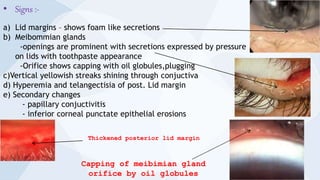
• Signs :-
a) Lid margins – shows foam like secretions
b) Meibommian glands
-openings are prominent with secretions expressed by pressure
on lids with toothpaste appearance
-Orifice shows capping with oil globules,plugging
c)Vertical yellowish streaks shining through conjuctiva
d) Hyperemia and telangectisia of post. Lid margin
e) Secondary changes
- papillary conjuctivitis
- inferior corneal punctate epithelial erosions
Capping of meibimian gland
orifice by oil globules
Thickened posterior lid margin
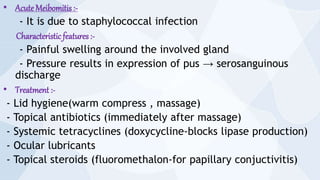
• Acute Meibomitis :-
- It is due to staphylococcal infection
Characteristic features:-
- Painful swelling around the involved gland
- Pressure results in expression of pus → serosanguinous
discharge
• Treatment :-
- Lid hygiene(warm compress , massage)
- Topical antibiotics (immediately after massage)
- Systemic tetracyclines (doxycycline-blocks lipase production)
- Ocular lubricants
- Topical steroids (fluoromethalon-for papillary conjuctivitis)
• It is associated infestation of lashes by lice
• Common in people living in poor hygienic conditions
• Clinicalfeatures:-
Infestation with lice causes chronic blepharitis & chronic follicular comjuctivitis
• Symptoms :-
- Chronic irritation
- Itching
- Burning
-Mild lacrimation
PHTHIRIASIS PALPEBRUM PEDICULOSIS
Due to infestation by phthiriasis pubis(crab
louse)
Due to infestation by pediculus humanus
corporis / capitis
Common in adults & mainly acquired as
sexually transmitted disease
Infested lice spreads to involve lashes
• Signs:-
a)Lid margin – red & inflammed
b)Slit lamp examination – Lice anchoring lashes with claws
c)Nits – seen as opalescent pearls adherent to base of cilia
d)Conjuctiva congestion on land standing cases
• Treatment :-
- Mechanical removal of lashes with forceps
- Application of antibiotic ointment & yellow mercuric oxide
1% to lid margins and lashes
- Delousing of patient
Blepharitis
Blepharitis

Blepharitis

  • 2.
    • DEFINITION:- Blepharitis isa subacute (or) chronic inflammation of the lid margins Antomy of lid margin:- - It is about 2mm broad & is divided into 2 parts by the punctum(Medial & lateral) Lacrimal portion(medial) :- It is devoid of lashes & glands Ciliary portion ( lateral) :- It consists of rounded antr.boder Sharp post.border & an intermarginal strip (b/w the two borders) • The grey line divides the intermarginal strip into a)Anterior strip bearing 2-3 rows of lashes b)Posterior strip on which openings of meibomian glands are arranged in a row • Importance – the splitting of eyelids when required in operations is done at the level of grey line
  • 4.
    • TYPES OFBLEPHARITIS :- A.Bacterial blepharitis B.Seborrhoeic or Squamous blepharitis C.Mixed staphylococcal with seborrhoeic blepharitis D.Posterior blepharitis or Meibomitis E.Parasitic blepharitis
  • 5.
    • Also knownas -Chronic antr.blepharitis -Staphylococcal blepharitis -Ulcerative blepharitis • It is a chronic infection of the anterior part of lid margin • It is a common cause for occular & discomfort and irritation • It is usually starts in childhood & may continue throught out the life
  • 6.
    • ETIOLOGY :- Causative organisms – - (M/C) cogulase +ve staphylococci - Rarely streptococci , propionibacterium acnes & moraxella may be involved PREDISPOSING FACTORS :- Rarely includes chronic conjuctivitis and dacrocystitis
  • 7.
    • CLINICAL FEATURES:- Symptoms:- Chronic irritation Itching Mild lacrimation Gluing of cilia Mild photophobia Symptoms are worse in the morning Remissions and exacerbations in symptoms are quite common
  • 8.
    • SIGNS :- -Yellow crusts - Small ulcers on removing crusts - Hyperemia • Mild papillary conjuctivitis and conjuctiva hyperemia are common assosciations
  • 9.
  • 10.
    - Tylosis - Epiphora -Eczema of skin & ectropion - Recurrent styes - Marginal keratitis - Tear film instabillity → dry eye
  • 11.
    • Treatment :- a)Lid hyegine(twice daily) - includes - Warm compress - Crust removal (3% sodium bicarbonate) - Avoid rubbing of eyes b) Antibioics - Eye ointment - Eye drops - Oral antibiotics (erythromycin,doxicycline) c) Topical steroids (Fluoromethalone) d) Occular lubricants
  • 12.
    • It isprimarily anterior blepharitis with some spill over posteriorly • ETIOLOGY:- - Assosciated with seborrhoea of scalp(dandruff) - Glands of zeis secrete abnormal excessive neutral lipids • Symptoms:- - whitish material at the lid margins - Mild discomfort - Irritation - occasional watering - Falling of eyelashes Corynebacterium acne Neutral lipis Irritating free fatty acids Seborrhoea of scalp
  • 13.
    • Signs:- - Accumulationof white dandruff like scales among lashes - Underlying surface hyperaemic with out ulcers - Lashes fall out easily - Lid margin is thickened • Complications:- similar to bacterial blepharitis • Treatment :- - General improvement of health & diet - Seborrhoea of scalp should treated - Removal of scales with luke warm sol. (3% NaHco /baby samphoo) - Antibiotics (erythromycin/doxicycline) 3 Madarosis & Lid oedema
  • 14.
    • It isinflammation of Meibomian glands • Two forms as Chronic & acute • Chronic type :- - Due to meibommian gland dysfunction - Common in middle aged people - Due to action of bacterial lipases • Clinical features :- a) Symptoms :- Chronic irritation Burning Mild lacrimation Symptoms are more worse in morning
  • 15.
    • Signs :- a)Lid margins – shows foam like secretions b) Meibommian glands -openings are prominent with secretions expressed by pressure on lids with toothpaste appearance -Orifice shows capping with oil globules,plugging c)Vertical yellowish streaks shining through conjuctiva d) Hyperemia and telangectisia of post. Lid margin e) Secondary changes - papillary conjuctivitis - inferior corneal punctate epithelial erosions Capping of meibimian gland orifice by oil globules Thickened posterior lid margin
  • 16.
    • Acute Meibomitis:- - It is due to staphylococcal infection Characteristic features:- - Painful swelling around the involved gland - Pressure results in expression of pus → serosanguinous discharge • Treatment :- - Lid hygiene(warm compress , massage) - Topical antibiotics (immediately after massage) - Systemic tetracyclines (doxycycline-blocks lipase production) - Ocular lubricants - Topical steroids (fluoromethalon-for papillary conjuctivitis)
  • 17.
    • It isassociated infestation of lashes by lice • Common in people living in poor hygienic conditions • Clinicalfeatures:- Infestation with lice causes chronic blepharitis & chronic follicular comjuctivitis • Symptoms :- - Chronic irritation - Itching - Burning -Mild lacrimation PHTHIRIASIS PALPEBRUM PEDICULOSIS Due to infestation by phthiriasis pubis(crab louse) Due to infestation by pediculus humanus corporis / capitis Common in adults & mainly acquired as sexually transmitted disease Infested lice spreads to involve lashes
  • 18.
    • Signs:- a)Lid margin– red & inflammed b)Slit lamp examination – Lice anchoring lashes with claws c)Nits – seen as opalescent pearls adherent to base of cilia d)Conjuctiva congestion on land standing cases • Treatment :- - Mechanical removal of lashes with forceps - Application of antibiotic ointment & yellow mercuric oxide 1% to lid margins and lashes - Delousing of patient