LIDS LACRIMALLIDS LACRIMAL
SYSTEM AND ORBITSYSTEM AND ORBIT
DR. GEETA LALDR. GEETA LAL
Eyelid diseasesEyelid diseases
 MalpositionsMalpositions
 InflammationInflammation
 InfectionsInfections
 TumoursTumours
Eyelid malpositionEyelid malposition
 EntropionEntropion
 EctropionEctropion
 PtosisPtosis
 Lid retractionLid retraction
 LagophthalmosLagophthalmos
EntropionEntropion
 Definition:Definition:
– An inward turning of the upper or lower eyelidAn inward turning of the upper or lower eyelid
 Aetiology:Aetiology:
– InvolutionalInvolutional: most common form; results from age related: most common form; results from age related
changes and laxity in the lower lid.changes and laxity in the lower lid.
– CicatricialCicatricial: seen in trachoma, Steven Johnson syndrome,: seen in trachoma, Steven Johnson syndrome,
ocular pemphigoid, chemical burns and trauma. Causedocular pemphigoid, chemical burns and trauma. Caused
by scarring and contraction of lid.by scarring and contraction of lid.
– SpasticSpastic: caused by spasm of orbicularis secondary to: caused by spasm of orbicularis secondary to
ocular irritation.ocular irritation.
– CongenitalCongenital: very rare.: very rare.
EntropionEntropion
 Symptoms and sequelae:Symptoms and sequelae:
– Ocular irritation, discomfortOcular irritation, discomfort
– Reflex wateringReflex watering
– Corneal abrasion with lashesCorneal abrasion with lashes
– Infected corneal ulcer if severeInfected corneal ulcer if severe
– Corneal scarringCorneal scarring
 Treatment:Treatment:
– Short term – Lubricants , taping of lidsShort term – Lubricants , taping of lids
– Long term – Surgical correctionLong term – Surgical correction
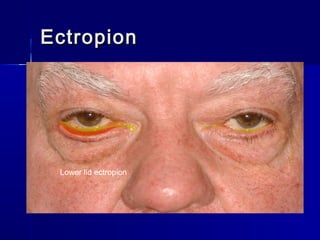
EctropionEctropion
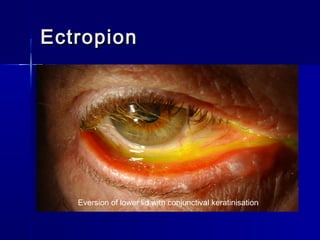
 Definition:Definition:
– An outward turning of the lower lid. If severe andAn outward turning of the lower lid. If severe and
prolonged may cause conjunctival keratinisation.prolonged may cause conjunctival keratinisation.
 Aetiology:Aetiology:
– InvolutionalInvolutional : due to age related tissue laxity: due to age related tissue laxity
– CicatricialCicatricial: scarring resulting from burns or surgery: scarring resulting from burns or surgery
– MechanicalMechanical : excessive lid weight by lid mass, e.g. tumour: excessive lid weight by lid mass, e.g. tumour
– ParalyticParalytic : associated with facial nerve palsy: associated with facial nerve palsy
– CongenitalCongenital : rare: rare
EctropionEctropion
 Symptoms:Symptoms:
– WateringWatering
– IrritationIrritation
– GrittinessGrittiness
– RednessRedness
 Treatment:Treatment:
– Short term – Lubricants , taping of lidsShort term – Lubricants , taping of lids
– Long term – Surgical correctionLong term – Surgical correction
EctropionEctropion
Eversion of lower lid with conjunctival keratinisation
EctropionEctropion
Lower lid ectropion
TrichiasisTrichiasis
Definition:Definition:
 Abnormal inturned eyelashes which rub against the eyeAbnormal inturned eyelashes which rub against the eye
 Can cause corneal abrasion – infection – scarringCan cause corneal abrasion – infection – scarring
CausesCauses::
 Staphylococcal blepharitisStaphylococcal blepharitis
 Trauma to the lidsTrauma to the lids
 Conjunctival scarring diseasesConjunctival scarring diseases
TreatmentTreatment ::
 EpilationEpilation
 CryotherapyCryotherapy
 ElectrolysisElectrolysis
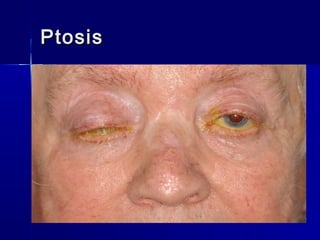
PtosisPtosis
Definition:Definition:
- Drooping of the upper eyelidDrooping of the upper eyelid
Can be unilateral or bilateralCan be unilateral or bilateral
PtosisPtosis
PtosisPtosis
AetiologyAetiology
 CongenitalCongenital
– Caused by weakness of the levator muscleCaused by weakness of the levator muscle
– can be unilateral or bilateralcan be unilateral or bilateral
– surgical correction is indicated for visual or cosmetic reasonssurgical correction is indicated for visual or cosmetic reasons
 Acquired:Acquired:
– Neurogenic – 3Neurogenic – 3rdrd
nerve palsy, Horners syndromenerve palsy, Horners syndrome
– Aponeurotic – dehiscence of levator palpebrae superioris , could be age relatedAponeurotic – dehiscence of levator palpebrae superioris , could be age related
(senile), traumatic or post operative(senile), traumatic or post operative
– Myogenic - myasthenia gravis, myotonic dystrophy, ocular myopathiesMyogenic - myasthenia gravis, myotonic dystrophy, ocular myopathies
– Mechanical - due to inflammation, tumour, vascular abnormality of upper lidMechanical - due to inflammation, tumour, vascular abnormality of upper lid
Management:Management:
 Treat the underlying conditionTreat the underlying condition
 Surgical correctionSurgical correction
Other lid abnormalitiesOther lid abnormalities
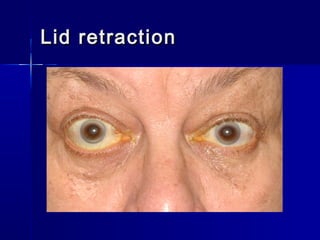
 Lid retractionLid retraction
– may be unilateral or bilateral and is almost invariably due tomay be unilateral or bilateral and is almost invariably due to
thyroid diseasethyroid disease
 LagophthalmosLagophthalmos
– incomplete closure of the eyelids due to 7incomplete closure of the eyelids due to 7thth
nerve palsynerve palsy
– results in exposure keratitisresults in exposure keratitis
– Treatment - lubricants, taping of lids, lateral tarsorraphyTreatment - lubricants, taping of lids, lateral tarsorraphy
 BlepharospasmBlepharospasm
– involuntary spasm of orbicularis muscle causing lid closureinvoluntary spasm of orbicularis muscle causing lid closure
– Causes: idiopathic, Parkinsons disease, PsycogenicCauses: idiopathic, Parkinsons disease, Psycogenic
– Treatment – Botox injectionTreatment – Botox injection
Lid retractionLid retraction
Lid inflammationLid inflammation
 BlepharitisBlepharitis
- Chronic inflammation of the lid marginsChronic inflammation of the lid margins
- Bilateral, symmetricalBilateral, symmetrical
 TypesTypes
- StaphylococcalStaphylococcal
- SeborrheicSeborrheic
 CausesCauses
- Staphylococcal chronic infection- Staphylococcal chronic infection
- Meibomian gland dysfunction- Meibomian gland dysfunction
- Acne Rosacea associated- Acne Rosacea associated
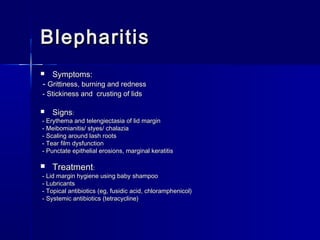
BlepharitisBlepharitis
 Symptoms:Symptoms:
-- Grittiness, burning and rednessGrittiness, burning and redness
- Stickiness and crusting of lids- Stickiness and crusting of lids
 SignsSigns::
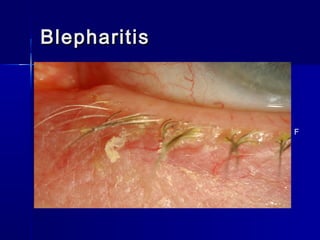
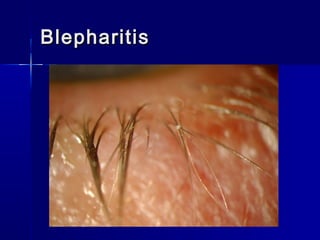
- Erythema and telengiectasia of lid margin- Erythema and telengiectasia of lid margin
- Meibomianitis/ styes/ chalazia- Meibomianitis/ styes/ chalazia
- Scaling around lash roots- Scaling around lash roots
- Tear film dysfunction- Tear film dysfunction
- Punctate epithelial erosions, marginal keratitis- Punctate epithelial erosions, marginal keratitis
 TreatmentTreatment::
- Lid margin hygiene using baby shampoo- Lid margin hygiene using baby shampoo
- Lubricants- Lubricants
- Topical antibiotics (eg, fusidic acid, chloramphenicol)- Topical antibiotics (eg, fusidic acid, chloramphenicol)
- Systemic antibiotics (tetracycline)- Systemic antibiotics (tetracycline)
BlepharitisBlepharitis
F
BlepharitisBlepharitis
Non neoplastic lidNon neoplastic lid
lesionslesions
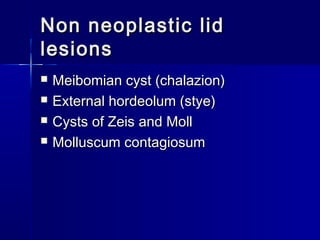
 Meibomian cyst (chalazion)Meibomian cyst (chalazion)
 External hordeolum (stye)External hordeolum (stye)
 Cysts of Zeis and MollCysts of Zeis and Moll
 Molluscum contagiosumMolluscum contagiosum
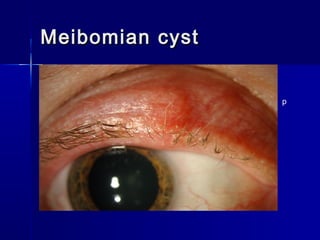
Meibomian cystMeibomian cyst
 Inflamed painful lid swelling due to a blocked meibomian ductInflamed painful lid swelling due to a blocked meibomian duct
 Very common in patients with blepharitisVery common in patients with blepharitis
 Initial treatment is hot compresses and topical antibioticInitial treatment is hot compresses and topical antibiotic
ointment 4 times a day for 2 weeks If the lump persists after 3ointment 4 times a day for 2 weeks If the lump persists after 3
months, do an incision and curettagemonths, do an incision and curettage
 In children commonly associated with localised infectiveIn children commonly associated with localised infective
cellulitis (preseptal cellulitis) requiring oral/intravenouscellulitis (preseptal cellulitis) requiring oral/intravenous
antibioticsantibiotics
Meibomian cystMeibomian cyst
p
Non neoplastic lidNon neoplastic lid
lesionslesions
External hordeolum (stye)External hordeolum (stye)
 A small abscess of an eye lash follicleA small abscess of an eye lash follicle
 An acute, painful inflamed swelling on the anterior lid margin, pointingAn acute, painful inflamed swelling on the anterior lid margin, pointing
through the skinthrough the skin
 Rx - Removal of the associated lash, hot bathing, topical antibiotic ointmentRx - Removal of the associated lash, hot bathing, topical antibiotic ointment
Cysts of Zeis and MollCysts of Zeis and Moll
 A cyst of Zeis is a small, whitish, chronic, painless opaque nodule on the lidA cyst of Zeis is a small, whitish, chronic, painless opaque nodule on the lid
marginmargin
 A cyst of Moll is similar but translucentA cyst of Moll is similar but translucent
 Rx - simple excision (usually not necessary)Rx - simple excision (usually not necessary)
Molluscum ContagiosumMolluscum Contagiosum
 Umbilicated lesion on the lid caused by pox virusUmbilicated lesion on the lid caused by pox virus
 Usually unilateral associated with follicular conjunctivitisUsually unilateral associated with follicular conjunctivitis
 Rx – Shave excisionRx – Shave excision
Benign tumours of theBenign tumours of the
eyelideyelid
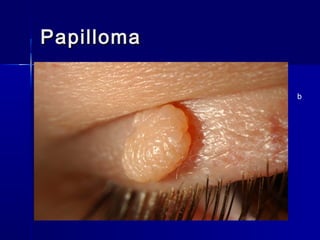
 Papilloma (viral wart)Papilloma (viral wart)
 Seborrhoeic keratosesSeborrhoeic keratoses
 KeratoacanthomaKeratoacanthoma
 NaeviNaevi
 Capillary haemangiomaCapillary haemangioma
 XanthalesmaXanthalesma
PapillomaPapilloma
b
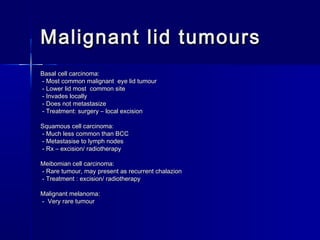
Malignant lid tumoursMalignant lid tumours
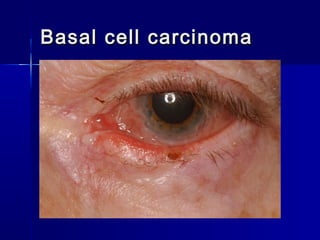
Basal cell carcinoma:Basal cell carcinoma:
- Most common malignant eye lid tumour- Most common malignant eye lid tumour
- Lower lid most common site- Lower lid most common site
- Invades locally- Invades locally
- Does not metastasize- Does not metastasize
- Treatment: surgery – local excision- Treatment: surgery – local excision
Squamous cell carcinoma:Squamous cell carcinoma:
- Much less common than BCC- Much less common than BCC
- Metastasise to lymph nodes- Metastasise to lymph nodes
- Rx – excision/ radiotherapy- Rx – excision/ radiotherapy
Meibomian cell carcinoma:Meibomian cell carcinoma:
- Rare tumour, may present as recurrent chalazion- Rare tumour, may present as recurrent chalazion
- Treatment : excision/ radiotherapy- Treatment : excision/ radiotherapy
Malignant melanoma:Malignant melanoma:
- Very rare tumour- Very rare tumour
Basal cell carcinomaBasal cell carcinoma
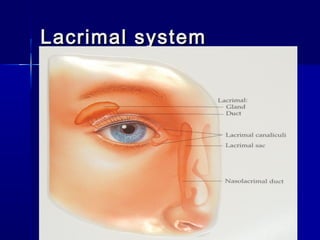
Lacrimal systemLacrimal system
INSERT PICTUREINSERT PICTURE
TO EXPLAINTO EXPLAIN
ANATOMYANATOMY
EXPLAIN TEAREXPLAIN TEAR
PRODUCTIONPRODUCTION
AND DRAINAGEAND DRAINAGE
WITH NARRATIVEWITH NARRATIVE
NOT TEXTNOT TEXT
The watering eyeThe watering eye
 TearingTearing
– Can be due to lacrimation (hypersecretion) orCan be due to lacrimation (hypersecretion) or
epiphora (decreased tear elimination)epiphora (decreased tear elimination)
 Causes of lacrimationCauses of lacrimation
– Corneal F.B.Corneal F.B.
– Corneal irritationCorneal irritation
– Ocular surface inflammationOcular surface inflammation
The watering eyeThe watering eye
Causes of epiphoraCauses of epiphora
 Anatomical - strictures, tumoursAnatomical - strictures, tumours
 Physiologic dysfunction – orbicularis musclePhysiologic dysfunction – orbicularis muscle
weakness, punctal or eyelid malposition,weakness, punctal or eyelid malposition,
nasal obstructionnasal obstruction
The watering eyeThe watering eye
ManagementManagement::
 Displaced punctum in entropion and blocked punctum etc canDisplaced punctum in entropion and blocked punctum etc can
be diagnosed by careful inspection and the cause removed orbe diagnosed by careful inspection and the cause removed or
corrected surgically.corrected surgically.
 Canalicular and nasolacrimal obstruction in adult can beCanalicular and nasolacrimal obstruction in adult can be
diagnosed by probing and syringing of the lacrimaldiagnosed by probing and syringing of the lacrimal
canaliculum. This is treated surgically bycanaliculum. This is treated surgically by
dacryocystorhinostomy (DCR).dacryocystorhinostomy (DCR).
 Congenital nasolacrimal duct obstruction – spontaneous cureCongenital nasolacrimal duct obstruction – spontaneous cure
by the age of 12-18 months is the rule, aided by regularby the age of 12-18 months is the rule, aided by regular
massage over the lacrimal sac. After this age probing of themassage over the lacrimal sac. After this age probing of the
nasolacrimal duct carried out under GA. Patency confirmed bynasolacrimal duct carried out under GA. Patency confirmed by
syringing.syringing.
Orbital diseasesOrbital diseases
Thyroid eye diseaseThyroid eye disease
 Aetiology – autoantibodies to both thyroidAetiology – autoantibodies to both thyroid
and orbital tissue cause inflammation in theand orbital tissue cause inflammation in the
orbit. The extraocular muscles areorbit. The extraocular muscles are
particularly affected.particularly affected.
 Clinical features - the clinical courseClinical features - the clinical course
involves an active congestive stage lasting 2involves an active congestive stage lasting 2
-3 yrs, followed by quiescent stage-3 yrs, followed by quiescent stage
characterised by residual restriction ofcharacterised by residual restriction of
ocular movements.ocular movements.
Thyroid eye diseaseThyroid eye disease
SymptomsSymptoms
 Redness, irritation, discomfortRedness, irritation, discomfort
 Wide - eyed (staring) appearanceWide - eyed (staring) appearance
 Double visionDouble vision
 Decreased vision in severe casesDecreased vision in severe cases
SignsSigns
 Fullness of the eyelidsFullness of the eyelids
 Conjunctival hyperaemia and chemosisConjunctival hyperaemia and chemosis
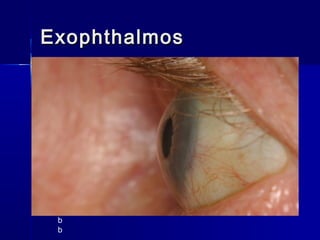
 Proptosis (exophthalmos) may be unilateral or bilateralProptosis (exophthalmos) may be unilateral or bilateral
 Lid retractionLid retraction
 Lid lagLid lag
 Restricted eye movementsRestricted eye movements
 Optic neuropathy – sight threatening complication caused by compression ofOptic neuropathy – sight threatening complication caused by compression of
the optic nerve or its blood supply by swollen orbital tissue.the optic nerve or its blood supply by swollen orbital tissue.
ExophthalmosExophthalmos
b
b
Thyroid eye diseaseThyroid eye disease
InvestigationsInvestigations
– T3, T4 and TSHT3, T4 and TSH
– Thyroid autoantibodies raisedThyroid autoantibodies raised
 RadiologyRadiology
– CT scan of the orbit – Enlarged extraocular musclesCT scan of the orbit – Enlarged extraocular muscles
(tendons spared) and enlarged soft tissue(tendons spared) and enlarged soft tissue
– Optic nerve may be compressed in the canalOptic nerve may be compressed in the canal
– Clinical and radiological findings more important thanClinical and radiological findings more important than
biochemical profile in establishing a diagnosis.biochemical profile in establishing a diagnosis.
Thyroid eye diseaseThyroid eye disease
 TreatmentTreatment
– Lubricants and non steroidal anti inflammatoriesLubricants and non steroidal anti inflammatories
– Prisms for double visionPrisms for double vision
– Systemic steroidsSystemic steroids
– Immunosuppressants (Azathioprine, cyclophosphamide)Immunosuppressants (Azathioprine, cyclophosphamide)
– Radiotherapy as an adjunctive therapy to steroidsRadiotherapy as an adjunctive therapy to steroids
– Surgery:Surgery:
 Orbital decompression for acute optic nerve compression notOrbital decompression for acute optic nerve compression not
responding to immunosuppression and for cosmesis whenresponding to immunosuppression and for cosmesis when
burnt outburnt out
 Strabismus surgery for double visionStrabismus surgery for double vision
 Surgery to correct lid retractionSurgery to correct lid retraction
Orbital cellulitisOrbital cellulitis
 DefinitionDefinition
– A potentially life threatening acuteA potentially life threatening acute
bacterial infection of the soft tissues ofbacterial infection of the soft tissues of
the orbitthe orbit
 AetiologyAetiology
– Secondary to sinusitisSecondary to sinusitis
– Infected chalazion in childrenInfected chalazion in children
– Following trauma or surgeryFollowing trauma or surgery
Orbital cellulitisOrbital cellulitis
 SymptomsSymptoms
– Acute lid swelling and redness, pain and malaiseAcute lid swelling and redness, pain and malaise
 SignsSigns
– Reduced visual acuityReduced visual acuity
– Lid oedema and erythemaLid oedema and erythema
– ChemosisChemosis
– ProptosisProptosis
– Painful ophthalmoplegiaPainful ophthalmoplegia
– Optic disc swellingOptic disc swelling
 ComplicationsComplications
– Intra cranial infection, cavernous sinus thrombosis and blindnessIntra cranial infection, cavernous sinus thrombosis and blindness
 ManagementManagement
– Intravenous antibioticsIntravenous antibiotics
– Orbital CT, to rule out an abscessOrbital CT, to rule out an abscess
– Surgery for abscess drainage or sinus washout.Surgery for abscess drainage or sinus washout.
Orbital tumoursOrbital tumours
 Muscle – RhabdomyosarcomaMuscle – Rhabdomyosarcoma
 Vascular – Capillary haemangiomaVascular – Capillary haemangioma
 Lacrimal – Carcinoma of lacrimal glandLacrimal – Carcinoma of lacrimal gland
 Neural – Optic nerve glioma and opticNeural – Optic nerve glioma and optic
nerve sheath meningiomanerve sheath meningioma
 MetastaticMetastatic
Orbital tumoursOrbital tumours
 Rhabdomyosarcoma:Rhabdomyosarcoma:
– Rare but aggressive tumourRare but aggressive tumour
– Children mainlyChildren mainly
– Progressive proptosisProgressive proptosis
– Palpable mass may be presentPalpable mass may be present
– Management: incisional biopsy to confirmManagement: incisional biopsy to confirm
diagnosis followed by radiotherapy anddiagnosis followed by radiotherapy and
chemotherapychemotherapy
Orbital tumoursOrbital tumours
 Capillary haemangiomaCapillary haemangioma
– presents in infancy with an anterior orbitalpresents in infancy with an anterior orbital
swellingswelling
– may increase in size when cryingmay increase in size when crying
– similar eyelid lesion (strawberry naevus)similar eyelid lesion (strawberry naevus)
may also be presentmay also be present
– most of the tumours involutemost of the tumours involute
spontaneouslyspontaneously
Orbital tumoursOrbital tumours
 Neural tumours:Neural tumours:
– Optic nerve glioma: Presents with slowly progressive proptosisOptic nerve glioma: Presents with slowly progressive proptosis
and visual lossand visual loss
– Optic nerve sheath meningioma: Typically affects middle agedOptic nerve sheath meningioma: Typically affects middle aged
females, causes slowly progressive visual loss followed byfemales, causes slowly progressive visual loss followed by
proptosis.proptosis.
 Metastatic:Metastatic:
– Bilateral orbital metastases of neuroblastoma to orbit presentsBilateral orbital metastases of neuroblastoma to orbit presents
with bilateral ecchymosis in a 2yr old child.with bilateral ecchymosis in a 2yr old child.
 Dermoid cyst:Dermoid cyst:
– Presents in children with proptosis and/or palpable massPresents in children with proptosis and/or palpable mass
– Rx - excisionRx - excision
Orbital blow out fractureOrbital blow out fracture
 Blow-out fracture of orbital floor - is typically caused by a sudden increase in the orbitalBlow-out fracture of orbital floor - is typically caused by a sudden increase in the orbital
pressure by a striking object which is >5cm in diameter such as a fist or tennis ball.pressure by a striking object which is >5cm in diameter such as a fist or tennis ball.
 Clinical features:Clinical features:
– Periorbital oedemaPeriorbital oedema
– EnophthalmosEnophthalmos
– Vertical diplopiaVertical diplopia
– Infra orbital anaesthesiaInfra orbital anaesthesia
– Subcutaneous emphysemaSubcutaneous emphysema
 InvestigationsInvestigations
– X- ray orbit and sinusesX- ray orbit and sinuses
– CT scanCT scan
 Management:Management:
– Antibiotics to prevent infection from maxillary sinusAntibiotics to prevent infection from maxillary sinus
– Avoid blowing noseAvoid blowing nose
– Observation vs. surgeryObservation vs. surgery

Lacrimal system disorders

  • 1.
    LIDS LACRIMALLIDS LACRIMAL SYSTEMAND ORBITSYSTEM AND ORBIT DR. GEETA LALDR. GEETA LAL
  • 2.
    Eyelid diseasesEyelid diseases MalpositionsMalpositions  InflammationInflammation  InfectionsInfections  TumoursTumours
  • 3.
    Eyelid malpositionEyelid malposition EntropionEntropion  EctropionEctropion  PtosisPtosis  Lid retractionLid retraction  LagophthalmosLagophthalmos
  • 4.
    EntropionEntropion  Definition:Definition: – Aninward turning of the upper or lower eyelidAn inward turning of the upper or lower eyelid  Aetiology:Aetiology: – InvolutionalInvolutional: most common form; results from age related: most common form; results from age related changes and laxity in the lower lid.changes and laxity in the lower lid. – CicatricialCicatricial: seen in trachoma, Steven Johnson syndrome,: seen in trachoma, Steven Johnson syndrome, ocular pemphigoid, chemical burns and trauma. Causedocular pemphigoid, chemical burns and trauma. Caused by scarring and contraction of lid.by scarring and contraction of lid. – SpasticSpastic: caused by spasm of orbicularis secondary to: caused by spasm of orbicularis secondary to ocular irritation.ocular irritation. – CongenitalCongenital: very rare.: very rare.
  • 5.
    EntropionEntropion  Symptoms andsequelae:Symptoms and sequelae: – Ocular irritation, discomfortOcular irritation, discomfort – Reflex wateringReflex watering – Corneal abrasion with lashesCorneal abrasion with lashes – Infected corneal ulcer if severeInfected corneal ulcer if severe – Corneal scarringCorneal scarring  Treatment:Treatment: – Short term – Lubricants , taping of lidsShort term – Lubricants , taping of lids – Long term – Surgical correctionLong term – Surgical correction
  • 6.
    EctropionEctropion  Definition:Definition: – Anoutward turning of the lower lid. If severe andAn outward turning of the lower lid. If severe and prolonged may cause conjunctival keratinisation.prolonged may cause conjunctival keratinisation.  Aetiology:Aetiology: – InvolutionalInvolutional : due to age related tissue laxity: due to age related tissue laxity – CicatricialCicatricial: scarring resulting from burns or surgery: scarring resulting from burns or surgery – MechanicalMechanical : excessive lid weight by lid mass, e.g. tumour: excessive lid weight by lid mass, e.g. tumour – ParalyticParalytic : associated with facial nerve palsy: associated with facial nerve palsy – CongenitalCongenital : rare: rare
  • 7.
    EctropionEctropion  Symptoms:Symptoms: – WateringWatering –IrritationIrritation – GrittinessGrittiness – RednessRedness  Treatment:Treatment: – Short term – Lubricants , taping of lidsShort term – Lubricants , taping of lids – Long term – Surgical correctionLong term – Surgical correction
  • 8.
    EctropionEctropion Eversion of lowerlid with conjunctival keratinisation
  • 9.
  • 10.
    TrichiasisTrichiasis Definition:Definition:  Abnormal inturnedeyelashes which rub against the eyeAbnormal inturned eyelashes which rub against the eye  Can cause corneal abrasion – infection – scarringCan cause corneal abrasion – infection – scarring CausesCauses::  Staphylococcal blepharitisStaphylococcal blepharitis  Trauma to the lidsTrauma to the lids  Conjunctival scarring diseasesConjunctival scarring diseases TreatmentTreatment ::  EpilationEpilation  CryotherapyCryotherapy  ElectrolysisElectrolysis
  • 11.
    PtosisPtosis Definition:Definition: - Drooping ofthe upper eyelidDrooping of the upper eyelid Can be unilateral or bilateralCan be unilateral or bilateral
  • 12.
  • 13.
    PtosisPtosis AetiologyAetiology  CongenitalCongenital – Causedby weakness of the levator muscleCaused by weakness of the levator muscle – can be unilateral or bilateralcan be unilateral or bilateral – surgical correction is indicated for visual or cosmetic reasonssurgical correction is indicated for visual or cosmetic reasons  Acquired:Acquired: – Neurogenic – 3Neurogenic – 3rdrd nerve palsy, Horners syndromenerve palsy, Horners syndrome – Aponeurotic – dehiscence of levator palpebrae superioris , could be age relatedAponeurotic – dehiscence of levator palpebrae superioris , could be age related (senile), traumatic or post operative(senile), traumatic or post operative – Myogenic - myasthenia gravis, myotonic dystrophy, ocular myopathiesMyogenic - myasthenia gravis, myotonic dystrophy, ocular myopathies – Mechanical - due to inflammation, tumour, vascular abnormality of upper lidMechanical - due to inflammation, tumour, vascular abnormality of upper lid Management:Management:  Treat the underlying conditionTreat the underlying condition  Surgical correctionSurgical correction
  • 14.
    Other lid abnormalitiesOtherlid abnormalities  Lid retractionLid retraction – may be unilateral or bilateral and is almost invariably due tomay be unilateral or bilateral and is almost invariably due to thyroid diseasethyroid disease  LagophthalmosLagophthalmos – incomplete closure of the eyelids due to 7incomplete closure of the eyelids due to 7thth nerve palsynerve palsy – results in exposure keratitisresults in exposure keratitis – Treatment - lubricants, taping of lids, lateral tarsorraphyTreatment - lubricants, taping of lids, lateral tarsorraphy  BlepharospasmBlepharospasm – involuntary spasm of orbicularis muscle causing lid closureinvoluntary spasm of orbicularis muscle causing lid closure – Causes: idiopathic, Parkinsons disease, PsycogenicCauses: idiopathic, Parkinsons disease, Psycogenic – Treatment – Botox injectionTreatment – Botox injection
  • 15.
  • 16.
    Lid inflammationLid inflammation BlepharitisBlepharitis - Chronic inflammation of the lid marginsChronic inflammation of the lid margins - Bilateral, symmetricalBilateral, symmetrical  TypesTypes - StaphylococcalStaphylococcal - SeborrheicSeborrheic  CausesCauses - Staphylococcal chronic infection- Staphylococcal chronic infection - Meibomian gland dysfunction- Meibomian gland dysfunction - Acne Rosacea associated- Acne Rosacea associated
  • 17.
    BlepharitisBlepharitis  Symptoms:Symptoms: -- Grittiness,burning and rednessGrittiness, burning and redness - Stickiness and crusting of lids- Stickiness and crusting of lids  SignsSigns:: - Erythema and telengiectasia of lid margin- Erythema and telengiectasia of lid margin - Meibomianitis/ styes/ chalazia- Meibomianitis/ styes/ chalazia - Scaling around lash roots- Scaling around lash roots - Tear film dysfunction- Tear film dysfunction - Punctate epithelial erosions, marginal keratitis- Punctate epithelial erosions, marginal keratitis  TreatmentTreatment:: - Lid margin hygiene using baby shampoo- Lid margin hygiene using baby shampoo - Lubricants- Lubricants - Topical antibiotics (eg, fusidic acid, chloramphenicol)- Topical antibiotics (eg, fusidic acid, chloramphenicol) - Systemic antibiotics (tetracycline)- Systemic antibiotics (tetracycline)
  • 18.
  • 19.
  • 20.
    Non neoplastic lidNonneoplastic lid lesionslesions  Meibomian cyst (chalazion)Meibomian cyst (chalazion)  External hordeolum (stye)External hordeolum (stye)  Cysts of Zeis and MollCysts of Zeis and Moll  Molluscum contagiosumMolluscum contagiosum
  • 21.
    Meibomian cystMeibomian cyst Inflamed painful lid swelling due to a blocked meibomian ductInflamed painful lid swelling due to a blocked meibomian duct  Very common in patients with blepharitisVery common in patients with blepharitis  Initial treatment is hot compresses and topical antibioticInitial treatment is hot compresses and topical antibiotic ointment 4 times a day for 2 weeks If the lump persists after 3ointment 4 times a day for 2 weeks If the lump persists after 3 months, do an incision and curettagemonths, do an incision and curettage  In children commonly associated with localised infectiveIn children commonly associated with localised infective cellulitis (preseptal cellulitis) requiring oral/intravenouscellulitis (preseptal cellulitis) requiring oral/intravenous antibioticsantibiotics
  • 22.
  • 23.
    Non neoplastic lidNonneoplastic lid lesionslesions External hordeolum (stye)External hordeolum (stye)  A small abscess of an eye lash follicleA small abscess of an eye lash follicle  An acute, painful inflamed swelling on the anterior lid margin, pointingAn acute, painful inflamed swelling on the anterior lid margin, pointing through the skinthrough the skin  Rx - Removal of the associated lash, hot bathing, topical antibiotic ointmentRx - Removal of the associated lash, hot bathing, topical antibiotic ointment Cysts of Zeis and MollCysts of Zeis and Moll  A cyst of Zeis is a small, whitish, chronic, painless opaque nodule on the lidA cyst of Zeis is a small, whitish, chronic, painless opaque nodule on the lid marginmargin  A cyst of Moll is similar but translucentA cyst of Moll is similar but translucent  Rx - simple excision (usually not necessary)Rx - simple excision (usually not necessary) Molluscum ContagiosumMolluscum Contagiosum  Umbilicated lesion on the lid caused by pox virusUmbilicated lesion on the lid caused by pox virus  Usually unilateral associated with follicular conjunctivitisUsually unilateral associated with follicular conjunctivitis  Rx – Shave excisionRx – Shave excision
  • 24.
    Benign tumours oftheBenign tumours of the eyelideyelid  Papilloma (viral wart)Papilloma (viral wart)  Seborrhoeic keratosesSeborrhoeic keratoses  KeratoacanthomaKeratoacanthoma  NaeviNaevi  Capillary haemangiomaCapillary haemangioma  XanthalesmaXanthalesma
  • 25.
  • 26.
    Malignant lid tumoursMalignantlid tumours Basal cell carcinoma:Basal cell carcinoma: - Most common malignant eye lid tumour- Most common malignant eye lid tumour - Lower lid most common site- Lower lid most common site - Invades locally- Invades locally - Does not metastasize- Does not metastasize - Treatment: surgery – local excision- Treatment: surgery – local excision Squamous cell carcinoma:Squamous cell carcinoma: - Much less common than BCC- Much less common than BCC - Metastasise to lymph nodes- Metastasise to lymph nodes - Rx – excision/ radiotherapy- Rx – excision/ radiotherapy Meibomian cell carcinoma:Meibomian cell carcinoma: - Rare tumour, may present as recurrent chalazion- Rare tumour, may present as recurrent chalazion - Treatment : excision/ radiotherapy- Treatment : excision/ radiotherapy Malignant melanoma:Malignant melanoma: - Very rare tumour- Very rare tumour
  • 27.
  • 28.
    Lacrimal systemLacrimal system INSERTPICTUREINSERT PICTURE TO EXPLAINTO EXPLAIN ANATOMYANATOMY EXPLAIN TEAREXPLAIN TEAR PRODUCTIONPRODUCTION AND DRAINAGEAND DRAINAGE WITH NARRATIVEWITH NARRATIVE NOT TEXTNOT TEXT
  • 29.
    The watering eyeThewatering eye  TearingTearing – Can be due to lacrimation (hypersecretion) orCan be due to lacrimation (hypersecretion) or epiphora (decreased tear elimination)epiphora (decreased tear elimination)  Causes of lacrimationCauses of lacrimation – Corneal F.B.Corneal F.B. – Corneal irritationCorneal irritation – Ocular surface inflammationOcular surface inflammation
  • 30.
    The watering eyeThewatering eye Causes of epiphoraCauses of epiphora  Anatomical - strictures, tumoursAnatomical - strictures, tumours  Physiologic dysfunction – orbicularis musclePhysiologic dysfunction – orbicularis muscle weakness, punctal or eyelid malposition,weakness, punctal or eyelid malposition, nasal obstructionnasal obstruction
  • 31.
    The watering eyeThewatering eye ManagementManagement::  Displaced punctum in entropion and blocked punctum etc canDisplaced punctum in entropion and blocked punctum etc can be diagnosed by careful inspection and the cause removed orbe diagnosed by careful inspection and the cause removed or corrected surgically.corrected surgically.  Canalicular and nasolacrimal obstruction in adult can beCanalicular and nasolacrimal obstruction in adult can be diagnosed by probing and syringing of the lacrimaldiagnosed by probing and syringing of the lacrimal canaliculum. This is treated surgically bycanaliculum. This is treated surgically by dacryocystorhinostomy (DCR).dacryocystorhinostomy (DCR).  Congenital nasolacrimal duct obstruction – spontaneous cureCongenital nasolacrimal duct obstruction – spontaneous cure by the age of 12-18 months is the rule, aided by regularby the age of 12-18 months is the rule, aided by regular massage over the lacrimal sac. After this age probing of themassage over the lacrimal sac. After this age probing of the nasolacrimal duct carried out under GA. Patency confirmed bynasolacrimal duct carried out under GA. Patency confirmed by syringing.syringing.
  • 32.
    Orbital diseasesOrbital diseases Thyroideye diseaseThyroid eye disease  Aetiology – autoantibodies to both thyroidAetiology – autoantibodies to both thyroid and orbital tissue cause inflammation in theand orbital tissue cause inflammation in the orbit. The extraocular muscles areorbit. The extraocular muscles are particularly affected.particularly affected.  Clinical features - the clinical courseClinical features - the clinical course involves an active congestive stage lasting 2involves an active congestive stage lasting 2 -3 yrs, followed by quiescent stage-3 yrs, followed by quiescent stage characterised by residual restriction ofcharacterised by residual restriction of ocular movements.ocular movements.
  • 33.
    Thyroid eye diseaseThyroideye disease SymptomsSymptoms  Redness, irritation, discomfortRedness, irritation, discomfort  Wide - eyed (staring) appearanceWide - eyed (staring) appearance  Double visionDouble vision  Decreased vision in severe casesDecreased vision in severe cases SignsSigns  Fullness of the eyelidsFullness of the eyelids  Conjunctival hyperaemia and chemosisConjunctival hyperaemia and chemosis  Proptosis (exophthalmos) may be unilateral or bilateralProptosis (exophthalmos) may be unilateral or bilateral  Lid retractionLid retraction  Lid lagLid lag  Restricted eye movementsRestricted eye movements  Optic neuropathy – sight threatening complication caused by compression ofOptic neuropathy – sight threatening complication caused by compression of the optic nerve or its blood supply by swollen orbital tissue.the optic nerve or its blood supply by swollen orbital tissue.
  • 34.
  • 35.
    Thyroid eye diseaseThyroideye disease InvestigationsInvestigations – T3, T4 and TSHT3, T4 and TSH – Thyroid autoantibodies raisedThyroid autoantibodies raised  RadiologyRadiology – CT scan of the orbit – Enlarged extraocular musclesCT scan of the orbit – Enlarged extraocular muscles (tendons spared) and enlarged soft tissue(tendons spared) and enlarged soft tissue – Optic nerve may be compressed in the canalOptic nerve may be compressed in the canal – Clinical and radiological findings more important thanClinical and radiological findings more important than biochemical profile in establishing a diagnosis.biochemical profile in establishing a diagnosis.
  • 36.
    Thyroid eye diseaseThyroideye disease  TreatmentTreatment – Lubricants and non steroidal anti inflammatoriesLubricants and non steroidal anti inflammatories – Prisms for double visionPrisms for double vision – Systemic steroidsSystemic steroids – Immunosuppressants (Azathioprine, cyclophosphamide)Immunosuppressants (Azathioprine, cyclophosphamide) – Radiotherapy as an adjunctive therapy to steroidsRadiotherapy as an adjunctive therapy to steroids – Surgery:Surgery:  Orbital decompression for acute optic nerve compression notOrbital decompression for acute optic nerve compression not responding to immunosuppression and for cosmesis whenresponding to immunosuppression and for cosmesis when burnt outburnt out  Strabismus surgery for double visionStrabismus surgery for double vision  Surgery to correct lid retractionSurgery to correct lid retraction
  • 37.
    Orbital cellulitisOrbital cellulitis DefinitionDefinition – A potentially life threatening acuteA potentially life threatening acute bacterial infection of the soft tissues ofbacterial infection of the soft tissues of the orbitthe orbit  AetiologyAetiology – Secondary to sinusitisSecondary to sinusitis – Infected chalazion in childrenInfected chalazion in children – Following trauma or surgeryFollowing trauma or surgery
  • 38.
    Orbital cellulitisOrbital cellulitis SymptomsSymptoms – Acute lid swelling and redness, pain and malaiseAcute lid swelling and redness, pain and malaise  SignsSigns – Reduced visual acuityReduced visual acuity – Lid oedema and erythemaLid oedema and erythema – ChemosisChemosis – ProptosisProptosis – Painful ophthalmoplegiaPainful ophthalmoplegia – Optic disc swellingOptic disc swelling  ComplicationsComplications – Intra cranial infection, cavernous sinus thrombosis and blindnessIntra cranial infection, cavernous sinus thrombosis and blindness  ManagementManagement – Intravenous antibioticsIntravenous antibiotics – Orbital CT, to rule out an abscessOrbital CT, to rule out an abscess – Surgery for abscess drainage or sinus washout.Surgery for abscess drainage or sinus washout.
  • 39.
    Orbital tumoursOrbital tumours Muscle – RhabdomyosarcomaMuscle – Rhabdomyosarcoma  Vascular – Capillary haemangiomaVascular – Capillary haemangioma  Lacrimal – Carcinoma of lacrimal glandLacrimal – Carcinoma of lacrimal gland  Neural – Optic nerve glioma and opticNeural – Optic nerve glioma and optic nerve sheath meningiomanerve sheath meningioma  MetastaticMetastatic
  • 40.
    Orbital tumoursOrbital tumours Rhabdomyosarcoma:Rhabdomyosarcoma: – Rare but aggressive tumourRare but aggressive tumour – Children mainlyChildren mainly – Progressive proptosisProgressive proptosis – Palpable mass may be presentPalpable mass may be present – Management: incisional biopsy to confirmManagement: incisional biopsy to confirm diagnosis followed by radiotherapy anddiagnosis followed by radiotherapy and chemotherapychemotherapy
  • 41.
    Orbital tumoursOrbital tumours Capillary haemangiomaCapillary haemangioma – presents in infancy with an anterior orbitalpresents in infancy with an anterior orbital swellingswelling – may increase in size when cryingmay increase in size when crying – similar eyelid lesion (strawberry naevus)similar eyelid lesion (strawberry naevus) may also be presentmay also be present – most of the tumours involutemost of the tumours involute spontaneouslyspontaneously
  • 42.
    Orbital tumoursOrbital tumours Neural tumours:Neural tumours: – Optic nerve glioma: Presents with slowly progressive proptosisOptic nerve glioma: Presents with slowly progressive proptosis and visual lossand visual loss – Optic nerve sheath meningioma: Typically affects middle agedOptic nerve sheath meningioma: Typically affects middle aged females, causes slowly progressive visual loss followed byfemales, causes slowly progressive visual loss followed by proptosis.proptosis.  Metastatic:Metastatic: – Bilateral orbital metastases of neuroblastoma to orbit presentsBilateral orbital metastases of neuroblastoma to orbit presents with bilateral ecchymosis in a 2yr old child.with bilateral ecchymosis in a 2yr old child.  Dermoid cyst:Dermoid cyst: – Presents in children with proptosis and/or palpable massPresents in children with proptosis and/or palpable mass – Rx - excisionRx - excision
  • 43.
    Orbital blow outfractureOrbital blow out fracture  Blow-out fracture of orbital floor - is typically caused by a sudden increase in the orbitalBlow-out fracture of orbital floor - is typically caused by a sudden increase in the orbital pressure by a striking object which is >5cm in diameter such as a fist or tennis ball.pressure by a striking object which is >5cm in diameter such as a fist or tennis ball.  Clinical features:Clinical features: – Periorbital oedemaPeriorbital oedema – EnophthalmosEnophthalmos – Vertical diplopiaVertical diplopia – Infra orbital anaesthesiaInfra orbital anaesthesia – Subcutaneous emphysemaSubcutaneous emphysema  InvestigationsInvestigations – X- ray orbit and sinusesX- ray orbit and sinuses – CT scanCT scan  Management:Management: – Antibiotics to prevent infection from maxillary sinusAntibiotics to prevent infection from maxillary sinus – Avoid blowing noseAvoid blowing nose – Observation vs. surgeryObservation vs. surgery