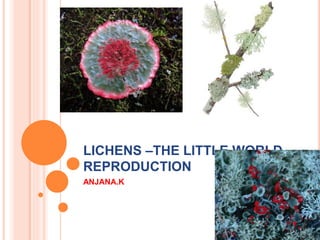
LICHENS –THE LITTLE WORLD
REPRODUCTION
ANJANA.K
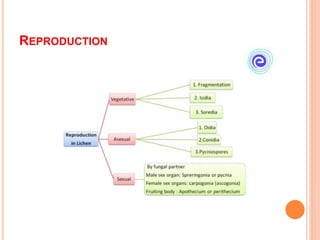
REPRODUCTION
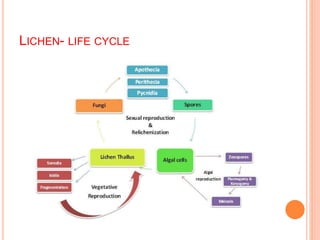
1. VEGETATIVE REPRODUCTION
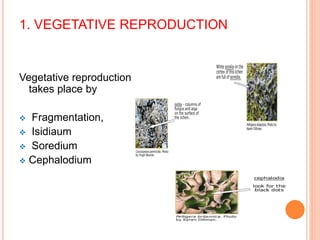
Vegetative reproduction
takes place by
 Fragmentation,
 Isidiaum
 Soredium
 Cephalodium
1.FRAGMENTATION

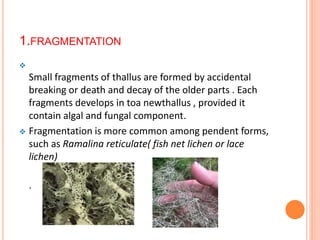
Small fragments of thallus are formed by accidental
breaking or death and decay of the older parts . Each
fragments develops in toa newthallus , provided it
contain algal and fungal component.
 Fragmentation is more common among pendent forms,
such as Ramalina reticulate( fish net lichen or lace
lichen)
.
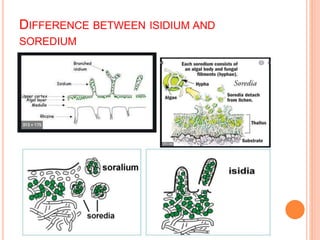
2.ISIDIUM
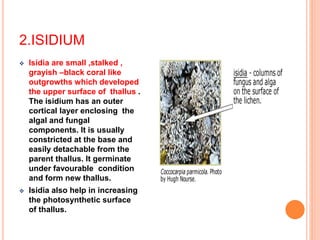
 Isidia are small ,stalked ,
grayish –black coral like
outgrowths which developed
the upper surface of thallus .
The isidium has an outer
cortical layer enclosing the
algal and fungal
components. It is usually
constricted at the base and
easily detachable from the
parent thallus. It germinate
under favourable condition
and form new thallus.
 Isidia also help in increasing
the photosynthetic surface
of thallus.
SHAPES OF ISIDIUM
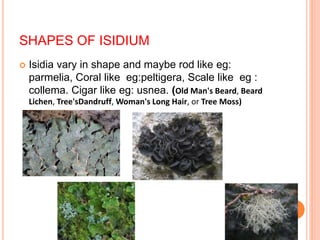
 Isidia vary in shape and maybe rod like eg:
parmelia, Coral like eg:peltigera, Scale like eg :
collema. Cigar like eg: usnea. (Old Man's Beard, Beard
Lichen, Tree'sDandruff, Woman's Long Hair, or Tree Moss)
3.SOREDIUM
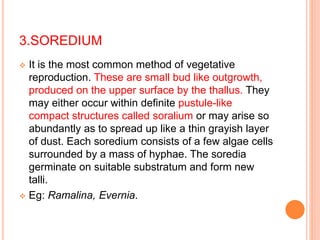
 It is the most common method of vegetative
reproduction. These are small bud like outgrowth,
produced on the upper surface by the thallus. They
may either occur within definite pustule-like
compact structures called soralium or may arise so
abundantly as to spread up like a thin grayish layer
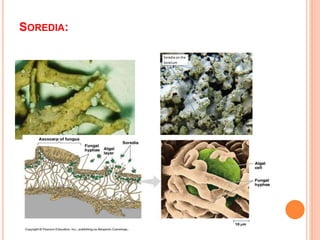
of dust. Each soredium consists of a few algae cells
surrounded by a mass of hyphae. The soredia
germinate on suitable substratum and form new
talli.
 Eg: Ramalina, Evernia.
SOREDIA:
DIFFERENCE BETWEEN ISIDIUM AND
SOREDIUM
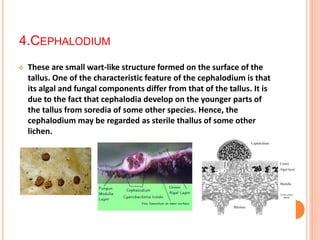
4.CEPHALODIUM
 These are small wart-like structure formed on the surface of the
tallus. One of the characteristic feature of the cephalodium is that
its algal and fungal components differ from that of the tallus. It is
due to the fact that cephalodia develop on the younger parts of
the tallus from soredia of some other species. Hence, the
cephalodium may be regarded as sterile thallus of some other
lichen.
ASEXUAL REPRODUCTION
 Lichens reproduce asexually by forming asexual spores
of fungal origin.
ASEXUALSPORES
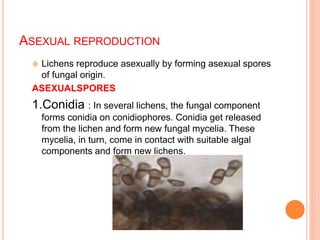
1.Conidia : In several lichens, the fungal component
forms conidia on conidiophores. Conidia get released
from the lichen and form new fungal mycelia. These
mycelia, in turn, come in contact with suitable algal
components and form new lichens.
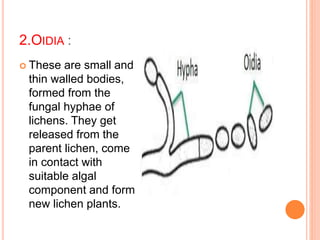
2.OIDIA :
 These are small and
thin walled bodies,
formed from the
fungal hyphae of
lichens. They get
released from the
parent lichen, come
in contact with
suitable algal
component and form
new lichen plants.
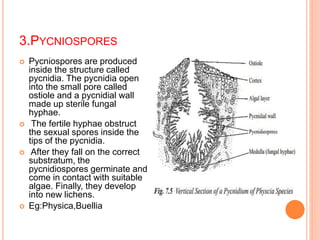
3.PYCNIOSPORES
 Pycniospores are produced
inside the structure called
pycnidia. The pycnidia open
into the small pore called
ostiole and a pycnidial wall
made up sterile fungal
hyphae.
 The fertile hyphae obstruct
the sexual spores inside the
tips of the pycnidia.
 After they fall on the correct
substratum, the
pycnidiospores germinate and
come in contact with suitable
algae. Finally, they develop
into new lichens.
 Eg:Physica,Buellia
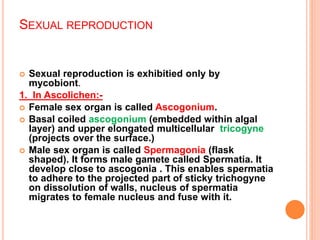
SEXUAL REPRODUCTION
 Sexual reproduction is exhibitied only by
mycobiont.
1. In Ascolichen:-
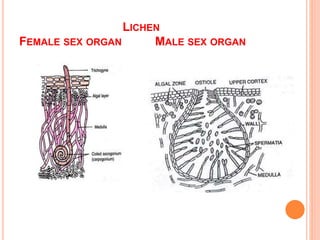
 Female sex organ is called Ascogonium.
 Basal coiled ascogonium (embedded within algal
layer) and upper elongated multicellular tricogyne
(projects over the surface.)
 Male sex organ is called Spermagonia (flask
shaped). It forms male gamete called Spermatia. It
develop close to ascogonia . This enables spermatia
to adhere to the projected part of sticky trichogyne
on dissolution of walls, nucleus of spermatia
migrates to female nucleus and fuse with it.
LICHEN
FEMALE SEX ORGAN MALE SEX ORGAN
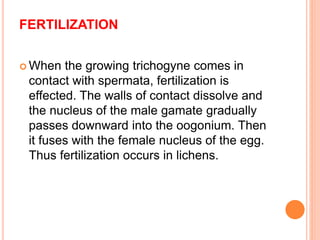
FERTILIZATION
 When the growing trichogyne comes in
contact with spermata, fertilization is
effected. The walls of contact dissolve and
the nucleus of the male gamate gradually
passes downward into the oogonium. Then
it fuses with the female nucleus of the egg.
Thus fertilization occurs in lichens.
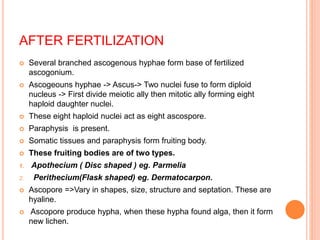
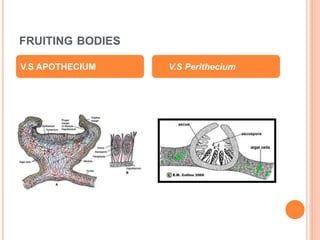
AFTER FERTILIZATION
 Several branched ascogenous hyphae form base of fertilized
ascogonium.
 Ascogeouns hyphae -> Ascus-> Two nuclei fuse to form diploid
nucleus -> First divide meiotic ally then mitotic ally forming eight
haploid daughter nuclei.
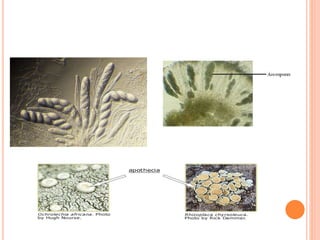
 These eight haploid nuclei act as eight ascospore.
 Paraphysis is present.
 Somatic tissues and paraphysis form fruiting body.
 These fruiting bodies are of two types.
1. Apothecium ( Disc shaped ) eg. Parmelia
2. Perithecium(Flask shaped) eg. Dermatocarpon.
 Ascopore =>Vary in shapes, size, structure and septation. These are
hyaline.
 Ascopore produce hypha, when these hypha found alga, then it form
new lichen.
FRUITING BODIES
V.S APOTHECIUM V.S Perithecium
2. IN BASIDIOLICHEN:-
The sexuality in Basidiolichens is very
much reduced. Sexual phenomenon is
represented only by the fusion of nucleus of
opposite strains to produce basidia. So
Basidiolichens reproduce by basidiospores
produced in basidia. Each basidium bears
four basidiospores at the tip of sterigmata.
LICHEN- LIFE CYCLE
REFERENCES
 A text book of botany ( SINGH-PANDE-JAIN)
 A Textbook of Botany P.N PANDEY& MISHRA

lichen reoroduction (new).pptx

  • 1.
    LICHENS –THE LITTLEWORLD REPRODUCTION ANJANA.K
  • 2.
  • 3.
    1. VEGETATIVE REPRODUCTION Vegetativereproduction takes place by  Fragmentation,  Isidiaum  Soredium  Cephalodium
  • 4.
    1.FRAGMENTATION  Small fragments ofthallus are formed by accidental breaking or death and decay of the older parts . Each fragments develops in toa newthallus , provided it contain algal and fungal component.  Fragmentation is more common among pendent forms, such as Ramalina reticulate( fish net lichen or lace lichen) .
  • 5.
    2.ISIDIUM  Isidia aresmall ,stalked , grayish –black coral like outgrowths which developed the upper surface of thallus . The isidium has an outer cortical layer enclosing the algal and fungal components. It is usually constricted at the base and easily detachable from the parent thallus. It germinate under favourable condition and form new thallus.  Isidia also help in increasing the photosynthetic surface of thallus.
  • 6.
    SHAPES OF ISIDIUM Isidia vary in shape and maybe rod like eg: parmelia, Coral like eg:peltigera, Scale like eg : collema. Cigar like eg: usnea. (Old Man's Beard, Beard Lichen, Tree'sDandruff, Woman's Long Hair, or Tree Moss)
  • 7.
    3.SOREDIUM  It isthe most common method of vegetative reproduction. These are small bud like outgrowth, produced on the upper surface by the thallus. They may either occur within definite pustule-like compact structures called soralium or may arise so abundantly as to spread up like a thin grayish layer of dust. Each soredium consists of a few algae cells surrounded by a mass of hyphae. The soredia germinate on suitable substratum and form new talli.  Eg: Ramalina, Evernia.
  • 8.
  • 9.
  • 10.
    4.CEPHALODIUM  These aresmall wart-like structure formed on the surface of the tallus. One of the characteristic feature of the cephalodium is that its algal and fungal components differ from that of the tallus. It is due to the fact that cephalodia develop on the younger parts of the tallus from soredia of some other species. Hence, the cephalodium may be regarded as sterile thallus of some other lichen.
  • 11.
    ASEXUAL REPRODUCTION  Lichensreproduce asexually by forming asexual spores of fungal origin. ASEXUALSPORES 1.Conidia : In several lichens, the fungal component forms conidia on conidiophores. Conidia get released from the lichen and form new fungal mycelia. These mycelia, in turn, come in contact with suitable algal components and form new lichens.
  • 12.
    2.OIDIA :  Theseare small and thin walled bodies, formed from the fungal hyphae of lichens. They get released from the parent lichen, come in contact with suitable algal component and form new lichen plants.
  • 13.
    3.PYCNIOSPORES  Pycniospores areproduced inside the structure called pycnidia. The pycnidia open into the small pore called ostiole and a pycnidial wall made up sterile fungal hyphae.  The fertile hyphae obstruct the sexual spores inside the tips of the pycnidia.  After they fall on the correct substratum, the pycnidiospores germinate and come in contact with suitable algae. Finally, they develop into new lichens.  Eg:Physica,Buellia
  • 14.
    SEXUAL REPRODUCTION  Sexualreproduction is exhibitied only by mycobiont. 1. In Ascolichen:-  Female sex organ is called Ascogonium.  Basal coiled ascogonium (embedded within algal layer) and upper elongated multicellular tricogyne (projects over the surface.)  Male sex organ is called Spermagonia (flask shaped). It forms male gamete called Spermatia. It develop close to ascogonia . This enables spermatia to adhere to the projected part of sticky trichogyne on dissolution of walls, nucleus of spermatia migrates to female nucleus and fuse with it.
  • 15.
  • 16.
    FERTILIZATION  When thegrowing trichogyne comes in contact with spermata, fertilization is effected. The walls of contact dissolve and the nucleus of the male gamate gradually passes downward into the oogonium. Then it fuses with the female nucleus of the egg. Thus fertilization occurs in lichens.
  • 17.
    AFTER FERTILIZATION  Severalbranched ascogenous hyphae form base of fertilized ascogonium.  Ascogeouns hyphae -> Ascus-> Two nuclei fuse to form diploid nucleus -> First divide meiotic ally then mitotic ally forming eight haploid daughter nuclei.  These eight haploid nuclei act as eight ascospore.  Paraphysis is present.  Somatic tissues and paraphysis form fruiting body.  These fruiting bodies are of two types. 1. Apothecium ( Disc shaped ) eg. Parmelia 2. Perithecium(Flask shaped) eg. Dermatocarpon.  Ascopore =>Vary in shapes, size, structure and septation. These are hyaline.  Ascopore produce hypha, when these hypha found alga, then it form new lichen.
  • 18.
  • 20.
    2. IN BASIDIOLICHEN:- Thesexuality in Basidiolichens is very much reduced. Sexual phenomenon is represented only by the fusion of nucleus of opposite strains to produce basidia. So Basidiolichens reproduce by basidiospores produced in basidia. Each basidium bears four basidiospores at the tip of sterigmata.
  • 21.
  • 22.
    REFERENCES  A textbook of botany ( SINGH-PANDE-JAIN)  A Textbook of Botany P.N PANDEY& MISHRA