Course Code: Bot-301
Course Title: Diversity of Plants
Credit Hours: 3(2-1)
Dr. Riffat Nasim Fatima and
Dr. Sana Tehseen
Assistant professor
Department of Botany
GCWUF
Cycas is commonly found in tropical and subtropical regions
of the world
Cycas revoluta (sago palm) is most common and widely
studied species in the sub-continent
It is cultivated for yield of starch-rich sago used as food
Cycas circinalis is cultivated as ornamental for its large
attractive palm-like leaves
Systematic Position
Gymnospermae
Division: Cycadophyta
Class: Cycadopsida
Order: Cycadales
Family: Cycadaceae
Genus: Cycas
(Greek word kykos means a palm/cocopalm)
Plant Body
Cycas plant body is a
heterosporous sporophyte
Cycas plant shows a short,
tuberous, unbranched stem which
bears a crown of large fern-like
leaves
Stem is covered with tough leaf
bases
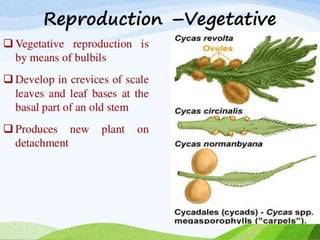
In some species large adventitious
buds called bulbils develop on the
basal part of the stem
These bulbils contain reserve food
material and help in vegetative
propagation
Leave of caycas are pinnately compound and exhibit
circinate vernation
Shoot apex is protected by a rosette of brown scale leaves
Plants grow very slowly adding a new crow of leaves every
2 or 3 years, alternating with a crown of scale leaves
Each crown remain on the stem for many years
Root of cycas plant is of two types;
Normal and Coralloid
Normal roots:
Normal tap roots grow from radical deep inside the soil
giving out lateral branches
Some of the lateral roots grow apogeotropically towards the
surface of soil and branch dichotomously
These roots are short, thick and swollen at the tips
Much branched mass appears like a coral on the soil surface
hence called as coralloid roots
Do not bear root caps
Cluster has lenticel like apertures
Become infested with blue green algae to fin atmospheric
N2
In this way a symbiotic relationship is established
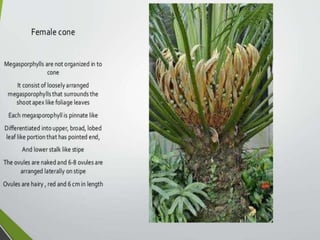
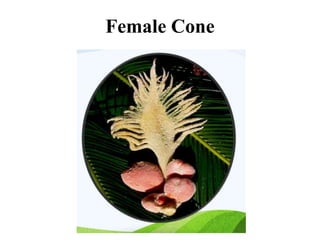
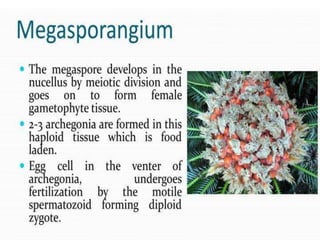
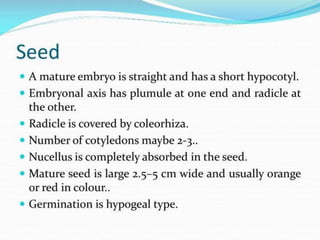
Female Cone
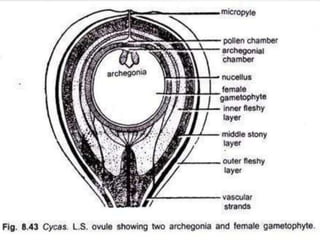
Structure of Ovule
Ovule is erect and has an opening called as micropyle
The part opposite to micropyle is called as chalaza
Massive nucellus is surrounded by a single integument
Integument is differentiated into outer, inner and middle
layer (thick that become stony during seed formation)
The nucellus is equivalent to megasporangium and consists
of thin walled parenchyma having dense cytoplasm
Nucellus grows into a beak called nucellor beak
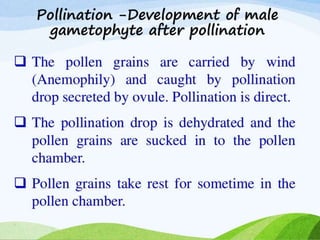
The upper part of beak form pollen chamber and pollens are
lodged into it after pollination
References
https://study.com/academy/lesson/gymnosper
ms-characteristics-definition-types.html
https://www.slideshare.net/SyedaFari2/cycas
https://www.slideshare.net/MohdTariq25/gym
nosperm-characteristics
https://slideplayer.com/slide/14446521/
https://www.slideserve.com/varsha/cycas-
structure-reproduction-life-cycle
https://www.easybiologyclass.com/general-
characters-of-gymnosperms-lecture-notes-
with-ppt/
cycas.pptx