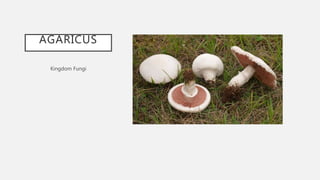
AGARICUS
Kingdom Fungi
TAXONOMIC POSITION
Kingdom : fungi
Division : Amastigomycotina
Sub-division : Basidiomycotina
Class :Holobasidiomycetidae
Order : Agaricales
Family : Agaricaceae
Genus : Agaricus
Species : A.compestris
HABITAT
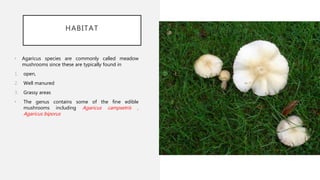
• Agaricus species are commonly called meadow
mushrooms since these are typically found in
1. open,
2. Well manured
3. Grassy areas
• The genus contains some of the fine edible
mushrooms including Agaricus campsetris ,
Agaricus biporus
AGARICUS COMPESTRIS
Agaricus compestris ( L. campaster =relating to plain or
flat field )
• It is common edible, and cosmopolitan species
• It grows in damp and dead organic substances such
as humus, horse dung, damp rotten wooden logs.,
tree trunks, and meadows in decaying organic mater
PLANT BODY
• The plant body of fungus can be
divided into tow main parts
1. the vegetative mycelium
2. basidiocarp formed of hyphae ( sexual
reproduction )
VEGETATIVE MYCELIUM
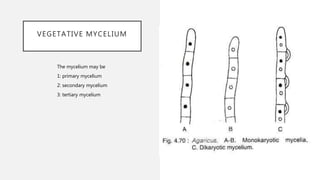
The mycelium may be
1: primary mycelium
2: secondary mycelium
3: tertiary mycelium
PRIMARY MYCELIUM
1. It is monokaryotic, short lived and develops from
germination of basidiospore
2. The hyphae are septate and hyaline
3. The cells are short and contain oil globules,
vacuoles and thin protoplasm
SECONDARY MYCELIUM
1. It is dikaryotic and arose by dikaryotization
through somatogamy of two compatible
monokaryotic hyphae
2. The hyphae composing secondary mycelium are
long , branched , septate and have short cells.
3. Typical dolipore septa are present between
adjacent cells
4. The secondary mycelium is more abundant ,
perinnating and produce mushrooms year after
year .
DOLIPORE SEPTUM
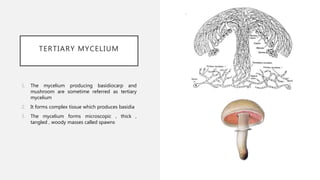
TERTIARY MYCELIUM
1. The mycelium producing basidiocarp and
mushroom are sometime referred as tertiary
mycelium
2. It forms complex tissue which produces basidia
3. The mycelium forms microscopic , thick ,
tangled , woody masses called spawns
REPRODUCTION
1. The fungus reproduces sexually usually
2. The definite sex organs are absent
3. Plasmogamy is done by fusion of two compatible
somatic hyphae , which results in the formation of
a dikaryon
4. The nuclei of the dikaryon to produce dikaryotic
secondary mycelium
5. The basidiocarp develop from the hyphae of
subterranean , perennial secondary mycelium
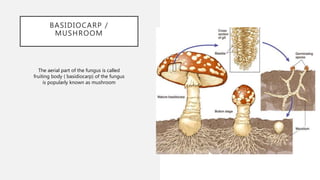
BASIDIOCARP /
MUSHROOM
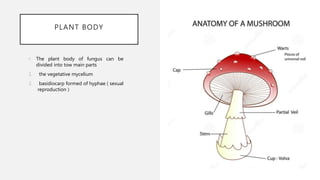
The aerial part of the fungus is called
fruiting body ( basidiocarp) of the fungus
is popularly known as mushroom
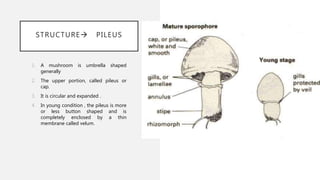
STRUCTURE PILEUS
1. A mushroom is umbrella shaped
generally
2. The upper portion, called pileus or
cap.
3. It is circular and expanded .
4. In young condition , the pileus is more
or less button shaped and is
completely enclosed by a thin
membrane called velum.
STIPE
The pileus is borne on a fleshy , pinkish –white ,
stalk called stipe
As the pileus grows in size the velum ruptures
and its remnants surround the stipe , called
annulus
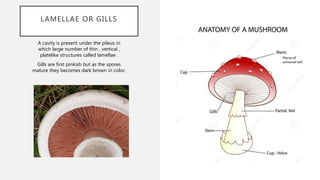
LAMELLAE OR GILLS
A cavity is present under the pileus in
which large number of thin , vertical ,
platelike structures called lamellae .
Gills are first pinkish but as the spores
mature they becomes dark brown in color.
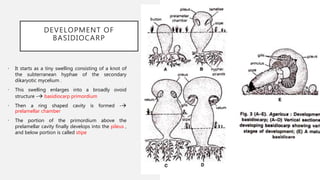
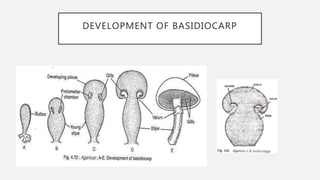
DEVELOPMENT OF
BASIDIOCARP
• It starts as a tiny swelling consisting of a knot of
the subterranean hyphae of the secondary
dikaryotic mycelium .
• This swelling enlarges into a broadly ovoid
structure - basidiocarp primordium
• Then a ring shaped cavity is formed -
prelamellar chamber
• The portion of the primordium above the
prelamellar cavity finally develops into the pileus ,
and below portion is called stipe
DEVELOPMENT OF BASIDIOCARP
LAMELLAE
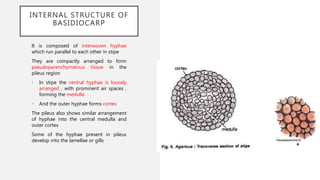
INTERNAL STRUCTURE OF
BASIDIOCARP
It is composed of interwoven hyphae
which run parallel to each other in stipe
They are compactly arranged to form
pseudoparenchymatous tissue in the
pileus region
• In stipe the central hyphae is loosely
arranged , with prominent air spaces ,
forming the medulla
• And the outer hyphae forms cortex
The pileus also shows similar arrangement
of hyphae into the central medulla and
outer cortex
Some of the hyphae present in pileus
develop into the lamellae or gills
STRUCTURE OF LAMELLA
Each lamella consists of three parts .
1. Hymenium
2. Trama
3. Sub-hymenium
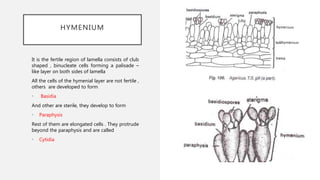
HYMENIUM
It is the fertile region of lamella consists of club
shaped , binucleate cells forming a palisade –
like layer on both sides of lamella
All the cells of the hymenial layer are not fertile ,
others are developed to form
• Basidia
And other are sterile, they develop to form
• Paraphysis
Rest of them are elongated cells . They protrude
beyond the paraphysis and are called
• Cytidia
TRAMA
Internal to hymenium is called trama
It consists of multinucleated elongated
cells . That extends from hyphae of the
pileus
This hyphae are so oriented that their long
axis lie parallel to the hymenium
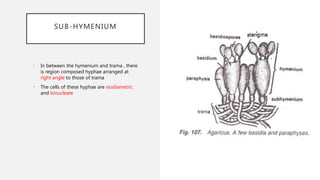
SUB-HYMENIUM
• In between the hymenium and trama , there
is region composed hyphae arranged at
right angle to those of trama
• The cells of these hyphae are isodiametric
and binucleate
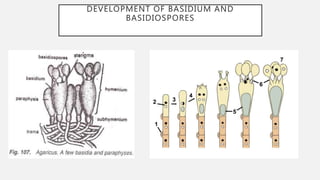
DEVELOPMENT OF BASIDIUM AND
BASIDIOSPORES
DISCHARGE OF
BASIDIOSPORE
BY SMALL DROP OF
LIQUID
FAIRY RINGS
MARASMIUS OREADES
AGARICUS CAMPSETRIS
LIFE CYCLE OF MUSHROOM

Agaricus

  • 1.
  • 2.
    TAXONOMIC POSITION Kingdom :fungi Division : Amastigomycotina Sub-division : Basidiomycotina Class :Holobasidiomycetidae Order : Agaricales Family : Agaricaceae Genus : Agaricus Species : A.compestris
  • 3.
    HABITAT • Agaricus speciesare commonly called meadow mushrooms since these are typically found in 1. open, 2. Well manured 3. Grassy areas • The genus contains some of the fine edible mushrooms including Agaricus campsetris , Agaricus biporus
  • 4.
    AGARICUS COMPESTRIS Agaricus compestris( L. campaster =relating to plain or flat field ) • It is common edible, and cosmopolitan species • It grows in damp and dead organic substances such as humus, horse dung, damp rotten wooden logs., tree trunks, and meadows in decaying organic mater
  • 5.
    PLANT BODY • Theplant body of fungus can be divided into tow main parts 1. the vegetative mycelium 2. basidiocarp formed of hyphae ( sexual reproduction )
  • 6.
    VEGETATIVE MYCELIUM The myceliummay be 1: primary mycelium 2: secondary mycelium 3: tertiary mycelium
  • 7.
    PRIMARY MYCELIUM 1. Itis monokaryotic, short lived and develops from germination of basidiospore 2. The hyphae are septate and hyaline 3. The cells are short and contain oil globules, vacuoles and thin protoplasm
  • 8.
    SECONDARY MYCELIUM 1. Itis dikaryotic and arose by dikaryotization through somatogamy of two compatible monokaryotic hyphae 2. The hyphae composing secondary mycelium are long , branched , septate and have short cells. 3. Typical dolipore septa are present between adjacent cells 4. The secondary mycelium is more abundant , perinnating and produce mushrooms year after year .
  • 9.
  • 10.
    TERTIARY MYCELIUM 1. Themycelium producing basidiocarp and mushroom are sometime referred as tertiary mycelium 2. It forms complex tissue which produces basidia 3. The mycelium forms microscopic , thick , tangled , woody masses called spawns
  • 11.
    REPRODUCTION 1. The fungusreproduces sexually usually 2. The definite sex organs are absent 3. Plasmogamy is done by fusion of two compatible somatic hyphae , which results in the formation of a dikaryon 4. The nuclei of the dikaryon to produce dikaryotic secondary mycelium 5. The basidiocarp develop from the hyphae of subterranean , perennial secondary mycelium
  • 12.
    BASIDIOCARP / MUSHROOM The aerialpart of the fungus is called fruiting body ( basidiocarp) of the fungus is popularly known as mushroom
  • 13.
    STRUCTURE PILEUS 1. Amushroom is umbrella shaped generally 2. The upper portion, called pileus or cap. 3. It is circular and expanded . 4. In young condition , the pileus is more or less button shaped and is completely enclosed by a thin membrane called velum.
  • 14.
    STIPE The pileus isborne on a fleshy , pinkish –white , stalk called stipe As the pileus grows in size the velum ruptures and its remnants surround the stipe , called annulus
  • 15.
    LAMELLAE OR GILLS Acavity is present under the pileus in which large number of thin , vertical , platelike structures called lamellae . Gills are first pinkish but as the spores mature they becomes dark brown in color.
  • 16.
    DEVELOPMENT OF BASIDIOCARP • Itstarts as a tiny swelling consisting of a knot of the subterranean hyphae of the secondary dikaryotic mycelium . • This swelling enlarges into a broadly ovoid structure - basidiocarp primordium • Then a ring shaped cavity is formed - prelamellar chamber • The portion of the primordium above the prelamellar cavity finally develops into the pileus , and below portion is called stipe
  • 17.
  • 18.
  • 19.
    INTERNAL STRUCTURE OF BASIDIOCARP Itis composed of interwoven hyphae which run parallel to each other in stipe They are compactly arranged to form pseudoparenchymatous tissue in the pileus region • In stipe the central hyphae is loosely arranged , with prominent air spaces , forming the medulla • And the outer hyphae forms cortex The pileus also shows similar arrangement of hyphae into the central medulla and outer cortex Some of the hyphae present in pileus develop into the lamellae or gills
  • 20.
    STRUCTURE OF LAMELLA Eachlamella consists of three parts . 1. Hymenium 2. Trama 3. Sub-hymenium
  • 21.
    HYMENIUM It is thefertile region of lamella consists of club shaped , binucleate cells forming a palisade – like layer on both sides of lamella All the cells of the hymenial layer are not fertile , others are developed to form • Basidia And other are sterile, they develop to form • Paraphysis Rest of them are elongated cells . They protrude beyond the paraphysis and are called • Cytidia
  • 22.
    TRAMA Internal to hymeniumis called trama It consists of multinucleated elongated cells . That extends from hyphae of the pileus This hyphae are so oriented that their long axis lie parallel to the hymenium
  • 23.
    SUB-HYMENIUM • In betweenthe hymenium and trama , there is region composed hyphae arranged at right angle to those of trama • The cells of these hyphae are isodiametric and binucleate
  • 24.
    DEVELOPMENT OF BASIDIUMAND BASIDIOSPORES
  • 25.
  • 26.
  • 27.
  • 28.
  • 29.
    LIFE CYCLE OFMUSHROOM