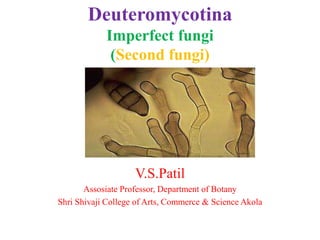
Deuteromycotina
Imperfect fungi
(Second fungi)
V.S.Patil
Assosiate Professor, Department of Botany
Shri Shivaji College of Arts, Commerce & Science Akola
General charecters-
1.Deuteromycetes occur mostly as saprophytes on a
wide range of substrates, but a large number of them
are parasites on plants and animals (including
humans) and cause a variety of diseases.
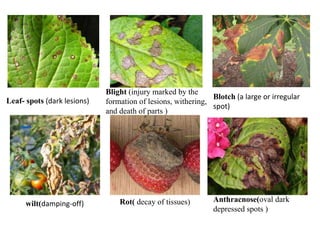
2.Leaf- spots, blights, blotch, wilts, rots, anthracnose,
etc. are the important diseases of plants, while
diseases like meningitis, candidiasis, skin diseases,
nail diseases, dermatomycosis as ringworms,
athlete’s foot, etc. occur in animals (including
humans).
3.The species of fungi that reproduce asexually of the
fungal division Ascomycota & Basidiomycota.
Blight (injury marked by the
formation of lesions, withering,
and death of parts )
Leaf- spots (dark lesions)
Blotch (a large or irregular
spot)
wilt(damping-off) Rot( decay of tissues) Anthracnose(oval dark
depressed spots )
Meningitis( inflammation of
the brain and spinal cord lining) Candidiasis skin diseases
Nail diseases Ringworms Athlete’s foot,
4.These fungi are also known as the asexual fungi or fungi
imperfecti or mitosporic fungi. These fungi will not reproduce
sexually so known as the imperfect fungi.
5.The somatic body is characterized by the production of septate
mycelium, branched hyphae and asexual life cycle.
The hyphae may be inter- or intracellular, and their cell wall chiefly
contains chitin-glucan.
6.The certain fungus produces appressoria and haustoria.
7.The asexual reproduction may take place by hyphal fragments,
budding (common in Blastomycetes), arthrospores (flat-ended asexual
spores formed by the breaking up of cells from the hypha),
chlamydospores (thick-walled modified cells functioning as resting
spores), or most commonly by conidia or conidiospores (nonmotile
spores formed externally on the surface of hyphae or on specialized
hyphal branches called conidiophores).
8. The cell of conidiophore that produces conidia is called
conidiogenous cell and the conidia may be produced either at
the tip or side of the conidiogenous cell either singly or in
chains.
9.The conidiophores are either frees from one anther
(mononematous) or they may be aggregated to form
specialized structures such as synnemata and sporodochia.
10.In large number of Deuteromycetes, the conidiophores are
formed in more specialized and organized fruiting layers
present within the specialized fruiting bodies called
conidiomata (sing. Conidioma; formerly called conidiocarps).
The conidiomata may be acervulus or pycnidium.
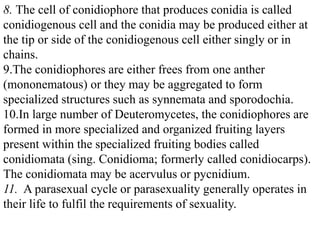
11. A parasexual cycle or parasexuality generally operates in
their life to fulfil the requirements of sexuality.
12. Deuteromycetes abundantly occur in soil where
they play a vital role in the decomposition of organic
matter and thus bring about recycling of nutrients in
nature.
13. Some deuteromycetous fungi are medicinally very
important. For convenience, the wonder drug
penicillin is commercially obtained from Penicillium
chrysogenum, whereas P. griseofulvum is the source of
the production of griseofulvin antibiotic.
14. The use of deuteromycetous fungi in fermentation
is so important that without them there would be no
such fermentation industry as it is in their presence.
Many new and novel chemical compounds are
obtained from these fungi at industrial level.
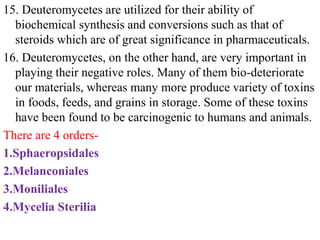
15. Deuteromycetes are utilized for their ability of
biochemical synthesis and conversions such as that of
steroids which are of great significance in pharmaceuticals.
16. Deuteromycetes, on the other hand, are very important in
playing their negative roles. Many of them bio-deteriorate
our materials, whereas many more produce variety of toxins
in foods, feeds, and grains in storage. Some of these toxins
have been found to be carcinogenic to humans and animals.
There are 4 orders-
1.Sphaeropsidales
2.Melanconiales
3.Moniliales
4.Mycelia Sterilia
Sphaeropsidales-An order of imperfect fungi in which the conidia are produced in
pycnidia or similar chambered cavities and which include both saprophytes and
parasites.(A)
Melanconiales-An order of imperfect fungi that have the conidia borne in acervuli
which are either immersed or erumpent and that are parasites of higher plants.(B)
Moniliales- An order of imperfect fungi lacking conidiophores or having conidiophores
that are superficial and free or gathered in tufts or cushion-shaped masses. (C)
Mycelia Sterilia-
A B C
A group that is usually considered more or less equivalent to an order and
that comprises genera of imperfect fungi having no known spore stage and
producing sclerotia, rhizomorphs, or simply mycelial masses.(D)
D
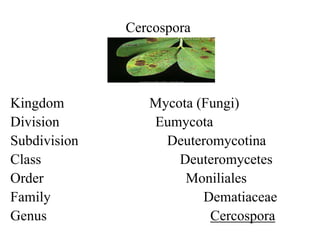
Cercospora
Kingdom Mycota (Fungi)
Division Eumycota
Subdivision Deuteromycotina
Class Deuteromycetes
Order Moniliales
Family Dematiaceae
Genus Cercospora
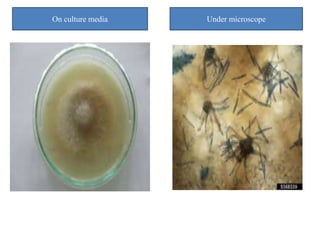
On culture media Under microscope
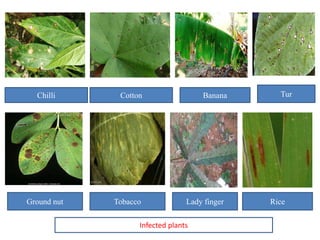
Tobacco
Chilli Cotton
Ground nut
Banana
Lady finger Rice
Tur
Infected plants
Introduction-
It commonly occurs parasitically on many plants of
economic importance, and causes the leaf spot disease
on arhar, cotton, rice, chillies, Calotropis, Arachis
hypogaea.
1.Leaf spot or Tikka disease of ground nut −C.
arachidicola, C. personata
2.Sigatoka’ leaf-spot disease of banana − C. musae
3.‘Frog-eye’ leaf-spot of tobacco − C. necotinae
4.Leaf-spot disease of lady’s finger − C. hibiscus
5.Leaf-spot disease of cajanus cajan − C. indica
6.Leaf-spot disease of cotton− C. gossypina
7.Leaf-spot disease of rice − C. oryzae.
1. Habit and Habitat
Cercospora is a very large genus of family
Dematiaceae. It includes about 3800 form-species.
Majority of the species are parasitic and cause leaf
spot of economically important plants. C. apii is a
human pathogen and may cause several lesions on the
face.
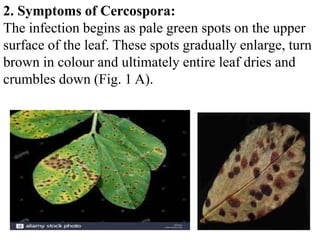
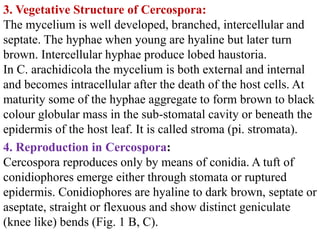
2. Symptoms of Cercospora:
The infection begins as pale green spots on the upper
surface of the leaf. These spots gradually enlarge, turn
brown in colour and ultimately entire leaf dries and
crumbles down (Fig. 1 A).
3. Vegetative Structure of Cercospora:
The mycelium is well developed, branched, intercellular and
septate. The hyphae when young are hyaline but later turn
brown. Intercellular hyphae produce lobed haustoria.
In C. arachidicola the mycelium is both external and internal
and becomes intracellular after the death of the host cells. At
maturity some of the hyphae aggregate to form brown to black
colour globular mass in the sub-stomatal cavity or beneath the
epidermis of the host leaf. It is called stroma (pi. stromata).
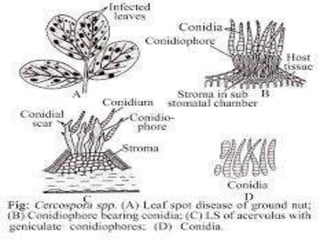
4. Reproduction in Cercospora:
Cercospora reproduces only by means of conidia. A tuft of
conidiophores emerge either through stomata or ruptured
epidermis. Conidiophores are hyaline to dark brown, septate or
aseptate, straight or flexuous and show distinct geniculate
(knee like) bends (Fig. 1 B, C).
Each conidiophore forms single conidium acrogenously at its
apex. The growth of the conidiophore is renewed after the
formation of first conidium. The mature conidium is pushed
aside due to sub-apical growth of the conidiophore. On
detachment each conidium leaves a geniculate scar or conidial
scar on the conidiophore at the place of its attachment.
Conidia are long cylindrical, obclavate, multi-septate
(tranverse septa), hyaline or brownish in colour (Fig. 1 D).
They vary in size but always have a breadth, length ratio of 1:
10 − 1: 150.
The conidia are disseminated by wind or rain splash. Under
suitable conditions (24-28°C temperature) conidia germinate
by giving rise to one or more germ tubes. Each germ tube
develops into a new mycelium. The perfect stages of C.
arachidicola and C. personata are Mycosphaerella arachidicola
and M. berkeleyii respectively.
Cercospora
Cercospora
Cercospora

Cercospora

  • 1.
    Deuteromycotina Imperfect fungi (Second fungi) V.S.Patil AssosiateProfessor, Department of Botany Shri Shivaji College of Arts, Commerce & Science Akola
  • 2.
    General charecters- 1.Deuteromycetes occurmostly as saprophytes on a wide range of substrates, but a large number of them are parasites on plants and animals (including humans) and cause a variety of diseases. 2.Leaf- spots, blights, blotch, wilts, rots, anthracnose, etc. are the important diseases of plants, while diseases like meningitis, candidiasis, skin diseases, nail diseases, dermatomycosis as ringworms, athlete’s foot, etc. occur in animals (including humans). 3.The species of fungi that reproduce asexually of the fungal division Ascomycota & Basidiomycota.
  • 3.
    Blight (injury markedby the formation of lesions, withering, and death of parts ) Leaf- spots (dark lesions) Blotch (a large or irregular spot) wilt(damping-off) Rot( decay of tissues) Anthracnose(oval dark depressed spots )
  • 4.
    Meningitis( inflammation of thebrain and spinal cord lining) Candidiasis skin diseases Nail diseases Ringworms Athlete’s foot,
  • 5.
    4.These fungi arealso known as the asexual fungi or fungi imperfecti or mitosporic fungi. These fungi will not reproduce sexually so known as the imperfect fungi. 5.The somatic body is characterized by the production of septate mycelium, branched hyphae and asexual life cycle. The hyphae may be inter- or intracellular, and their cell wall chiefly contains chitin-glucan. 6.The certain fungus produces appressoria and haustoria. 7.The asexual reproduction may take place by hyphal fragments, budding (common in Blastomycetes), arthrospores (flat-ended asexual spores formed by the breaking up of cells from the hypha), chlamydospores (thick-walled modified cells functioning as resting spores), or most commonly by conidia or conidiospores (nonmotile spores formed externally on the surface of hyphae or on specialized hyphal branches called conidiophores).
  • 6.
    8. The cellof conidiophore that produces conidia is called conidiogenous cell and the conidia may be produced either at the tip or side of the conidiogenous cell either singly or in chains. 9.The conidiophores are either frees from one anther (mononematous) or they may be aggregated to form specialized structures such as synnemata and sporodochia. 10.In large number of Deuteromycetes, the conidiophores are formed in more specialized and organized fruiting layers present within the specialized fruiting bodies called conidiomata (sing. Conidioma; formerly called conidiocarps). The conidiomata may be acervulus or pycnidium. 11. A parasexual cycle or parasexuality generally operates in their life to fulfil the requirements of sexuality.
  • 7.
    12. Deuteromycetes abundantlyoccur in soil where they play a vital role in the decomposition of organic matter and thus bring about recycling of nutrients in nature. 13. Some deuteromycetous fungi are medicinally very important. For convenience, the wonder drug penicillin is commercially obtained from Penicillium chrysogenum, whereas P. griseofulvum is the source of the production of griseofulvin antibiotic. 14. The use of deuteromycetous fungi in fermentation is so important that without them there would be no such fermentation industry as it is in their presence. Many new and novel chemical compounds are obtained from these fungi at industrial level.
  • 8.
    15. Deuteromycetes areutilized for their ability of biochemical synthesis and conversions such as that of steroids which are of great significance in pharmaceuticals. 16. Deuteromycetes, on the other hand, are very important in playing their negative roles. Many of them bio-deteriorate our materials, whereas many more produce variety of toxins in foods, feeds, and grains in storage. Some of these toxins have been found to be carcinogenic to humans and animals. There are 4 orders- 1.Sphaeropsidales 2.Melanconiales 3.Moniliales 4.Mycelia Sterilia
  • 9.
    Sphaeropsidales-An order ofimperfect fungi in which the conidia are produced in pycnidia or similar chambered cavities and which include both saprophytes and parasites.(A) Melanconiales-An order of imperfect fungi that have the conidia borne in acervuli which are either immersed or erumpent and that are parasites of higher plants.(B) Moniliales- An order of imperfect fungi lacking conidiophores or having conidiophores that are superficial and free or gathered in tufts or cushion-shaped masses. (C) Mycelia Sterilia- A B C A group that is usually considered more or less equivalent to an order and that comprises genera of imperfect fungi having no known spore stage and producing sclerotia, rhizomorphs, or simply mycelial masses.(D) D
  • 10.
    Cercospora Kingdom Mycota (Fungi) DivisionEumycota Subdivision Deuteromycotina Class Deuteromycetes Order Moniliales Family Dematiaceae Genus Cercospora
  • 11.
    On culture mediaUnder microscope
  • 12.
    Tobacco Chilli Cotton Ground nut Banana Ladyfinger Rice Tur Infected plants
  • 13.
    Introduction- It commonly occursparasitically on many plants of economic importance, and causes the leaf spot disease on arhar, cotton, rice, chillies, Calotropis, Arachis hypogaea. 1.Leaf spot or Tikka disease of ground nut −C. arachidicola, C. personata 2.Sigatoka’ leaf-spot disease of banana − C. musae 3.‘Frog-eye’ leaf-spot of tobacco − C. necotinae 4.Leaf-spot disease of lady’s finger − C. hibiscus 5.Leaf-spot disease of cajanus cajan − C. indica 6.Leaf-spot disease of cotton− C. gossypina 7.Leaf-spot disease of rice − C. oryzae.
  • 14.
    1. Habit andHabitat Cercospora is a very large genus of family Dematiaceae. It includes about 3800 form-species. Majority of the species are parasitic and cause leaf spot of economically important plants. C. apii is a human pathogen and may cause several lesions on the face.
  • 15.
    2. Symptoms ofCercospora: The infection begins as pale green spots on the upper surface of the leaf. These spots gradually enlarge, turn brown in colour and ultimately entire leaf dries and crumbles down (Fig. 1 A).
  • 16.
    3. Vegetative Structureof Cercospora: The mycelium is well developed, branched, intercellular and septate. The hyphae when young are hyaline but later turn brown. Intercellular hyphae produce lobed haustoria. In C. arachidicola the mycelium is both external and internal and becomes intracellular after the death of the host cells. At maturity some of the hyphae aggregate to form brown to black colour globular mass in the sub-stomatal cavity or beneath the epidermis of the host leaf. It is called stroma (pi. stromata). 4. Reproduction in Cercospora: Cercospora reproduces only by means of conidia. A tuft of conidiophores emerge either through stomata or ruptured epidermis. Conidiophores are hyaline to dark brown, septate or aseptate, straight or flexuous and show distinct geniculate (knee like) bends (Fig. 1 B, C).
  • 17.
    Each conidiophore formssingle conidium acrogenously at its apex. The growth of the conidiophore is renewed after the formation of first conidium. The mature conidium is pushed aside due to sub-apical growth of the conidiophore. On detachment each conidium leaves a geniculate scar or conidial scar on the conidiophore at the place of its attachment. Conidia are long cylindrical, obclavate, multi-septate (tranverse septa), hyaline or brownish in colour (Fig. 1 D). They vary in size but always have a breadth, length ratio of 1: 10 − 1: 150. The conidia are disseminated by wind or rain splash. Under suitable conditions (24-28°C temperature) conidia germinate by giving rise to one or more germ tubes. Each germ tube develops into a new mycelium. The perfect stages of C. arachidicola and C. personata are Mycosphaerella arachidicola and M. berkeleyii respectively.