Agaricus
Dr. Rachana Choudhary
Asstt. Prof. Department of Microbiology
Shri Shankaracharya Mahavidyalaya Junwani Bhilai
Habit & Habitat
Species of Agaricus
Structure of Agaricus
Reproduction in Agaricus
1. Vegetative Reproduction
2. Asexual Reproduction
3. Sexual Reproduction
Conclusion
References
Synopsis
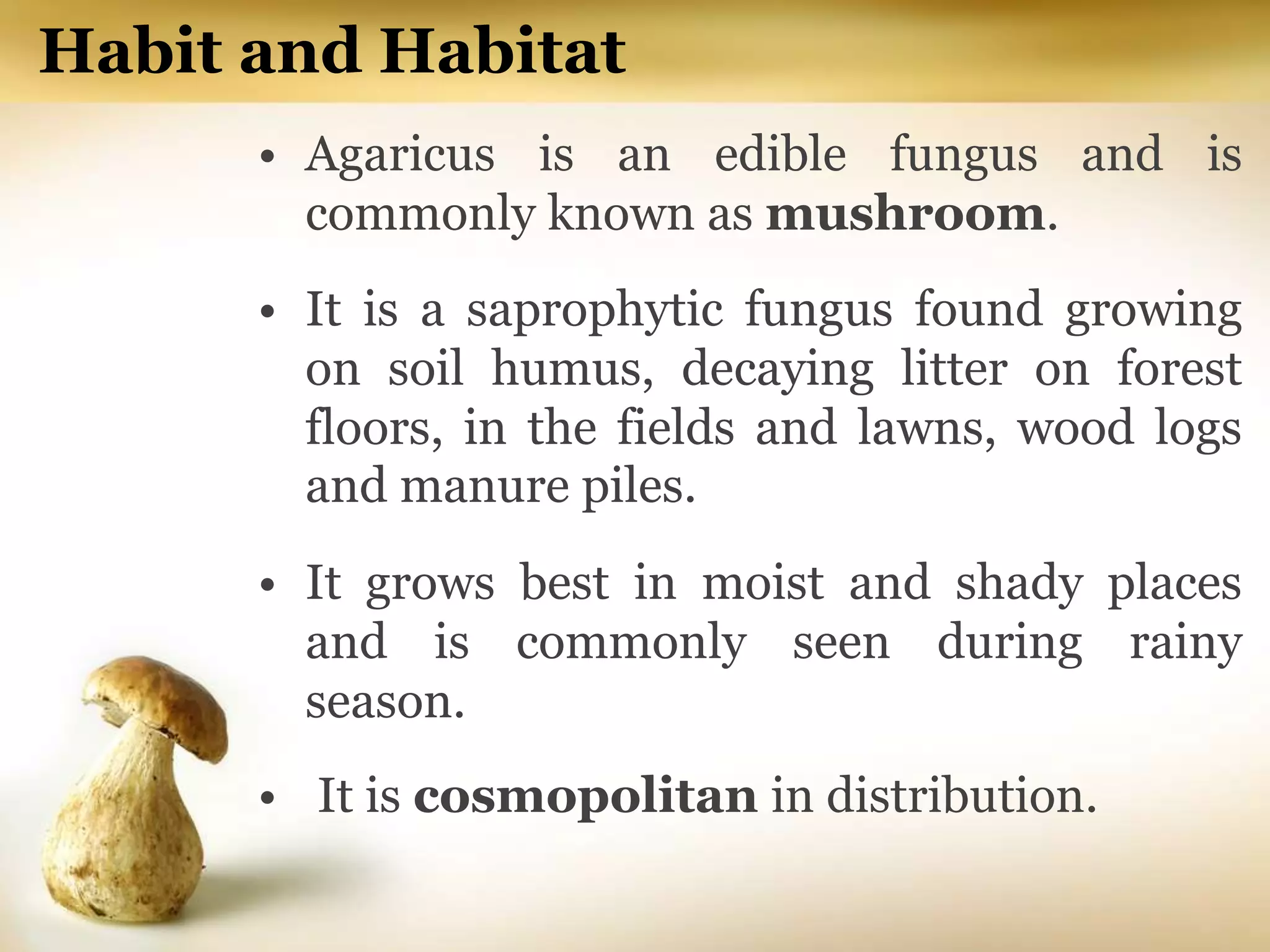
Habit and Habitat
• Agaricus is an edible fungus and is
commonly known as mushroom.
• It is a saprophytic fungus found growing
on soil humus, decaying litter on forest
floors, in the fields and lawns, wood logs
and manure piles.
• It grows best in moist and shady places
and is commonly seen during rainy
season.
• It is cosmopolitan in distribution.
Species of Agaricus
• About 25 species of Agaricus have been reported from India.
It is commonly known as kukurmutta in U.P. and
dhingri in Punjab.
• A. campestris (field mushroom),
• A. bisporus (A. brunnescence; white mushroom) are
common edible mushrooms.
• A. bisporus (cultivated mushroom) is widely cultivated for
food purposes in Solan (Himachal Pradesh).
– Some species of Agaricus are poisonous (e.g., A.
xanthoderma) and some species may cause
gastrointestinal disturbances in some persons (e.g., A.
placomyces, A. silvaticus).
Structure of Agaricus
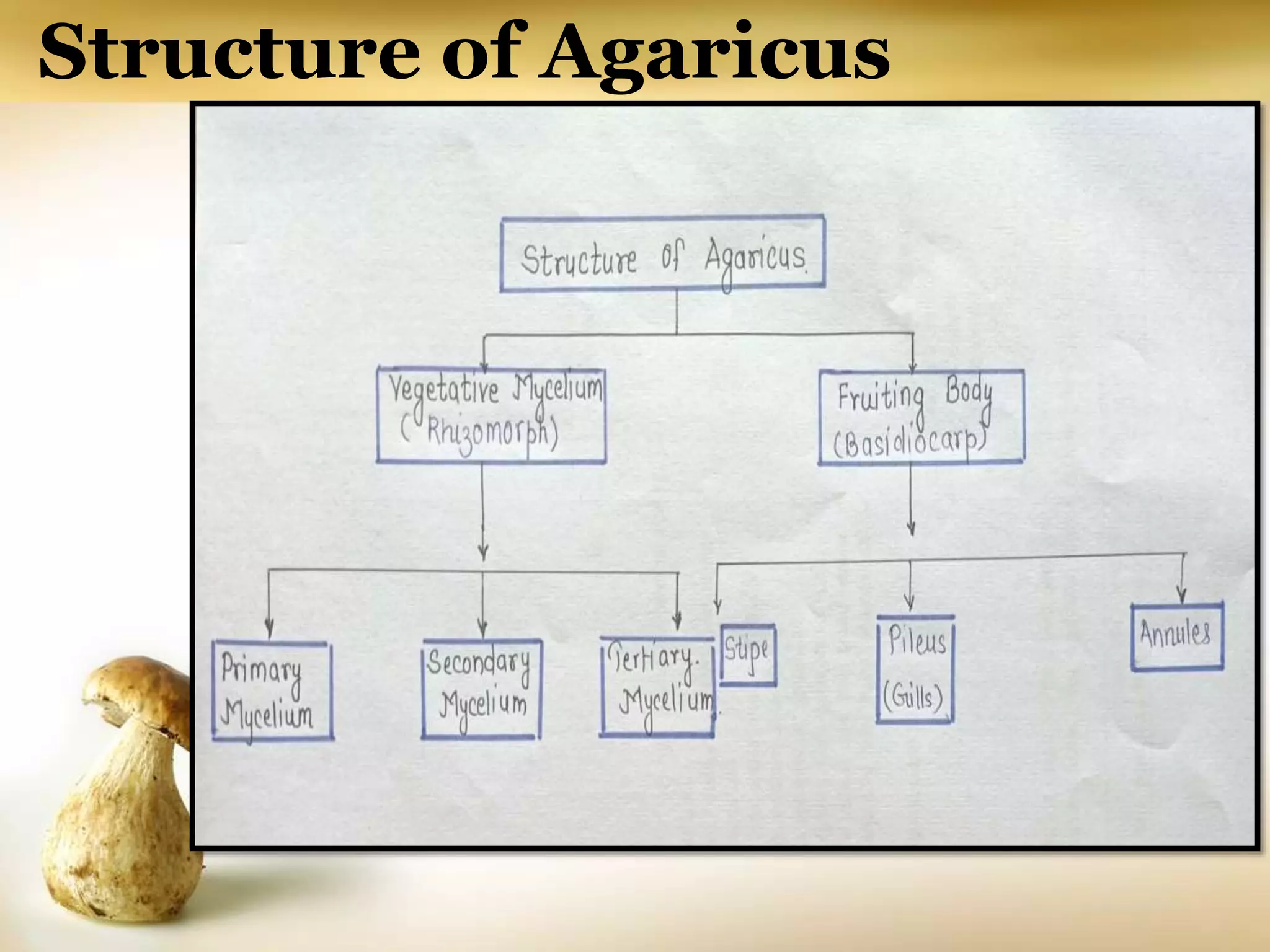
It can be studied in two
parts:
(a).Vegetative mycelium (living
inside the soil) Rhizomorph
(b).Fruiting body or
basidiocarp (present above
the soil and edible in young
stage)
Structure of Agaricus
(a) Vegetative Structure
• Vegetative mycelium is of three
types:
• Primary Mycelium:
• It originates by the germination of
uninucleate basidiospores carrying
either ‘+’ or ‘-‘ strain. The cells are
uninucleate i.e., monokaryotic. It is
short lived and becomes bi-nucleate
by fusing of two compatible hyphae
(Fig. 1 A).
Secondary Mycelium:
• It originates from primary mycelium. After fusion of the
hyphae of two opposite strains, the nucleus from one hypha
migrates to the other and later gives rise to the bi-nucleate
secondary mycelium i.e., dikaryotic. It is long lived and
abundant .
Tertiary Mycelium:
• The secondary mycelium grows extensively under the soil and
becomes organised into special tissue to form the fruiting
body or basidiocarp
• The fruiting body appears like umbrella above ground. It
is made up of dikaryotic hyphae. These hyphae are
called tertiary mycelium. The mycelium is
subterranean. The hyphae are septate and
branched.
Fairy Rings of Agaricus
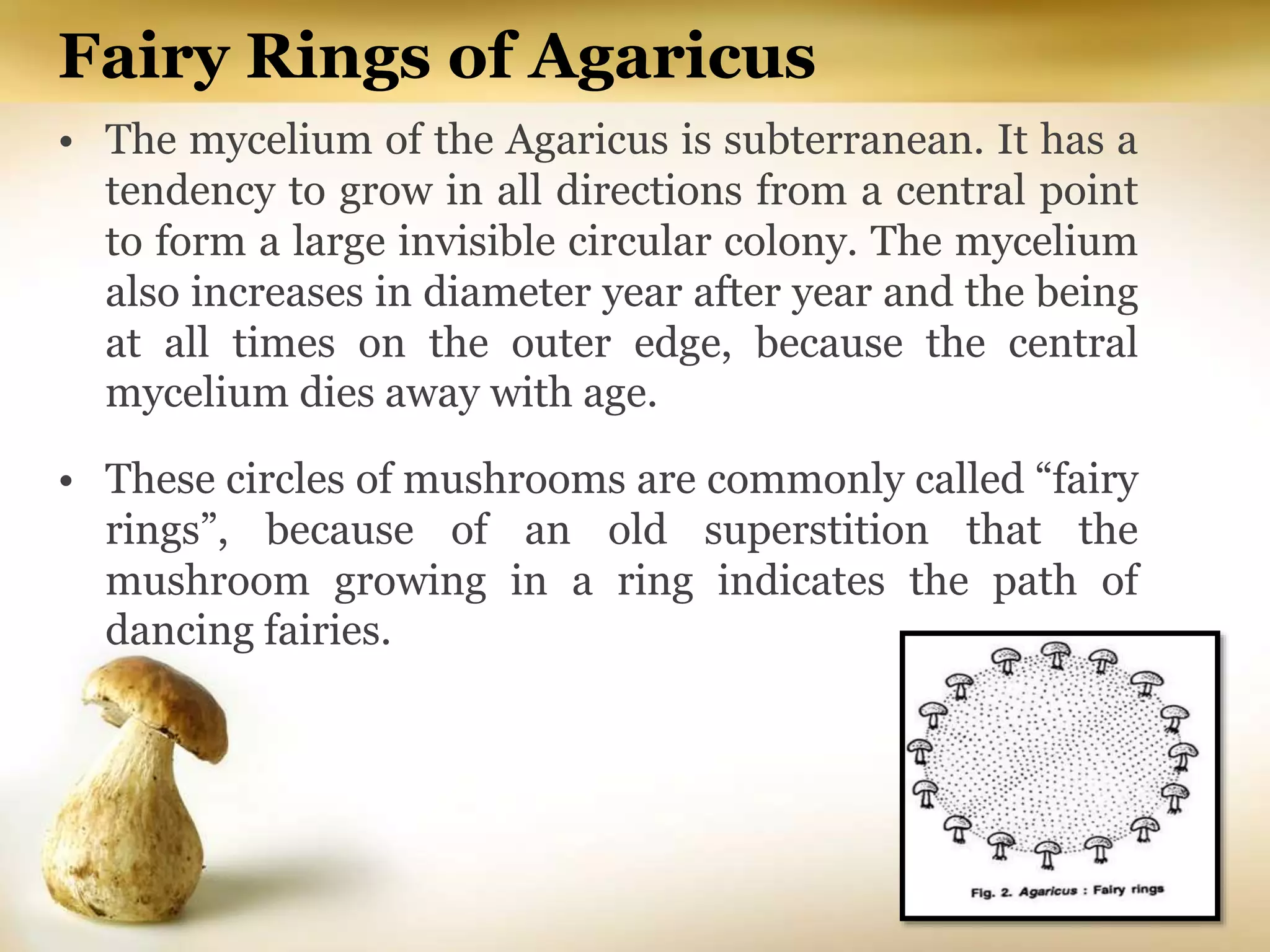
• The mycelium of the Agaricus is subterranean. It has a
tendency to grow in all directions from a central point
to form a large invisible circular colony. The mycelium
also increases in diameter year after year and the being
at all times on the outer edge, because the central
mycelium dies away with age.
• These circles of mushrooms are commonly called “fairy
rings”, because of an old superstition that the
mushroom growing in a ring indicates the path of
dancing fairies.
(b).Structure & Anatomy of Basidiocarp
The mature fruiting body can be differentiated into
three parts
1.Stipe
2.Pileus
3.Annulus
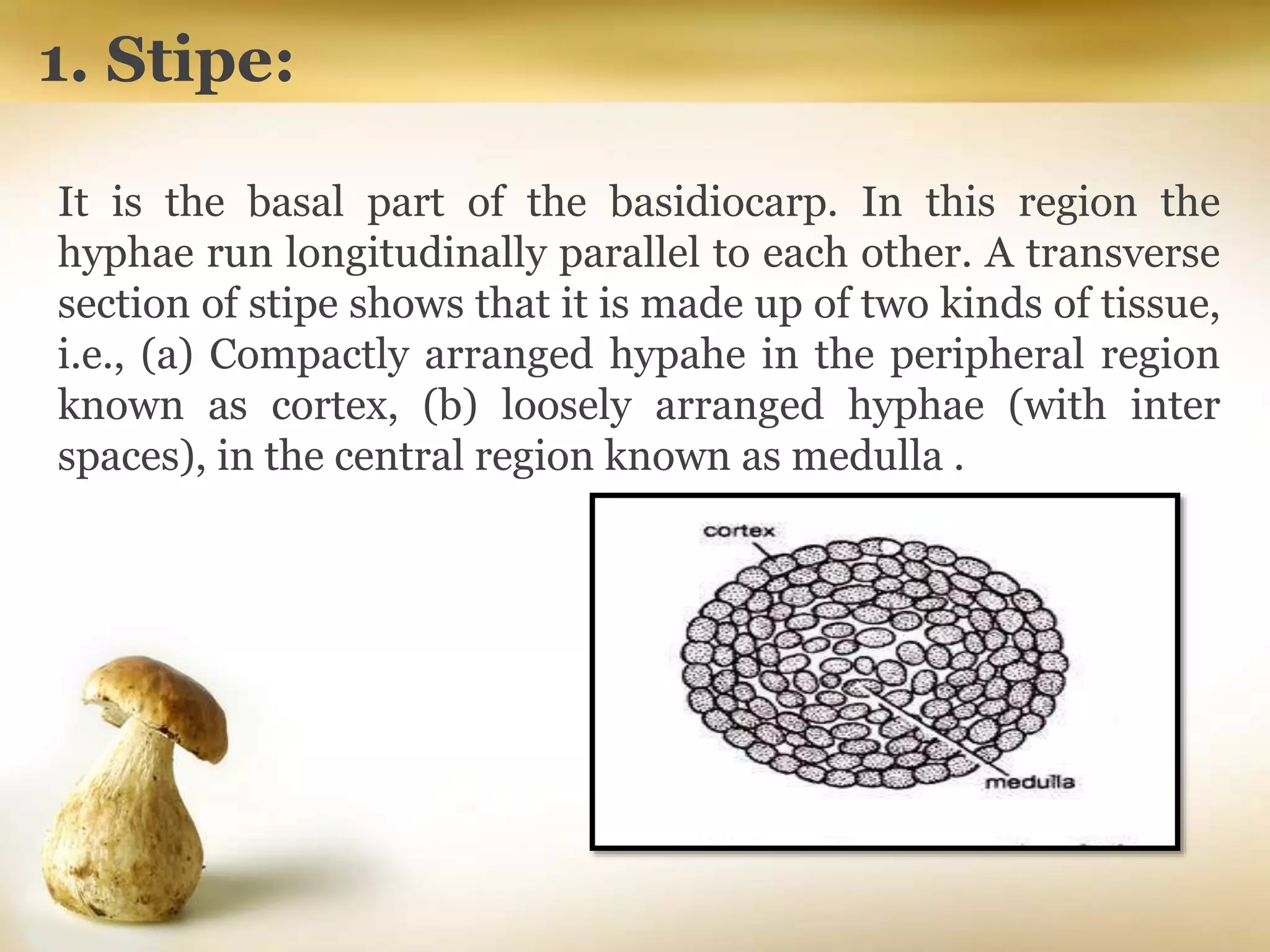
1. Stipe:
It is the basal part of the basidiocarp. In this region the
hyphae run longitudinally parallel to each other. A transverse
section of stipe shows that it is made up of two kinds of tissue,
i.e., (a) Compactly arranged hypahe in the peripheral region
known as cortex, (b) loosely arranged hyphae (with inter
spaces), in the central region known as medulla .
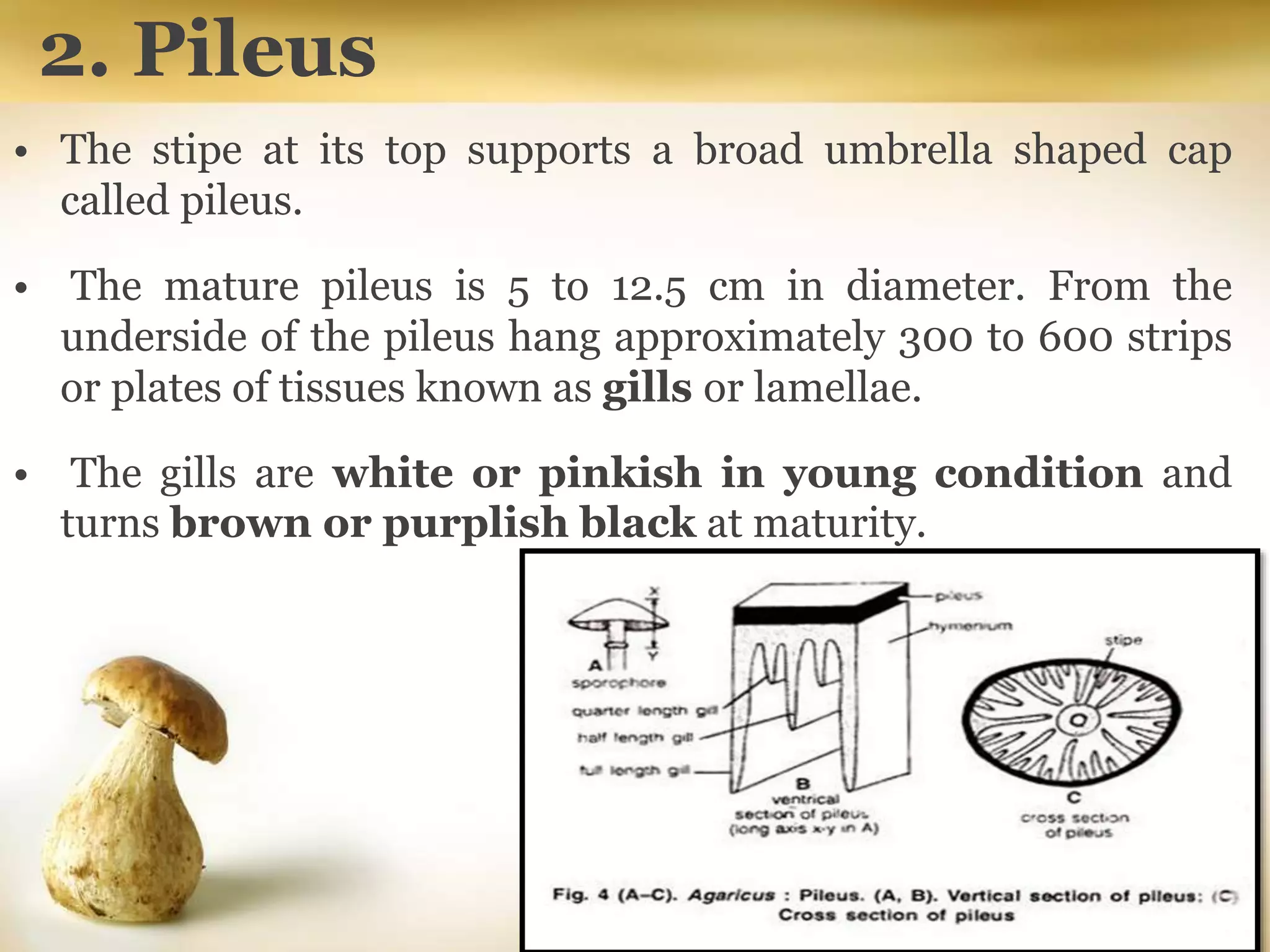
2. Pileus
• The stipe at its top supports a broad umbrella shaped cap
called pileus.
• The mature pileus is 5 to 12.5 cm in diameter. From the
underside of the pileus hang approximately 300 to 600 strips
or plates of tissues known as gills or lamellae.
• The gills are white or pinkish in young condition and
turns brown or purplish black at maturity.
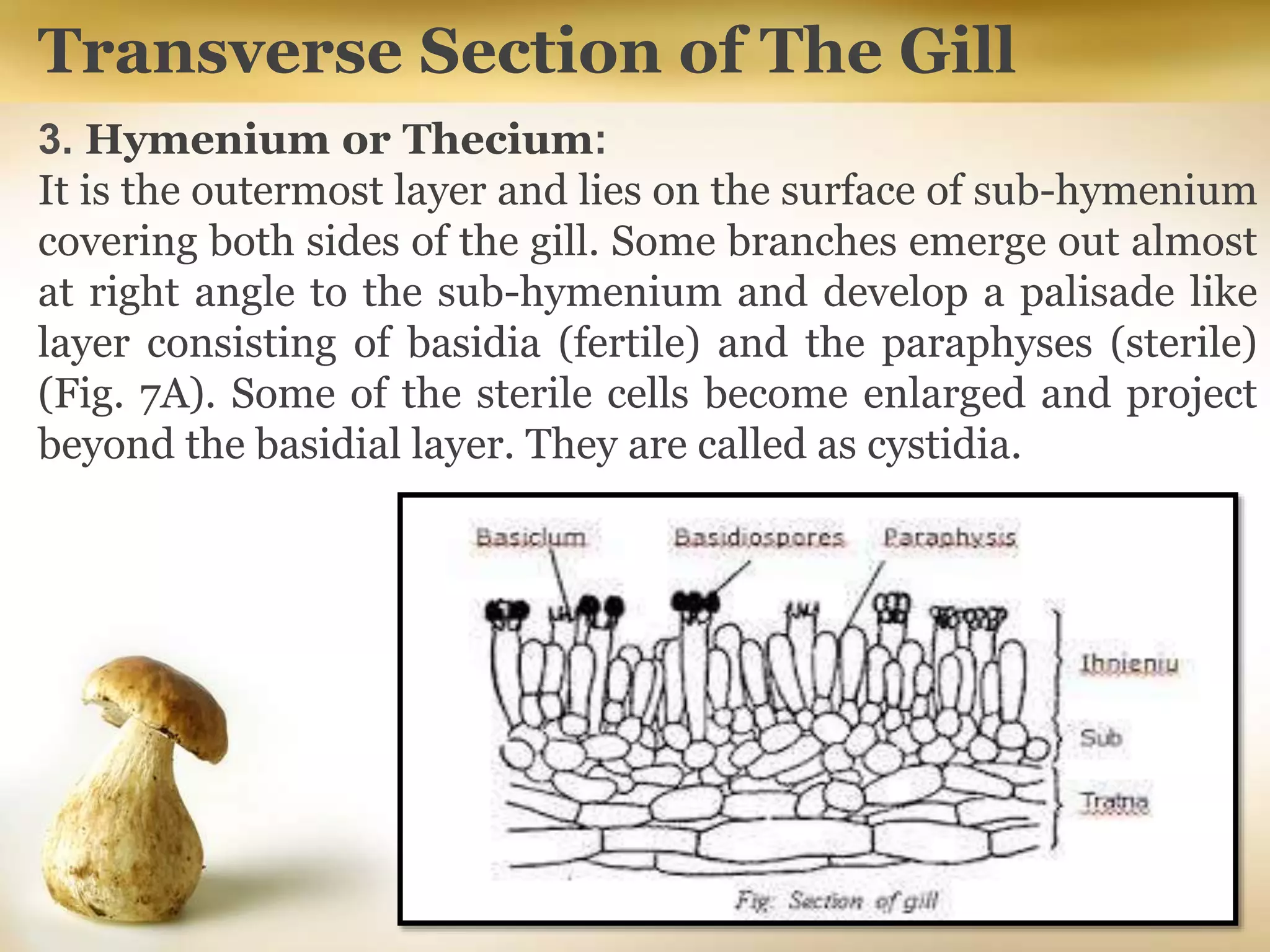
Transverse Section of The Gill
1. Trama:
It is the middle part of the gill. It is made up of
loosely arranged interwoven mass of
plectenchymatous tissue of long, slender hyphae.
These hyphae run, more or less, longitudinally.
2. Sub-Hymenium or Hypothecium:
The hyphae of the trama region curve outwards
towards each surface of the gill. They end in small
diametric cells forming a compact layer known as
sub-hymenium.
Transverse Section of The Gill
3. Hymenium or Thecium:
It is the outermost layer and lies on the surface of sub-hymenium
covering both sides of the gill. Some branches emerge out almost
at right angle to the sub-hymenium and develop a palisade like
layer consisting of basidia (fertile) and the paraphyses (sterile)
(Fig. 7A). Some of the sterile cells become enlarged and project
beyond the basidial layer. They are called as cystidia.
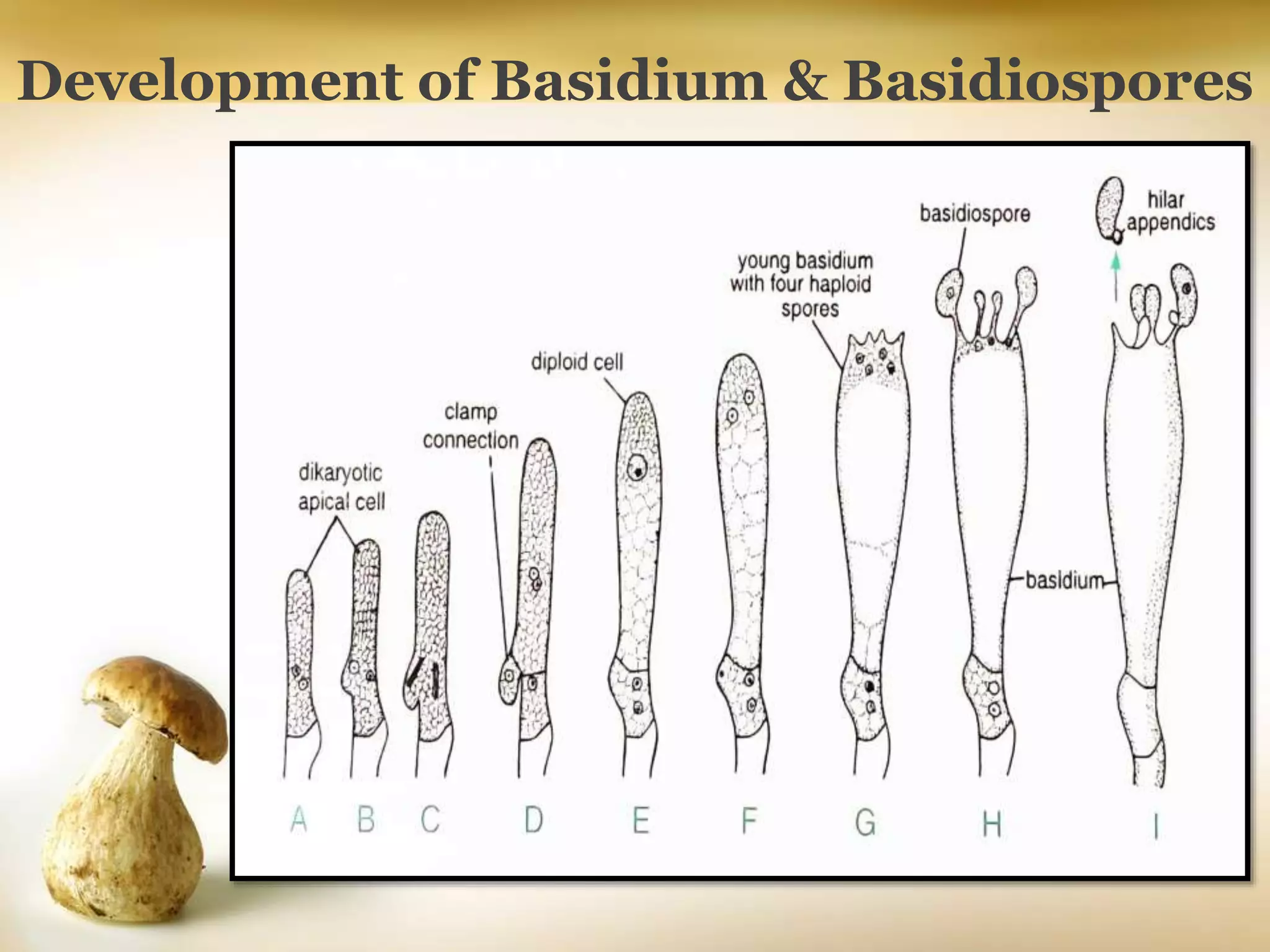
Development of Basidium & Basidiospores
Reproduction in Agaricus:
1. Vegetative Reproduction
2. Asexual Reproduction
3. Sexual Reproduction
1.Vegetative Reproduction:
It reproduces vegetatively by the mycelium in the soil & the
broken parts of it are capable of reproducing the fungus.
2. Asexual Reproduction:
(a). Chlamydospores are produced which are lateral or
intercalary in position. On germination, it gives rise to
hyphae.
(b). Oidia/Conidia may also be formed
under certain conditions which are also
known to have sexual function in the
diplodisation.
3. Sexual Reproduction
The sexual reproduction is mainly somatogamous or
pseudogamous. The sex organs are completely absent and
their function has been taken over by the somatic hyphae which
are heterothallic.
However, a few species of Agaricus, like A. campestris A.
bisporus, are homothallic.
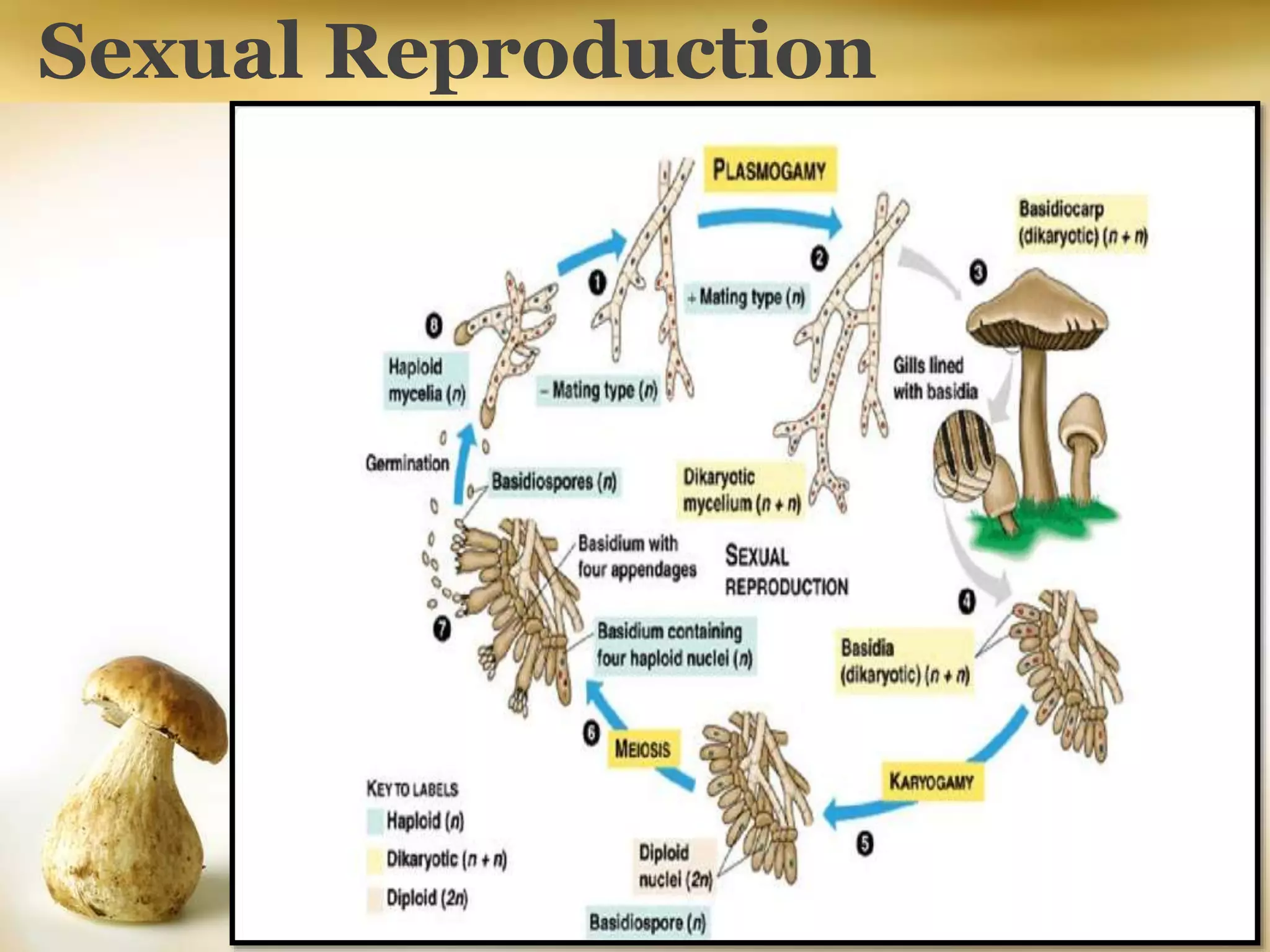
(a) Plasmogamy
(b) Karyogamy
Plasmogamy
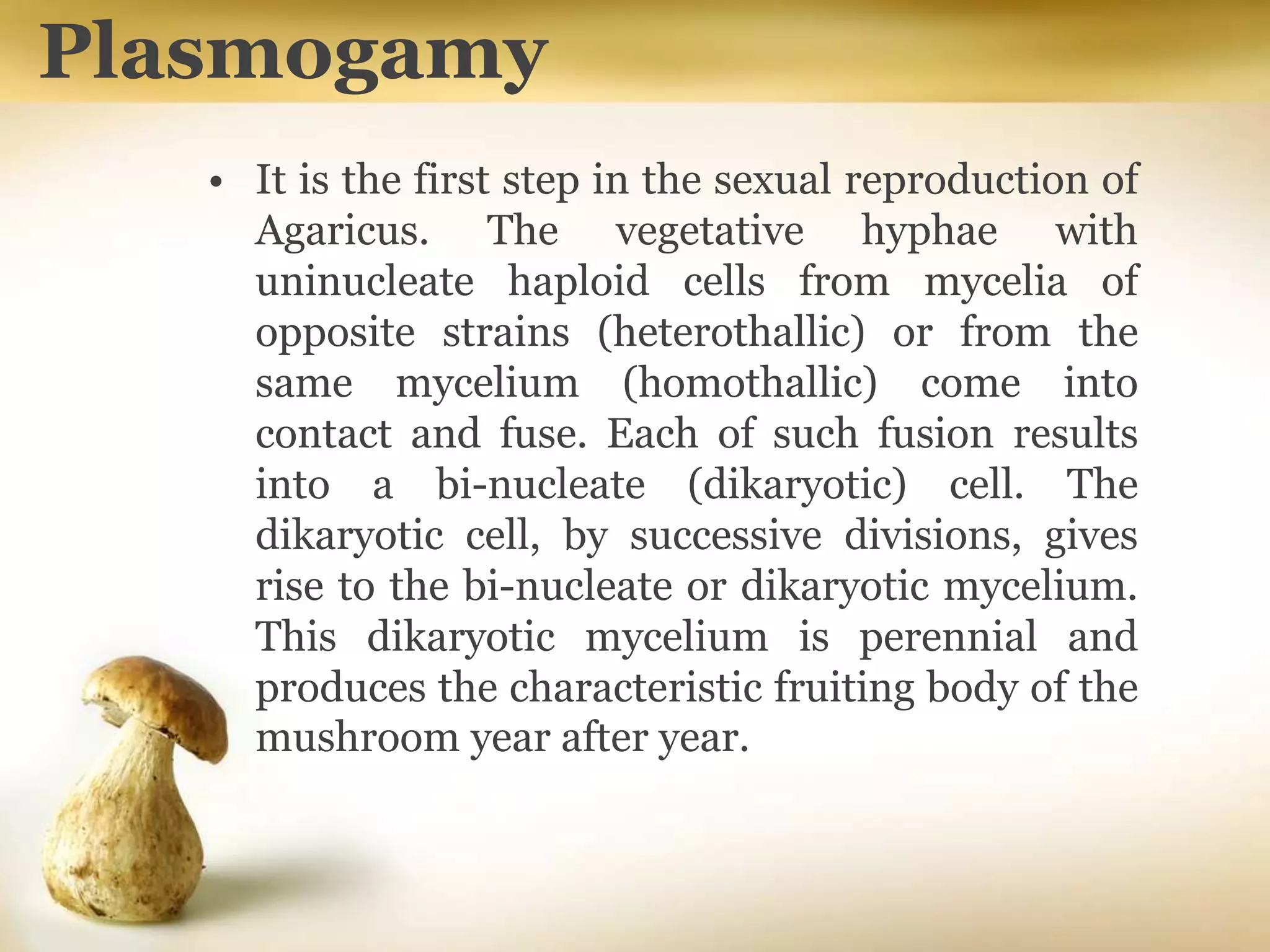
• It is the first step in the sexual reproduction of
Agaricus. The vegetative hyphae with
uninucleate haploid cells from mycelia of
opposite strains (heterothallic) or from the
same mycelium (homothallic) come into
contact and fuse. Each of such fusion results
into a bi-nucleate (dikaryotic) cell. The
dikaryotic cell, by successive divisions, gives
rise to the bi-nucleate or dikaryotic mycelium.
This dikaryotic mycelium is perennial and
produces the characteristic fruiting body of the
mushroom year after year.
Karyogamy
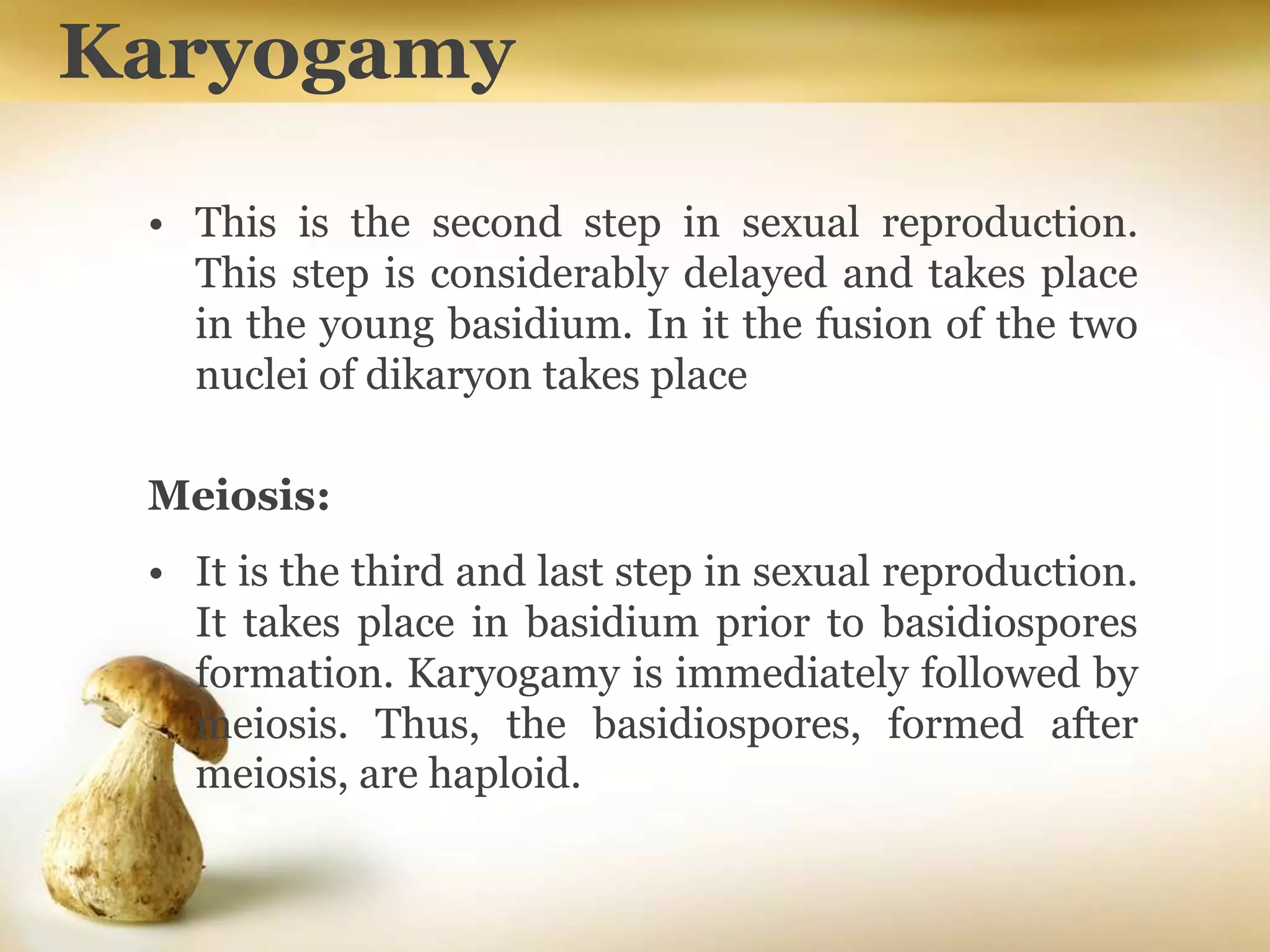
• This is the second step in sexual reproduction.
This step is considerably delayed and takes place
in the young basidium. In it the fusion of the two
nuclei of dikaryon takes place
Meiosis:
• It is the third and last step in sexual reproduction.
It takes place in basidium prior to basidiospores
formation. Karyogamy is immediately followed by
meiosis. Thus, the basidiospores, formed after
meiosis, are haploid.
Sexual Reproduction
Conclusion
The extracts of the tested Agaricus species are a
promising source of antioxidant, antimicrobial,
and antiquorum sensing compounds and is
proved to be healthy foods. Regarding the
antibacterial and antifungal potential, the
ethanolic extracts were more effective than the
methanolic ones.
References
• General Microbiology by R.P. Singh
• Microbiology by Dubey & Maheshwari
• Botany by Y.D. Tyagi
• Google search
• SlideShare
Thank you

Agaricus

  • 1.
    Agaricus Dr. Rachana Choudhary Asstt.Prof. Department of Microbiology Shri Shankaracharya Mahavidyalaya Junwani Bhilai
  • 2.
    Habit & Habitat Speciesof Agaricus Structure of Agaricus Reproduction in Agaricus 1. Vegetative Reproduction 2. Asexual Reproduction 3. Sexual Reproduction Conclusion References Synopsis
  • 3.
    Habit and Habitat •Agaricus is an edible fungus and is commonly known as mushroom. • It is a saprophytic fungus found growing on soil humus, decaying litter on forest floors, in the fields and lawns, wood logs and manure piles. • It grows best in moist and shady places and is commonly seen during rainy season. • It is cosmopolitan in distribution.
  • 4.
    Species of Agaricus •About 25 species of Agaricus have been reported from India. It is commonly known as kukurmutta in U.P. and dhingri in Punjab. • A. campestris (field mushroom), • A. bisporus (A. brunnescence; white mushroom) are common edible mushrooms. • A. bisporus (cultivated mushroom) is widely cultivated for food purposes in Solan (Himachal Pradesh). – Some species of Agaricus are poisonous (e.g., A. xanthoderma) and some species may cause gastrointestinal disturbances in some persons (e.g., A. placomyces, A. silvaticus).
  • 5.
    Structure of Agaricus Itcan be studied in two parts: (a).Vegetative mycelium (living inside the soil) Rhizomorph (b).Fruiting body or basidiocarp (present above the soil and edible in young stage)
  • 6.
  • 7.
    (a) Vegetative Structure •Vegetative mycelium is of three types: • Primary Mycelium: • It originates by the germination of uninucleate basidiospores carrying either ‘+’ or ‘-‘ strain. The cells are uninucleate i.e., monokaryotic. It is short lived and becomes bi-nucleate by fusing of two compatible hyphae (Fig. 1 A).
  • 8.
    Secondary Mycelium: • Itoriginates from primary mycelium. After fusion of the hyphae of two opposite strains, the nucleus from one hypha migrates to the other and later gives rise to the bi-nucleate secondary mycelium i.e., dikaryotic. It is long lived and abundant . Tertiary Mycelium: • The secondary mycelium grows extensively under the soil and becomes organised into special tissue to form the fruiting body or basidiocarp • The fruiting body appears like umbrella above ground. It is made up of dikaryotic hyphae. These hyphae are called tertiary mycelium. The mycelium is subterranean. The hyphae are septate and branched.
  • 9.
    Fairy Rings ofAgaricus • The mycelium of the Agaricus is subterranean. It has a tendency to grow in all directions from a central point to form a large invisible circular colony. The mycelium also increases in diameter year after year and the being at all times on the outer edge, because the central mycelium dies away with age. • These circles of mushrooms are commonly called “fairy rings”, because of an old superstition that the mushroom growing in a ring indicates the path of dancing fairies.
  • 10.
    (b).Structure & Anatomyof Basidiocarp The mature fruiting body can be differentiated into three parts 1.Stipe 2.Pileus 3.Annulus
  • 11.
    1. Stipe: It isthe basal part of the basidiocarp. In this region the hyphae run longitudinally parallel to each other. A transverse section of stipe shows that it is made up of two kinds of tissue, i.e., (a) Compactly arranged hypahe in the peripheral region known as cortex, (b) loosely arranged hyphae (with inter spaces), in the central region known as medulla .
  • 12.
    2. Pileus • Thestipe at its top supports a broad umbrella shaped cap called pileus. • The mature pileus is 5 to 12.5 cm in diameter. From the underside of the pileus hang approximately 300 to 600 strips or plates of tissues known as gills or lamellae. • The gills are white or pinkish in young condition and turns brown or purplish black at maturity.
  • 13.
    Transverse Section ofThe Gill 1. Trama: It is the middle part of the gill. It is made up of loosely arranged interwoven mass of plectenchymatous tissue of long, slender hyphae. These hyphae run, more or less, longitudinally. 2. Sub-Hymenium or Hypothecium: The hyphae of the trama region curve outwards towards each surface of the gill. They end in small diametric cells forming a compact layer known as sub-hymenium.
  • 14.
    Transverse Section ofThe Gill 3. Hymenium or Thecium: It is the outermost layer and lies on the surface of sub-hymenium covering both sides of the gill. Some branches emerge out almost at right angle to the sub-hymenium and develop a palisade like layer consisting of basidia (fertile) and the paraphyses (sterile) (Fig. 7A). Some of the sterile cells become enlarged and project beyond the basidial layer. They are called as cystidia.
  • 15.
    Development of Basidium& Basidiospores
  • 16.
    Reproduction in Agaricus: 1.Vegetative Reproduction 2. Asexual Reproduction 3. Sexual Reproduction
  • 17.
    1.Vegetative Reproduction: It reproducesvegetatively by the mycelium in the soil & the broken parts of it are capable of reproducing the fungus. 2. Asexual Reproduction: (a). Chlamydospores are produced which are lateral or intercalary in position. On germination, it gives rise to hyphae. (b). Oidia/Conidia may also be formed under certain conditions which are also known to have sexual function in the diplodisation.
  • 18.
    3. Sexual Reproduction Thesexual reproduction is mainly somatogamous or pseudogamous. The sex organs are completely absent and their function has been taken over by the somatic hyphae which are heterothallic. However, a few species of Agaricus, like A. campestris A. bisporus, are homothallic. (a) Plasmogamy (b) Karyogamy
  • 19.
    Plasmogamy • It isthe first step in the sexual reproduction of Agaricus. The vegetative hyphae with uninucleate haploid cells from mycelia of opposite strains (heterothallic) or from the same mycelium (homothallic) come into contact and fuse. Each of such fusion results into a bi-nucleate (dikaryotic) cell. The dikaryotic cell, by successive divisions, gives rise to the bi-nucleate or dikaryotic mycelium. This dikaryotic mycelium is perennial and produces the characteristic fruiting body of the mushroom year after year.
  • 20.
    Karyogamy • This isthe second step in sexual reproduction. This step is considerably delayed and takes place in the young basidium. In it the fusion of the two nuclei of dikaryon takes place Meiosis: • It is the third and last step in sexual reproduction. It takes place in basidium prior to basidiospores formation. Karyogamy is immediately followed by meiosis. Thus, the basidiospores, formed after meiosis, are haploid.
  • 21.
  • 22.
    Conclusion The extracts ofthe tested Agaricus species are a promising source of antioxidant, antimicrobial, and antiquorum sensing compounds and is proved to be healthy foods. Regarding the antibacterial and antifungal potential, the ethanolic extracts were more effective than the methanolic ones.
  • 23.
    References • General Microbiologyby R.P. Singh • Microbiology by Dubey & Maheshwari • Botany by Y.D. Tyagi • Google search • SlideShare
  • 24.