From Greek oidos, "swelling" + gonos, “Reproductive Structure"
Oedogonium
Oedogonium is an unbranched, filamentous green, fresh water alga that is easily identified by the distinctive rings at the
apical ends of certain cells.
Each cellular division creates a new ring on the cap cell. The cells are cylindrical, contain a parietal, netlike chloroplast
with several pyrenoids.
DR. SAURABH KUMAR, HOD BOTANY KCMT
Occurrence of Oedogonium:
Oedogonium is an exclusively fresh water alga. They are very
common in pools, ponds, lakes etc.
The filamentous plant body may get attached with the stone, wood,
leaves of aquatic plants, small branches of dead plant remain in water
etc. by their basal cell the holdfast.
Some species like O. terrestris are terrestrial.
Plant Body(Thallus) of Oedogonium:
The thalloid plant body is green, multicellular and filamentous.
The filaments are unbranched and cells of each filament are attached
end to end and form uniseriate row.
The filament is differentiated into 3 types of cells:
1. Basal cell,
2. Apical cell
3. Middle cells.
Filaments of Oedogonium
Oedogonium in Fresh
water
DR. SAURABH KUMAR, HOD BOTANY KCMT
Cell Structure:
The cells are elongated and cylindrical with a slightly swollen or dilated
upper end.
The cell wall is made up of three layers; an outer chitinous, a middle
layer of pectin and an inner layer of cellulose.
The center of the cell is occupied by a large vacuole.
There is a single, large, reticulate chloroplast present in the protoplasm.
The strands of the chloroplast are parallel to the long axis of the cell. Many
pyrenoids are present.
There is a single large parietal nucleus .The nucleus is haploid.
Growth and cell division :
Growth in Oedogonium takes places as a result of cell division which is
largely intercalary.
Only certain cells in the filament divide.
Every cell division is accompanied by the formation of a specialized
structure called the cap cell.
The cell division in Oedogonium is peculiar and unique. DR. SAURABH KUMAR, HOD BOTANY KCMT
Reproduction
All three types, Vegetative, Asexual and Sexual reproduction are seen in Oedogonium.
Vegetative Reproduction
The vegetative reproduction takes place by means of fragmentation. The fragmentation takes place by
(i) Dying out of some cell here and there in the filament,
(ii) through accidental breaking,
(iii) formation of zoospores or gametes and liberation because of wall splitting. Each fragment by cell division and growth
develops into a new filament.
Asexual Reproduction
In Oedogonium, asexual reproduction takes place by three kinds of asexual spores (i) Zoospores, (ii) Akinites and
(iii) Aplanospores
Zoospores
They are produced singly in the specialized cell called zoosporangium.
Any cap cell usually , the recently divided one which contains abundant reserved food material may become zoosporangium.
The entire protoplast of the zoosporangium contracts from the cell wall and becomes a rounded mass.
The basal granules are connected by fibrous strands to form complete circular ring.
DR. SAURABH KUMAR, HOD BOTANY KCMT
From each granule arise a single flagellum. In this way a
ring of flagella is formed around beak (stephanokont).
With the formation of zoospore, the cell wall near the
upper end splits transversely and the upper portion of cell
is lifted off like a lid.
The mature zoospores, slips out through the aperture.
The zoospore swim freely in the water.
The zoospore possesses an eye spot, a chloroplast, a haploid
nucleus and numerous vacuoles. The liberated zoospore
remains motile for about an hour. Then it settles down,
attaches itself to the substratum. It withdraws the flagella
and secrets a cell wall.
The one celled zoospore divides transversely forming an
basal cell and a apical cell.
The basal cell remains colorless and does not divide again. It
develops into a cylindrical hapteron or holdfast.
The upper cell by the normal methods of division and
redivision of its daughter cells forms the new filament.
Stages in Asexual Reproduction
in Oedogonium
DR. SAURABH KUMAR, HOD BOTANY KCMT
Akinete Formation
In some species of Oedogonium, during unfavorable conditions, resting cells or akinetes
are formed.
They are thick walled, reddish brown, rounded or oval structures.
They are formed in chains, each inside an inflated cell resembling an oogonium.
The akinetes are rich in starch as reserve food material and reddish orange oil.
On returning of favorable condition each akinete germinates into a new filament.
Aplanospore formation
Aplanospore are non-motile, non flagellate, Uninucleate cells
They are slightly oblong or spherical and formed one or two in each cell.
The cell of the filament producing Aplanospore is called Aplanosporangium
Aplanospore are produce during dry season
When favorable season comes, the aplanospore comes out of the aplanosporangium and
germinate into new plants
Akinetes Formation in Oedogonium
Aplanospore
Formation
DR. SAURABH KUMAR, HOD BOTANY KCMT
Sexual Reproduction
The sexual reproduction in Oedogonium is Advanced Oogamous type.
The sexual cells or the gametes are structurally and physiologically
different. They are produced in highly specialized reproductive organs,
the gametangia.
The male gametangia is called the antheridium and the female
gametangia is called the oogonium.
Depending on the distribution of sex organs, species of Oedogonium
are grouped into two categories:
1. Macrandrous species
2. Nannandrous species.
Macrandrous species:
The species of Oedogonium that produces antheridia and oogonia in
normal filament is called Macrandrous species. They may be
monoecious producing antheridia and oogonia on the same filament or
dioecious producing antheridia and oogonia on different filaments.
Nannandrous species:
The species of Oedogonium that produce oogonium in normal filament
and antheridium in small, dwarf filament or nannadria is called
Nannadrous species. DR. SAURABH KUMAR, HOD BOTANY KCMT
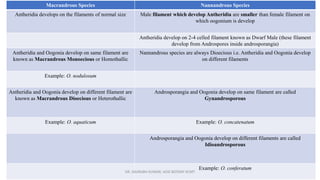
Macrandrous Species Nannandrous Species
Antheridia develops on the filaments of normal size Male filament which develop Antheridia are smaller than female filament on
which oogonium is develop
Antheridia develop on 2-4 celled filament known as Dwarf Male (these filament
develop from Androspores inside androsporangia)
Antheridia and Oogonia develop on same filament are
known as Macrandrous Monoecious or Homothallic
Nannandrous species are always Dioecious i.e. Antheridia and Oogonia develop
on different filaments
Example: O. nodulosum
Antheridia and Oogonia develop on different filament are
known as Macrandrous Dioecious or Heterothallic
Androsporangia and Oogonia develop on same filament are called
Gynandrosporous
Example: O. aquaticum Example: O. concatenatum
Androsporangia and Oogonia develop on different filaments are called
Idioandrosporous
Example: O. conferatum
DR. SAURABH KUMAR, HOD BOTANY KCMT
Sexual Reproduction in Macrandous forms:
The development of antheridia and oogonia is similar in both monoecious and
dioecious species.
Antheridia
Antheridia are formed in either terminal or intercalary cell of the filament.
Any cap cell may function as antheridial mother cell.
The antheridial mother cell divides into two unequal cells, the upper small
antheridium and the lower larger sister cell.
The sister cell divides again repeatedly, so as to give rise a series of 2 to 40
antheridia.
The protoplast of each antheridia divides mitotically, by transverse or vertical
wall into two haploid daughter protoplasts.
Each protoplast becomes pear-shaped and develops a ring of flagella around a
colorless portion at its one end and metamorphoses into an antherozoid or sperm.
Thus two antherozoids are produced in each antheridium.
The wall of antheridium ruptures transversely and two antherozoids are freed into
a thin vesicle. Soon, the vesicles dissolves and two antherozoids swim freely in the
water. Antherozoids are smaller in size and have fewer flagella. The liberated
antherozoids swim freely and finally reach the oogonia.
DR. SAURABH KUMAR, HOD BOTANY KCMT
Oogonia
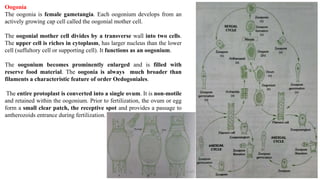
The oogonia is female gametangia. Each oogonium develops from an
actively growing cap cell called the oogonial mother cell.
The oogonial mother cell divides by a transverse wall into two cells.
The upper cell is riches in cytoplasm, has larger nucleus than the lower
cell (suffultory cell or supporting cell). It functions as an oogonium.
The oogonium becomes prominently enlarged and is filled with
reserve food material. The oogonia is always much broader than
filaments a characteristic feature of order Oedogoniales.
The entire protoplast is converted into a single ovum. It is non-motile
and retained within the oogonium. Prior to fertilization, the ovum or egg
form a small clear patch, the receptive spot and provides a passage to
antherozoids entrance during fertilization.
DR. SAURABH KUMAR, HOD BOTANY KCMT
Sexual Reproduction in Nannadrous forms:
The nannandrous species are dioecious.
The oogonia are produced on normal, large filaments.
The antheridia are produced by special, short, few celled filament called the dwarf or
nannadria.
The dwarf male are produced by the germination of peculiar type of motile spores
called the androspores.
The androspores are produced within cells called the androsporangia.
If oogonia and androsporangia are present in the same plant, the condition is called
gynandrosporous.
The species in which androsporangia are borne in a separate filament, it is named as
idioandrosporous.
Structure and germination of Androspores
Androsporangia are similar to antheridia in development and are produced by unequal
division of mother cell but are rather larger.
The androsporangia are flat, discoid cells. Its protoplast metamorphoses into a single
androspore.
The androspore are motile and are provided with a sub-polar crown of flagella.
DR. SAURABH KUMAR, HOD BOTANY KCMT
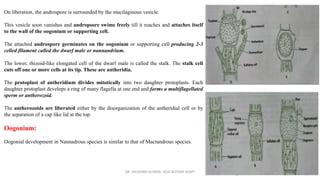
On liberation, the androspore is surrounded by the mucilaginous vesicle.
This vesicle soon vanishes and andropsore swims freely till it reaches and attaches itself
to the wall of the oogonium or supporting cell.
The attached androspore germinates on the oogonium or supporting cell producing 2-3
celled filament called the dwarf male or nannandrium.
The lower, rhizoid-like elongated cell of the dwarf male is called the stalk. The stalk cell
cuts off one or more cells at its tip. These are antheridia.
The protoplast of antheridium divides mitotically into two daughter protoplasts. Each
daughter protoplast develops a ring of many flagella at one end and forms a multiflagellated
sperm or antherozoid.
The antherozoids are liberated either by the disorganization of the antheridial cell or by
the separation of a cap like lid at the top.
Oogonium:
Oogonial development in Nannadrous species is similar to that of Macrandrous species.
DR. SAURABH KUMAR, HOD BOTANY KCMT
Fertilization:
It is similar in both Nannandrous and Macrandrous forms.
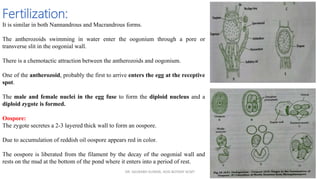
The antherozoids swimming in water enter the oogonium through a pore or
transverse slit in the oogonial wall.
There is a chemotactic attraction between the antherozoids and oogonium.
One of the antherozoid, probably the first to arrive enters the egg at the receptive
spot.
The male and female nuclei in the egg fuse to form the diploid nucleus and a
diploid zygote is formed.
Oospore:
The zygote secretes a 2-3 layered thick wall to form an oospore.
Due to accumulation of reddish oil oospore appears red in color.
The oospore is liberated from the filament by the decay of the oogonial wall and
rests on the mud at the bottom of the pond where it enters into a period of rest.
DR. SAURABH KUMAR, HOD BOTANY KCMT
Germination of Oospore:
After a period of rest, the oospore germinates. Prior to germination, the diploid
oospore nucleus undergoes zygotic meiosis to form four haploid nuclei.
The haploid nuclei are organized into four uninucleate daughter protoplasts by
cleavage of the oospore protoplast.
Soon, each haploid daughter protoplasts furnishes itself with a crown of flagella to
become a motile spore resembling the zoospore of the asexual stage. It may be called a
meiozoospore.
The oospore wall ruptures to liberate the mature, motile meiozoospores. They are at
first surrounded by a delicate vesicle. The vesicle soon disappears.
The liberated meiozoospores swims about for a while and then settles down to
germinate.
They grow into haploid Oedogonium plants. In dioecious species, two zoospores
develop into male and two into female filaments.
Life Cycle:
The life cycle is known as haplontic because the plant is haploid.
The only diploid stage is the zygote which soon undergoes meiosis resulting in 4
haploid zoospores.
The zoospores germinate into new haploid filaments. DR. SAURABH KUMAR, HOD BOTANY KCMT