LICHENS
BY
Dr P B MALLIKHARJUNA
GFGC YB
25-4-2020
LICHENS
 Lichens are the most important symbiotic living organisms / plants on
the earth.
 Theophrastus (371-284 BC), the Father of Botany, to denote the
superficial growth on the tree bark, coined the term ‘LICHEN’.
 Lichenology is a branch of Botany that deals with the study of Lichens.
 Acharius (1798), a Swedish lichenologist, is the Father of Lichenology.
 Lichens are one of the largest group of plants consisting about 500
genera and 18000 species included in 9 orders.
 A lichen can be defined as “the dual organism with symbiotic
(mutualistic) association of a fungus with an alga”.
 Mycobiont: is the fungal partner. It is the exhabitant, dominant,
colourless, protective and reproductive partner.
 Phycobiont:is the algal partner. It is the inhabitant, recessive,
coloured autotrophic partner.
Although, lichens are the symbiotic associations, the
relationship between a fungus and an alga is like a Master
and Slave. It is known as “HELOTISM” (Crombie,1885).
Fungus is the Master and alga is the Slave
Occurrence: Lichens are one of the most widely distributed plants ranging from the polar to the
deserts, and aquatic bodies.
 Lichens are the dominant vegetation both in the Arctic and Antarctic regions.
 They will grow as lithophytes, xerophytes, epiphytes, mesophytes, and hydrophytes.
 Some of these are Clandonia rangiferina (Reindeer moss), Peltigera (Aquatic lichen),
Gyrophora (White lichen), Graphis, Parmelia, Haematomma, Cora, Dictyonema, etc.
 They show great variation in their size, shape, structure, morphology, growth rate and
ecology.
 In a typical lichen, the fungal partner (the Mycobiont) is the most abundant component, which
accounts for 90-95% of the total biomass, whereas the algal partner( Phycobiont) accounts for
5-10%.
 The fungal hyphae form a close network resembling a tissue like mass with the algal cells
often embedded in it.
 Lichens based on their habitat
(distribution), external morphology,
internal anatomy, and the partners
involved (fungal and algal) are classified
into several types.
1) Based on their Habitat: There are three
types of lichens,viz.,
a) Saxicoles (which grow on the rocks),
b) Corticoles (which grow on the Bark), and
c) Terricoles (which grow on the soil).
1) Based on the Habit / Morphology:
There are three types of lichens viz.,
a) Crustose lichens: These are the most common type
with thin mat like thalloid plants, firmly attached to
the substratum. Ex: Graphis, Haematomma (More
common on the barren rocks). The pioneers of the
xeorsere type of plant sucession
b) Foliose lichens: These are thalloid; flatten leaf like
plants attached to the substratum through rhizines.
Ex: Parmelia (More common in the tropical forests
as corticoles)
c) Fruiticose lichens: These are usually a small shrub
like vertically or pendulously growing plants. They
are common in the temperate and polar regions. Ex:
Cladonia
1) Based on the Internal Structure:
Lichens may be of a) Homoimerous
and b) Heteroimerous
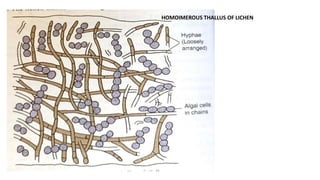
In Homoimerous lichens, the fungal
hyphae are loosely arranged. Several
crustose lichens belongs to this
category.
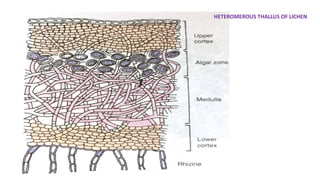
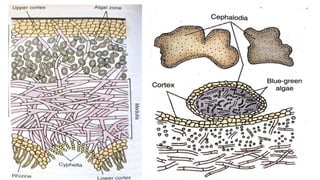
In Heteroimerous lichens, the fungal
hyphae are thick and compact and
thereby surrounding the alga.
1) Based on the Fungal Partner:
Lichens can be classified into three types viz., a)
Ascolichens, b) Basidiolichens and c)
Deuterolichens
a) Ascolichens: The fungal partner belongs to the class
Ascomycetes. These are the abundant type. Over 98%
lichens are Ascolichens. Ex: Parmelia, Graphis.
Apothecia, perithecia and pseudothecia are the
common fruiting bodies. They may be
(Apothecia) or (Perithecia).
b) Basidiolichens: The fungal partner belongs to the class
Basidiomycetes. They are very less in number (<1%).
Some of these are Cora, Corella and DIctyoma. They
produce pycnidial cups.
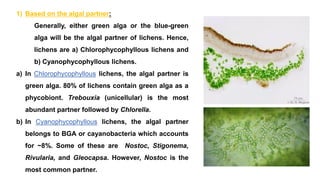
1) Based on the algal partner:
Generally, either green alga or the blue-green
alga will be the algal partner of lichens. Hence,
lichens are a) Chlorophycophyllous lichens and
b) Cyanophycophyllous lichens.
a) In Chlorophycophyllous lichens, the algal partner is
green alga. 80% of lichens contain green alga as a
phycobiont. Trebouxia (unicellular) is the most
abundant partner followed by Chlorella.
b) In Cyanophycophyllous lichens, the algal partner
belongs to BGA or cayanobacteria which accounts
for ~8%. Some of these are Nostoc, Stigonema,
Rivularia, and Gleocapsa. However, Nostoc is the
most common partner.
HOMOIMEROUS THALLUS OF LICHEN
HETEROMEROUS THALLUS OF LICHEN
REPRODUCTION IN LICHENS:
 Both vegetative/asexual reproduction and sexual reproduction are present
in Lichens.
 The Vegetative Reproduction: takes place very frequently either by the
fragmentation process or by the formation of different types of diaspores
(having both alga and fungus) such as Soredia and Isidia.
 In the vegetative propagation, both the partners are involved and develop
into a new daughter Lichen.
 Fragmentation is the common mode of vegetation where the fragments are
arise either due to the progressive death and decay of older portion or due
to the involvement physical factor.
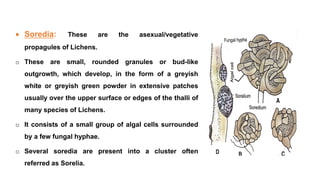
 Soredia: These are the asexual/vegetative
propagules of Lichens.
o These are small, rounded granules or bud-like
outgrowth, which develop, in the form of a greyish
white or greyish green powder in extensive patches
usually over the upper surface or edges of the thalli of
many species of Lichens.
o It consists of a small group of algal cells surrounded
by a few fungal hyphae.
o Several soredia are present into a cluster often
referred as Sorelia.
 Isidia: These are the asexual/vegetative
propagules of Lichens.
o These are small, conical warts developed on
the upper thallus of many Lichens.
o An isidium is usually surrounded by cortex and
diasporic in composition
o Their shape is highly variable among lichens
ranging from rod shape to coral-like structure.
Ex: Parmelia, Usnea.
Sexual Reproduction: Sexual reproduction occurs in many
Lichens and in this, only the fungal partner (the mycobiont ) is
involved. The role of algal partner is passive or very absent.
 The mode of sexual reproduction in lichens maybe spermatogamy.
 Ascolichens produce the sex organs namely Spermogonium (male)
and Carpogonium (female). After fertilization, they produce the
special fruiting bodies such as Apothecium, Perithecium and some
times Puesdothecia. Ex: Parmelia
 While, the Basidiolichens, produce basispores followed by the
formation of the Pycnidia, as the sexual apparatus. After
spermatogamy, the sexual fruiting body develops as Basidiocarp like
in Agaricus. Ex: Corella.
Sexual reproduction in Ascolichens:
 Since majority of the lichens are with Ascomycetous fungal partner, it will
reproduce sexually by the formation of two different types of sex organs.
 The male reproductive structure is Spermogonium and the female reproductive
sex organ is Carpogonium.
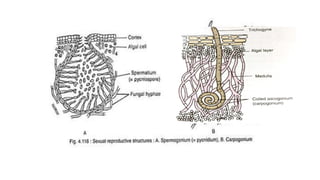
 The spergonium is a flask shaped structure that usually present present upper
surface of the thallus. It is with a pore called ostiole, and several muticelluar
spmertiophores which produce the uni-nucleate spheroidal sermatia.
 The carpogonium is a special cellular filament. It consists of two portions, the
lower coiled portion usually called Ascogonium and it is multi-cellular and
monokaryotic. It lies deep in the medullary region of the thallus.
 The straight upper portion of the carpogonium is called trichogyne and it is
multicellular. The component cells are elongated one with the porous cross
septa.
 The trichogyne receives the spermatia (the male gametes) which in turn
penetrates and finally reaches the corpogonium and subject to fertilization
resulting a diploid cell called ascus mother cell. This cell proliferates into
several asci and whereby the diploid nucleus undergo meiosis and produce
haploid ascospores
 Likewise, so many filaments arise and protrude above the surface of the thallus
and produces the characteristic fruiting bodies viz., 1) Apothecium 2)
Perithecium and 3) Pseudothecia with or without stalk.
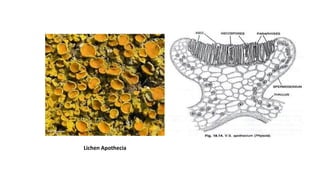
Lichen Apothecia
1) Apothecium: is a major type of sexual fruiting body of Ascolichens.
 It is generally round and cup-shaped structure.
 Their colour is highly variable ranging from reddish to black colour.
 In some lichens, the apothecia contain only the mycobiont but the phycobiont is absent. Ex:
Cladonia.
 However, in majority of the lichens, the apothecia possess both the partners. Ex: Parmelia.
Apothecium structure: Apothecium is lined with palisade-like layer cells called
Hymenium.
 The Hymenium consists of a series of elongated cells – the asci, intermixed with sterile
hyphae – the paraphyses.
 Each ascus usually contains eight ascospores (bi-celled).
The liberated ascospores liberated, if come in contact with suitable alga, produce the
new daughter thallus. Otherwise they perish.
1) Perithecium: This is another sexual fruiting body of the
Ascolichens.
 It is much smaller than the apothecium and flask shaped
structure and appears as a small dot on the surface of the
thallus.
 The dark coloured wall bound it.
 The cavity is lined with asci.
 The paraphyses are few in number or totally absent.
 It is embedded in the elevations of the thallus on the
upper side.
 It opens through a small pore called an Ostiole.
ECOLOGICAL ROLE OF LICHENS
1) Lichens are serving as the indicators of Air pollution. Especially they are very sensitive to
the NO2 and SO2 gases.
2) They involve in the soil formation on the rocks called biological weathering.
3) They are the first/pioneer colonizers on a barren rock in the establishment of ecological
plant succession.
4) Some lichens may be used as tools in order to determine the age of the rocks and the past
events occurred called Lichenometry.
ECONOMIC IMPORTANCE OF LICHENS
 Since lichens are rich with secondary metabolites like alkaloids, oils and other substances,
lichens are extensively used in medicine, besides serving as food and fodder to man and
animals. Further, several acids, dyes (orecin, litmus) are extracted. Also using in perfume
and dhoop industries