– Lichens - Fungi in closely integrated
association with green algae and/or blue-
green algae.
– Mycorrhizae - Fungi associated with
exterior (ectotrophic) or interior
(endotrophic) of plant roots
– Endophytes - fungi associated with shoots
of plants
lichens - predominant
ground cover in tundra
trees dependent on
mycorrhizae
- dual organisms
– Lichens very tough - typically grow in extreme
environments (arctic, hot deserts, bare rock etc.) -
often dominant life form where they occur (8% of
world). Consist of:-
– mycobiont (fungus) - obtains water and minerals,
builds shape (thallus), produces the reproductive
structures.
– Phycobiont (alga) - contributes photosynthate
Probably more a case of balanced parasitism than
symbiosis.
• The mycobiont has two principal
roles:
 to protect the photobiont from exposure to intense sunlight
and desiccation
– to absorb mineral nutrients from the underlying surface or
from minute traces of atmospheric contaminants.
• The photobiont also has two roles:
 to synthesise organic nutrients from carbon dioxide
– in the case of cyanobacteria, to produce ammonium (and
then organic nitrogen compounds) from N2 gas, by nitrogen
fixation. In some ecosystems such as desert soils, tundra
heaths, and Douglas-fir forests of the Pacific Northwest of
the USA, lichens can provide the major input of nitrogen
which supports other forms of life.
http://helios.bto.ed.ac.uk/bto/microbes/lichen.htm
– Nomenclature - there are ca 20,000 sp.
named after the mycobiont (500 genera)
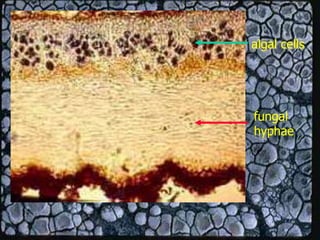
– Structure - The mycobiont forms the major
part (95%) of the thallus (body) and
produces any sexual spores. The photobiont
exists as cells, often in layers just below the
surface, within the thallus
• The Phycobiont.
– Only 24 genera of algae, either Chlorophyta (green
algae) or Cyanobacteria (prokaryotes - blue-green
algae). In 70% of lichens the alga is a sp. of
Trebouxia.
– Some algae (not Trebouxia) can be free living
– some lichens have both blue-green and green algae
as phycobionts in same thallus.
Trebouxia cells - the
most common green
algae found in lichens
Cells of Nostoc - a
blue-green alga
found in lichens.
–Mycobiont.
–98% Ascomycetes, rest Basidiomycetes.
–40% of all Ascomycetes are obligate lichens.
–About half have teleomorph + anamorph,
half teleomorph only + small number
anamorph only. Never free-living
–apparently originated many times
independently
fungus hyphae
algal cells
fungal
hyphae
algal cells
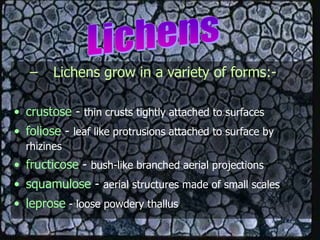
– Lichens grow in a variety of forms:-
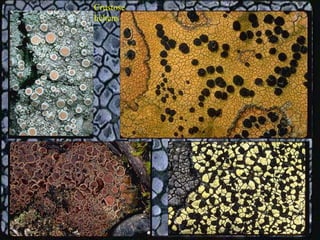
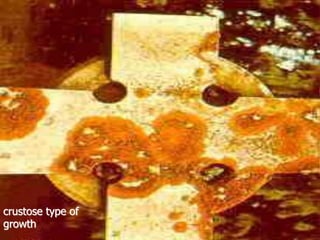
• crustose - thin crusts tightly attached to surfaces
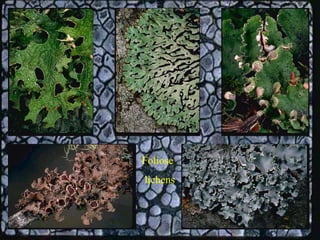
• foliose - leaf like protrusions attached to surface by
rhizines
• fructicose - bush-like branched aerial projections
• squamulose - aerial structures made of small scales
• leprose - loose powdery thallus
Crustose
lichens
crustose type of
growth
crustose type of growth
crustose lichen on bark
Foliose
lichens
Foliose type of growth
crustose
foliose
fructicose (reindeer
moss)
fruticose type of
growth
fructicose
lichens
Squamulose type of growth
podetia
– fungus can reproduce:-
–sexually by ascospores (no algal component)
- spore must ‘locate’ a suitable alga
–asexually
- soredia - powdery masses of alga + hyphae
- isidia - finger like masses of alga + hyphae
• Sexual reproduction.
• Most lichen fungi produce apothecial ascoma
(cup-shaped)
• Asci form in the apothecia and release ascopores -
BUT no algal component.
• A few lichen fungi are basidiomycetes and
produce ‘mushrooms’
apothecia
– Ascospores contain no algae - so how does the lichen
reassemble ?
– The fungus can grow slowly for a while without alga - grows
as disorganized mass - no shape. Once it meets alga, grows
as organized mass into lichen form.
– needs to find an alga of correct species to survive -
sometimes can last a little longer by forming temporary
associations with other algae
– we can only simulate reassembly in the lab when we starve
both components first.
• Asexual reproduction.
– Soredia - algal cells wrapped in threads of fungus
– Isidia - tiny projections from the surface of the lichen
that can break off easily and grow into a new lichen.
Most lichens are very brittle when they're dry, and some
depend on just plain breakage to produce fragments that,
like soredia and isidia, can be blown around by wind,
washed along by water, or carried off as passengers on
insects or birds.
Soredia
Isidia
Lichens
– lichens produce many unique compounds
– weak phenolic acids
– provide resistance to grazing
– UV resistance?
– Important in sp. identification
– some antibiotics,
– fungal genes produce these compounds
but only active when alga present !
 Lichens grow slowly (only 5-10% of mass is
alga and they are often in very dry situations)
but are extremely resistant to effects of
drought, floods, heat or cold.
 Lichens have great longevity - can live for
thousands of years.
– Lichens - are a very important ecological
component in extreme habitats
–eg in tundra - - dominant lifeform - provide
grazing (‘reindeer moss’)
–weathering of bare rock ---> soil
– often absent from agricultural or urban
environments (sensitivity to pollution)
Lichenometry (studies of lichen
growth rate) used in geology
(how long since rocks emerged
from ice) and pollution.
Lichens have no roots - depend
on rain - so ultrasensitive to rain
borne pollution
Montreal area showing
correlation between SO2
pollution (below) and
lichen presence (red dots
on map at left)
Lichens and Pollution.
Lichen fungi are extremely efficient in accumulating
nutrients from trace levels in the atmosphere and so are
especially sensitive to pollution.
An extreme demonstration of this is the ability of lichens to
accumulate radioactive isotopes from the environment.
Following the Chernobyl disaster, the lichens (mainly
Cladonia rangiferina, the "reindeer moss") of northern
Scandinavia accumulated so much radioactivity that reindeer
feeding on them were considered dangerous for human
consumption.
Oakmoss lichen -
important in fine
perfumes (S-central
Europe)
Usnea filipendula
traditionally used
as medicine for
wounds - has
been found to
contain some
potent
antibiotics)
Wolf lichen" (Letharia
vulpina) - the most
widely used dye lichen
for native peoples in
North America,
Flying squirrel nest
made entirely of
Bryoria
FOOD. Mountain
goats, Caribou eat
lichens.
The golden plover uses
Thamnolia vermicularis in
its nests. More than 50
species of birds in North
America known to use
lichens in nest building.
NESTS
CAMOUFLAGE -
lacewing insects
covered in lichen
FOOD. - Witch's hair
lichen blows off trees -
helps black-tailed deer
survive when other
forage under snow
A case of reverse lichenosis or just a universal parasite ?
The large marine brown alga, Ascophyllum nodosum
always contains the fungus, Mycosphaerella ascophylli
2% of lichens have
fungi belonging to the
Basidiomycetes and so
produce mushroom-type
fruiting bodies. e.g.
Omphalina ericetorum
Multiclavula
corynoides
Follow-up to Lecture
• Read Chap 7
• View Fifth Kingdom CD/ Web page (Chap 7)
• Review these lecture notes on Web
• know main features of Lichens
• review terms -
• mycobiont; photobiont; soredia; isidia
• 5 growth forms (crustose etc.)

lichens (2).PPT

  • 1.
    – Lichens -Fungi in closely integrated association with green algae and/or blue- green algae. – Mycorrhizae - Fungi associated with exterior (ectotrophic) or interior (endotrophic) of plant roots – Endophytes - fungi associated with shoots of plants
  • 2.
    lichens - predominant groundcover in tundra trees dependent on mycorrhizae
  • 4.
    - dual organisms –Lichens very tough - typically grow in extreme environments (arctic, hot deserts, bare rock etc.) - often dominant life form where they occur (8% of world). Consist of:- – mycobiont (fungus) - obtains water and minerals, builds shape (thallus), produces the reproductive structures. – Phycobiont (alga) - contributes photosynthate Probably more a case of balanced parasitism than symbiosis.
  • 5.
    • The mycobionthas two principal roles:  to protect the photobiont from exposure to intense sunlight and desiccation – to absorb mineral nutrients from the underlying surface or from minute traces of atmospheric contaminants. • The photobiont also has two roles:  to synthesise organic nutrients from carbon dioxide – in the case of cyanobacteria, to produce ammonium (and then organic nitrogen compounds) from N2 gas, by nitrogen fixation. In some ecosystems such as desert soils, tundra heaths, and Douglas-fir forests of the Pacific Northwest of the USA, lichens can provide the major input of nitrogen which supports other forms of life. http://helios.bto.ed.ac.uk/bto/microbes/lichen.htm
  • 6.
    – Nomenclature -there are ca 20,000 sp. named after the mycobiont (500 genera) – Structure - The mycobiont forms the major part (95%) of the thallus (body) and produces any sexual spores. The photobiont exists as cells, often in layers just below the surface, within the thallus
  • 7.
    • The Phycobiont. –Only 24 genera of algae, either Chlorophyta (green algae) or Cyanobacteria (prokaryotes - blue-green algae). In 70% of lichens the alga is a sp. of Trebouxia. – Some algae (not Trebouxia) can be free living – some lichens have both blue-green and green algae as phycobionts in same thallus.
  • 8.
    Trebouxia cells -the most common green algae found in lichens Cells of Nostoc - a blue-green alga found in lichens.
  • 9.
    –Mycobiont. –98% Ascomycetes, restBasidiomycetes. –40% of all Ascomycetes are obligate lichens. –About half have teleomorph + anamorph, half teleomorph only + small number anamorph only. Never free-living –apparently originated many times independently
  • 10.
  • 11.
  • 12.
    – Lichens growin a variety of forms:- • crustose - thin crusts tightly attached to surfaces • foliose - leaf like protrusions attached to surface by rhizines • fructicose - bush-like branched aerial projections • squamulose - aerial structures made of small scales • leprose - loose powdery thallus
  • 13.
  • 14.
  • 15.
  • 16.
  • 17.
  • 18.
  • 19.
  • 20.
  • 21.
  • 22.
    Squamulose type ofgrowth podetia
  • 23.
    – fungus canreproduce:- –sexually by ascospores (no algal component) - spore must ‘locate’ a suitable alga –asexually - soredia - powdery masses of alga + hyphae - isidia - finger like masses of alga + hyphae
  • 24.
    • Sexual reproduction. •Most lichen fungi produce apothecial ascoma (cup-shaped) • Asci form in the apothecia and release ascopores - BUT no algal component. • A few lichen fungi are basidiomycetes and produce ‘mushrooms’
  • 25.
  • 27.
    – Ascospores containno algae - so how does the lichen reassemble ? – The fungus can grow slowly for a while without alga - grows as disorganized mass - no shape. Once it meets alga, grows as organized mass into lichen form. – needs to find an alga of correct species to survive - sometimes can last a little longer by forming temporary associations with other algae – we can only simulate reassembly in the lab when we starve both components first.
  • 28.
    • Asexual reproduction. –Soredia - algal cells wrapped in threads of fungus – Isidia - tiny projections from the surface of the lichen that can break off easily and grow into a new lichen. Most lichens are very brittle when they're dry, and some depend on just plain breakage to produce fragments that, like soredia and isidia, can be blown around by wind, washed along by water, or carried off as passengers on insects or birds.
  • 29.
  • 30.
    Lichens – lichens producemany unique compounds – weak phenolic acids – provide resistance to grazing – UV resistance? – Important in sp. identification – some antibiotics, – fungal genes produce these compounds but only active when alga present !
  • 31.
     Lichens growslowly (only 5-10% of mass is alga and they are often in very dry situations) but are extremely resistant to effects of drought, floods, heat or cold.  Lichens have great longevity - can live for thousands of years.
  • 32.
    – Lichens -are a very important ecological component in extreme habitats –eg in tundra - - dominant lifeform - provide grazing (‘reindeer moss’) –weathering of bare rock ---> soil – often absent from agricultural or urban environments (sensitivity to pollution)
  • 33.
    Lichenometry (studies oflichen growth rate) used in geology (how long since rocks emerged from ice) and pollution. Lichens have no roots - depend on rain - so ultrasensitive to rain borne pollution Montreal area showing correlation between SO2 pollution (below) and lichen presence (red dots on map at left)
  • 34.
    Lichens and Pollution. Lichenfungi are extremely efficient in accumulating nutrients from trace levels in the atmosphere and so are especially sensitive to pollution. An extreme demonstration of this is the ability of lichens to accumulate radioactive isotopes from the environment. Following the Chernobyl disaster, the lichens (mainly Cladonia rangiferina, the "reindeer moss") of northern Scandinavia accumulated so much radioactivity that reindeer feeding on them were considered dangerous for human consumption.
  • 35.
    Oakmoss lichen - importantin fine perfumes (S-central Europe) Usnea filipendula traditionally used as medicine for wounds - has been found to contain some potent antibiotics) Wolf lichen" (Letharia vulpina) - the most widely used dye lichen for native peoples in North America,
  • 36.
    Flying squirrel nest madeentirely of Bryoria FOOD. Mountain goats, Caribou eat lichens. The golden plover uses Thamnolia vermicularis in its nests. More than 50 species of birds in North America known to use lichens in nest building. NESTS CAMOUFLAGE - lacewing insects covered in lichen FOOD. - Witch's hair lichen blows off trees - helps black-tailed deer survive when other forage under snow
  • 37.
    A case ofreverse lichenosis or just a universal parasite ? The large marine brown alga, Ascophyllum nodosum always contains the fungus, Mycosphaerella ascophylli
  • 38.
    2% of lichenshave fungi belonging to the Basidiomycetes and so produce mushroom-type fruiting bodies. e.g. Omphalina ericetorum Multiclavula corynoides
  • 39.
    Follow-up to Lecture •Read Chap 7 • View Fifth Kingdom CD/ Web page (Chap 7) • Review these lecture notes on Web • know main features of Lichens • review terms - • mycobiont; photobiont; soredia; isidia • 5 growth forms (crustose etc.)