Structure, reproduction, life history and
systematic position of Lycopodium
Sankrita Gaonkar
Assistant Professor in Botany
sankrita002@gmail.com
Contents
• Systematic position
• Morphology
• Anatomy
• Reproduction
• Life cycle
• References
Systematic position
• Division – Lycophyta
• Class – Lycopsida (Eligulopsida)
• Order – Lycopodiales
• Family – Lycopodiadeae
• Genus - Lycopodium
Lycopodium
Distribution
• 400 spp. – found under varied habitats
• Some grow in cold climates of Arctic region
• Some inhabit tropical and sub-tropical regions
• In India – 33 spp. – mostly in Eastern Himalayas, South
Indian mountains
Habit
• Most are tropical spp., epiphytic – grow hanging from tree
trunks
• Temperate spp. – grow in wood-lands, on moist and acidic
soils
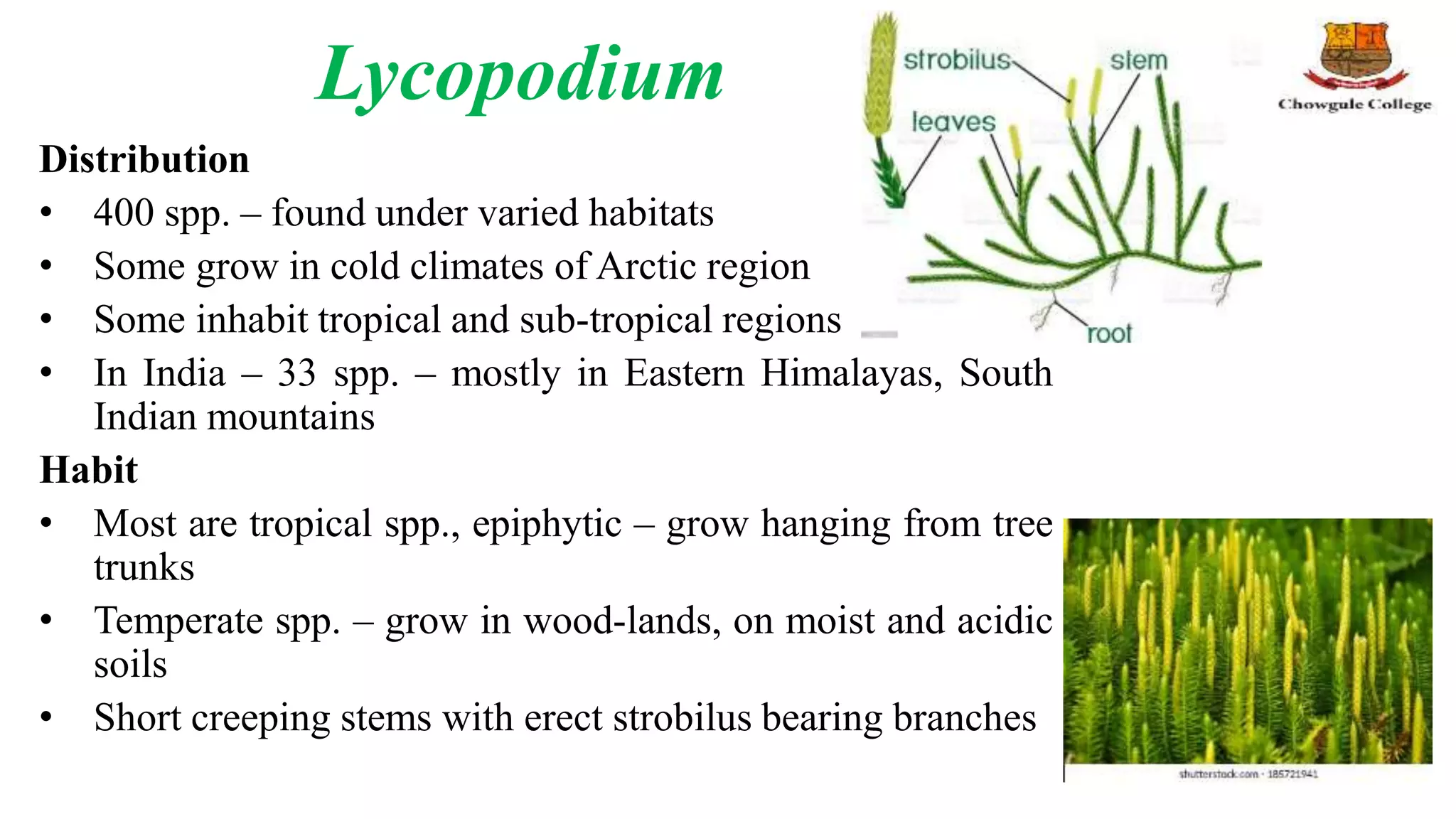
• Short creeping stems with erect strobilus bearing branches
Stem:
• Dichotomously branched
• Dichotomy – equal or unequal
• Unequal branches – one remains small and other grows
longer
• Small branches ultimately stop growth and bear strobili
• Unequal dichotomy  Pseudomonopodial – e.g., L.
clavatum, L. densum, L. obscurum
Leaf:
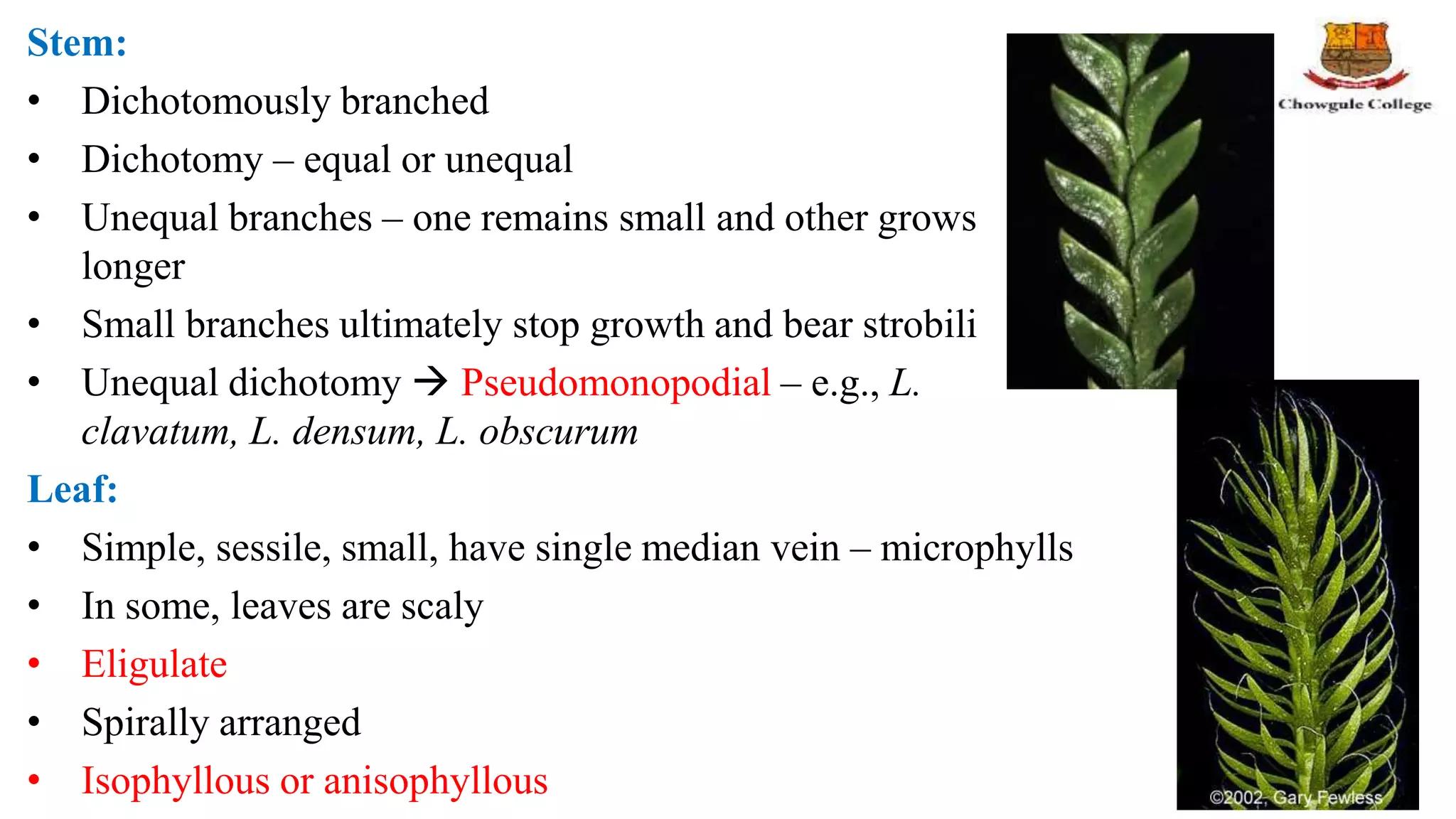
• Simple, sessile, small, have single median vein – microphylls
• In some, leaves are scaly
• Eligulate
• Spirally arranged
• Isophyllous or anisophyllous
Root:
• Dichotomously branched
• Arise from lower side of prostrate stems
Anatomy
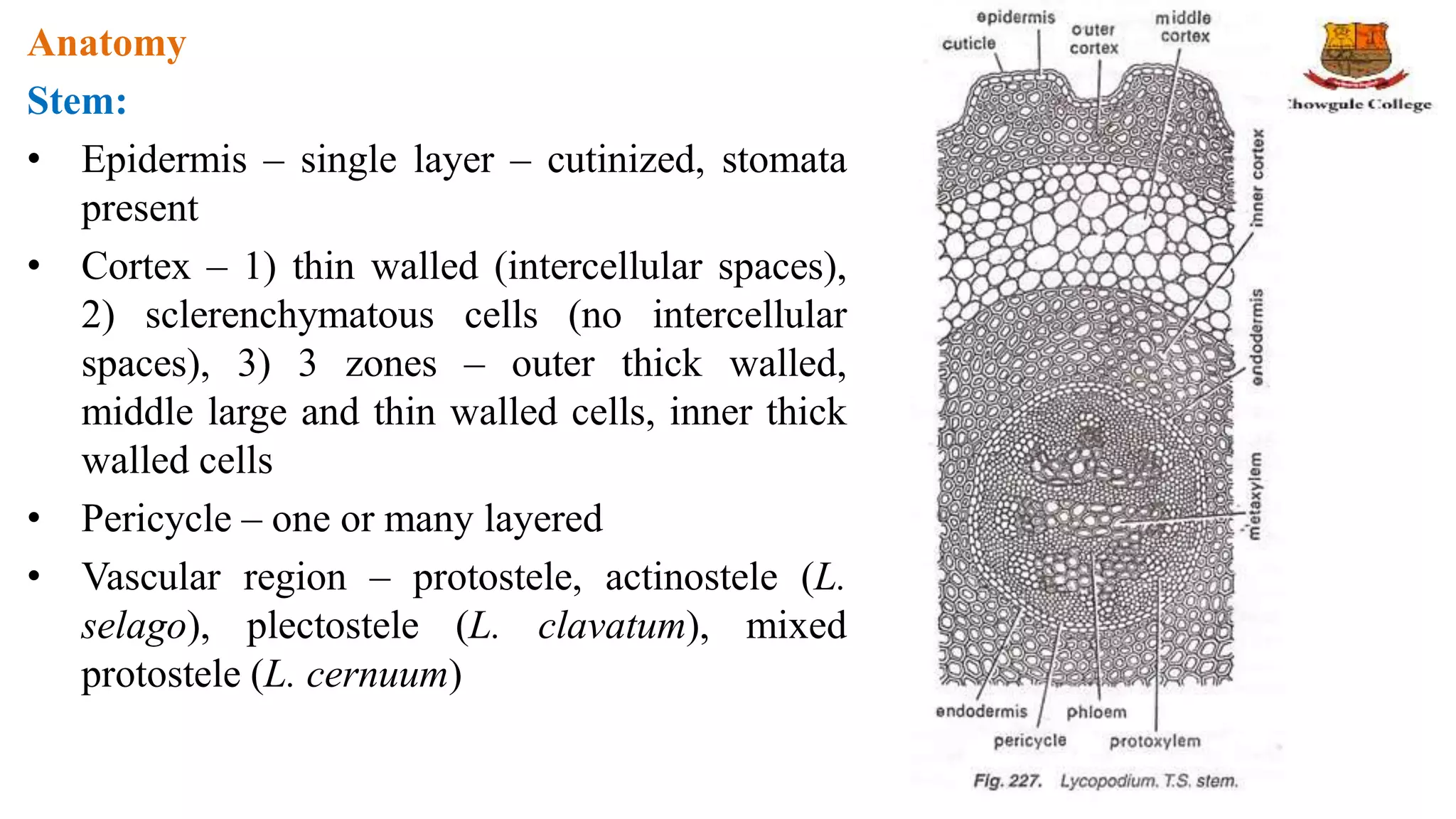
Stem:
• Epidermis – single layer – cutinized, stomata
present
• Cortex – 1) thin walled (intercellular spaces),
2) sclerenchymatous cells (no intercellular
spaces), 3) 3 zones – outer thick walled,
middle large and thin walled cells, inner thick
walled cells
• Pericycle – one or many layered
• Vascular region – protostele, actinostele (L.
selago), plectostele (L. clavatum), mixed
protostele (L. cernuum)
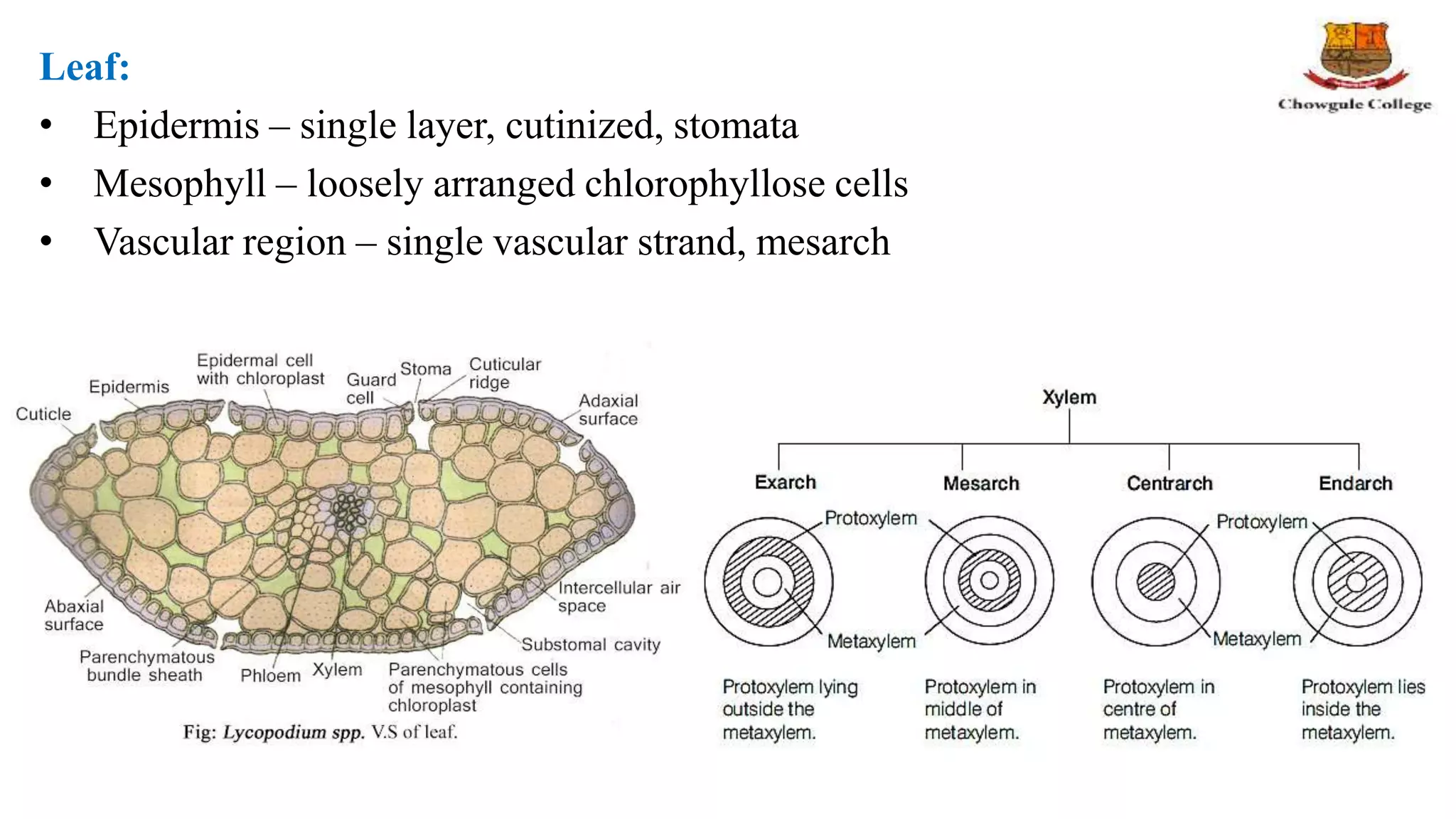
Leaf:
• Epidermis – single layer, cutinized, stomata
• Mesophyll – loosely arranged chlorophyllose cells
• Vascular region – single vascular strand, mesarch
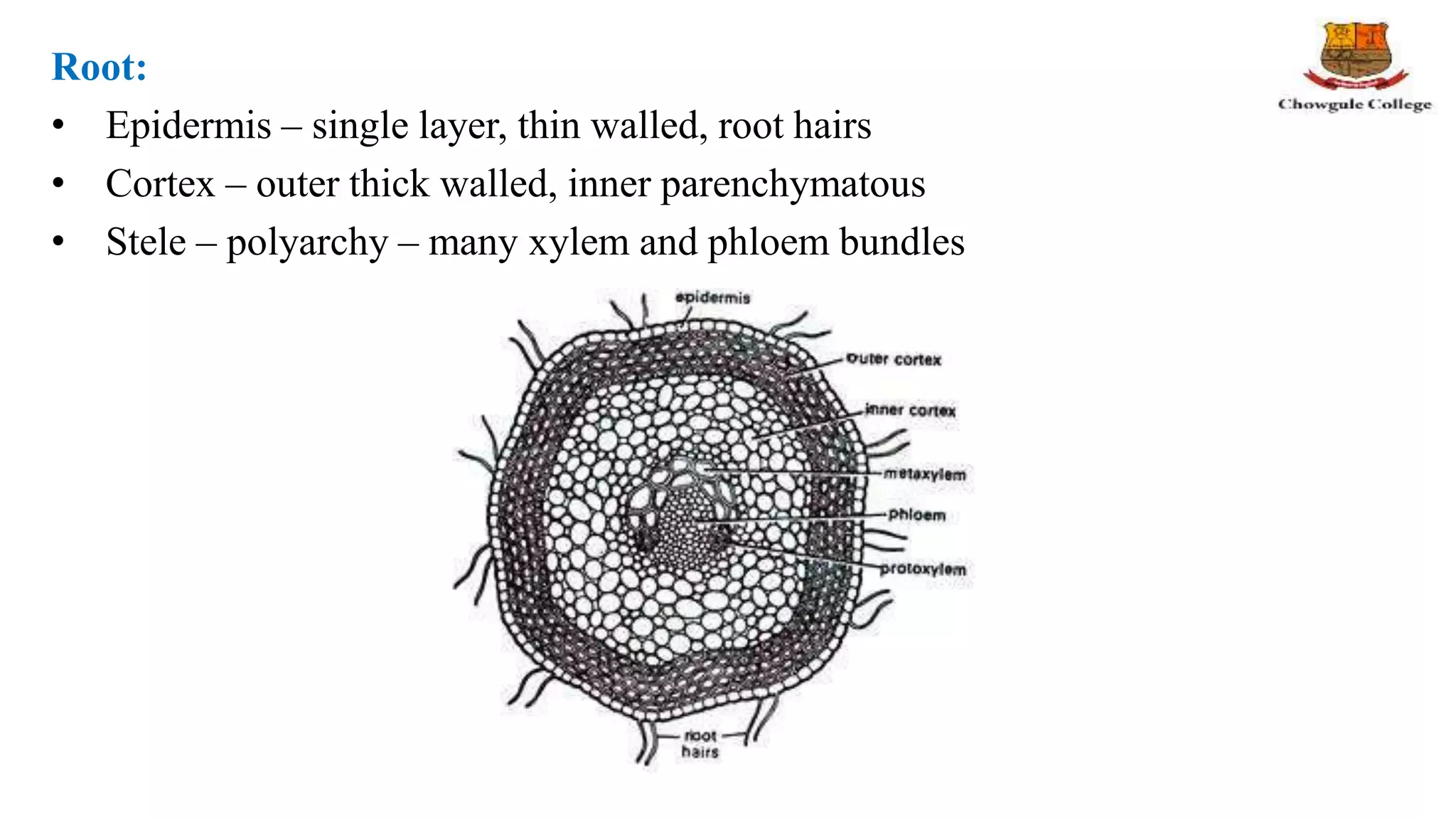
Root:
• Epidermis – single layer, thin walled, root hairs
• Cortex – outer thick walled, inner parenchymatous
• Stele – polyarchy – many xylem and phloem bundles
REPRODUCTION:
• By vegetative means and by spores and sexually
1. Vegetative Reproduction:
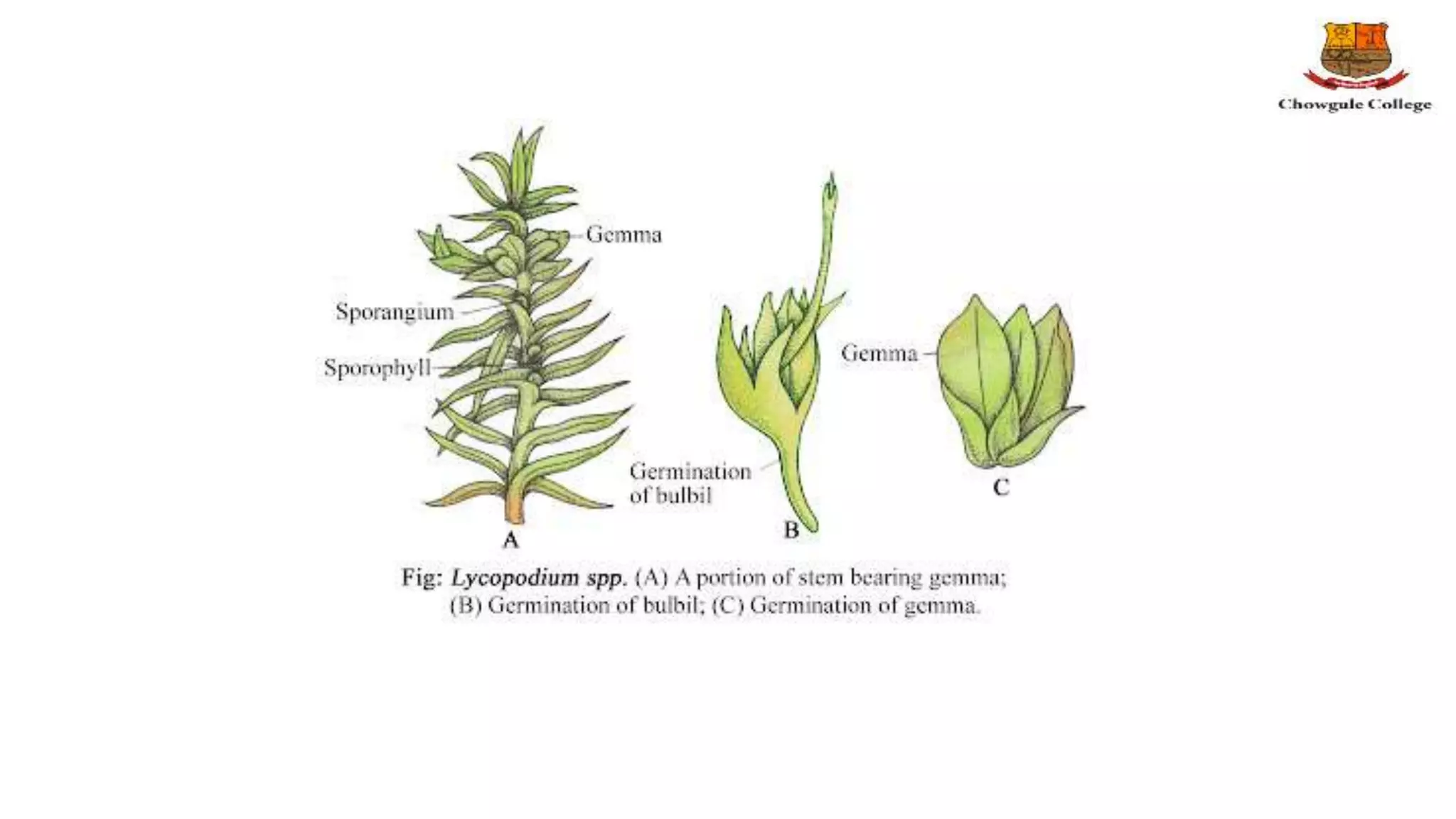
(a) By Gemmae or Bulbils – modified vegetative structures – arise as lateral outgrowths
near stem apex.
(b) Fragmentation – branches gets separated from parent plant due to dead and decay of
older parts – grow into new individual plants.
(c) By Resting Buds – In some species, tip of the rhizome or branches store food material
and becomes thick with crowded leaves - resting buds. During unfavorable condition,
whole plant dies except resting buds – resumes growth at advent of favorable
condition, and produces a new individual.
(d) By Root Tubercles – originate from parenchymatous region of cortex. It consists of a
group of cells with stored food material and protected by thick walls – capable to
germinate into a new plant individual.
(e) By Adventitious Buds – developed from isolated bulbil leaves. It also develops in stem
near the apex
2. Spore Formation:
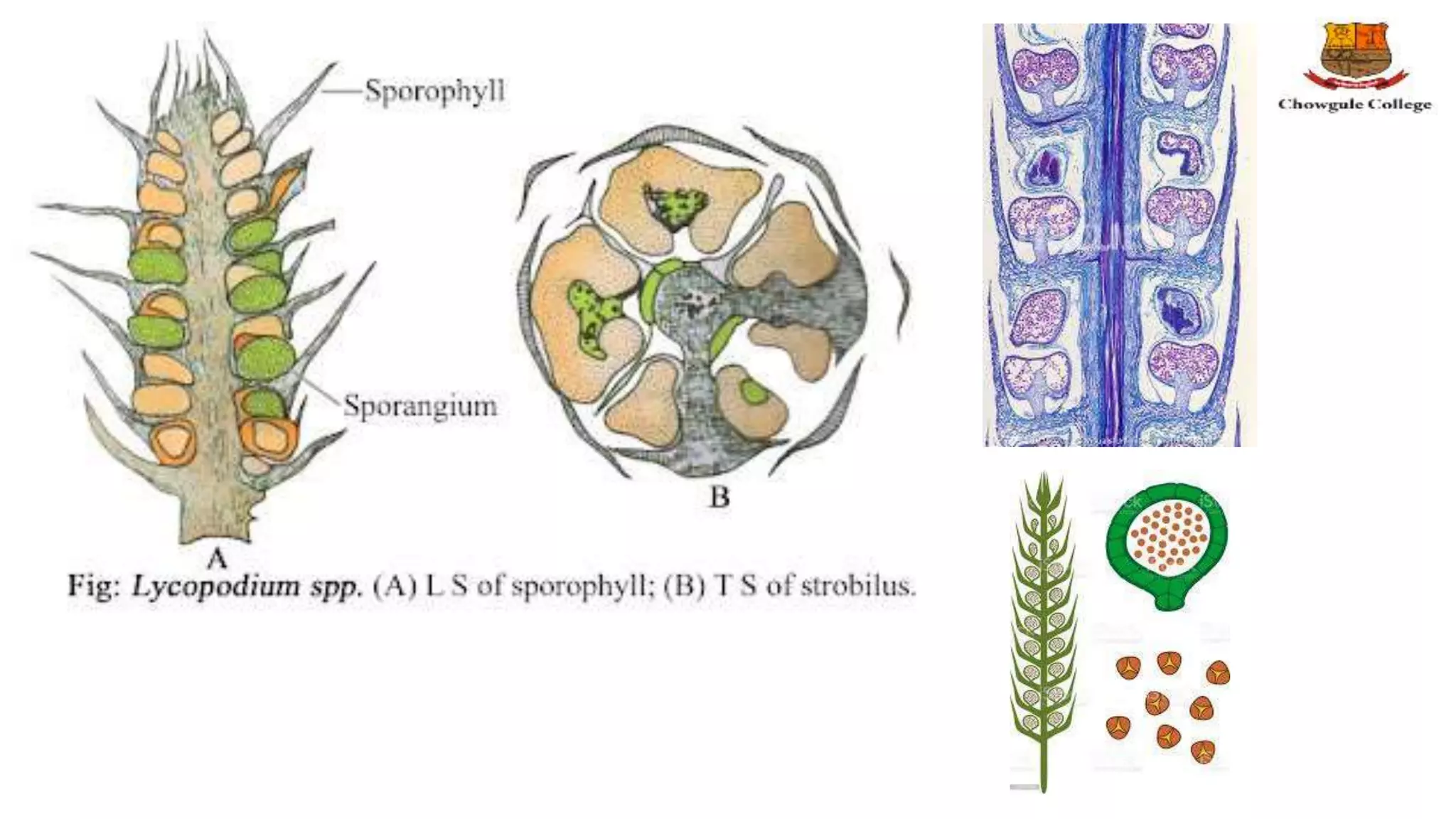
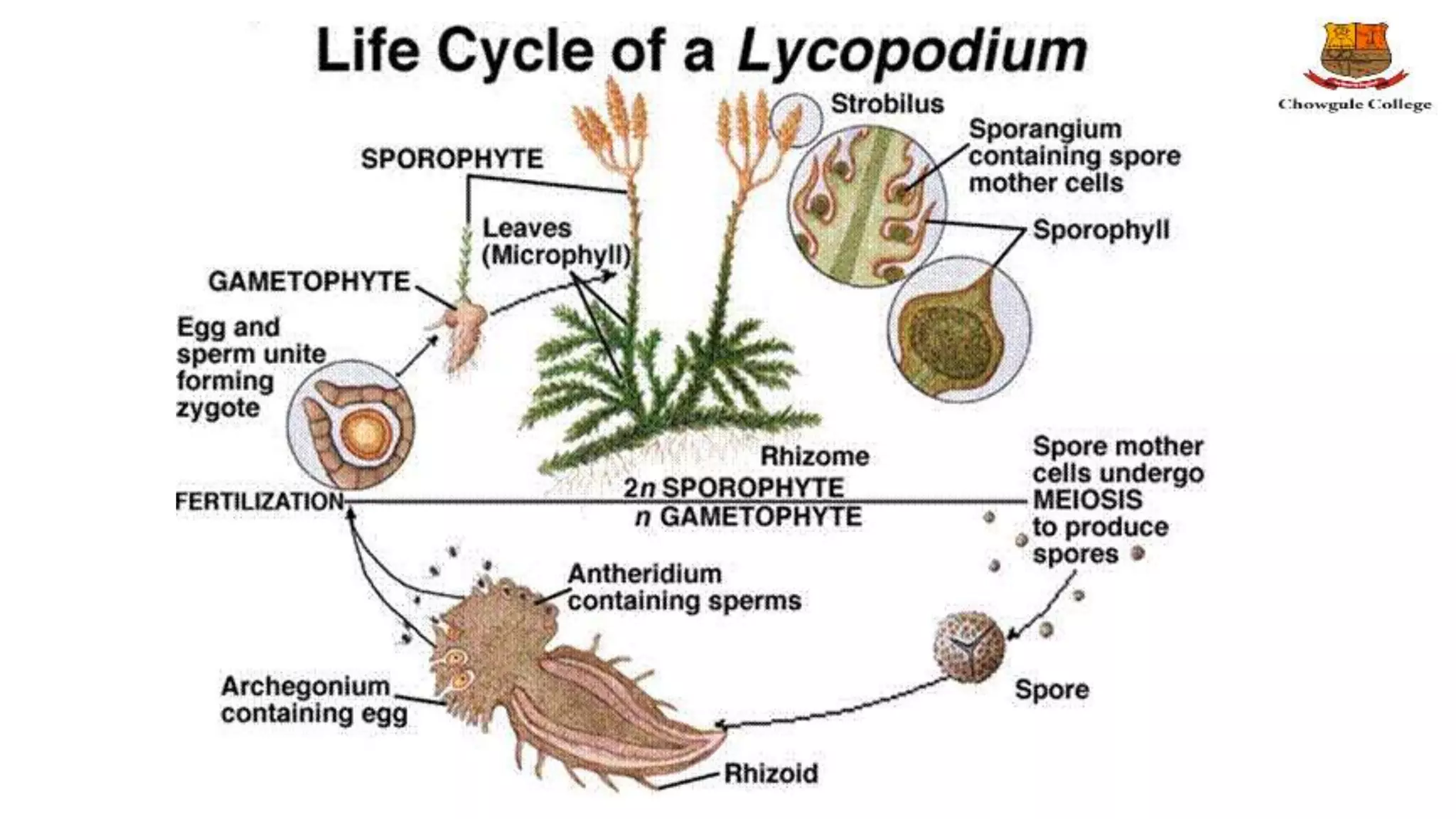
• Spores formed in specialized reproductive structure – strobili (singular :
Strobilus) or cone
• Strobilus – slender, sessile or stalked, simple, un-branched or dichotomously
branched, arising at apex of stem or branches, consists of central axis in
which fertile leaves or sporophylls are spirally arranged. Each sporophyll
bears a sporangium at base
• Sporangium – yellow or orange with sterile jacket layer of 2-3 layers of cells
thick. Within jacket layer is fertile sporogenous tissue with nutritive tissue
known as tapetum. Sporogenous tissue later differentiates into spore mother
cells, each of which by meiotic division produces spore-tetrad
• Lycopodium is homosporous, i.e., it produces only one type of spores. As
soon as the spores are developed, haploid (n) gametophytic generation begins
Prothallus is homothallic – bears both male and female sex organs, i.e., antheridia
and archegonia in single gametophytic plant body
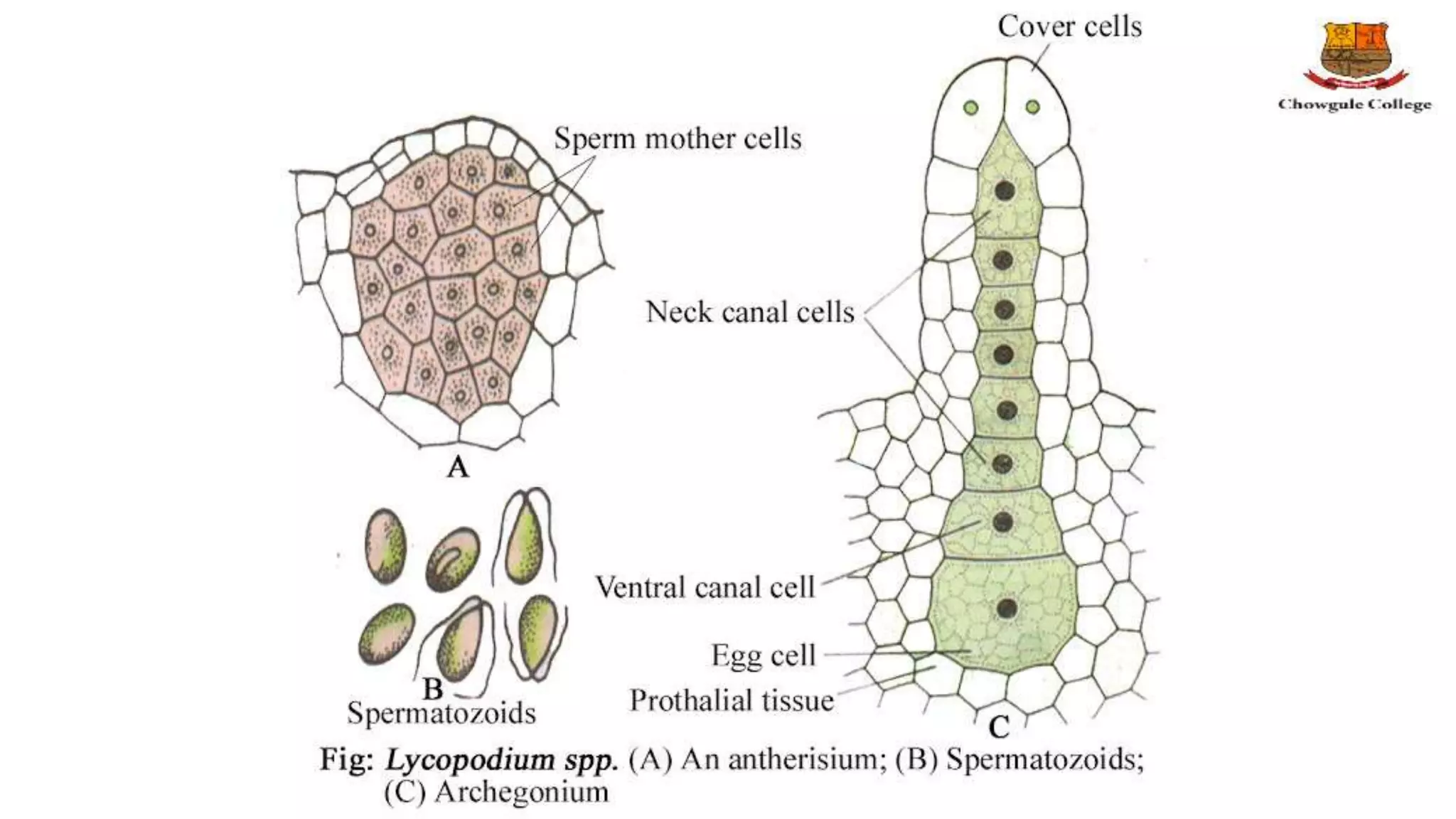
1. Antheridia – arise in several numbers in gametophytic plant body. They
remain either wholly embedded in gametophytic tissue or projected slightly.
Each antheridium is surrounded by a jacket layer of one-celled in thickness.
Inside jacket layer lies numerous sperm mother cells, which directly
metamorphosed into small, cubical, biflagellate sperm.
2. Archegonia – arise in numbers in gametophytic plant body . They also
remain sunken with only their neck projecting outwardly. A mature
archegonium consists of a neck, composed of 6-13 neck canal cells, and a
narrow venter, composed of one ventral canal cell and an egg cell.
References
• Vashishta BR. 2010. Botany for degree students:
Pteridophytes. S. Chand & company ltd.
• Pandey B.P. (2009). Botany for degree students: B.Sc. First
Year. S. Chand & Company Ltd. New Delhi.

Structure, reproduction, life history and systematic position of Lycopodium

  • 1.
    Structure, reproduction, lifehistory and systematic position of Lycopodium Sankrita Gaonkar Assistant Professor in Botany sankrita002@gmail.com
  • 2.
    Contents • Systematic position •Morphology • Anatomy • Reproduction • Life cycle • References
  • 3.
    Systematic position • Division– Lycophyta • Class – Lycopsida (Eligulopsida) • Order – Lycopodiales • Family – Lycopodiadeae • Genus - Lycopodium
  • 4.
    Lycopodium Distribution • 400 spp.– found under varied habitats • Some grow in cold climates of Arctic region • Some inhabit tropical and sub-tropical regions • In India – 33 spp. – mostly in Eastern Himalayas, South Indian mountains Habit • Most are tropical spp., epiphytic – grow hanging from tree trunks • Temperate spp. – grow in wood-lands, on moist and acidic soils • Short creeping stems with erect strobilus bearing branches
  • 5.
    Stem: • Dichotomously branched •Dichotomy – equal or unequal • Unequal branches – one remains small and other grows longer • Small branches ultimately stop growth and bear strobili • Unequal dichotomy  Pseudomonopodial – e.g., L. clavatum, L. densum, L. obscurum Leaf: • Simple, sessile, small, have single median vein – microphylls • In some, leaves are scaly • Eligulate • Spirally arranged • Isophyllous or anisophyllous
  • 6.
    Root: • Dichotomously branched •Arise from lower side of prostrate stems
  • 7.
    Anatomy Stem: • Epidermis –single layer – cutinized, stomata present • Cortex – 1) thin walled (intercellular spaces), 2) sclerenchymatous cells (no intercellular spaces), 3) 3 zones – outer thick walled, middle large and thin walled cells, inner thick walled cells • Pericycle – one or many layered • Vascular region – protostele, actinostele (L. selago), plectostele (L. clavatum), mixed protostele (L. cernuum)
  • 8.
    Leaf: • Epidermis –single layer, cutinized, stomata • Mesophyll – loosely arranged chlorophyllose cells • Vascular region – single vascular strand, mesarch
  • 9.
    Root: • Epidermis –single layer, thin walled, root hairs • Cortex – outer thick walled, inner parenchymatous • Stele – polyarchy – many xylem and phloem bundles
  • 10.
    REPRODUCTION: • By vegetativemeans and by spores and sexually 1. Vegetative Reproduction: (a) By Gemmae or Bulbils – modified vegetative structures – arise as lateral outgrowths near stem apex. (b) Fragmentation – branches gets separated from parent plant due to dead and decay of older parts – grow into new individual plants. (c) By Resting Buds – In some species, tip of the rhizome or branches store food material and becomes thick with crowded leaves - resting buds. During unfavorable condition, whole plant dies except resting buds – resumes growth at advent of favorable condition, and produces a new individual. (d) By Root Tubercles – originate from parenchymatous region of cortex. It consists of a group of cells with stored food material and protected by thick walls – capable to germinate into a new plant individual. (e) By Adventitious Buds – developed from isolated bulbil leaves. It also develops in stem near the apex
  • 12.
    2. Spore Formation: •Spores formed in specialized reproductive structure – strobili (singular : Strobilus) or cone • Strobilus – slender, sessile or stalked, simple, un-branched or dichotomously branched, arising at apex of stem or branches, consists of central axis in which fertile leaves or sporophylls are spirally arranged. Each sporophyll bears a sporangium at base • Sporangium – yellow or orange with sterile jacket layer of 2-3 layers of cells thick. Within jacket layer is fertile sporogenous tissue with nutritive tissue known as tapetum. Sporogenous tissue later differentiates into spore mother cells, each of which by meiotic division produces spore-tetrad • Lycopodium is homosporous, i.e., it produces only one type of spores. As soon as the spores are developed, haploid (n) gametophytic generation begins
  • 14.
    Prothallus is homothallic– bears both male and female sex organs, i.e., antheridia and archegonia in single gametophytic plant body 1. Antheridia – arise in several numbers in gametophytic plant body. They remain either wholly embedded in gametophytic tissue or projected slightly. Each antheridium is surrounded by a jacket layer of one-celled in thickness. Inside jacket layer lies numerous sperm mother cells, which directly metamorphosed into small, cubical, biflagellate sperm. 2. Archegonia – arise in numbers in gametophytic plant body . They also remain sunken with only their neck projecting outwardly. A mature archegonium consists of a neck, composed of 6-13 neck canal cells, and a narrow venter, composed of one ventral canal cell and an egg cell.
  • 17.
    References • Vashishta BR.2010. Botany for degree students: Pteridophytes. S. Chand & company ltd. • Pandey B.P. (2009). Botany for degree students: B.Sc. First Year. S. Chand & Company Ltd. New Delhi.