Submitted by:-
Priyanka Dixit
M.Sc previous
Submitted to:-
Prof. Samuel G Singh Sir
CONTENT
 Introduction
 Definitions
 History
 Habitat
 Classification
 Nature of association
 Composition
 Structure
 Reproduction
 Economic importance
 Lichen as bioindicator
 Lichenometry
Introduction
Lichens are considered plant-like organisms that show
symbiotic association with algae , till now there are
15,000 species of lichen. They mainly show symbiotic
association with green algae or cyanobacteria and
fungi (mostly ascomycetes and basidiomycetes) .They
are found all across the world depending on the
condition of the environment . They are majorly found
in colony form , like on the tree bark , exposed rock ,
and as a part of biological soil crust .
Lichens are also used as human beings as a source of
food along with medicine extraction and dye . They are
also considered a major source of food for reindeer a
major source of food for reindeer that roam the far
northern ranges .
Definitions
• Lichen: structurally organized permanent symbiotic
association of fungi and algae .
• Lichenology: Branch of biology deals with study of lichen.
• Mycobiont: Fungal component of lichen.
• Phycobiont: Algal component of lichen.
• Symbiosis: Association/interaction of organisms where
both partners are mutually benefitted.
• Algae in turn supplies organic food to fungus.
• Fungus protect algae from unfavorable conditions.
• This type of symbiosis is called as heliotism (master and
slave relationship)
• Fungal component is prominent in lichen than algal
component.
• Growth of lichen is very slow.
• Lichen produce a specific acid known as lichen acid.
History
• Schwender(1867-68):- Helotism
• Anton von De Bary(1887):-Symbiosis
• Reinke(1896):-Mutualism
• Elenkin(1902):-Endosaprophytism
• Awasthi:-Poly symbiosis
Habitat
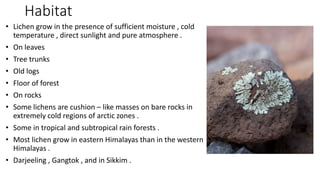
• Lichen grow in the presence of sufficient moisture , cold
temperature , direct sunlight and pure atmosphere .
• On leaves
• Tree trunks
• Old logs
• Floor of forest
• On rocks
• Some lichens are cushion – like masses on bare rocks in
extremely cold regions of arctic zones .
• Some in tropical and subtropical rain forests .
• Most lichen grow in eastern Himalayas than in the western
Himalayas .
• Darjeeling , Gangtok , and in Sikkim .
Classification
• Based on their growth
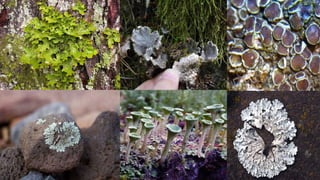
1. Crustose :- It is a lichen that sticks tight to the
substance on which it is growing on. As the name
suggests, it is crusty and even forms a crust on
the substrate it is growing.
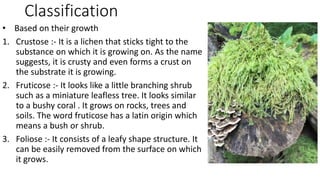
2. Fruticose :- It looks like a little branching shrub
such as a miniature leafless tree. It looks similar
to a bushy coral . It grows on rocks, trees and
soils. The word fruticose has a latin origin which
means a bush or shrub.
3. Foliose :- It consists of a leafy shape structure. It
can be easily removed from the surface on which
it grows.
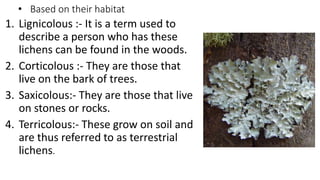
• Based on their habitat
1. Lignicolous :- It is a term used to
describe a person who has these
lichens can be found in the woods.
2. Corticolous :- They are those that
live on the bark of trees.
3. Saxicolous:- They are those that live
on stones or rocks.
4. Terricolous:- These grow on soil and
are thus referred to as terrestrial
lichens.
• Based on their internal structure
1. Heteromerous lichens
2. Homoiomerous lichens
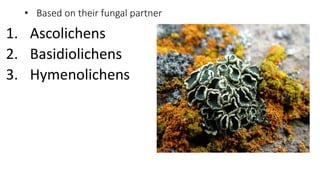
• Based on their fungal partner
1. Ascolichens
2. Basidiolichens
3. Hymenolichens
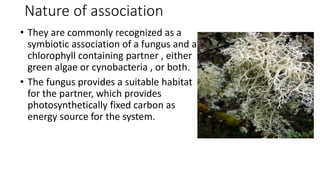
Nature of association
• They are commonly recognized as a
symbiotic association of a fungus and a
chlorophyll containing partner , either
green algae or cynobacteria , or both.
• The fungus provides a suitable habitat
for the partner, which provides
photosynthetically fixed carbon as
energy source for the system.
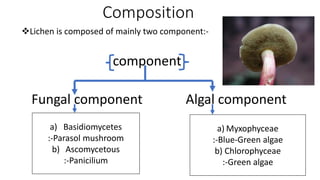
Composition
Lichen is composed of mainly two component:-
component
Fungal component Algal component
a) Basidiomycetes
:-Parasol mushroom
b) Ascomycetous
:-Panicilium
a) Myxophyceae
:-Blue-Green algae
b) Chlorophyceae
:-Green algae
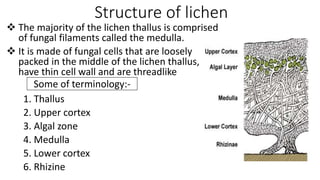
Structure of lichen
 The majority of the lichen thallus is comprised
of fungal filaments called the medulla.
 It is made of fungal cells that are loosely
packed in the middle of the lichen thallus,
have thin cell wall and are threadlike
1. Thallus
2. Upper cortex
3. Algal zone
4. Medulla
5. Lower cortex
6. Rhizine
Some of terminology:-
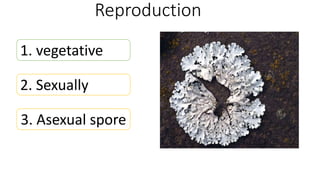
Reproduction
1. vegetative
2. Sexually
3. Asexual spore
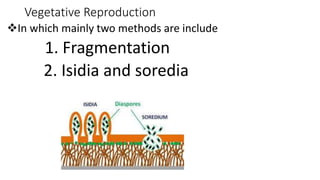
Vegetative Reproduction
In which mainly two methods are include
1. Fragmentation
2. Isidia and soredia
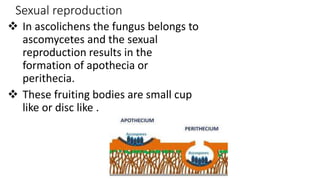
Sexual reproduction
 In ascolichens the fungus belongs to
ascomycetes and the sexual
reproduction results in the
formation of apothecia or
perithecia.
 These fruiting bodies are small cup
like or disc like .
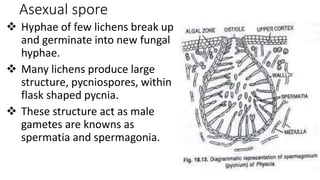
Asexual spore
 Hyphae of few lichens break up
and germinate into new fungal
hyphae.
 Many lichens produce large
structure, pycniospores, within
flask shaped pycnia.
 These structure act as male
gametes are knowns as
spermatia and spermagonia.
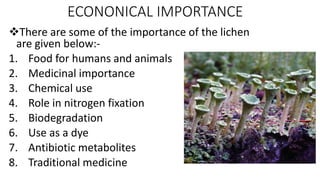
ECONONICAL IMPORTANCE
There are some of the importance of the lichen
are given below:-
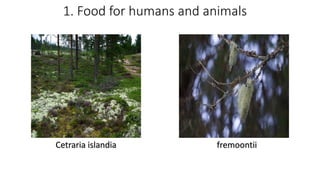
1. Food for humans and animals
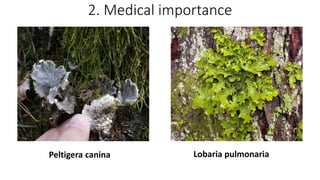
2. Medicinal importance
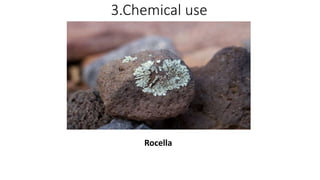
3. Chemical use
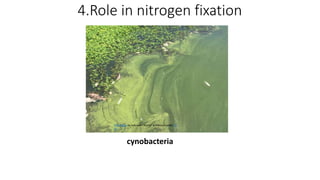
4. Role in nitrogen fixation
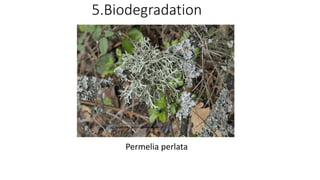
5. Biodegradation
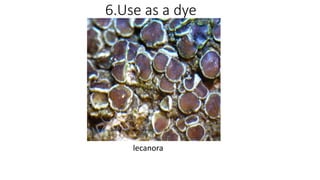
6. Use as a dye
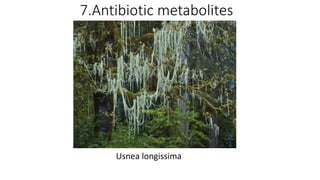
7. Antibiotic metabolites
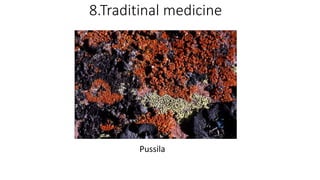
8. Traditional medicine
1. Food for humans and animals
Cetraria islandia fremoontii
2. Medical importance
Peltigera canina Lobaria pulmonaria
3.Chemical use
Rocella
4.Role in nitrogen fixation
cynobacteria
This Photo by Unknown Author is licensed under CC
BY
5.Biodegradation
Permelia perlata
This Photo by Unknown Author is licensed under CC BY-SA
6.Use as a dye
lecanora
This Photo by Unknown Author is licensed under CC BY
7.Antibiotic metabolites
Usnea longissima
This
Pho
to
by
Unk
now
n
Aut
hor
is
lice
nse
d
und
er
CC
BY-
NC-
ND
8.Traditinal medicine
Pussila
This
Phot
o
by
Unkn
own
Auth
or
is
licens
ed
unde
r
CC
BY-
SA-
NC
Lichen as bioindicator
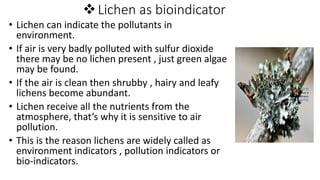
• Lichen can indicate the pollutants in
environment.
• If air is very badly polluted with sulfur dioxide
there may be no lichen present , just green algae
may be found.
• If the air is clean then shrubby , hairy and leafy
lichens become abundant.
• Lichen receive all the nutrients from the
atmosphere, that’s why it is sensitive to air
pollution.
• This is the reason lichens are widely called as
environment indicators , pollution indicators or
bio-indicators.
This
Photo
by
Unknown
Author
is
licensed
under
CC
BY-SA
 Lichenometry
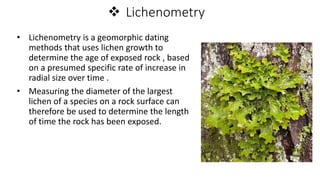
• Lichenometry is a geomorphic dating
methods that uses lichen growth to
determine the age of exposed rock , based
on a presumed specific rate of increase in
radial size over time .
• Measuring the diameter of the largest
lichen of a species on a rock surface can
therefore be used to determine the length
of time the rock has been exposed.
lichen (1).pptx
lichen (1).pptx

lichen (1).pptx

  • 1.
    Submitted by:- Priyanka Dixit M.Scprevious Submitted to:- Prof. Samuel G Singh Sir
  • 2.
    CONTENT  Introduction  Definitions History  Habitat  Classification  Nature of association  Composition  Structure  Reproduction  Economic importance  Lichen as bioindicator  Lichenometry
  • 3.
    Introduction Lichens are consideredplant-like organisms that show symbiotic association with algae , till now there are 15,000 species of lichen. They mainly show symbiotic association with green algae or cyanobacteria and fungi (mostly ascomycetes and basidiomycetes) .They are found all across the world depending on the condition of the environment . They are majorly found in colony form , like on the tree bark , exposed rock , and as a part of biological soil crust . Lichens are also used as human beings as a source of food along with medicine extraction and dye . They are also considered a major source of food for reindeer a major source of food for reindeer that roam the far northern ranges .
  • 4.
    Definitions • Lichen: structurallyorganized permanent symbiotic association of fungi and algae . • Lichenology: Branch of biology deals with study of lichen. • Mycobiont: Fungal component of lichen. • Phycobiont: Algal component of lichen. • Symbiosis: Association/interaction of organisms where both partners are mutually benefitted. • Algae in turn supplies organic food to fungus. • Fungus protect algae from unfavorable conditions. • This type of symbiosis is called as heliotism (master and slave relationship) • Fungal component is prominent in lichen than algal component. • Growth of lichen is very slow. • Lichen produce a specific acid known as lichen acid.
  • 5.
    History • Schwender(1867-68):- Helotism •Anton von De Bary(1887):-Symbiosis • Reinke(1896):-Mutualism • Elenkin(1902):-Endosaprophytism • Awasthi:-Poly symbiosis
  • 6.
    Habitat • Lichen growin the presence of sufficient moisture , cold temperature , direct sunlight and pure atmosphere . • On leaves • Tree trunks • Old logs • Floor of forest • On rocks • Some lichens are cushion – like masses on bare rocks in extremely cold regions of arctic zones . • Some in tropical and subtropical rain forests . • Most lichen grow in eastern Himalayas than in the western Himalayas . • Darjeeling , Gangtok , and in Sikkim .
  • 7.
    Classification • Based ontheir growth 1. Crustose :- It is a lichen that sticks tight to the substance on which it is growing on. As the name suggests, it is crusty and even forms a crust on the substrate it is growing. 2. Fruticose :- It looks like a little branching shrub such as a miniature leafless tree. It looks similar to a bushy coral . It grows on rocks, trees and soils. The word fruticose has a latin origin which means a bush or shrub. 3. Foliose :- It consists of a leafy shape structure. It can be easily removed from the surface on which it grows.
  • 8.
    • Based ontheir habitat 1. Lignicolous :- It is a term used to describe a person who has these lichens can be found in the woods. 2. Corticolous :- They are those that live on the bark of trees. 3. Saxicolous:- They are those that live on stones or rocks. 4. Terricolous:- These grow on soil and are thus referred to as terrestrial lichens.
  • 9.
    • Based ontheir internal structure 1. Heteromerous lichens 2. Homoiomerous lichens
  • 10.
    • Based ontheir fungal partner 1. Ascolichens 2. Basidiolichens 3. Hymenolichens
  • 11.
    Nature of association •They are commonly recognized as a symbiotic association of a fungus and a chlorophyll containing partner , either green algae or cynobacteria , or both. • The fungus provides a suitable habitat for the partner, which provides photosynthetically fixed carbon as energy source for the system.
  • 12.
    Composition Lichen is composedof mainly two component:- component Fungal component Algal component a) Basidiomycetes :-Parasol mushroom b) Ascomycetous :-Panicilium a) Myxophyceae :-Blue-Green algae b) Chlorophyceae :-Green algae
  • 13.
    Structure of lichen The majority of the lichen thallus is comprised of fungal filaments called the medulla.  It is made of fungal cells that are loosely packed in the middle of the lichen thallus, have thin cell wall and are threadlike 1. Thallus 2. Upper cortex 3. Algal zone 4. Medulla 5. Lower cortex 6. Rhizine Some of terminology:-
  • 14.
  • 15.
    Vegetative Reproduction In whichmainly two methods are include 1. Fragmentation 2. Isidia and soredia
  • 16.
    Sexual reproduction  Inascolichens the fungus belongs to ascomycetes and the sexual reproduction results in the formation of apothecia or perithecia.  These fruiting bodies are small cup like or disc like .
  • 17.
    Asexual spore  Hyphaeof few lichens break up and germinate into new fungal hyphae.  Many lichens produce large structure, pycniospores, within flask shaped pycnia.  These structure act as male gametes are knowns as spermatia and spermagonia.
  • 18.
    ECONONICAL IMPORTANCE There aresome of the importance of the lichen are given below:- 1. Food for humans and animals 2. Medicinal importance 3. Chemical use 4. Role in nitrogen fixation 5. Biodegradation 6. Use as a dye 7. Antibiotic metabolites 8. Traditional medicine
  • 19.
    1. Food forhumans and animals Cetraria islandia fremoontii
  • 20.
    2. Medical importance Peltigeracanina Lobaria pulmonaria
  • 21.
  • 22.
    4.Role in nitrogenfixation cynobacteria This Photo by Unknown Author is licensed under CC BY
  • 23.
    5.Biodegradation Permelia perlata This Photoby Unknown Author is licensed under CC BY-SA
  • 24.
    6.Use as adye lecanora This Photo by Unknown Author is licensed under CC BY
  • 25.
  • 26.
  • 27.
    Lichen as bioindicator •Lichen can indicate the pollutants in environment. • If air is very badly polluted with sulfur dioxide there may be no lichen present , just green algae may be found. • If the air is clean then shrubby , hairy and leafy lichens become abundant. • Lichen receive all the nutrients from the atmosphere, that’s why it is sensitive to air pollution. • This is the reason lichens are widely called as environment indicators , pollution indicators or bio-indicators. This Photo by Unknown Author is licensed under CC BY-SA
  • 28.
     Lichenometry • Lichenometryis a geomorphic dating methods that uses lichen growth to determine the age of exposed rock , based on a presumed specific rate of increase in radial size over time . • Measuring the diameter of the largest lichen of a species on a rock surface can therefore be used to determine the length of time the rock has been exposed.