BATRACHOSPERMUM
Red Alga
Nisar Ahmad lone
Assistant Professor Botany
GDC Women Bla
RHODOPHYCEAE
CLASSIFICATION
Class Rhodophyceae
Sub-Class: Florideae
Order: Nemalionales
Family: Batrachospermaceae
Genus Batrachospermum
OCCURANCE
 Fresh water red alga
found in slow moving
waters of lakes, ponds,
streams in tropical and
temperate regions
 Some species attached
to stones in rivers
 Most species annual but
B.vagum perennial
 5 species in india
e.g, B .monaliformae,
B.vagum
OCCURANCE
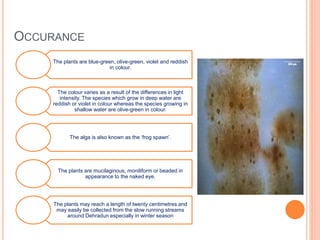
The plants are blue-green, olive-green, violet and reddish
in colour.
The colour varies as a result of the differences in light
intensity. The species which grow in deep water are
reddish or violet in colour whereas the species growing in
shallow water are olive-green in colour.
The alga is also known as the ‘frog spawn’.
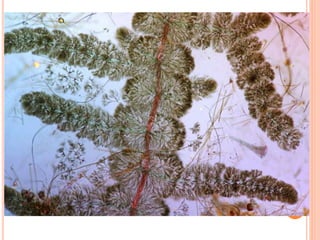
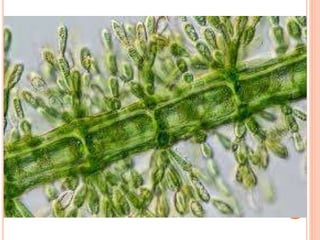
The plants are mucilaginous, moniliform or beaded in
appearance to the naked eye.
The plants may reach a length of twenty centimetres and
may easily be collected from the slow running streams
around Dehradun especially in winter season
THALLUS STRUCTURE
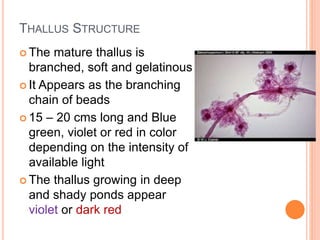
 The mature thallus is
branched, soft and gelatinous
 It Appears as the branching
chain of beads
 15 – 20 cms long and Blue
green, violet or red in color
depending on the intensity of
available light
 The thallus growing in deep
and shady ponds appear
violet or dark red
THALLUS STRUCTURE
 In shallow and illuminated
ponds the thallus appears
dark green in colour
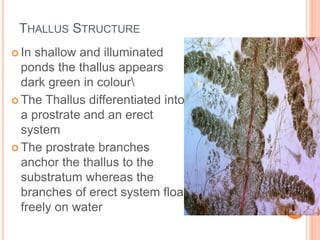
 The Thallus differentiated into
a prostrate and an erect
system
 The prostrate branches
anchor the thallus to the
substratum whereas the
branches of erect system float
freely on water
THALLUS STRUCTURE
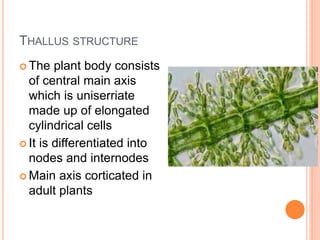
 The plant body consists
of central main axis
which is uniserriate
made up of elongated
cylindrical cells
 It is differentiated into
nodes and internodes
 Main axis corticated in
adult plants
THALLUS STRUCTURE
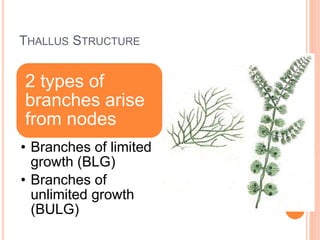
2 types of
branches arise
from nodes
• Branches of limited
growth (BLG)
• Branches of
unlimited growth
(BULG)
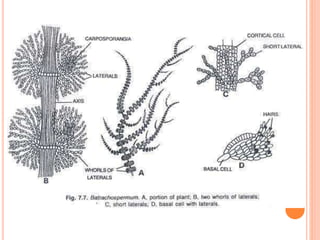
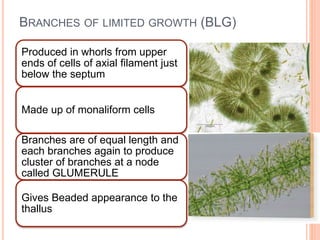
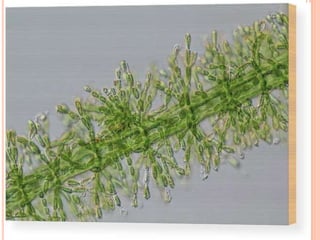
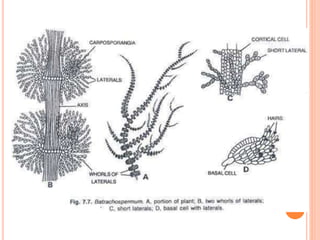
BRANCHES OF LIMITED GROWTH (BLG)
Produced in whorls from upper
ends of cells of axial filament just
below the septum
Made up of monaliform cells
Branches are of equal length and
each branches again to produce
cluster of branches at a node
called GLUMERULE
Gives Beaded appearance to the
thallus
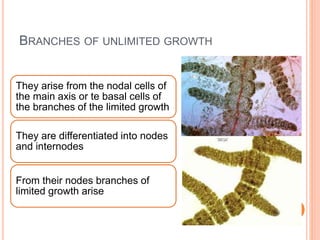
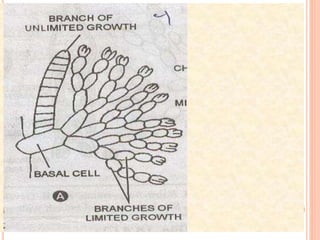
BRANCHES OF UNLIMITED GROWTH
They arise from the nodal cells of
the main axis or te basal cells of
the branches of the limited growth
They are differentiated into nodes
and internodes
From their nodes branches of
limited growth arise
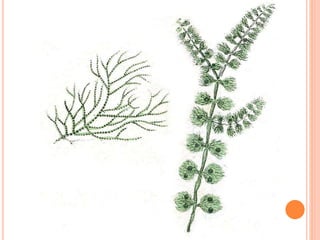
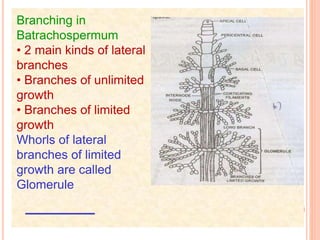
Branching in
Batrachospermum
• 2 main kinds of lateral
branches
• Branches of unlimited
growth
• Branches of limited
growth
Whorls of lateral
branches of limited
growth are called
Glomerule
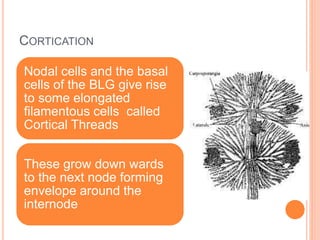
CORTICATION
Nodal cells and the basal
cells of the BLG give rise
to some elongated
filamentous cells called
Cortical Threads
These grow down wards
to the next node forming
envelope around the
internode
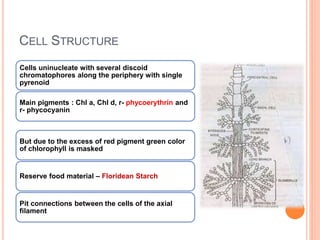
CELL STRUCTURE
Cells uninucleate with several discoid
chromatophores along the periphery with single
pyrenoid
Main pigments : Chl a, Chl d, r- phycoerythrin and
r- phycocyanin
But due to the excess of red pigment green color
of chlorophyll is masked
Reserve food material – Floridean Starch
Pit connections between the cells of the axial
filament
GROWTH
 The main axis as well as the branches of unlimited
growth grow by means of a dome shaped,
hemispherical apical cell
 Repeated transverse divisions- uniseriate row of cell
 From the upper ends of each cell 4-6 protuberances are
given out which separate by means of septa to give rise
to Pericentral Cells
 Pericentral Cells function as the basal cells of BLG
 Branches of unlimited growth also develop from the
basal cells
 Basal cell also gives rise to corticating threads
 In older parts the basal cells separate and give rise to
node and the cells of the central axis elongate and form
internode
LIFE CYCLE
Reproduction
Asexual and Sexual
SEXUAL REPRODUCTION
SEXUAL REPRODUCTION
SEXUAL REPRODUCTION
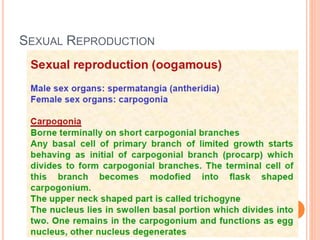
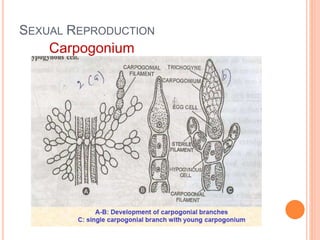
Carpogonium
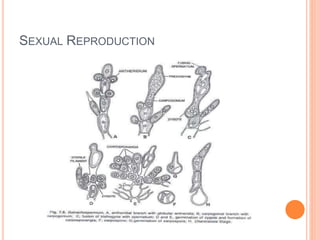
SEXUAL REPRODUCTION
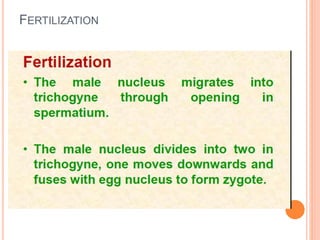
FERTILIZATION
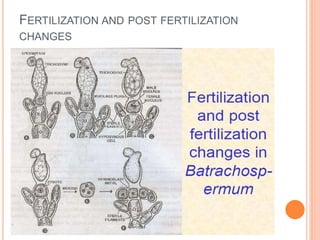
FERTILIZATION AND POST FERTILIZATION
CHANGES
 After fertilization Trichogyne shrivels
 Zygote undergoes meiosis- 4 haploid nuclei
 Nuclei divide repeatedly
 Protuberances formed on carpogonial wall
 Nuclei migrate into them
 Gonimoblast initials
 Divide repeatedly to form Gonimoblat filaments
 Terminal cell of gonimoblast filament forms
Carposporangium
FERTILIZATION AND POST FERTILIZATION
CHANGES
Single carpospore in each carposporangium
Carpospores- single, naked and non-motile
The lower sterile cells of the gonimoblast filaments give rise to many
sterile filaments which form an envelope around the carposporangia and
gonimoblast filaments
This composite structure is called Cystocarp of Carposporophyte
Carposporophyte i,e gonimoblast filaments and carposporangia and
sterile filaments grow as a parasite on the female plant
Carpospores liberated from carposporangia
FERTILIZATION AND POST FERTILIZATION
CHANGES
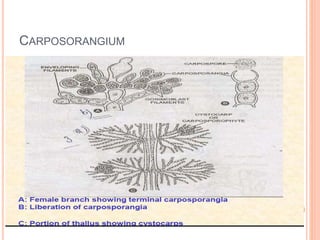
CARPOSORANGIUM
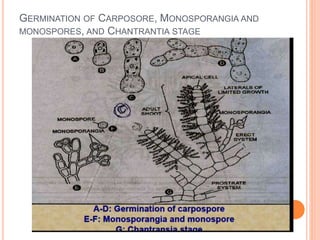
GERMINATION OF CARPOSPORE
Carpospores after being released
from the carposporangia get attached
t some substratum
Germinate by protonema formation
which is heterotrichous system
This stage is called juvenile stage or
Chantrantia stage as it was earlier
considered to be separate genus
GERMINATION OF CARPOSORE, MONOSPORANGIA AND
MONOSPORES, AND CHANTRANTIA STAGE
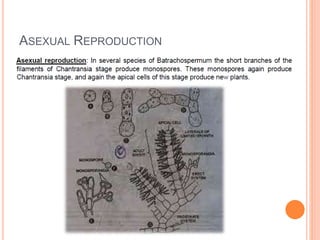
ASEXUAL REPRODUCTION
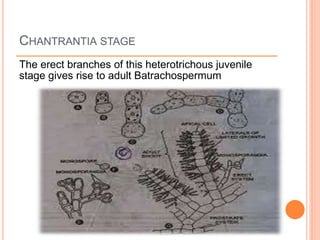
CHANTRANTIA STAGE
The erect branches of this heterotrichous juvenile
stage gives rise to adult Batrachospermum
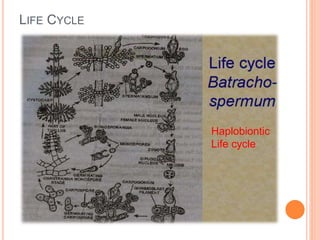
LIFE CYCLE
Haplobiontic
Life cycle
Batrachospermum.pptx

Batrachospermum.pptx

  • 1.
    BATRACHOSPERMUM Red Alga Nisar Ahmadlone Assistant Professor Botany GDC Women Bla RHODOPHYCEAE
  • 3.
    CLASSIFICATION Class Rhodophyceae Sub-Class: Florideae Order:Nemalionales Family: Batrachospermaceae Genus Batrachospermum
  • 4.
    OCCURANCE  Fresh waterred alga found in slow moving waters of lakes, ponds, streams in tropical and temperate regions  Some species attached to stones in rivers  Most species annual but B.vagum perennial  5 species in india e.g, B .monaliformae, B.vagum
  • 5.
    OCCURANCE The plants areblue-green, olive-green, violet and reddish in colour. The colour varies as a result of the differences in light intensity. The species which grow in deep water are reddish or violet in colour whereas the species growing in shallow water are olive-green in colour. The alga is also known as the ‘frog spawn’. The plants are mucilaginous, moniliform or beaded in appearance to the naked eye. The plants may reach a length of twenty centimetres and may easily be collected from the slow running streams around Dehradun especially in winter season
  • 6.
    THALLUS STRUCTURE  Themature thallus is branched, soft and gelatinous  It Appears as the branching chain of beads  15 – 20 cms long and Blue green, violet or red in color depending on the intensity of available light  The thallus growing in deep and shady ponds appear violet or dark red
  • 7.
    THALLUS STRUCTURE  Inshallow and illuminated ponds the thallus appears dark green in colour  The Thallus differentiated into a prostrate and an erect system  The prostrate branches anchor the thallus to the substratum whereas the branches of erect system float freely on water
  • 8.
    THALLUS STRUCTURE  Theplant body consists of central main axis which is uniserriate made up of elongated cylindrical cells  It is differentiated into nodes and internodes  Main axis corticated in adult plants
  • 10.
    THALLUS STRUCTURE 2 typesof branches arise from nodes • Branches of limited growth (BLG) • Branches of unlimited growth (BULG)
  • 13.
    BRANCHES OF LIMITEDGROWTH (BLG) Produced in whorls from upper ends of cells of axial filament just below the septum Made up of monaliform cells Branches are of equal length and each branches again to produce cluster of branches at a node called GLUMERULE Gives Beaded appearance to the thallus
  • 15.
    BRANCHES OF UNLIMITEDGROWTH They arise from the nodal cells of the main axis or te basal cells of the branches of the limited growth They are differentiated into nodes and internodes From their nodes branches of limited growth arise
  • 17.
    Branching in Batrachospermum • 2main kinds of lateral branches • Branches of unlimited growth • Branches of limited growth Whorls of lateral branches of limited growth are called Glomerule
  • 18.
    CORTICATION Nodal cells andthe basal cells of the BLG give rise to some elongated filamentous cells called Cortical Threads These grow down wards to the next node forming envelope around the internode
  • 20.
    CELL STRUCTURE Cells uninucleatewith several discoid chromatophores along the periphery with single pyrenoid Main pigments : Chl a, Chl d, r- phycoerythrin and r- phycocyanin But due to the excess of red pigment green color of chlorophyll is masked Reserve food material – Floridean Starch Pit connections between the cells of the axial filament

  • 21.
    GROWTH  The mainaxis as well as the branches of unlimited growth grow by means of a dome shaped, hemispherical apical cell  Repeated transverse divisions- uniseriate row of cell  From the upper ends of each cell 4-6 protuberances are given out which separate by means of septa to give rise to Pericentral Cells  Pericentral Cells function as the basal cells of BLG  Branches of unlimited growth also develop from the basal cells  Basal cell also gives rise to corticating threads  In older parts the basal cells separate and give rise to node and the cells of the central axis elongate and form internode
  • 22.
  • 23.
  • 24.
  • 25.
  • 26.
  • 27.
  • 28.
    FERTILIZATION AND POSTFERTILIZATION CHANGES
  • 29.
     After fertilizationTrichogyne shrivels  Zygote undergoes meiosis- 4 haploid nuclei  Nuclei divide repeatedly  Protuberances formed on carpogonial wall  Nuclei migrate into them  Gonimoblast initials  Divide repeatedly to form Gonimoblat filaments  Terminal cell of gonimoblast filament forms Carposporangium FERTILIZATION AND POST FERTILIZATION CHANGES
  • 30.
    Single carpospore ineach carposporangium Carpospores- single, naked and non-motile The lower sterile cells of the gonimoblast filaments give rise to many sterile filaments which form an envelope around the carposporangia and gonimoblast filaments This composite structure is called Cystocarp of Carposporophyte Carposporophyte i,e gonimoblast filaments and carposporangia and sterile filaments grow as a parasite on the female plant Carpospores liberated from carposporangia FERTILIZATION AND POST FERTILIZATION CHANGES
  • 31.
  • 32.
    GERMINATION OF CARPOSPORE Carposporesafter being released from the carposporangia get attached t some substratum Germinate by protonema formation which is heterotrichous system This stage is called juvenile stage or Chantrantia stage as it was earlier considered to be separate genus
  • 33.
    GERMINATION OF CARPOSORE,MONOSPORANGIA AND MONOSPORES, AND CHANTRANTIA STAGE
  • 34.
  • 35.
    CHANTRANTIA STAGE The erectbranches of this heterotrichous juvenile stage gives rise to adult Batrachospermum
  • 36.