LICHENS
Prepared By: Asad Khan
Roll No: B-01
5th Semester
BS Botany
CONTENTS
1. Introduction
2. History
3. Distribution
4. External Structure of Thallus (Shapes of Lichens)
5. Internal Structure of Thallus
6. Classification
7. Reproduction
8. Harmful Effects
9. Economic Importance
INTRODUCTION
• Beneficial Association or combination of Algae and Fungi.
• Dual Organism
• Algal Component ---- Phycobiont (e.g. Trebouxia)
• Fungal Component – Mycobiont
HISTORY
• The term lichen is used by Theophrastus in History of Plant.
• Lichen is a word of Greek origin which means “any superficial growth on the bark of
trees”.
DISTRIBUTION
• 400 genera and 15000 spp.
• Cosmopolitan
• Found in Temperate and Tropical regions.
• Grow on soil, rocks, trees, marine.

• Also in Arid to Moist.
EXTERNAL STRUCTURE
OF
THALLUS
CRUSTOSE
• Flattened
• Scale-like
• No lower surface
• Tightly bound to substratum
Lecanora spp.
(Ascolichenes)
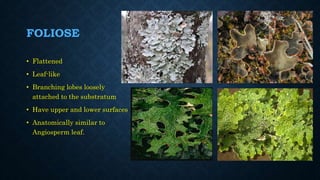
FOLIOSE
• Flattened
• Leaf-like
• Branching lobes loosely
attached to the substratum
• Have upper and lower surfaces
• Anatomically similar to
Angiosperm leaf.
Evernia spp.
(Ascolichenes)
Lobaria spp.
(Ascolichenes)
Pseudovernia spp.
(Ascolichenes)
Xanthoria spp.
(Ascolichenes)
Cora spp.
(Basidiolichenes)
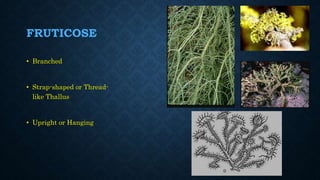
FRUTICOSE
• Branched
• Strap-shaped or Thread-
like Thallus
• Upright or Hanging
Usnea spp.
(Ascolichenes)
INTERNAL STRUCTURE
OF
THALLUS
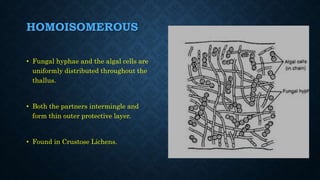
HOMOISOMEROUS
• Fungal hyphae and the algal cells are
uniformly distributed throughout the
thallus.
• Both the partners intermingle and
form thin outer protective layer.
• Found in Crustose Lichens.
HETEROMEROUS
• Thallus is differentiated into four distinct
layers .
1. Upper Cortex
2. Algal Zone
3. Medulla
4. Lower Cortex
• Foliose and Fruticose Lichens
CLASSIFICATION
OF
LICHENS
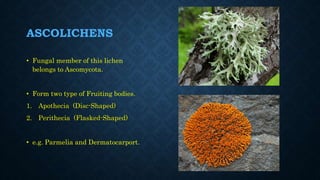
ASCOLICHENS
• Fungal member of this lichen
belongs to Ascomycota.
• Form two type of Fruiting bodies.
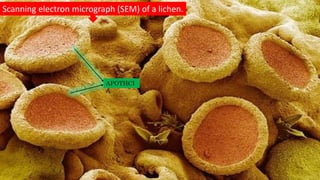
1. Apothecia (Disc-Shaped)
2. Perithecia (Flasked-Shaped)
• e.g. Parmelia and Dermatocarport.
BASIDIOLICHENS
• The fungal member of this lichen
belongs to Basidiomycota.
• e.g. Dictyonema and Corella.
DEUTEROLICHEN
• The fungal partner belongs to
Deuteromycota.
REPRODUCTION
VEGETATIVE REPRODUCTION
1. Fragmentation
ASEXUAL REPRODUCTION
1. Soridia Formation
o fine powdery granules
2. Isidia Formation
o minute outgrowths from
the thallus
SEXUAL REPRODUCTION
• Perform by fungal component.
• Ascospores and Basidiospore
formation
• Ascospore and Basidiospore
germinate and make contact with
algal cells.
Scanning electron micrograph (SEM) of a lichen.
APOTHCI
A
ECONOMIC IMPORTANCE
OF
LICHENS
HARMFUL EFFECTS
.
• Amphiloma and Cladonia parasitize on mosses
(Reindeer moss) and cause total destruction of
moss colonies.
• Different lichens, mainly crustose type, cause
serious damage to window glasses and marble
stones of old buildings.
• Lichens like Letharia vulpina (wolf moss) are
highly poisonous. Vulpinic acid is the poisonous
substance present in this lichen.
USEFUL EFFECTS
AS FOOD AND FODDER
• Used as food by human being in many
parts of the world .
• Also by different animals such as Snails,
Slugs and Termites etc.
• Contain polysaccharide, lichenin,
cellulose, vitamin and certain enzymes.
AS MEDICINE
• Used in the treatment of Diarrhoea,
Fevers, Epilepsy, Hydrophobia and
Skin diseases.
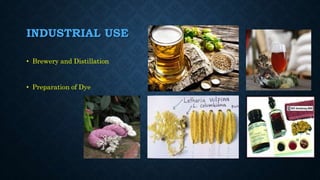
INDUSTRIAL USE
• Brewery and Distillation
• Preparation of Dye
COSMETICS AND PERFUMERY
• The aromatic compounds available in
lichen thallus are extracted and used in
the preparation of cosmetic articles and
perfumes.
• Essential oils extracted from species of
Ramalina and Evernia are used in the
manufacture of cosmetic soap.
REFERENCE
• www.biologydiscussion.com/lichens-2/lichens-definition-structure-and-reproduction-
with-diagram/69697
• https://biologyboom.com/lichens/
• www.Britannica.com/science/lichen
• https://en.wikipedia.org/wiki/lichen
THE END
THANKS

Introduction to Lichens