Lichens
Saajida Sultaana Mahusook
 Lichens are the association between specific ascomycetes (fungi)
and either green algae or cyanobacteria.
 The fungal partner is termed the mycobiont and the algal or
cyanobacterial partner, the phycobiont.
 The fungus obtains nutrients from its partner by projections of fungal
hyphae called haustoria, which penetrate the phycobiont cell wall.
 It also uses O2 produced by the phycobiont for respiration.
 In turn, the fungus protects the phycobiont from high light intensities,
provides water and minerals, and creates a firm substratum within
which the phycobiont can grow protected from environmental stress.
 This is an ancient association; 600 million-year-old lichenlike fossils
from South China indicate that the relationship between fungi and
their photoautotrophic partners developed prior to the evolution of
vascular plants.
 Although all lichen symbioses were once considered mutualistic, it
appears to be a controlled parasitism in those cases where the
phytobiotic cyanobacteria and algae grow more quickly when
cultured without their mycobiont.
 Lichens are found worldwide and occur in a variety of environmental
conditions.
 A diverse group of organisms, they can colonize a wide range of
surfaces and are frequently found on tree bark, exposed rock, and
as a part of biological soil crust.
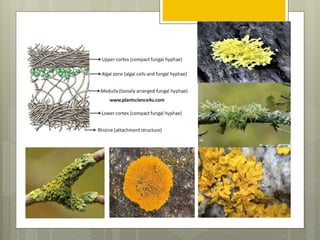
 The composite body of a lichen is called a thallus (plural thalli);
 The body is anchored to its substrate by hairlike growths
called rhizines.
 Lichens that form a crustlike covering that is thin and tightly bound to
the substrate are called crustose.
 Squamulose lichens are small and leafy with loose attachments to
the substrate.
 Foliose lichens are large and leafy, reaching diameters of several
feet in some species, and are usually attached to the substrate by
their large plate like thalli at the centre.
 In addition to their morphological forms, lichen thalli are also
classified by the ratio of phycobiont cells (i.e., cells of the
photosynthetic partner) to mycobiont cells (i.e., cells of the fungus).
 The homoeomerous type of thallus consists of numerous algal cells
distributed among a lesser number of fungal cells, while the
heteromerous thallus has a predominance of fungal cells.
Reproduction
Asexual methods
 Fragmentation:
It consists of breaking up of the established thalli into segments which are
distributed to start new growths.
 Soredia and isidia. The isidia are elongated outgrows from the thallus
that break off for dispersal. The soredia are small groups of algal cells
surrounded by fungal filaments. They accumulate in soralia that sit upon
the thallus surface. Both structures - soredia and isidia consist of algae
and fungi and can be dispersed with help of wind, water or animals, so
as to grow into young lichens in suitable conditions.
 Asexual spores
Sexual method
 It is entirely the concern of the fungal partner on which the sexual organs
are developed. The male reproductive organ is called the spermogonium
and the female carpogonium.
Importance
 Lichens have been used by humans as food and as sources of
medicine and dye.
 They also provide two-thirds of the food supply for the caribou
and reindeer that roam the far northern ranges.
 Lichens are key players in a variety of environmental processes. For
example, cyanobacterial photobionts participate in nitrogen fixation.
 Lichens also contribute to a phenomenon known as biological
weathering. The lichen mycobionts can break down rocks and
release minerals by producing certain chemicals.
 Lichens are excellent indicators of pollution. According to the Forest
Service lichens can absorb pollutants such as heavy metals, carbon
and sulfur into their thalli. Extracting these pollutants gives an
indication of the levels present in the atmosphere. This process is
known as lichen biomonitoring.
Reference
 https://www.britannica.com/science/lichen
 https://www.livescience.com/55008-lichens.html
 https://www.pieninypn.pl/en/1160/0/lichen-reproduction.html
 http://www.biologydiscussion.com/botany/lichens-
botany/reproduction-in-lichens-with-diagram-botany/63911
Thank you