PEZIZA
(The Cup Fungus)
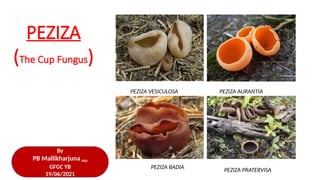
PEZIZA VESICULOSA PEZIZA AURANTIA
PEZIZA BADIA PEZIZA PRATERVISA
By
PB Mallikharjuna PhD
GFGC YB
19/06/2021
PEZIZA
(Cup fungus)
 Systemic Position / Classification:
Kingdom : Mycota / Fungi
Division : Eumycotina
Sub-division : Ascomycotina
Class : Ascomycetes
Sub-class : Discomycetes
Order : Pezizales
Family : Pezizaceae
Introduction: It is a cup fungus genus and
having about 100 species.
 Some of these are Peziza vesiculosa, P. aurantia,
P. succosa, P. badia, P. rependa, P. coccinea, P.
catinum, P. tectoria, and so on.
 Peziza vesiculosa is the cosmopolitan species.
 All the species are strictly saprophytes, which grow
on the dead and decaying substrates.
Habit and Habitat:
 Peziza present in a wide range of habitats
including the organic rich soils, manure
heaps, dung, rotting wood or straw, burnt
ground and sand dunes.
 Coprophilous fungi: Some of the species will
grow on the animal waste or dung called
coprophilous fungi. Ex: Peziza badia.
 Peziza is a mycelial fungus, which grow
usually hidden in the substratum and thereby
ramify with it.
 Peziza has distinctly two structural parts viz., the vegetative mycelium
and the reproductive fructification apothecium.
 Mycelium is hypogenous (subterranean), microscopic and present
perennially in the substratum, while the apothecium is epigenous
( epiterranean), macroscopic, brilliantly coloured and short-lived fleshy
structure.
 The mycelium is microscopic, septate, monokaryotic, filamentous, with
the profusely branched hyphae.
 Its mode of nutrition is saprophytic, which absorbs the nutrients from the
substratum by the activity of released extra-cellular enzymes.
Reproduction: Peziza has both types of reproduction viz., the asexual
reproduction and the sexual reproduction.
Asexual Reproduction: is less common in Peziza. However, it takes place
by the formation of Conidiospores and Chlamydiospores.
 The condiospores are produced as the spheroidal structures from the tip
of conidiophores. On its germination produces a new individual emerges.
 The chlamydiospores are 1 - many thick walled, intercalary resting spores.
On its germination during favourable condition a new daughter mycelium
emerges.
Sexual Reproduction: It is the most common type of reproduction.
However, no sex organs are formed in Peziza and no sexual apparatus is found in Peziza
vesiculosa.
 Somatogamy is the common type of sexual reproduction, which occurs by the involvement
of the two adjacent cells of different hyphae or the same hypha which are tangled in
condition.
 Further, the cell walls are fused between these cells and becomes a single cell called an
Ascus mother cell, which is dikaryotic in nature. (2 nucleate)
 The ascogenous mother cell will undergo profuse divisions and thereby resulting the
Ascogenous hyphae formation.
 These structures will grow further aerially and profusely multiplied and in turn resulting the
asci. Meanwhile the pseudo-parenchymatous mycelial mat is surround them and there by
producing the Ascocarp or Apothecium.
VS of the young Apothecium of Peziza
Sexual reproduction
Apothecium:
 It is the sexual fruiting body of the cup fungi including
Peziza.
 The apothecium is a large (2-5 cm in diameter) epigeon,
brilliantly coloured (orange-red), fleshy, open cup or
saucer-like structure. It is a short-lived structure.
 The apothecia may be sessile or sub-sessile (Stiphe)
structures, regular in form and large in size (from 2 cm
to several inches).
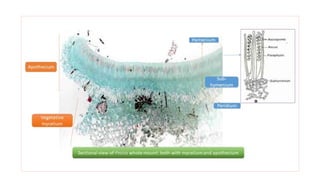
 A typical apothecium usually consists 3 distinct layers
namely 1) The hymenium, 2) the sub-hymenium and 3)
The peridium, from inner side to outer side.
Apothecium of Peziza vesiculosa
Apothecium of Peziza aurantia
A portion of the magnified view
A portion of the fertile portion (hymenium) of
apothecium under low power of compound microscope
Operculum
Ascospores
Ascus
 Hymenium is the inner portion of the apothecium and it is the fertile region.
 It has several vertically present unbranched tubular fertile filaments called Asci.
 Each ascus is a long tubular, vacuolated structure with operculum at its top. It
contains 8 - ascospores, which are obliquely arranged. The ascospores are
uninucleate, ellipsoidal and haploid structures.
 The asci filaments are traversed by the branched or unbranched, slightly
pigmented sterile filaments called paraphyses. They play a dual role, a) protection
to the adjacent fertile asci, and b) helps in the spore disposal due to hygroscopic
nature.
 The sub-hymenium and peridium are the sterile outer layer of the apothecium.
These are developed due to the involvement of pseudo-parenchyma of the
vegetative sterile hyphae.
Life cycle of Peziza