TYPE STUDY OF
ECTOCARPUS
Presented By
Naveen.A.N
I MSc Microbiology
Govt Science College
Bangalore
INTRODUCTION
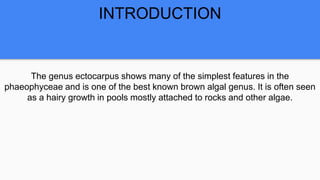
The genus ectocarpus shows many of the simplest features in the
phaeophyceae and is one of the best known brown algal genus. It is often seen
as a hairy growth in pools mostly attached to rocks and other algae.
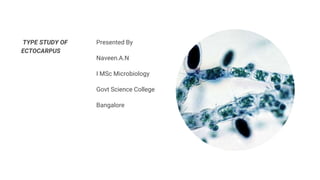
Fig.1: Vegetative morphology of Ectocarpus.
TAXONOMIC POSITION
❖ Division - Phaeophyta
❖ Class - Isogeneratae
❖ Order - Ectocarpales
❖ Family - Ectocarpaceae
❖ Genus - Ectocarpus
Distribution
● Found in abundance
● Worldwide distribution
● Plenty in atlantic coast,pacific coast
● Some are Marine algae
● Few freshwater forms
● Some species occur in shallow water
● 410 species
● 16 species in india
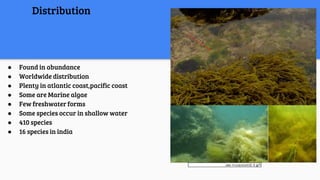
Fig.2: Vegetative morphology of
Ectocarpus.
Morphology
➢ Brown Algae, Branched Filamentous, Caespitose, Thallus Brown Or Yellow In
Colour,30 Cm In Length
➢ Plants are dioecious, because male and female gametes are formed in
gametangia borne on different thalli
➢ Heterotrichous ,Monosiphonous( Uniseriate), Lower Parts Become
Polysiphonous Due To Longitudinal Division
➢ The Prostate Portion Found Attached To The Substratum
➢ The Branches Of Erect System Develops From The Prostrate System Into A Tuft
➢ The Branches Are Always Lateral And Arise Just Beneath The Septa
➢ Vacuolated Cells With Few Chromatophores Forming A Colourless Hair
➢ Erect System Is Photosynthetic Which Bears Reproductive Organs
➢ in some species sporangia may arise terminally up but burning directly on the
prostate base
➢ pseudo parenchymatous
CELL STRUCTURE
➢ cells are small ,rectangular or cylindrical Uninucleate
and contain chloroplast with pyrenoid
➢ The pyrenoid is stalked and pear shaped
➢ the cell wall is thick, mucilaginous, consisting of 3 Pectic
cellulose liars
➢ the cell wall constitutes alginic acid and fucoidan
➢ photosynthetic pigments are chlorophyll A, chlorophyll c,
beta carotene and fucoxanthin.
➢ Vacuoles called as physodes which contains polyphenols
the cells are totipotent and gene content
➢ Plurilocular sporangium of some ectocarpus species
contain polyhydron virus like particles
➢ Ectocarpus Reproduce Both Asexually And Sexually
➢ Asexual Reproduction
➢ Takes Place By Means Of Bi Flagellate Zoospores
Produced In Two Kinds Of Sporangium Namely
➢ Unicellular Or Unilocular Sporangia
➢ Multicellular Or Pluralocular Sporangia
Reproduction
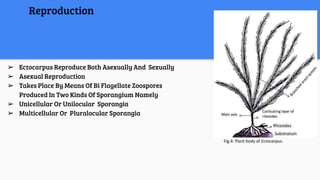
Fig.4: Plant body of Ectocarpus.
Development Of Unilocular Sporangium
➢ The Terminal cell Of a short branchlet develops
into an unilocular sporangium
➢ chromatophores increases within the young
sporangium And it becomes several fold
➢ The diploid Nucleus of the initial cell first
undergoes meiosis followed by Mitotic divisions
to produce haploid daughter nuclei.
➢ there is cleavage of the of cytoplasm to form
many uninucleate daughter protoplast units
➢ each unit undergoes metamorphosis into a
pyriform bi flagellate haploid Swarmer called as
meiozoospores
➢ The flagella are unequal and Inserted laterally
➢ acronematic and pantonematic flagella
➢ Liberation of meiozoospores in a gelatinous mass
➢ ultimately meiozoospores come to rest and loses
there flagella
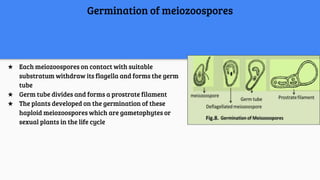
Germination of meiozoospores
★ Each meiozoospores on contact with suitable
substratum withdraw its flagella and forms the germ
tube
★ Germ tube divides and forms a prostrate filament
★ The plants developed on the germination of these
haploid meiozoospores which are gametophytes or
sexual plants in the life cycle
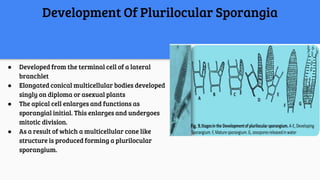
Development Of Plurilocular Sporangia
● Developed from the terminal cell of a lateral
branchlet
● Elongated conical multicellular bodies developed
singly on diploma or asexual plants
● The apical cell enlarges and functions as
sporangial initial. This enlarges and undergoes
mitotic division.
● As a result of which a multicellular cone like
structure is produced forming a plurilocular
sporangium.
SEXUAL REPRODUCTION
● It is of both isogamous and anisogamous type
● Anisogamous may be of 2types
● Morphological anisogamy
● Physiological anisogamy
● These are produced inside the plurilocular gamentangia
Fig.5: Some small/dwarf species of Ectocarpus.
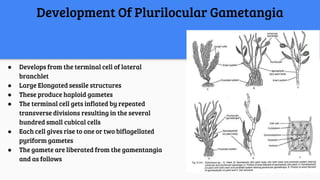
Development Of Plurilocular Gametangia
● Develops from the terminal cell of lateral
branchlet
● Large Elongated sessile structures
● These produce haploid gametes
● The terminal cell gets inflated by repeated
transverse divisions resulting in the several
hundred small cubical cells
● Each cell gives rise to one or two biflagellated
pyriform gametes
● The gamete are liberated from the gamentangia
and as follows
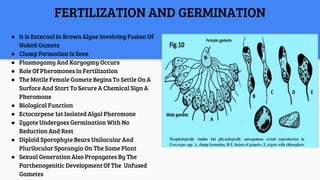
FERTILIZATION AND GERMINATION
● It Is External In Brown Algae Involving Fusion Of
Naked Gamete
● Clump Formation Is Seen
● Plasmogamy And Karyogmy Occurs
● Role Of Pheromones in Fertilization
● The Motile Female Gamete Begins To Settle On A
Surface And Start To Secure A Chemical Sign A
Pheromone
● Biological Function
● Ectocarpene 1st Isolated Algal Pheromone
● Zygote Undergoes Germination With No
Reduction And Rest
● Diploid Sporophyte Bears Unilocular And
Plurilocular Sporangia On The Same Plant
● Sexual Generation Also Propagates By The
Parthenogenitic Development Of The Unfused
Gametes
Ultrastructure of Gamete in Ectocarpus
STRUCTURE OF GAMETES
● Gametes Shows The Flagellum With The Eukaryotic
Arrangement Of Microtubes
● Chromatophore Is Shown With Thylakoids And
Fucixanthin Granules
● Nucleus Is Centrally Located
● Cell Wall Is Thin And Tightly Appressed
● Female Gamete Is Thigmotactic
● Male Gamete Is Chemotaxis
Life cycle
● A Haploid Diploid Life Cycle
● Alternation Of Generation Or Isomorphic
● Two Distinct Phases Can Be Seen
● The Diploid Sporophyte
● The Haploid Gametophyte
● Morphologically Both Are Similar So This Type Is Called
As Isomorphic
● Reduplication Of Sporophyte
● Reduplication Of Gametophyte
Economic importance
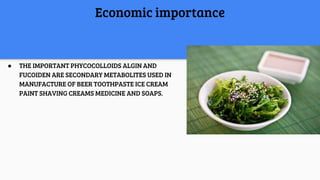
● THE IMPORTANT PHYCOCOLLOIDS ALGIN AND
FUCOIDEN ARE SECONDARY METABOLITES USED IN
MANUFACTURE OF BEER TOOTHPASTE ICE CREAM
PAINT SHAVING CREAMS MEDICINE AND SOAPS.
Ectocarpus