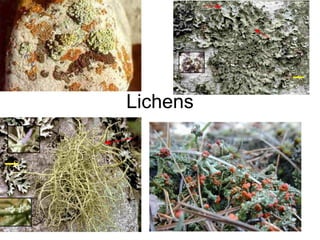
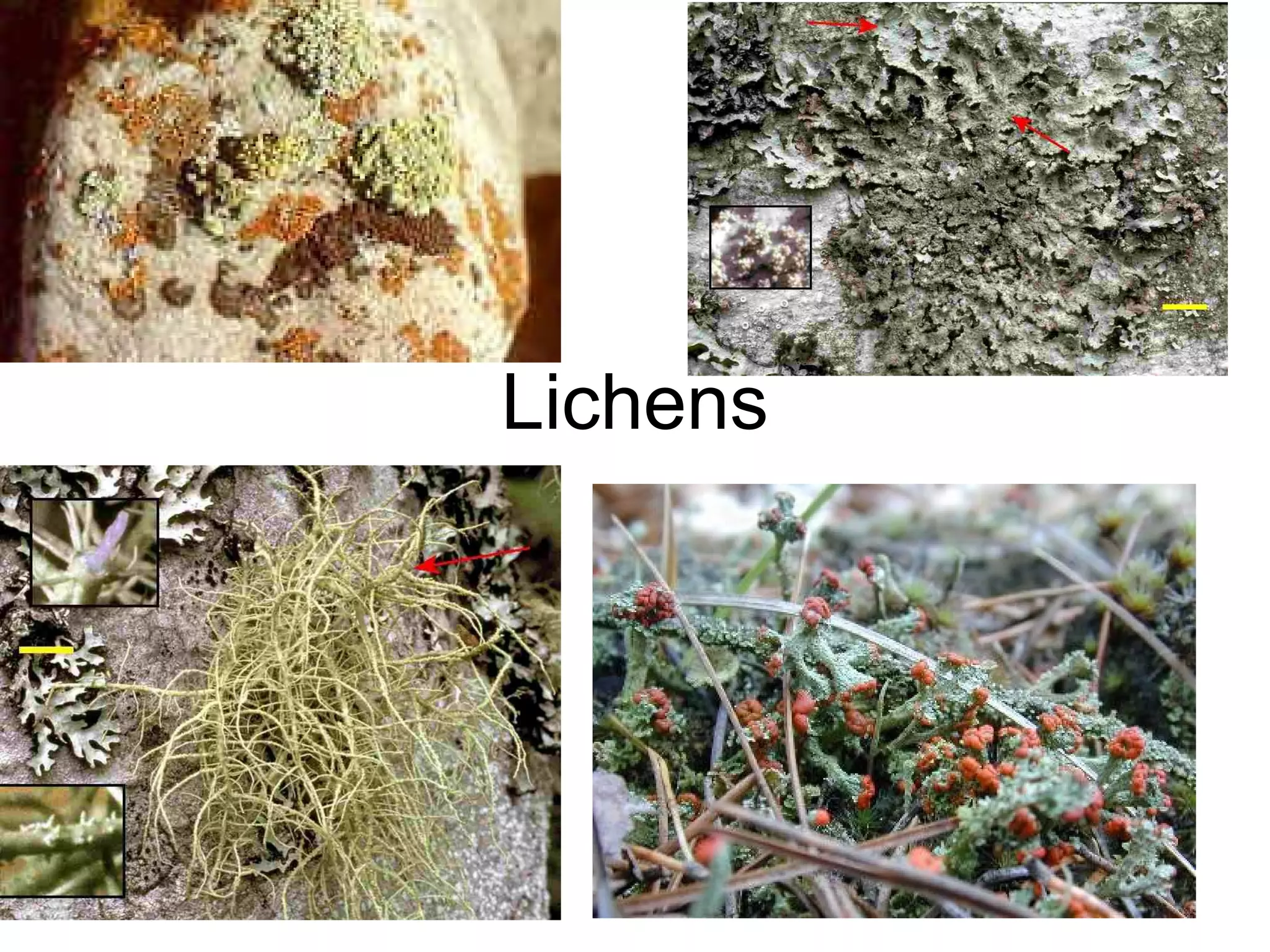
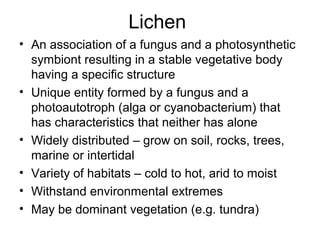
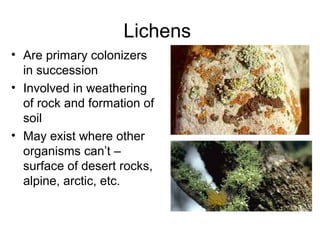
Lichens
Lichen
• An association of a fungus and a photosynthetic
symbiont resulting in a stable vegetative body
having a specific structure
• Unique entity formed by a fungus and a
photoautotroph (alga or cyanobacterium) that
has characteristics that neither has alone
• Widely distributed – grow on soil, rocks, trees,
marine or intertidal
• Variety of habitats – cold to hot, arid to moist
• Withstand environmental extremes
• May be dominant vegetation (e.g. tundra)
Lichens
• Are primary colonizers
in succession
• Involved in weathering
of rock and formation of
soil
• May exist where other
organisms can’t –
surface of desert rocks,
alpine, arctic, etc.
Air pollution
• Even though lichens are very resistant to
natural environmental extremes – they are
extremely sensitive to air pollution –
particularly SO2
• Obtain nutrients from atmosphere, not soil
• Both species composition and numbers of
thalli decline from edge to center of
industrialized areas
• Some are useful as indicator species
Classification
• Classified to species –based on
morphology of fungal symbiont
• Classification of the lichenized fungus
• Fungal symbiont never found free-living
• Are currently ca. 14,000 species of
lichenized fungi
• Most are in the Ascomycota – ratio of
lichenized to nonlichenized Ascomycota is
14,000 : 15,000
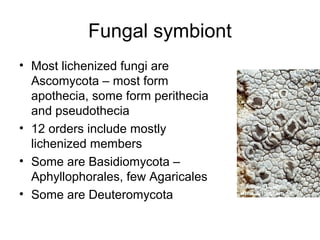
Fungal symbiont
• Most lichenized fungi are
Ascomycota – most form
apothecia, some form perithecia
and pseudothecia
• 12 orders include mostly
lichenized members
• Some are Basidiomycota –
Aphyllophorales, few Agaricales
• Some are Deuteromycota
Autotrophic symbionts
• Green algae – Trebouxia is a common
genus, found in 75% of lichens in
temperate zone
• Cyanobacteria – Nostoc is a common
genus
• Ca. 26 genera of algae and cyanobacteria
found in lichens, 90% of lichens contain
Trebouxia, Nostoc or one other genus
• Autotroph may be free living
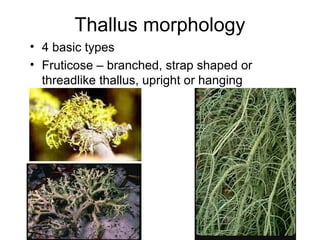
Thallus morphology
• 4 basic types
• Fruticose – branched, strap shaped or
threadlike thallus, upright or hanging
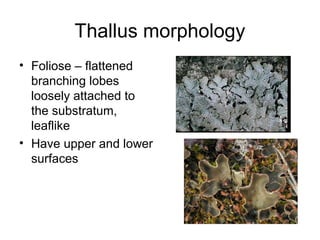
Thallus morphology
• Foliose – flattened
branching lobes
loosely attached to
the substratum,
leaflike
• Have upper and lower
surfaces
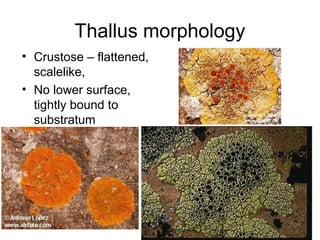
Thallus morphology
• Crustose – flattened,
scalelike,
• No lower surface,
tightly bound to
substratum
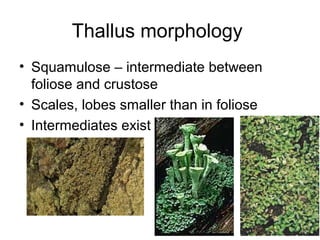
Thallus morphology
• Squamulose – intermediate between
foliose and crustose
• Scales, lobes smaller than in foliose
• Intermediates exist
Internal structure
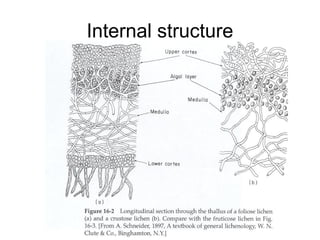
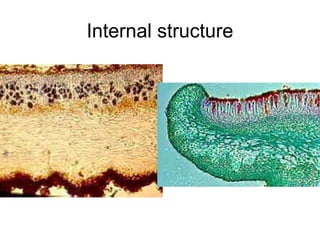
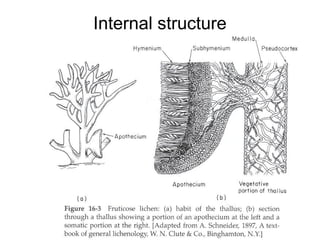
• Contain various zones or regions of fungal
tissue
• In most, the autotrophic symbiont is
restricted to a definite layer (in some, it is
dispersed throughout)
• Crustose thalli generally have simpler
structure than foliose or fruticose thalli
• May contain various fungal tissues and
cell types
Internal structure
Internal structure
Internal structure
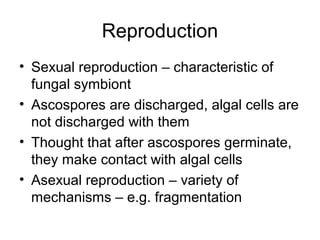
Reproduction
• Sexual reproduction – characteristic of
fungal symbiont
• Ascospores are discharged, algal cells are
not discharged with them
• Thought that after ascospores germinate,
they make contact with algal cells
• Asexual reproduction – variety of
mechanisms – e.g. fragmentation
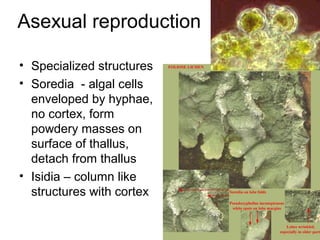
Asexual reproduction
• Specialized structures
• Soredia - algal cells
enveloped by hyphae,
no cortex, form
powdery masses on
surface of thallus,
detach from thallus
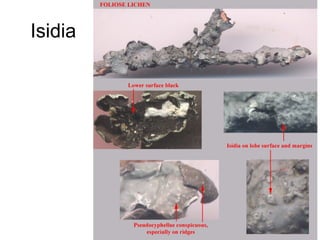
• Isidia – column like
structures with cortex
Isidia
Physiology
• Autotrophic associations – algal cells carry out
photosynthesis, lichen depends on net
production of organic compounds by
photosynthesis
• Most of the photosynthate (70-80%) produced
by alga is incorporated into the fungus
• Green algae secrete polyalcohols like ribitol,
cyanobacteria secrete glucose
• Photobiont becomes leaky of carbohydrates
when associated with fungus – not so when
grown alone
Growth
• Exhibit low growth rates – many grow at
rates of 1-4 mm/yr, up to 9 cm/yr
• Makes studies difficult
• Factors affecting growth
• Light – variable – some prefer low light
intensities, others high
• Temperature – variable
• Moisture – appears to be an important
variable, do not have water absorbing
organs, depend on moisture in air
Moisture
• When lichen thallus is wetted, absorbs water
quickly by gelatinous matrix in the cortex
• Starts growth process
• As thallus dries, growth process slows and
stops
• Dew and humidity are important sources of
moisture
• Thalli are inactive when dry – only grow
when wetted – may be responsible for slow
growth rate
Separation of symbionts
• Fungal symbionts grown in culture exhibit
slow growth rates (1-2 mm/yr)
• Many exhibit requirements for vitamins
• Algae also grow slowly in culture,
Trebouxia prefers organic N and low light
Resynthesis of lichens
• Difficult process – requires extreme
environmental conditions to maintain
• Periodic drying and low nutrients
• Extended periods of high moisture lead to
the fungus killing the alga
Symbiotic association
• Traditionally been classified as a
mutualistic symbiosis where both
symbionts benefit
• Fungus appears to be chief benefactor,
receives
– Organic compounds as C and energy source
– With cyanobacteria, N fixation may occur so
that the fungus also receives N source
Symbiotic association
• Benefits for autotrophic symbiont are less
clear-cut
– Fungus produces substances that absorb
water which is provided to alga
– Fungus takes up inorganic nutrients from
atmosphere
– Protects algal cells from mechanical injury,
predation, and high light intensities
– Association allows alga to achieve a wider
distribution than if free-living
Symbiotic association
• Trebouxia is not very successful as a free-
living alga
• Alga pays a high price for these benefits
• Lichen might be a better example of
controlled parasitism than mutualism
• Lichens are long term, close symbioses
• Together the organisms express different
characteristics than individually
Symbiotic association
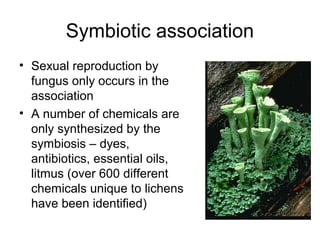
• Sexual reproduction by
fungus only occurs in the
association
• A number of chemicals are
only synthesized by the
symbiosis – dyes,
antibiotics, essential oils,
litmus (over 600 different
chemicals unique to lichens
have been identified)

Lichens

  • 1.
  • 2.
    Lichen • An associationof a fungus and a photosynthetic symbiont resulting in a stable vegetative body having a specific structure • Unique entity formed by a fungus and a photoautotroph (alga or cyanobacterium) that has characteristics that neither has alone • Widely distributed – grow on soil, rocks, trees, marine or intertidal • Variety of habitats – cold to hot, arid to moist • Withstand environmental extremes • May be dominant vegetation (e.g. tundra)
  • 3.
    Lichens • Are primarycolonizers in succession • Involved in weathering of rock and formation of soil • May exist where other organisms can’t – surface of desert rocks, alpine, arctic, etc.
  • 4.
    Air pollution • Eventhough lichens are very resistant to natural environmental extremes – they are extremely sensitive to air pollution – particularly SO2 • Obtain nutrients from atmosphere, not soil • Both species composition and numbers of thalli decline from edge to center of industrialized areas • Some are useful as indicator species
  • 5.
    Classification • Classified tospecies –based on morphology of fungal symbiont • Classification of the lichenized fungus • Fungal symbiont never found free-living • Are currently ca. 14,000 species of lichenized fungi • Most are in the Ascomycota – ratio of lichenized to nonlichenized Ascomycota is 14,000 : 15,000
  • 6.
    Fungal symbiont • Mostlichenized fungi are Ascomycota – most form apothecia, some form perithecia and pseudothecia • 12 orders include mostly lichenized members • Some are Basidiomycota – Aphyllophorales, few Agaricales • Some are Deuteromycota
  • 7.
    Autotrophic symbionts • Greenalgae – Trebouxia is a common genus, found in 75% of lichens in temperate zone • Cyanobacteria – Nostoc is a common genus • Ca. 26 genera of algae and cyanobacteria found in lichens, 90% of lichens contain Trebouxia, Nostoc or one other genus • Autotroph may be free living
  • 8.
    Thallus morphology • 4basic types • Fruticose – branched, strap shaped or threadlike thallus, upright or hanging
  • 9.
    Thallus morphology • Foliose– flattened branching lobes loosely attached to the substratum, leaflike • Have upper and lower surfaces
  • 10.
    Thallus morphology • Crustose– flattened, scalelike, • No lower surface, tightly bound to substratum
  • 11.
    Thallus morphology • Squamulose– intermediate between foliose and crustose • Scales, lobes smaller than in foliose • Intermediates exist
  • 12.
    Internal structure • Containvarious zones or regions of fungal tissue • In most, the autotrophic symbiont is restricted to a definite layer (in some, it is dispersed throughout) • Crustose thalli generally have simpler structure than foliose or fruticose thalli • May contain various fungal tissues and cell types
  • 13.
  • 14.
  • 15.
  • 16.
    Reproduction • Sexual reproduction– characteristic of fungal symbiont • Ascospores are discharged, algal cells are not discharged with them • Thought that after ascospores germinate, they make contact with algal cells • Asexual reproduction – variety of mechanisms – e.g. fragmentation
  • 17.
    Asexual reproduction • Specializedstructures • Soredia - algal cells enveloped by hyphae, no cortex, form powdery masses on surface of thallus, detach from thallus • Isidia – column like structures with cortex
  • 18.
  • 19.
    Physiology • Autotrophic associations– algal cells carry out photosynthesis, lichen depends on net production of organic compounds by photosynthesis • Most of the photosynthate (70-80%) produced by alga is incorporated into the fungus • Green algae secrete polyalcohols like ribitol, cyanobacteria secrete glucose • Photobiont becomes leaky of carbohydrates when associated with fungus – not so when grown alone
  • 20.
    Growth • Exhibit lowgrowth rates – many grow at rates of 1-4 mm/yr, up to 9 cm/yr • Makes studies difficult • Factors affecting growth • Light – variable – some prefer low light intensities, others high • Temperature – variable • Moisture – appears to be an important variable, do not have water absorbing organs, depend on moisture in air
  • 21.
    Moisture • When lichenthallus is wetted, absorbs water quickly by gelatinous matrix in the cortex • Starts growth process • As thallus dries, growth process slows and stops • Dew and humidity are important sources of moisture • Thalli are inactive when dry – only grow when wetted – may be responsible for slow growth rate
  • 22.
    Separation of symbionts •Fungal symbionts grown in culture exhibit slow growth rates (1-2 mm/yr) • Many exhibit requirements for vitamins • Algae also grow slowly in culture, Trebouxia prefers organic N and low light
  • 23.
    Resynthesis of lichens •Difficult process – requires extreme environmental conditions to maintain • Periodic drying and low nutrients • Extended periods of high moisture lead to the fungus killing the alga
  • 24.
    Symbiotic association • Traditionallybeen classified as a mutualistic symbiosis where both symbionts benefit • Fungus appears to be chief benefactor, receives – Organic compounds as C and energy source – With cyanobacteria, N fixation may occur so that the fungus also receives N source
  • 25.
    Symbiotic association • Benefitsfor autotrophic symbiont are less clear-cut – Fungus produces substances that absorb water which is provided to alga – Fungus takes up inorganic nutrients from atmosphere – Protects algal cells from mechanical injury, predation, and high light intensities – Association allows alga to achieve a wider distribution than if free-living
  • 26.
    Symbiotic association • Trebouxiais not very successful as a free- living alga • Alga pays a high price for these benefits • Lichen might be a better example of controlled parasitism than mutualism • Lichens are long term, close symbioses • Together the organisms express different characteristics than individually
  • 27.
    Symbiotic association • Sexualreproduction by fungus only occurs in the association • A number of chemicals are only synthesized by the symbiosis – dyes, antibiotics, essential oils, litmus (over 600 different chemicals unique to lichens have been identified)