Knowledge Management
        Practices
           @
Tata Consultancy Services
        PRESENTED BY
          DHEERAJ
Introduction
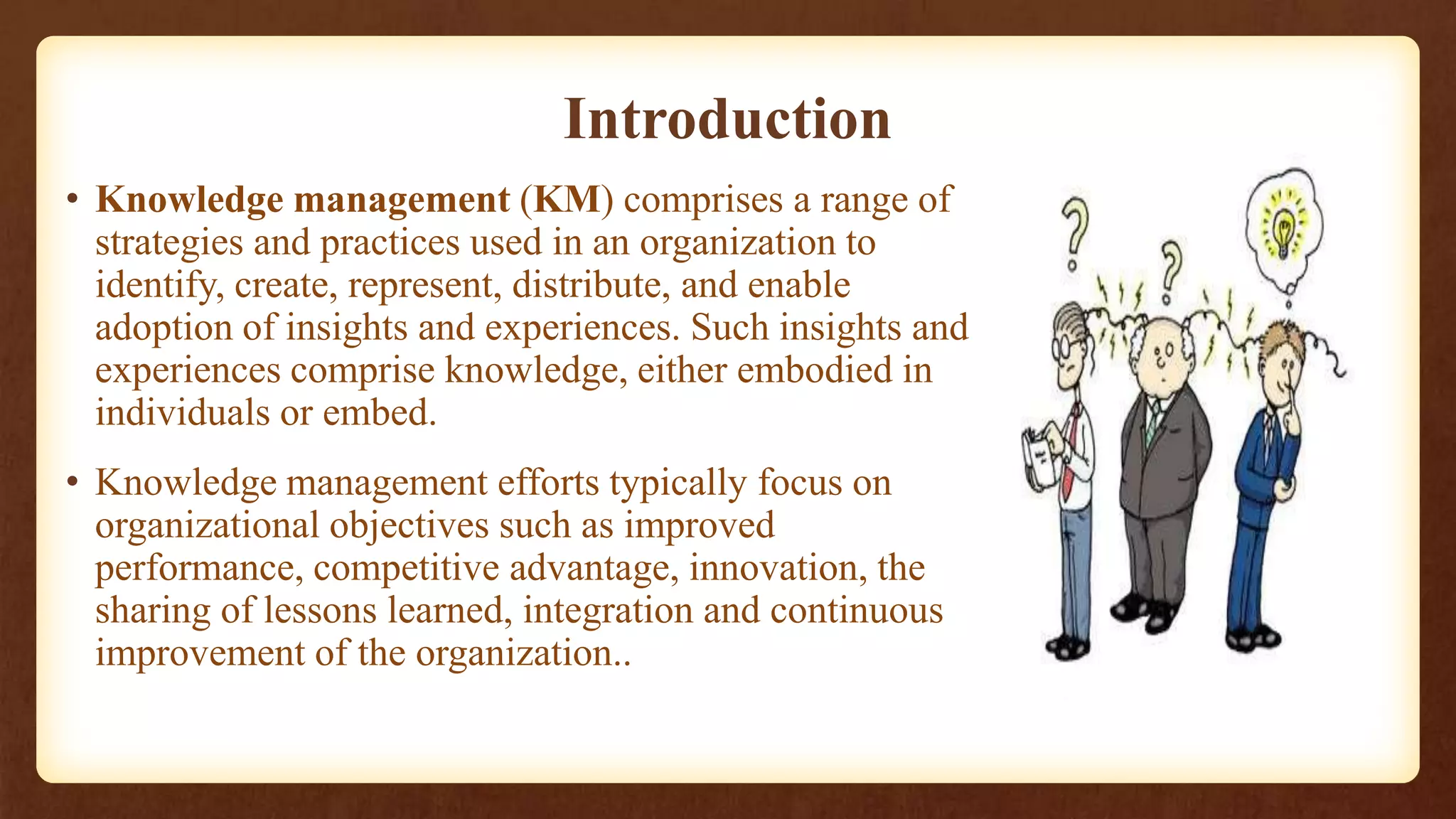
• Knowledge management (KM) comprises a range of
  strategies and practices used in an organization to
  identify, create, represent, distribute, and enable
  adoption of insights and experiences. Such insights and
  experiences comprise knowledge, either embodied in
  individuals or embed.
• Knowledge management efforts typically focus on
  organizational objectives such as improved
  performance, competitive advantage, innovation, the
  sharing of lessons learned, integration and continuous
  improvement of the organization..
1968
 • Started its operations

1972
 • F C Kholi 1st CEO
 • 1st assignment for TISCO i.e. punch card management system
1969
 • 1st project IBRS(Intelligent business Research Services) for external client Central Bank
   Of India.
 • Similar projects for 14 other banks.
1979
 • 1st international office in US with Ramadorai as head

1980
 • Won a contract to develop an account receivable system for American Express
Contd…..
Mid 1990’s
 • Management consultancy division of TCS was made a part of TCS.
 • This brought talent pool comprising experts in areas like HRD, MIS, and material
   management to provide strategic and operational solutions.
1999
 • KM pilot was launched and implemented.

2005
 •   May :- 45,714 people in 150 offices across 33 countries.
 •   12% revenue from Indian operations.
 •   76 customers who billed over US$5 million.
 •   October:- number of employees crossed 50,000 mark.
 •   Appointed CTO PS Vishwanathan.
Concepts and model used by TCS for knowledge
                           management
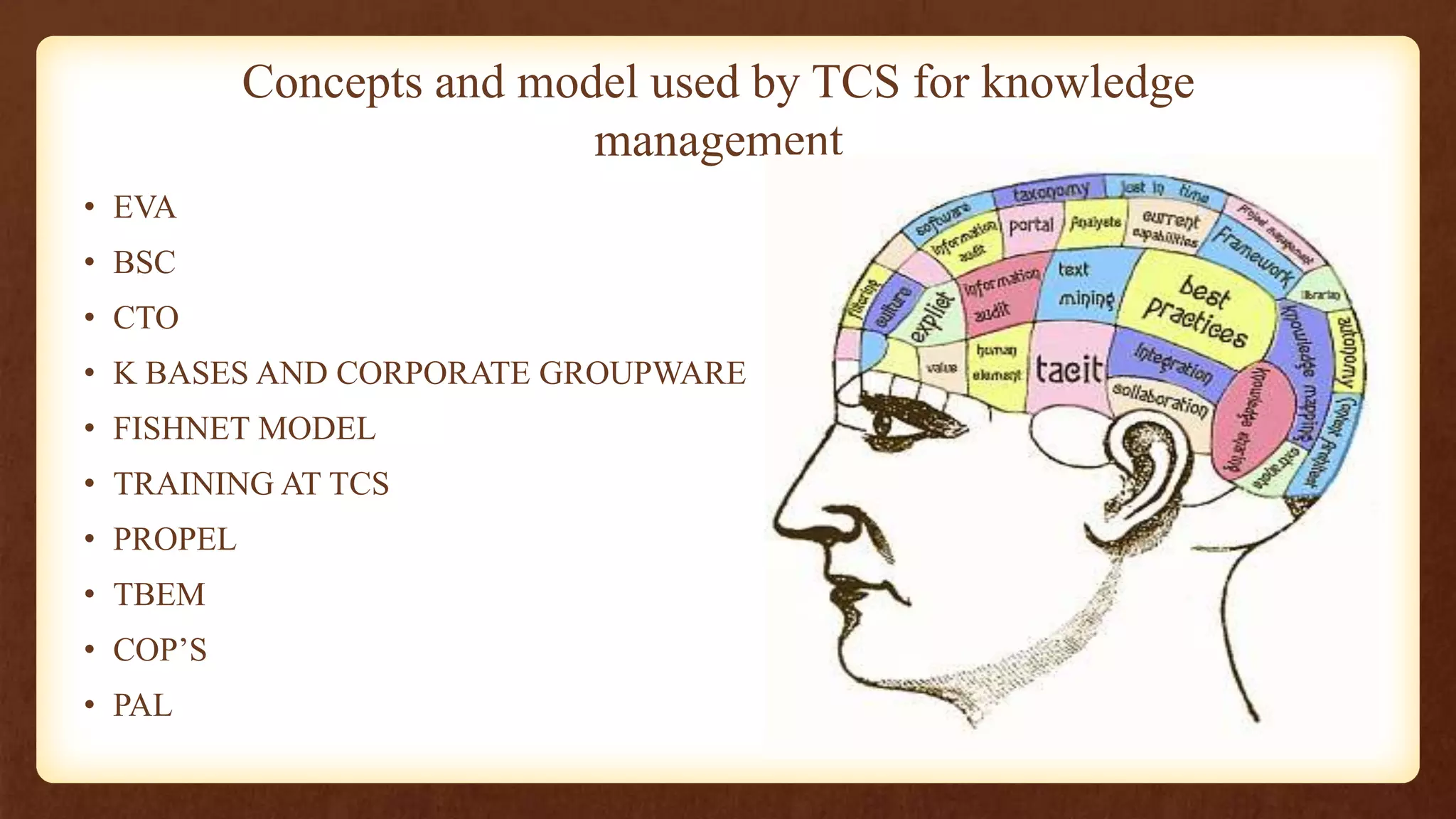
• EVA
• BSC
• CTO
• K BASES AND CORPORATE GROUPWARE
• FISHNET MODEL
• TRAINING AT TCS
• PROPEL
• TBEM
• COP’S
• PAL
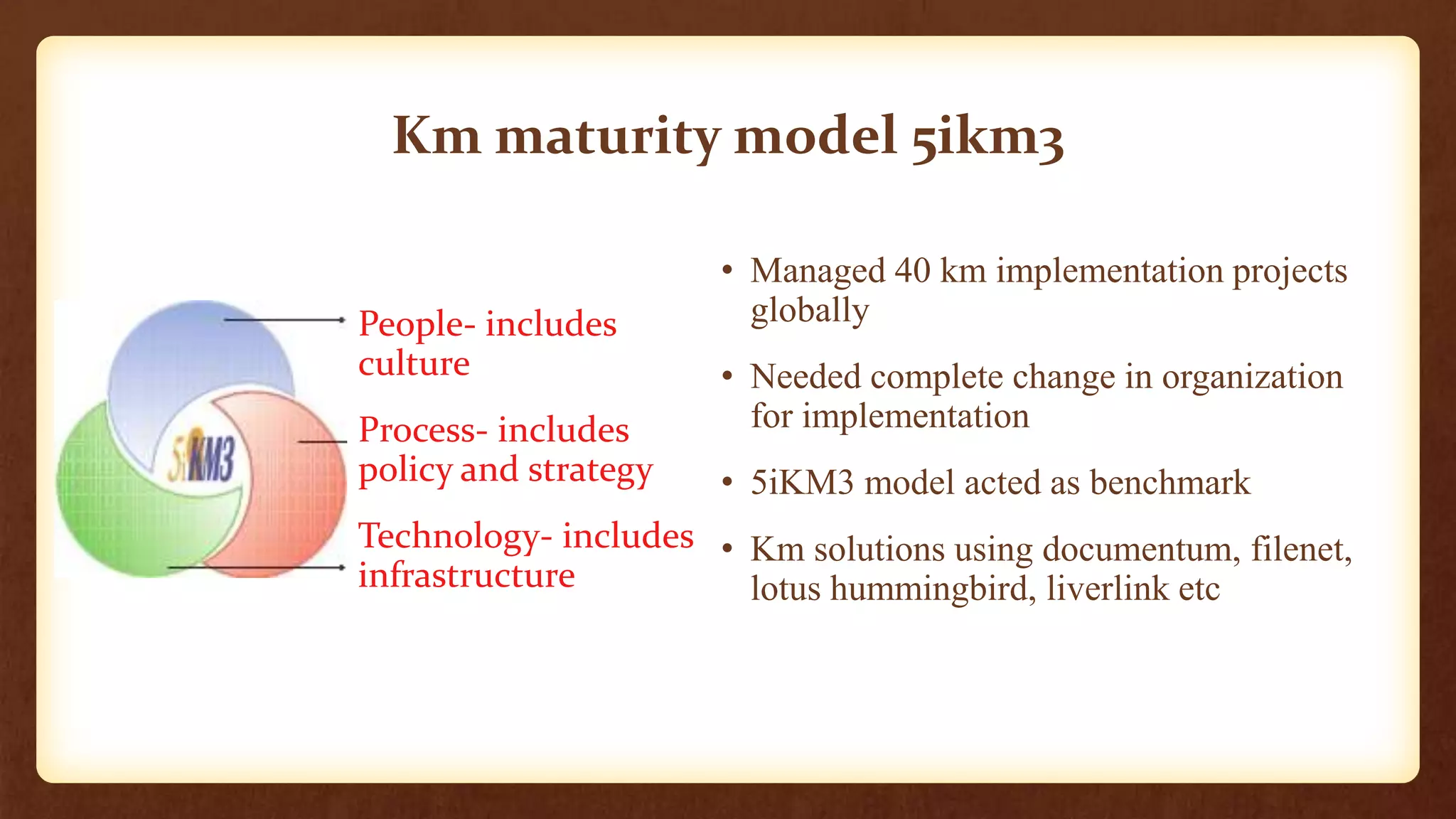
Km maturity model 5ikm3

                      • Managed 40 km implementation projects
People- includes        globally
culture               • Needed complete change in organization
Process- includes       for implementation
policy and strategy   • 5iKM3 model acted as benchmark
Technology- includes • Km solutions using documentum, filenet,
infrastructure         lotus hummingbird, liverlink etc
Km model continues……..
• It helped customers to formulate KM vision
  & strategy
• Road map for customers:
1. Explaining policies & procedures
2. Training and awareness session
3. KM implementation- requirement
   analysis, design, configuration, prototype,
   testing & user training
Stages of km maturity
• 1st-(initial stage) no formal process to put knowledge in use
• 2nd- (intent stage) realization of benefits by applying knowledge
• 3rd- (initiative stage) impact and benefits were seen
• 4th- (intelligent stage) collection and collaboration of intelligence
• 5th-(innovation)leading to process optimization
Benefits
Comprehensive maturity overview - KM solution describes each state
of maturity, addresses its objective, and maps the KM initiatives with the
perceived business benefits of each state.
Capabilities assessment - TCS help evaluate your current KM
capabilities in measuring its impact (both strategic and operational) on
business performance.
Seamless rollout - This model allows you to spot the areas of resistance
that affect the initiative and formulate change management programs to
address them.
Tcs

Tcs

  • 1.
    Knowledge Management Practices @ Tata Consultancy Services PRESENTED BY DHEERAJ
  • 2.
    Introduction • Knowledge management(KM) comprises a range of strategies and practices used in an organization to identify, create, represent, distribute, and enable adoption of insights and experiences. Such insights and experiences comprise knowledge, either embodied in individuals or embed. • Knowledge management efforts typically focus on organizational objectives such as improved performance, competitive advantage, innovation, the sharing of lessons learned, integration and continuous improvement of the organization..
  • 4.
    1968 • Startedits operations 1972 • F C Kholi 1st CEO • 1st assignment for TISCO i.e. punch card management system 1969 • 1st project IBRS(Intelligent business Research Services) for external client Central Bank Of India. • Similar projects for 14 other banks. 1979 • 1st international office in US with Ramadorai as head 1980 • Won a contract to develop an account receivable system for American Express
  • 5.
    Contd….. Mid 1990’s •Management consultancy division of TCS was made a part of TCS. • This brought talent pool comprising experts in areas like HRD, MIS, and material management to provide strategic and operational solutions. 1999 • KM pilot was launched and implemented. 2005 • May :- 45,714 people in 150 offices across 33 countries. • 12% revenue from Indian operations. • 76 customers who billed over US$5 million. • October:- number of employees crossed 50,000 mark. • Appointed CTO PS Vishwanathan.
  • 6.
    Concepts and modelused by TCS for knowledge management • EVA • BSC • CTO • K BASES AND CORPORATE GROUPWARE • FISHNET MODEL • TRAINING AT TCS • PROPEL • TBEM • COP’S • PAL
  • 7.
    Km maturity model5ikm3 • Managed 40 km implementation projects People- includes globally culture • Needed complete change in organization Process- includes for implementation policy and strategy • 5iKM3 model acted as benchmark Technology- includes • Km solutions using documentum, filenet, infrastructure lotus hummingbird, liverlink etc
  • 8.
    Km model continues…….. •It helped customers to formulate KM vision & strategy • Road map for customers: 1. Explaining policies & procedures 2. Training and awareness session 3. KM implementation- requirement analysis, design, configuration, prototype, testing & user training
  • 9.
    Stages of kmmaturity • 1st-(initial stage) no formal process to put knowledge in use • 2nd- (intent stage) realization of benefits by applying knowledge • 3rd- (initiative stage) impact and benefits were seen • 4th- (intelligent stage) collection and collaboration of intelligence • 5th-(innovation)leading to process optimization
  • 10.
    Benefits Comprehensive maturity overview- KM solution describes each state of maturity, addresses its objective, and maps the KM initiatives with the perceived business benefits of each state. Capabilities assessment - TCS help evaluate your current KM capabilities in measuring its impact (both strategic and operational) on business performance. Seamless rollout - This model allows you to spot the areas of resistance that affect the initiative and formulate change management programs to address them.