Leverage
Concept of Leverage
 The term leverage, in general refers to a relationship between two interrelated
variables. With reference to a business firm, these variables may be costs,
outputs, sales revenue, EBIT, Earnings per share (EPS) etc.
Operating leverage
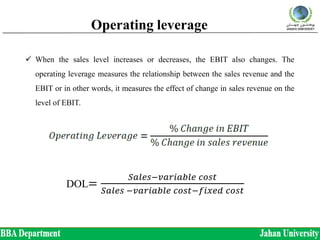
 When the sales level increases or decreases, the EBIT also changes. The
operating leverage measures the relationship between the sales revenue and the
EBIT or in other words, it measures the effect of change in sales revenue on the
level of EBIT.
DOL=
𝑆𝑎𝑙𝑒𝑠−𝑣𝑎𝑟𝑖𝑎𝑏𝑙𝑒 𝑐𝑜𝑠𝑡
𝑆𝑎𝑙𝑒𝑠 −𝑣𝑎𝑟𝑖𝑎𝑏𝑙𝑒 𝑐𝑜𝑠𝑡−𝑓𝑖𝑥𝑒𝑑 𝑐𝑜𝑠𝑡
Example
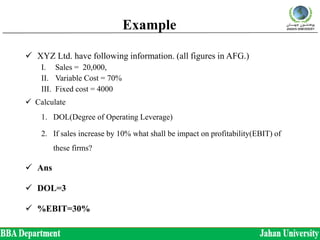
 XYZ Ltd. have following information. (all figures in AFG.)
I. Sales = 20,000,
II. Variable Cost = 70%
III. Fixed cost = 4000
 Calculate
1. DOL(Degree of Operating Leverage)
2. If sales increase by 10% what shall be impact on profitability(EBIT) of
these firms?
 Ans
 DOL=3
 %EBIT=30%
Financial leverage
 The financial leverage (FL) measures the relationship between the EBIT and the
EPS and it reflects the effect of change in EBIT on the level of EPS.
 DOF=
Example
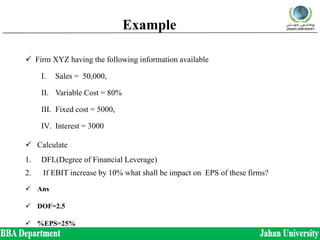
 Firm XYZ having the following information available
I. Sales = 50,000,
II. Variable Cost = 80%
III. Fixed cost = 5000,
IV. Interest = 3000
 Calculate
1. DFL(Degree of Financial Leverage)
2. If EBIT increase by 10% what shall be impact on EPS of these firms?
 Ans
 DOF=2.5
 %EPS=25%
Combined leverage
 The CL may be defined as the % change in EPS for a given change in the sales
level and may be calculated as follows
Example
 Firm ABC has the following information available
I. Sales = 20,000
II. Variable Cost = 70%
III. Fixed cost = 4000,
IV. Interest= 1000
 Calculate
1. DCL(Degree of Combined Leverage)
2. If Sales increase by 10% what shall be impact on EPS of these firms?
• Ans
• DCL=6
• %EPS=60%

Bf chapter 5

  • 1.
  • 2.
    Concept of Leverage The term leverage, in general refers to a relationship between two interrelated variables. With reference to a business firm, these variables may be costs, outputs, sales revenue, EBIT, Earnings per share (EPS) etc.
  • 3.
    Operating leverage  Whenthe sales level increases or decreases, the EBIT also changes. The operating leverage measures the relationship between the sales revenue and the EBIT or in other words, it measures the effect of change in sales revenue on the level of EBIT. DOL= 𝑆𝑎𝑙𝑒𝑠−𝑣𝑎𝑟𝑖𝑎𝑏𝑙𝑒 𝑐𝑜𝑠𝑡 𝑆𝑎𝑙𝑒𝑠 −𝑣𝑎𝑟𝑖𝑎𝑏𝑙𝑒 𝑐𝑜𝑠𝑡−𝑓𝑖𝑥𝑒𝑑 𝑐𝑜𝑠𝑡
  • 4.
    Example  XYZ Ltd.have following information. (all figures in AFG.) I. Sales = 20,000, II. Variable Cost = 70% III. Fixed cost = 4000  Calculate 1. DOL(Degree of Operating Leverage) 2. If sales increase by 10% what shall be impact on profitability(EBIT) of these firms?  Ans  DOL=3  %EBIT=30%
  • 5.
    Financial leverage  Thefinancial leverage (FL) measures the relationship between the EBIT and the EPS and it reflects the effect of change in EBIT on the level of EPS.  DOF=
  • 6.
    Example  Firm XYZhaving the following information available I. Sales = 50,000, II. Variable Cost = 80% III. Fixed cost = 5000, IV. Interest = 3000  Calculate 1. DFL(Degree of Financial Leverage) 2. If EBIT increase by 10% what shall be impact on EPS of these firms?  Ans  DOF=2.5  %EPS=25%
  • 7.
    Combined leverage  TheCL may be defined as the % change in EPS for a given change in the sales level and may be calculated as follows
  • 8.
    Example  Firm ABChas the following information available I. Sales = 20,000 II. Variable Cost = 70% III. Fixed cost = 4000, IV. Interest= 1000  Calculate 1. DCL(Degree of Combined Leverage) 2. If Sales increase by 10% what shall be impact on EPS of these firms? • Ans • DCL=6 • %EPS=60%