Chapter 5 The Trade-off between Risk  and Return © 2007  Thomson South-Western
Introduction to Risk and Return Valuing risky assets -  a task fundamental to financial management The three-step procedure is called  discounted cash flow (DCF) analysis.  Three-step procedure for valuing a risky asset 1. Determine the asset’s expected cash flows 2. Choose discount rate that reflects asset’s risk 3. Calculate present value (PV cash inflows - PV outflows)
Historical vs. Expected Returns Decisions Must Be Based On Expected Returns There Are Many Ways to Estimate Expected Returns Assume That Expected Return Going Forward Equals the Average Return in the Past Simple Way to Estimate Expected Return
Risk and Return Fundamentals Equity risk premium:  the difference in equity returns and returns on safe investments implies that stocks are riskier than bonds or bills trade-off always arises between expected risk and expected return
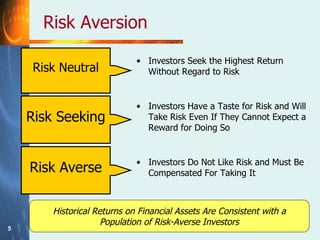
Risk Aversion Risk Neutral Investors Seek the Highest Return Without Regard to Risk Risk Seeking Investors Have a Taste for Risk and Will Take Risk Even If They Cannot Expect a Reward for Doing So   Risk Averse  Investors Do Not Like Risk and Must Be Compensated For Taking It Historical Returns on Financial Assets Are Consistent with a Population of Risk-Averse Investors
Probability Distribution Probability distribution tells us what outcomes are possible and associates a probability with each outcome. Normal distribution
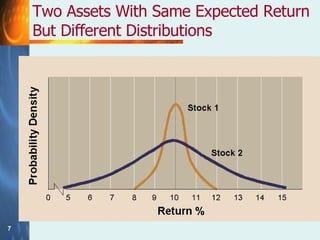
Two Assets With Same Expected Return But Different Distributions
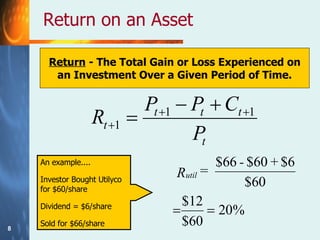
Return on an Asset Return  - The Total Gain or Loss Experienced on an Investment Over a Given Period of Time. An example.... Investor Bought Utilyco for $60/share Dividend = $6/share Sold for $66/share
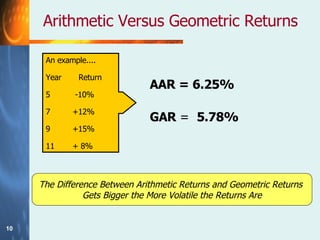
Arithmetic Versus Geometric Returns Arithmetic  return the simple average of annual returns: best estimate of expected return each year. Geometric  average return the compound annual return to an investor who bought and held a stock  t  years: Geometric avg return= (1+R 1 )(1+R 2 )(1+R 3 )….(1+R t )] 1/t  – 1 The Difference Between Arithmetic Returns and Geometric Returns  Gets Bigger the More Volatile the Returns Are
Arithmetic Versus Geometric Returns The Difference Between Arithmetic Returns and Geometric Returns  Gets Bigger the More Volatile the Returns Are AAR = 6.25% GAR  =  5.78% An example.... Year  Return  -10% +12% +15% + 8%
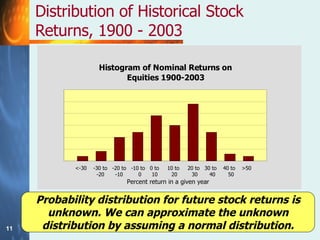
Distribution of Historical Stock Returns, 1900 - 2003 Percent return in a given year Probability distribution for future stock returns is unknown. We can approximate the unknown distribution by assuming a normal distribution. <-30  -30 to  -20 to  -10 to  0 to  10 to  20 to  30 to  40 to  >50 -20 -10 0 10 20 30 40 50
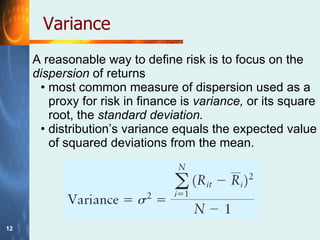
Variance A reasonable way to define risk is to focus on the  dispersion  of returns most common measure of dispersion used as a proxy for risk in finance is  variance,  or its square root, the  standard deviation.  distribution’s variance equals the expected value of squared deviations from the mean.
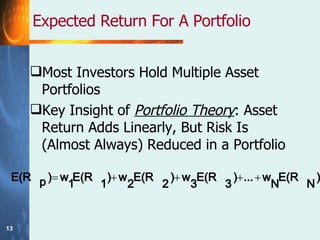
Expected Return For A Portfolio Most Investors Hold Multiple Asset Portfolios Key Insight of  Portfolio Theory : Asset Return Adds Linearly, But Risk Is (Almost Always) Reduced in a Portfolio
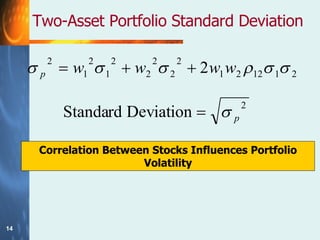
Two-Asset Portfolio Standard Deviation Correlation Between Stocks Influences Portfolio Volatility
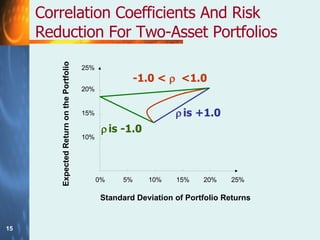
Correlation Coefficients And Risk Reduction For Two-Asset Portfolios 10% 15% 20% 25% 0% 5% 10% 15% 20% 25% Standard Deviation of Portfolio Returns Expected Return on the Portfolio    is +1.0 -1.0 <     <1.0    is -1.0
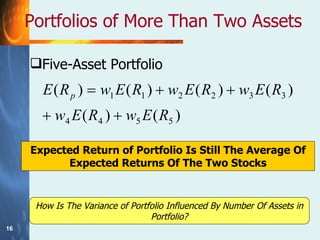
Portfolios of More Than Two Assets Five-Asset Portfolio  Expected Return of Portfolio Is Still The Average Of Expected Returns Of The Two Stocks How Is The Variance of Portfolio Influenced By Number Of Assets in Portfolio?
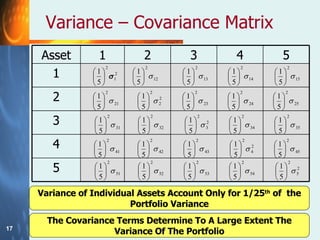
Variance – Covariance Matrix 5 4 3 2 1 5 4 3 2 1 Asset The Covariance Terms Determine To A Large Extent The Variance Of The Portfolio 5 4 3 2 1 5 4 3 2 1 Asset 5 4 3 2 1 5 4 3 2 1 Asset Variance of Individual Assets Account Only for 1/25 th  of  the Portfolio Variance
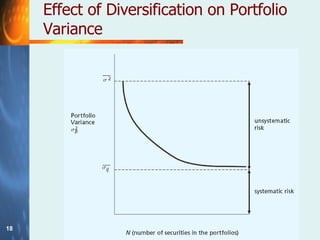
Effect of Diversification on Portfolio Variance
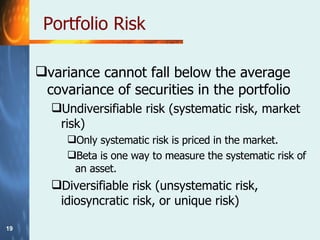
Portfolio Risk variance cannot fall below the average covariance of securities in the portfolio Undiversifiable risk (systematic risk, market risk) Only systematic risk is priced in the market.  Beta is one way to measure the systematic risk of an asset. Diversifiable risk (unsystematic risk, idiosyncratic risk, or unique risk)
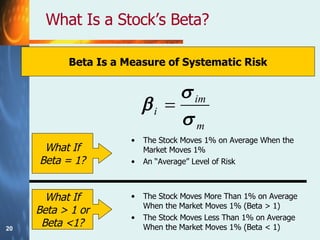
What Is a Stock’s Beta? Beta Is a Measure of Systematic Risk What If Beta > 1 or Beta <1? The Stock Moves More Than 1% on Average When the Market Moves 1% (Beta > 1) The Stock Moves Less Than 1% on Average When the Market Moves 1% (Beta < 1) What If Beta = 1? The Stock Moves 1% on Average When the Market Moves 1% An “Average” Level of Risk
Diversifiable And Non-Diversifiable Risk As Number of Assets Increases, Diversification Reduces the Importance of a Stock’s Own Variance Diversifiable risk, unsystematic risk Only an Asset’s Covariance  With All Other Assets  Contributes Measurably to Overall Portfolio Return Variance Non-diversifiable risk, systematic risk
How Risky Is an Individual Asset? First Approach – Asset’s Variance or Standard Deviation What Really Matters Is Systematic Risk….How an Asset Covaries With Everything Else Use Asset’s Beta
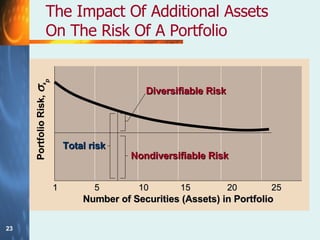
The Impact Of Additional Assets On The Risk Of A Portfolio Number of Securities (Assets) in Portfolio Portfolio Risk,   k p Nondiversifiable Risk Diversifiable Risk Total risk 1  5  10  15  20  25

Risk And Return

  • 1.
    Chapter 5 TheTrade-off between Risk and Return © 2007 Thomson South-Western
  • 2.
    Introduction to Riskand Return Valuing risky assets - a task fundamental to financial management The three-step procedure is called discounted cash flow (DCF) analysis. Three-step procedure for valuing a risky asset 1. Determine the asset’s expected cash flows 2. Choose discount rate that reflects asset’s risk 3. Calculate present value (PV cash inflows - PV outflows)
  • 3.
    Historical vs. ExpectedReturns Decisions Must Be Based On Expected Returns There Are Many Ways to Estimate Expected Returns Assume That Expected Return Going Forward Equals the Average Return in the Past Simple Way to Estimate Expected Return
  • 4.
    Risk and ReturnFundamentals Equity risk premium: the difference in equity returns and returns on safe investments implies that stocks are riskier than bonds or bills trade-off always arises between expected risk and expected return
  • 5.
    Risk Aversion RiskNeutral Investors Seek the Highest Return Without Regard to Risk Risk Seeking Investors Have a Taste for Risk and Will Take Risk Even If They Cannot Expect a Reward for Doing So Risk Averse Investors Do Not Like Risk and Must Be Compensated For Taking It Historical Returns on Financial Assets Are Consistent with a Population of Risk-Averse Investors
  • 6.
    Probability Distribution Probabilitydistribution tells us what outcomes are possible and associates a probability with each outcome. Normal distribution
  • 7.
    Two Assets WithSame Expected Return But Different Distributions
  • 8.
    Return on anAsset Return - The Total Gain or Loss Experienced on an Investment Over a Given Period of Time. An example.... Investor Bought Utilyco for $60/share Dividend = $6/share Sold for $66/share
  • 9.
    Arithmetic Versus GeometricReturns Arithmetic return the simple average of annual returns: best estimate of expected return each year. Geometric average return the compound annual return to an investor who bought and held a stock t years: Geometric avg return= (1+R 1 )(1+R 2 )(1+R 3 )….(1+R t )] 1/t – 1 The Difference Between Arithmetic Returns and Geometric Returns Gets Bigger the More Volatile the Returns Are
  • 10.
    Arithmetic Versus GeometricReturns The Difference Between Arithmetic Returns and Geometric Returns Gets Bigger the More Volatile the Returns Are AAR = 6.25% GAR = 5.78% An example.... Year Return -10% +12% +15% + 8%
  • 11.
    Distribution of HistoricalStock Returns, 1900 - 2003 Percent return in a given year Probability distribution for future stock returns is unknown. We can approximate the unknown distribution by assuming a normal distribution. <-30 -30 to -20 to -10 to 0 to 10 to 20 to 30 to 40 to >50 -20 -10 0 10 20 30 40 50
  • 12.
    Variance A reasonableway to define risk is to focus on the dispersion of returns most common measure of dispersion used as a proxy for risk in finance is variance, or its square root, the standard deviation. distribution’s variance equals the expected value of squared deviations from the mean.
  • 13.
    Expected Return ForA Portfolio Most Investors Hold Multiple Asset Portfolios Key Insight of Portfolio Theory : Asset Return Adds Linearly, But Risk Is (Almost Always) Reduced in a Portfolio
  • 14.
    Two-Asset Portfolio StandardDeviation Correlation Between Stocks Influences Portfolio Volatility
  • 15.
    Correlation Coefficients AndRisk Reduction For Two-Asset Portfolios 10% 15% 20% 25% 0% 5% 10% 15% 20% 25% Standard Deviation of Portfolio Returns Expected Return on the Portfolio  is +1.0 -1.0 <  <1.0  is -1.0
  • 16.
    Portfolios of MoreThan Two Assets Five-Asset Portfolio Expected Return of Portfolio Is Still The Average Of Expected Returns Of The Two Stocks How Is The Variance of Portfolio Influenced By Number Of Assets in Portfolio?
  • 17.
    Variance – CovarianceMatrix 5 4 3 2 1 5 4 3 2 1 Asset The Covariance Terms Determine To A Large Extent The Variance Of The Portfolio 5 4 3 2 1 5 4 3 2 1 Asset 5 4 3 2 1 5 4 3 2 1 Asset Variance of Individual Assets Account Only for 1/25 th of the Portfolio Variance
  • 18.
    Effect of Diversificationon Portfolio Variance
  • 19.
    Portfolio Risk variancecannot fall below the average covariance of securities in the portfolio Undiversifiable risk (systematic risk, market risk) Only systematic risk is priced in the market. Beta is one way to measure the systematic risk of an asset. Diversifiable risk (unsystematic risk, idiosyncratic risk, or unique risk)
  • 20.
    What Is aStock’s Beta? Beta Is a Measure of Systematic Risk What If Beta > 1 or Beta <1? The Stock Moves More Than 1% on Average When the Market Moves 1% (Beta > 1) The Stock Moves Less Than 1% on Average When the Market Moves 1% (Beta < 1) What If Beta = 1? The Stock Moves 1% on Average When the Market Moves 1% An “Average” Level of Risk
  • 21.
    Diversifiable And Non-DiversifiableRisk As Number of Assets Increases, Diversification Reduces the Importance of a Stock’s Own Variance Diversifiable risk, unsystematic risk Only an Asset’s Covariance With All Other Assets Contributes Measurably to Overall Portfolio Return Variance Non-diversifiable risk, systematic risk
  • 22.
    How Risky Isan Individual Asset? First Approach – Asset’s Variance or Standard Deviation What Really Matters Is Systematic Risk….How an Asset Covaries With Everything Else Use Asset’s Beta
  • 23.
    The Impact OfAdditional Assets On The Risk Of A Portfolio Number of Securities (Assets) in Portfolio Portfolio Risk,  k p Nondiversifiable Risk Diversifiable Risk Total risk 1 5 10 15 20 25