Debt versus Equity
2
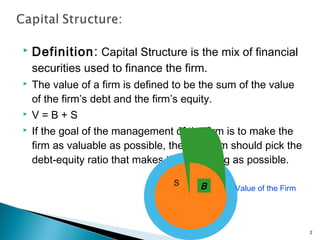
 Definition: Capital Structure is the mix of financial
securities used to finance the firm.
 The value of a firm is defined to be the sum of the value
of the firm’s debt and the firm’s equity.
 V = B + S
 If the goal of the management of the firm is to make the
firm as valuable as possible, then the firm should pick the
debt-equity ratio that makes the pie as big as possible.
Value of the FirmBS
 Business Risk
 Company Tax exposure
 Financial Flexibility
 Management Style
 Growth Rate
 Market Condition
 Cost of Fixed Assets
 Size of Business Organization
 Nature of business Organization
 Elasticity of Capital Structure
 Net Income Approach (NI)
 Net Operating Income Approach (NOI)
 Traditional Approach (TA)
 Modigliani and Miller Approach (MM)
 Need to consider two kinds of risk:
◦ Business risk
◦ Financial risk
 Standard measure is beta (controlling for financial
risk)
 Factors:
◦ Demand variability
◦ Sales price variability
◦ Input cost variability
◦ Ability to develop new products
◦ Foreign exchange exposure
◦ Operating leverage (fixed vs variable costs)
 The additional risk placed on the common
stockholders as a result of the decision to finance
with debt
 If the same firm is now capitalized with 50% debt
and 50% equity – with five people investing in debt
and five investing in equity
 The 5 who put up the equity will have to bear all
the business risk, so the common stock will be
twice as risky as it would have been had the firm
been all-equity (unlevered).
 Financial leverage concentrates the firm’s
business risk on the shareholders because debt-
holders, who receive fixed interest payments, bear
none of the business risk.
 Leverage increases shareholder risk
 Leverage also increases the return on equity (to
compensate for the higher risk)
 Interest is tax deductible (lowers the effective cost
of debt)
 Debt-holders are limited to a fixed return – so
stockholders do not have to share profits if the
business does exceptionally well
 Debt holders do not have voting rights
 Higher debt ratios lead to greater risk and higher
required interest rates (to compensate for the
additional risk)
Thank you

Capital structure ppt

  • 1.
  • 2.
    2  Definition: CapitalStructure is the mix of financial securities used to finance the firm.  The value of a firm is defined to be the sum of the value of the firm’s debt and the firm’s equity.  V = B + S  If the goal of the management of the firm is to make the firm as valuable as possible, then the firm should pick the debt-equity ratio that makes the pie as big as possible. Value of the FirmBS
  • 3.
     Business Risk Company Tax exposure  Financial Flexibility  Management Style  Growth Rate  Market Condition  Cost of Fixed Assets  Size of Business Organization  Nature of business Organization  Elasticity of Capital Structure
  • 4.
     Net IncomeApproach (NI)  Net Operating Income Approach (NOI)  Traditional Approach (TA)  Modigliani and Miller Approach (MM)
  • 5.
     Need toconsider two kinds of risk: ◦ Business risk ◦ Financial risk
  • 6.
     Standard measureis beta (controlling for financial risk)  Factors: ◦ Demand variability ◦ Sales price variability ◦ Input cost variability ◦ Ability to develop new products ◦ Foreign exchange exposure ◦ Operating leverage (fixed vs variable costs)
  • 7.
     The additionalrisk placed on the common stockholders as a result of the decision to finance with debt
  • 8.
     If thesame firm is now capitalized with 50% debt and 50% equity – with five people investing in debt and five investing in equity  The 5 who put up the equity will have to bear all the business risk, so the common stock will be twice as risky as it would have been had the firm been all-equity (unlevered).
  • 9.
     Financial leverageconcentrates the firm’s business risk on the shareholders because debt- holders, who receive fixed interest payments, bear none of the business risk.
  • 10.
     Leverage increasesshareholder risk  Leverage also increases the return on equity (to compensate for the higher risk)
  • 11.
     Interest istax deductible (lowers the effective cost of debt)  Debt-holders are limited to a fixed return – so stockholders do not have to share profits if the business does exceptionally well  Debt holders do not have voting rights
  • 12.
     Higher debtratios lead to greater risk and higher required interest rates (to compensate for the additional risk)
  • 13.

Editor's Notes

  • #3 Previous chapters discuss the capital budgeting decisions. Chapter 15&16 focus on the right hand side of the balance sheet model – capital structure.