
Leverages
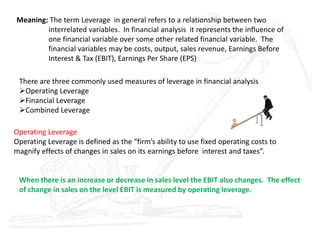
Meaning: The term Leverage in general refers to a relationship between two
interrelated variables. In financial analysis it represents the influence of
one financial variable over some other related financial variable. The
financial variables may be costs, output, sales revenue, Earnings Before
Interest & Tax (EBIT), Earnings Per Share (EPS)
There are three commonly used measures of leverage in financial analysis
Operating Leverage
Financial Leverage
Combined Leverage
Operating Leverage
Operating Leverage is defined as the “firm’s ability to use fixed operating costs to
magnify effects of changes in sales on its earnings before interest and taxes”.
When there is an increase or decrease in sales level the EBIT also changes. The effect
of change in sales on the level EBIT is measured by operating leverage.
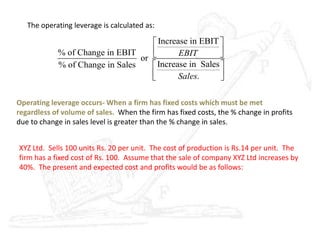
The operating leverage is calculated as:
Increase in EBIT
% of Change in EBIT
or
Increase in Sales% of Change in Sales
.
EBIT
Sales
 
  
 
  
Operating leverage occurs- When a firm has fixed costs which must be met
regardless of volume of sales. When the firm has fixed costs, the % change in profits
due to change in sales level is greater than the % change in sales.
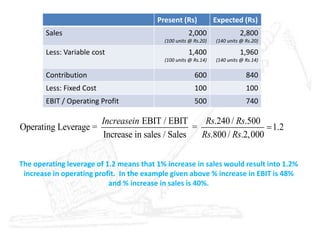
XYZ Ltd. Sells 100 units Rs. 20 per unit. The cost of production is Rs.14 per unit. The
firm has a fixed cost of Rs. 100. Assume that the sale of company XYZ Ltd increases by
40%. The present and expected cost and profits would be as follows:
Present (Rs) Expected (Rs)
Sales 2,000
(100 units @ Rs.20)
2,800
(140 units @ Rs.20)
Less: Variable cost 1,400
(100 units @ Rs.14)
1,960
(140 units @ Rs.14)
Contribution 600 840
Less: Fixed Cost 100 100
EBIT / Operating Profit 500 740
EBIT / EBIT .240 / .500
Operating Leverage = = 1.2
Increase in sales / Sales .800 / .2,000
Increasein Rs Rs
Rs Rs

The operating leverage of 1.2 means that 1% increase in sales would result into 1.2%
increase in operating profit. In the example given above % increase in EBIT is 48%
and % increase in sales is 40%.
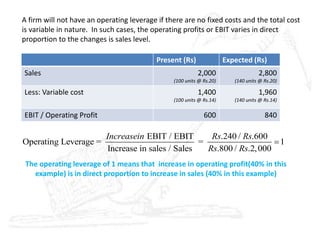
A firm will not have an operating leverage if there are no fixed costs and the total cost
is variable in nature. In such cases, the operating profits or EBIT varies in direct
proportion to the changes is sales level.
Present (Rs) Expected (Rs)
Sales 2,000
(100 units @ Rs.20)
2,800
(140 units @ Rs.20)
Less: Variable cost 1,400
(100 units @ Rs.14)
1,960
(140 units @ Rs.14)
EBIT / Operating Profit 600 840
EBIT / EBIT .240 / .600
Operating Leverage = = 1
Increase in sales / Sales .800 / .2,000
Increasein Rs Rs
Rs Rs

The operating leverage of 1 means that increase in operating profit(40% in this
example) is in direct proportion to increase in sales (40% in this example)
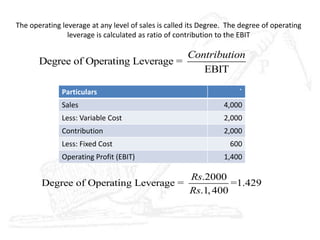
The operating leverage at any level of sales is called its Degree. The degree of operating
leverage is calculated as ratio of contribution to the EBIT
Degree of Operating Leverage =
EBIT
Contribution
Particulars `
Sales 4,000
Less: Variable Cost 2,000
Contribution 2,000
Less: Fixed Cost 600
Operating Profit (EBIT) 1,400
.2000
Degree of Operating Leverage = =1.429
.1,400
Rs
Rs
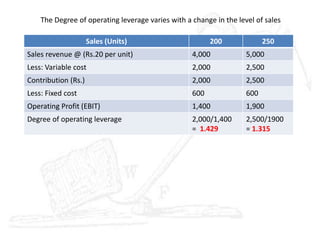
The Degree of operating leverage varies with a change in the level of sales
Sales (Units) 200 250
Sales revenue @ (Rs.20 per unit) 4,000 5,000
Less: Variable cost 2,000 2,500
Contribution (Rs.) 2,000 2,500
Less: Fixed cost 600 600
Operating Profit (EBIT) 1,400 1,900
Degree of operating leverage 2,000/1,400
= 1.429
2,500/1900
= 1.315
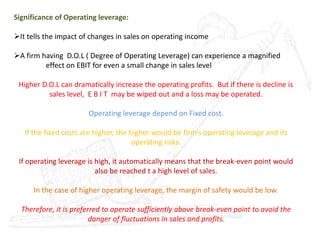
Significance of Operating leverage:
It tells the impact of changes in sales on operating income
A firm having D.O.L ( Degree of Operating Leverage) can experience a magnified
effect on EBIT for even a small change in sales level
Higher D.O.L can dramatically increase the operating profits. But if there is decline is
sales level, E B I T may be wiped out and a loss may be operated.
Operating leverage depend on Fixed cost.
If the fixed costs are higher, the higher would be firm’s operating leverage and its
operating risks.
If operating leverage is high, it automatically means that the break-even point would
also be reached t a high level of sales.
In the case of higher operating leverage, the margin of safety would be low.
Therefore, it is preferred to operate sufficiently above break-even point to avoid the
danger of fluctuations in sales and profits.
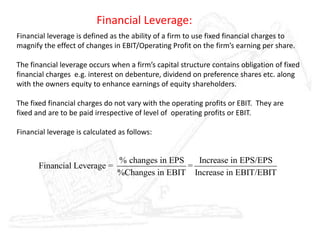
Financial Leverage:
Financial leverage is defined as the ability of a firm to use fixed financial charges to
magnify the effect of changes in EBIT/Operating Profit on the firm’s earning per share.
The financial leverage occurs when a firm’s capital structure contains obligation of fixed
financial charges e.g. interest on debenture, dividend on preference shares etc. along
with the owners equity to enhance earnings of equity shareholders.
The fixed financial charges do not vary with the operating profits or EBIT. They are
fixed and are to be paid irrespective of level of operating profits or EBIT.
Financial leverage is calculated as follows:
% changes in EPS Increase in EPS/EPS
Financial Leverage = =
%Changes in EBIT Increase in EBIT/EBIT
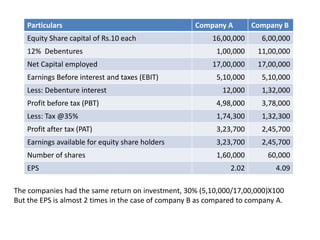
Particulars Company A Company B
Equity Share capital of Rs.10 each 16,00,000 6,00,000
12% Debentures 1,00,000 11,00,000
Net Capital employed 17,00,000 17,00,000
Earnings Before interest and taxes (EBIT) 5,10,000 5,10,000
Less: Debenture interest 12,000 1,32,000
Profit before tax (PBT) 4,98,000 3,78,000
Less: Tax @35% 1,74,300 1,32,300
Profit after tax (PAT) 3,23,700 2,45,700
Earnings available for equity share holders 3,23,700 2,45,700
Number of shares 1,60,000 60,000
EPS 2.02 4.09
The companies had the same return on investment, 30% (5,10,000/17,00,000)X100
But the EPS is almost 2 times in the case of company B as compared to company A.
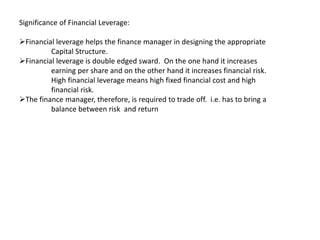
Significance of Financial Leverage:
Financial leverage helps the finance manager in designing the appropriate
Capital Structure.
Financial leverage is double edged sward. On the one hand it increases
earning per share and on the other hand it increases financial risk.
High financial leverage means high fixed financial cost and high
financial risk.
The finance manager, therefore, is required to trade off. i.e. has to bring a
balance between risk and return
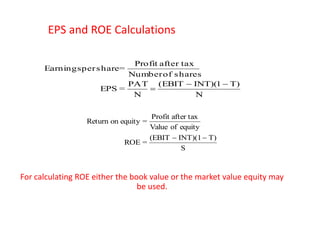
EPS and ROE Calculations
For calculating ROE either the book value or the market value equity may
be used.
N
)T1)(INTEBIT(
N
PAT
=EPS
sharesofNumber
after taxProfit
=shareperEarnings


S
)TINT)(1(EBIT
=ROE
equityofValue
after taxProfit
=equityonReturn

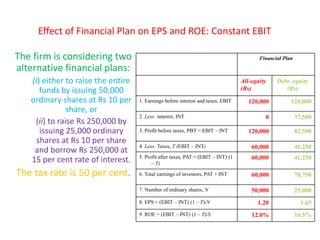
Effect of Financial Plan on EPS and ROE: Constant EBIT
The firm is considering two
alternative financial plans:
(i) either to raise the entire
funds by issuing 50,000
ordinary shares at Rs 10 per
share, or
(ii) to raise Rs 250,000 by
issuing 25,000 ordinary
shares at Rs 10 per share
and borrow Rs 250,000 at
15 per cent rate of interest.
The tax rate is 50 per cent.
Financial Plan
All-equity
(Rs)
Debt- equity
(Rs)
1. Earnings before interest and taxes, EBIT 120,000 120,000
2. Less: interest, INT 0 37,500
3. Profit before taxes, PBT = EBIT – INT 120,000 82,500
4. Less: Taxes, T (EBIT – INT) 60,000 41,250
5. Profit after taxes, PAT = (EBIT – INT) (1
– T)
60,000 41,250
6. Total earnings of investors, PAT + INT 60,000 78,750
7. Number of ordinary shares, N 50,000 25,000
8. EPS = (EBIT – INT) (1 – T)/N 1.20 1.65
9. ROE = (EBIT – INT) (1 – T)/S 12.0% 16.5%
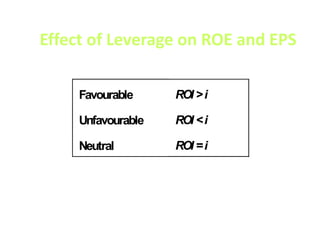
Effect of Leverage on ROE and EPS
Favourable ROI >i
Unfavourable ROI <i
Neutral ROI =i
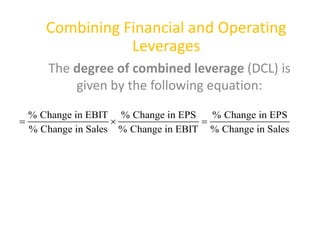
Combining Financial and Operating
Leverages
The degree of combined leverage (DCL) is
given by the following equation:
% Change in EBIT % Change in EPS % Change in EPS
% Change in Sales % Change in EBIT % Change in Sales
  
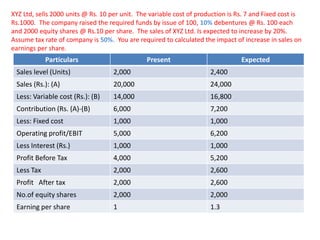
XYZ Ltd, sells 2000 units @ Rs. 10 per unit. The variable cost of production is Rs. 7 and Fixed cost is
Rs.1000. The company raised the required funds by issue of 100, 10% debentures @ Rs. 100 each
and 2000 equity shares @ Rs.10 per share. The sales of XYZ Ltd. Is expected to increase by 20%.
Assume tax rate of company is 50%. You are required to calculated the impact of increase in sales on
earnings per share.
Particulars Present Expected
Sales level (Units) 2,000 2,400
Sales (Rs.): (A) 20,000 24,000
Less: Variable cost (Rs.): (B) 14,000 16,800
Contribution (Rs. (A)-(B) 6,000 7,200
Less: Fixed cost 1,000 1,000
Operating profit/EBIT 5,000 6,200
Less Interest (Rs.) 1,000 1,000
Profit Before Tax 4,000 5,200
Less Tax 2,000 2,600
Profit After tax 2,000 2,600
No.of equity shares 2,000 2,000
Earning per share 1 1.3
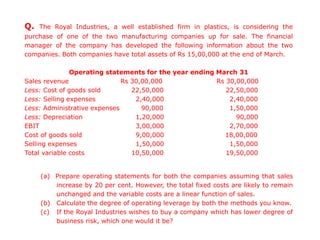
Q. The Royal Industries, a well established firm in plastics, is considering the
purchase of one of the two manufacturing companies up for sale. The financial
manager of the company has developed the following information about the two
companies. Both companies have total assets of Rs 15,00,000 at the end of March.
Operating statements for the year ending March 31
Sales revenue Rs 30,00,000 Rs 30,00,000
Less: Cost of goods sold 22,50,000 22,50,000
Less: Selling expenses 2,40,000 2,40,000
Less: Administrative expenses 90,000 1,50,000
Less: Depreciation 1,20,000 90,000
EBIT 3,00,000 2,70,000
Cost of goods sold 9,00,000 18,00,000
Selling expenses 1,50,000 1,50,000
Total variable costs 10,50,000 19,50,000
(a) Prepare operating statements for both the companies assuming that sales
increase by 20 per cent. However, the total fixed costs are likely to remain
unchanged and the variable costs are a linear function of sales.
(b) Calculate the degree of operating leverage by both the methods you know.
(c) If the Royal Industries wishes to buy a company which has lower degree of
business risk, which one would it be?
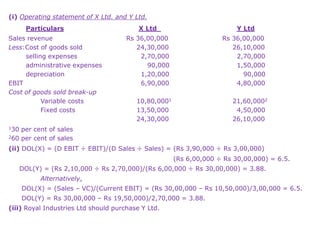
(i) Operating statement of X Ltd. and Y Ltd.
Particulars X Ltd Y Ltd
Sales revenue Rs 36,00,000 Rs 36,00,000
Less:Cost of goods sold 24,30,000 26,10,000
selling expenses 2,70,000 2,70,000
administrative expenses 90,000 1,50,000
depreciation 1,20,000 90,000
EBIT 6,90,000 4,80,000
Cost of goods sold break-up
Variable costs 10,80,0001 21,60,0002
Fixed costs 13,50,000 4,50,000
24,30,000 26,10,000
130 per cent of sales
260 per cent of sales
(ii) DOL(X) = (D EBIT ÷ EBIT)/(D Sales ÷ Sales) = (Rs 3,90,000 ÷ Rs 3,00,000)
(Rs 6,00,000 ÷ Rs 30,00,000) = 6.5.
DOL(Y) = (Rs 2,10,000 ÷ Rs 2,70,000)/(Rs 6,00,000 ÷ Rs 30,00,000) = 3.88.
Alternatively,
DOL(X) = (Sales – VC)/(Current EBIT) = (Rs 30,00,000 – Rs 10,50,000)/3,00,000 = 6.5.
DOL(Y) = Rs 30,00,000 – Rs 19,50,000)/2,70,000 = 3.88.
(iii) Royal Industries Ltd should purchase Y Ltd.
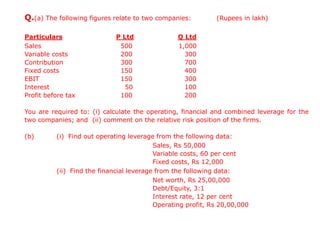
Q.(a) The following figures relate to two companies: (Rupees in lakh)
Particulars P Ltd Q Ltd
Sales 500 1,000
Variable costs 200 300
Contribution 300 700
Fixed costs 150 400
EBIT 150 300
Interest 50 100
Profit before tax 100 200
You are required to: (i) calculate the operating, financial and combined leverage for the
two companies; and (ii) comment on the relative risk position of the firms.
(b) (i) Find out operating leverage from the following data:
Sales, Rs 50,000
Variable costs, 60 per cent
Fixed costs, Rs 12,000
(ii) Find the financial leverage from the following data:
Net worth, Rs 25,00,000
Debt/Equity, 3:1
Interest rate, 12 per cent
Operating profit, Rs 20,00,000
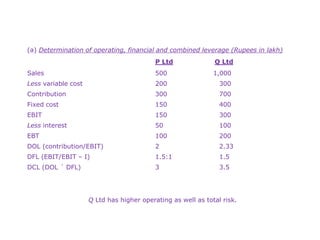
(a) Determination of operating, financial and combined leverage (Rupees in lakh)
P Ltd Q Ltd
Sales 500 1,000
Less variable cost 200 300
Contribution 300 700
Fixed cost 150 400
EBIT 150 300
Less interest 50 100
EBT 100 200
DOL (contribution/EBIT) 2 2.33
DFL (EBIT/EBIT – I) 1.5:1 1.5
DCL (DOL ´ DFL) 3 3.5
Q Ltd has higher operating as well as total risk.
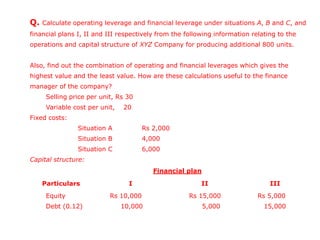
Q. Calculate operating leverage and financial leverage under situations A, B and C, and
financial plans I, II and III respectively from the following information relating to the
operations and capital structure of XYZ Company for producing additional 800 units.
Also, find out the combination of operating and financial leverages which gives the
highest value and the least value. How are these calculations useful to the finance
manager of the company?
Selling price per unit, Rs 30
Variable cost per unit, 20
Fixed costs:
Situation A Rs 2,000
Situation B 4,000
Situation C 6,000
Capital structure:
Financial plan
Particulars I II III
Equity Rs 10,000 Rs 15,000 Rs 5,000
Debt (0.12) 10,000 5,000 15,000
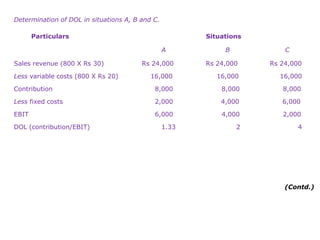
Determination of DOL in situations A, B and C.
Particulars Situations
A B C
Sales revenue (800 X Rs 30) Rs 24,000 Rs 24,000 Rs 24,000
Less variable costs (800 X Rs 20) 16,000 16,000 16,000
Contribution 8,000 8,000 8,000
Less fixed costs 2,000 4,000 6,000
EBIT 6,000 4,000 2,000
DOL (contribution/EBIT) 1.33 2 4
(Contd.)
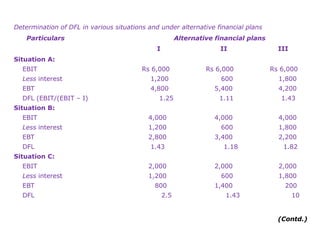
Determination of DFL in various situations and under alternative financial plans
Particulars Alternative financial plans
I II III
Situation A:
EBIT Rs 6,000 Rs 6,000 Rs 6,000
Less interest 1,200 600 1,800
EBT 4,800 5,400 4,200
DFL (EBIT/(EBIT – I) 1.25 1.11 1.43
Situation B:
EBIT 4,000 4,000 4,000
Less interest 1,200 600 1,800
EBT 2,800 3,400 2,200
DFL 1.43 1.18 1.82
Situation C:
EBIT 2,000 2,000 2,000
Less interest 1,200 600 1,800
EBT 800 1,400 200
DFL 2.5 1.43 10
(Contd.)
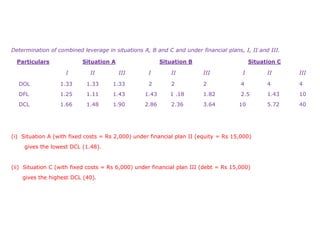
Determination of combined leverage in situations A, B and C and under financial plans, I, II and III.
Particulars Situation A Situation B Situation C
I II III I II III I II III
DOL 1.33 1.33 1.33 2 2 2 4 4 4
DFL 1.25 1.11 1.43 1.43 1 .18 1.82 2.5 1.43 10
DCL 1.66 1.48 1.90 2.86 2.36 3.64 10 5.72 40
(i) Situation A (with fixed costs = Rs 2,000) under financial plan II (equity = Rs 15,000)
gives the lowest DCL (1.48).
(ii) Situation C (with fixed costs = Rs 6,000) under financial plan III (debt = Rs 15,000)
gives the highest DCL (40).

Leverages 1

  • 1.
  • 2.
    Meaning: The termLeverage in general refers to a relationship between two interrelated variables. In financial analysis it represents the influence of one financial variable over some other related financial variable. The financial variables may be costs, output, sales revenue, Earnings Before Interest & Tax (EBIT), Earnings Per Share (EPS) There are three commonly used measures of leverage in financial analysis Operating Leverage Financial Leverage Combined Leverage Operating Leverage Operating Leverage is defined as the “firm’s ability to use fixed operating costs to magnify effects of changes in sales on its earnings before interest and taxes”. When there is an increase or decrease in sales level the EBIT also changes. The effect of change in sales on the level EBIT is measured by operating leverage.
  • 3.
    The operating leverageis calculated as: Increase in EBIT % of Change in EBIT or Increase in Sales% of Change in Sales . EBIT Sales           Operating leverage occurs- When a firm has fixed costs which must be met regardless of volume of sales. When the firm has fixed costs, the % change in profits due to change in sales level is greater than the % change in sales. XYZ Ltd. Sells 100 units Rs. 20 per unit. The cost of production is Rs.14 per unit. The firm has a fixed cost of Rs. 100. Assume that the sale of company XYZ Ltd increases by 40%. The present and expected cost and profits would be as follows:
  • 4.
    Present (Rs) Expected(Rs) Sales 2,000 (100 units @ Rs.20) 2,800 (140 units @ Rs.20) Less: Variable cost 1,400 (100 units @ Rs.14) 1,960 (140 units @ Rs.14) Contribution 600 840 Less: Fixed Cost 100 100 EBIT / Operating Profit 500 740 EBIT / EBIT .240 / .500 Operating Leverage = = 1.2 Increase in sales / Sales .800 / .2,000 Increasein Rs Rs Rs Rs  The operating leverage of 1.2 means that 1% increase in sales would result into 1.2% increase in operating profit. In the example given above % increase in EBIT is 48% and % increase in sales is 40%.
  • 5.
    A firm willnot have an operating leverage if there are no fixed costs and the total cost is variable in nature. In such cases, the operating profits or EBIT varies in direct proportion to the changes is sales level. Present (Rs) Expected (Rs) Sales 2,000 (100 units @ Rs.20) 2,800 (140 units @ Rs.20) Less: Variable cost 1,400 (100 units @ Rs.14) 1,960 (140 units @ Rs.14) EBIT / Operating Profit 600 840 EBIT / EBIT .240 / .600 Operating Leverage = = 1 Increase in sales / Sales .800 / .2,000 Increasein Rs Rs Rs Rs  The operating leverage of 1 means that increase in operating profit(40% in this example) is in direct proportion to increase in sales (40% in this example)
  • 6.
    The operating leverageat any level of sales is called its Degree. The degree of operating leverage is calculated as ratio of contribution to the EBIT Degree of Operating Leverage = EBIT Contribution Particulars ` Sales 4,000 Less: Variable Cost 2,000 Contribution 2,000 Less: Fixed Cost 600 Operating Profit (EBIT) 1,400 .2000 Degree of Operating Leverage = =1.429 .1,400 Rs Rs
  • 7.
    The Degree ofoperating leverage varies with a change in the level of sales Sales (Units) 200 250 Sales revenue @ (Rs.20 per unit) 4,000 5,000 Less: Variable cost 2,000 2,500 Contribution (Rs.) 2,000 2,500 Less: Fixed cost 600 600 Operating Profit (EBIT) 1,400 1,900 Degree of operating leverage 2,000/1,400 = 1.429 2,500/1900 = 1.315
  • 8.
    Significance of Operatingleverage: It tells the impact of changes in sales on operating income A firm having D.O.L ( Degree of Operating Leverage) can experience a magnified effect on EBIT for even a small change in sales level Higher D.O.L can dramatically increase the operating profits. But if there is decline is sales level, E B I T may be wiped out and a loss may be operated. Operating leverage depend on Fixed cost. If the fixed costs are higher, the higher would be firm’s operating leverage and its operating risks. If operating leverage is high, it automatically means that the break-even point would also be reached t a high level of sales. In the case of higher operating leverage, the margin of safety would be low. Therefore, it is preferred to operate sufficiently above break-even point to avoid the danger of fluctuations in sales and profits.
  • 9.
    Financial Leverage: Financial leverageis defined as the ability of a firm to use fixed financial charges to magnify the effect of changes in EBIT/Operating Profit on the firm’s earning per share. The financial leverage occurs when a firm’s capital structure contains obligation of fixed financial charges e.g. interest on debenture, dividend on preference shares etc. along with the owners equity to enhance earnings of equity shareholders. The fixed financial charges do not vary with the operating profits or EBIT. They are fixed and are to be paid irrespective of level of operating profits or EBIT. Financial leverage is calculated as follows: % changes in EPS Increase in EPS/EPS Financial Leverage = = %Changes in EBIT Increase in EBIT/EBIT
  • 10.
    Particulars Company ACompany B Equity Share capital of Rs.10 each 16,00,000 6,00,000 12% Debentures 1,00,000 11,00,000 Net Capital employed 17,00,000 17,00,000 Earnings Before interest and taxes (EBIT) 5,10,000 5,10,000 Less: Debenture interest 12,000 1,32,000 Profit before tax (PBT) 4,98,000 3,78,000 Less: Tax @35% 1,74,300 1,32,300 Profit after tax (PAT) 3,23,700 2,45,700 Earnings available for equity share holders 3,23,700 2,45,700 Number of shares 1,60,000 60,000 EPS 2.02 4.09 The companies had the same return on investment, 30% (5,10,000/17,00,000)X100 But the EPS is almost 2 times in the case of company B as compared to company A.
  • 11.
    Significance of FinancialLeverage: Financial leverage helps the finance manager in designing the appropriate Capital Structure. Financial leverage is double edged sward. On the one hand it increases earning per share and on the other hand it increases financial risk. High financial leverage means high fixed financial cost and high financial risk. The finance manager, therefore, is required to trade off. i.e. has to bring a balance between risk and return
  • 12.
    EPS and ROECalculations For calculating ROE either the book value or the market value equity may be used. N )T1)(INTEBIT( N PAT =EPS sharesofNumber after taxProfit =shareperEarnings   S )TINT)(1(EBIT =ROE equityofValue after taxProfit =equityonReturn 
  • 13.
    Effect of FinancialPlan on EPS and ROE: Constant EBIT The firm is considering two alternative financial plans: (i) either to raise the entire funds by issuing 50,000 ordinary shares at Rs 10 per share, or (ii) to raise Rs 250,000 by issuing 25,000 ordinary shares at Rs 10 per share and borrow Rs 250,000 at 15 per cent rate of interest. The tax rate is 50 per cent. Financial Plan All-equity (Rs) Debt- equity (Rs) 1. Earnings before interest and taxes, EBIT 120,000 120,000 2. Less: interest, INT 0 37,500 3. Profit before taxes, PBT = EBIT – INT 120,000 82,500 4. Less: Taxes, T (EBIT – INT) 60,000 41,250 5. Profit after taxes, PAT = (EBIT – INT) (1 – T) 60,000 41,250 6. Total earnings of investors, PAT + INT 60,000 78,750 7. Number of ordinary shares, N 50,000 25,000 8. EPS = (EBIT – INT) (1 – T)/N 1.20 1.65 9. ROE = (EBIT – INT) (1 – T)/S 12.0% 16.5%
  • 14.
    Effect of Leverageon ROE and EPS Favourable ROI >i Unfavourable ROI <i Neutral ROI =i
  • 15.
    Combining Financial andOperating Leverages The degree of combined leverage (DCL) is given by the following equation: % Change in EBIT % Change in EPS % Change in EPS % Change in Sales % Change in EBIT % Change in Sales   
  • 16.
    XYZ Ltd, sells2000 units @ Rs. 10 per unit. The variable cost of production is Rs. 7 and Fixed cost is Rs.1000. The company raised the required funds by issue of 100, 10% debentures @ Rs. 100 each and 2000 equity shares @ Rs.10 per share. The sales of XYZ Ltd. Is expected to increase by 20%. Assume tax rate of company is 50%. You are required to calculated the impact of increase in sales on earnings per share. Particulars Present Expected Sales level (Units) 2,000 2,400 Sales (Rs.): (A) 20,000 24,000 Less: Variable cost (Rs.): (B) 14,000 16,800 Contribution (Rs. (A)-(B) 6,000 7,200 Less: Fixed cost 1,000 1,000 Operating profit/EBIT 5,000 6,200 Less Interest (Rs.) 1,000 1,000 Profit Before Tax 4,000 5,200 Less Tax 2,000 2,600 Profit After tax 2,000 2,600 No.of equity shares 2,000 2,000 Earning per share 1 1.3
  • 17.
    Q. The RoyalIndustries, a well established firm in plastics, is considering the purchase of one of the two manufacturing companies up for sale. The financial manager of the company has developed the following information about the two companies. Both companies have total assets of Rs 15,00,000 at the end of March. Operating statements for the year ending March 31 Sales revenue Rs 30,00,000 Rs 30,00,000 Less: Cost of goods sold 22,50,000 22,50,000 Less: Selling expenses 2,40,000 2,40,000 Less: Administrative expenses 90,000 1,50,000 Less: Depreciation 1,20,000 90,000 EBIT 3,00,000 2,70,000 Cost of goods sold 9,00,000 18,00,000 Selling expenses 1,50,000 1,50,000 Total variable costs 10,50,000 19,50,000 (a) Prepare operating statements for both the companies assuming that sales increase by 20 per cent. However, the total fixed costs are likely to remain unchanged and the variable costs are a linear function of sales. (b) Calculate the degree of operating leverage by both the methods you know. (c) If the Royal Industries wishes to buy a company which has lower degree of business risk, which one would it be?
  • 18.
    (i) Operating statementof X Ltd. and Y Ltd. Particulars X Ltd Y Ltd Sales revenue Rs 36,00,000 Rs 36,00,000 Less:Cost of goods sold 24,30,000 26,10,000 selling expenses 2,70,000 2,70,000 administrative expenses 90,000 1,50,000 depreciation 1,20,000 90,000 EBIT 6,90,000 4,80,000 Cost of goods sold break-up Variable costs 10,80,0001 21,60,0002 Fixed costs 13,50,000 4,50,000 24,30,000 26,10,000 130 per cent of sales 260 per cent of sales (ii) DOL(X) = (D EBIT ÷ EBIT)/(D Sales ÷ Sales) = (Rs 3,90,000 ÷ Rs 3,00,000) (Rs 6,00,000 ÷ Rs 30,00,000) = 6.5. DOL(Y) = (Rs 2,10,000 ÷ Rs 2,70,000)/(Rs 6,00,000 ÷ Rs 30,00,000) = 3.88. Alternatively, DOL(X) = (Sales – VC)/(Current EBIT) = (Rs 30,00,000 – Rs 10,50,000)/3,00,000 = 6.5. DOL(Y) = Rs 30,00,000 – Rs 19,50,000)/2,70,000 = 3.88. (iii) Royal Industries Ltd should purchase Y Ltd.
  • 19.
    Q.(a) The followingfigures relate to two companies: (Rupees in lakh) Particulars P Ltd Q Ltd Sales 500 1,000 Variable costs 200 300 Contribution 300 700 Fixed costs 150 400 EBIT 150 300 Interest 50 100 Profit before tax 100 200 You are required to: (i) calculate the operating, financial and combined leverage for the two companies; and (ii) comment on the relative risk position of the firms. (b) (i) Find out operating leverage from the following data: Sales, Rs 50,000 Variable costs, 60 per cent Fixed costs, Rs 12,000 (ii) Find the financial leverage from the following data: Net worth, Rs 25,00,000 Debt/Equity, 3:1 Interest rate, 12 per cent Operating profit, Rs 20,00,000
  • 20.
    (a) Determination ofoperating, financial and combined leverage (Rupees in lakh) P Ltd Q Ltd Sales 500 1,000 Less variable cost 200 300 Contribution 300 700 Fixed cost 150 400 EBIT 150 300 Less interest 50 100 EBT 100 200 DOL (contribution/EBIT) 2 2.33 DFL (EBIT/EBIT – I) 1.5:1 1.5 DCL (DOL ´ DFL) 3 3.5 Q Ltd has higher operating as well as total risk.
  • 21.
    Q. Calculate operatingleverage and financial leverage under situations A, B and C, and financial plans I, II and III respectively from the following information relating to the operations and capital structure of XYZ Company for producing additional 800 units. Also, find out the combination of operating and financial leverages which gives the highest value and the least value. How are these calculations useful to the finance manager of the company? Selling price per unit, Rs 30 Variable cost per unit, 20 Fixed costs: Situation A Rs 2,000 Situation B 4,000 Situation C 6,000 Capital structure: Financial plan Particulars I II III Equity Rs 10,000 Rs 15,000 Rs 5,000 Debt (0.12) 10,000 5,000 15,000
  • 22.
    Determination of DOLin situations A, B and C. Particulars Situations A B C Sales revenue (800 X Rs 30) Rs 24,000 Rs 24,000 Rs 24,000 Less variable costs (800 X Rs 20) 16,000 16,000 16,000 Contribution 8,000 8,000 8,000 Less fixed costs 2,000 4,000 6,000 EBIT 6,000 4,000 2,000 DOL (contribution/EBIT) 1.33 2 4 (Contd.)
  • 23.
    Determination of DFLin various situations and under alternative financial plans Particulars Alternative financial plans I II III Situation A: EBIT Rs 6,000 Rs 6,000 Rs 6,000 Less interest 1,200 600 1,800 EBT 4,800 5,400 4,200 DFL (EBIT/(EBIT – I) 1.25 1.11 1.43 Situation B: EBIT 4,000 4,000 4,000 Less interest 1,200 600 1,800 EBT 2,800 3,400 2,200 DFL 1.43 1.18 1.82 Situation C: EBIT 2,000 2,000 2,000 Less interest 1,200 600 1,800 EBT 800 1,400 200 DFL 2.5 1.43 10 (Contd.)
  • 24.
    Determination of combinedleverage in situations A, B and C and under financial plans, I, II and III. Particulars Situation A Situation B Situation C I II III I II III I II III DOL 1.33 1.33 1.33 2 2 2 4 4 4 DFL 1.25 1.11 1.43 1.43 1 .18 1.82 2.5 1.43 10 DCL 1.66 1.48 1.90 2.86 2.36 3.64 10 5.72 40 (i) Situation A (with fixed costs = Rs 2,000) under financial plan II (equity = Rs 15,000) gives the lowest DCL (1.48). (ii) Situation C (with fixed costs = Rs 6,000) under financial plan III (debt = Rs 15,000) gives the highest DCL (40).